
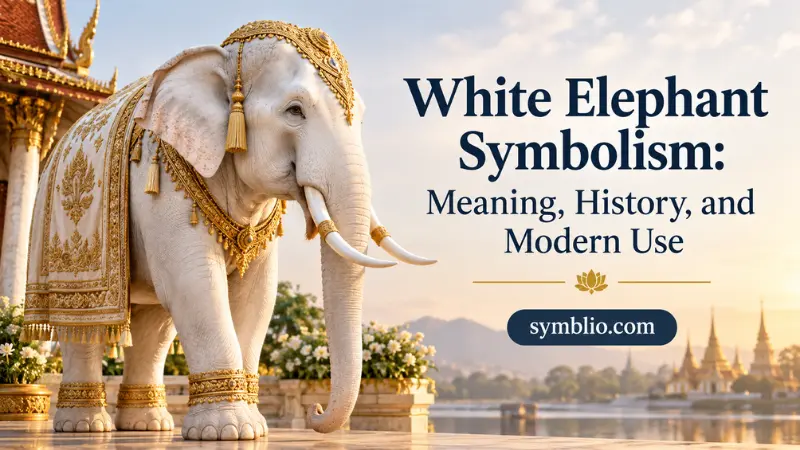
White elephant symbolism is closely associated with royalty, status, rarity, prosperity, and sacred importance, but its meaning changes considerably depending on cultural context. In the United States, the phrase is often connected with the playful “white elephant” gift exchange, while in South and Southeast Asian traditions, the white elephant has carried far more serious associations with kingship, religious merit, and social prestige.
The image itself is striking. An elephant with pale or unusually light skin is rare, visually distinctive, and difficult to overlook. That rarity helped make the animal a natural symbol of exceptional status. In cultures where elephants played important roles in warfare, transportation, ceremony, and royal life, an unusual elephant could acquire significance beyond its physical appearance.
Today, Americans may encounter white elephants in holiday games, artwork, books, tattoos, decorative objects, or discussions of Asian culture. Understanding the symbol requires separating these modern associations from the older traditions that gave the white elephant its distinctive place in history.
Quick Answer
White elephant symbolism commonly represents rarity, prestige, prosperity, and something unusually valuable in modern American culture, while the phrase can also suggest an expensive responsibility through the expression “white elephant.” Historically, white elephants were associated in parts of South and Southeast Asia with royal authority, sacred status, and religious merit.
TL;DR
- White elephants commonly symbolize rarity, status, prosperity, and prestige.
- Asian traditions connect them with kingship, sacredness, and merit.
- American culture often uses “white elephant” in a humorous way.
- The gift exchange meaning differs from the animal’s older symbolism.
- White elephant imagery can suggest dignity, abundance, or unusual responsibility.
- Modern interpretations depend heavily on cultural and personal context.
What Does a White Elephant Look Like?
A “white elephant” is not necessarily a completely white animal. The term traditionally refers to an elephant with unusually pale or depigmented skin, often appearing pinkish, gray, or cream rather than bright white.
The unusual appearance is part of what gives the animal its symbolic force. Elephants are already large, intelligent, and socially significant animals, so an exceptionally pale elephant can appear even more distinctive.
This distinction matters because popular artwork sometimes portrays white elephants as literally snow-white creatures. That is an artistic convention rather than a precise biological description.
The elephant itself also contributes to the symbolism. Its size can suggest strength and authority, while its long life and social nature can be associated with endurance, memory, family, and continuity.
What White Elephants Commonly Symbolize
Several meanings tend to appear repeatedly when white elephants are discussed.
Rarity is one of the most obvious. Something unusual naturally attracts attention, and a rare elephant historically represented something that ordinary people were unlikely to possess.
Prestige developed from the association between unusual elephants and royal courts. Possessing or controlling such an animal could communicate status.
Prosperity is another common interpretation. An elephant represented a substantial material resource, while a rare elephant could carry an even greater sense of abundance.
Sacredness is particularly important in South and Southeast Asian traditions. White elephants became connected with Buddhist and royal traditions in several cultures, although the specific beliefs differ by region.
Responsibility has a very different origin in modern English. The expression “white elephant” can describe something costly or burdensome to maintain despite having little practical value.
Because these meanings come from different historical contexts, it is misleading to treat them as one universal definition.
Ancient Roots and Early Symbolism
Elephants have been important throughout the history of South and Southeast Asia. They were used in warfare, royal ceremonies, transportation, forestry, and public displays. Their physical strength made them useful, while their intelligence and social behavior contributed to their cultural importance.
The unusually pale elephant became especially connected with royal power in several Southeast Asian traditions. In historical kingdoms, such animals could be treated as prestigious possessions rather than ordinary working animals.
The association between white elephants and rulers also developed a practical dimension. An elephant kept for ceremonial purposes required considerable resources, which meant that ownership itself could demonstrate wealth and authority.
Over time, the animal’s rarity and royal associations helped transform it into a symbol rather than merely an unusual creature.
The exact traditions differ across countries and historical periods, so there is no single ancient “white elephant meaning” that applies everywhere.
White Elephants and Buddhism
White elephants have an important place in Buddhist traditions, particularly in stories surrounding the Buddha’s birth.
In Buddhist tradition, Queen Maya is said to have dreamed of a white elephant before giving birth to Siddhartha Gautama. The story became an important part of Buddhist visual and literary tradition.
The elephant in this context is not simply a symbol of wealth. It can represent auspiciousness, spiritual importance, purity, and the arrival of an extraordinary person.
This association helps explain why white elephant imagery can appear in Buddhist art and cultural traditions even when the image has little connection with the modern American expression “white elephant.”
The religious interpretation should also be kept separate from generalized claims about “Asian symbolism.” Buddhism has developed across many countries, and local traditions have interpreted elephant imagery in different ways.
Royal Associations in Southeast Asia
Thailand, Myanmar, Laos, and other parts of Southeast Asia have long histories involving elephants and royal culture. Thailand in particular has maintained a strong cultural association between elephants and national heritage.
Historical royal traditions gave unusually pale elephants a special position. Their rarity could be associated with the prestige of the monarch, and ceremonial treatment distinguished them from ordinary working elephants.
Thailand’s continuing elephant traditions demonstrate that elephants remain culturally significant beyond their historical use in royal settings. Government cultural materials describe longstanding elephant traditions in communities such as Surin, where knowledge surrounding elephants has been passed through generations.
The important point is that the white elephant’s royal meaning developed within particular political and cultural systems. It should not be reduced to a generic idea that all Asian cultures view white elephants in exactly the same way.
Why White Means Something Different Here
White frequently carries associations with purity, sacredness, ceremony, or special status in religious and cultural traditions. However, white does not have one universal symbolic meaning.
In the case of the white elephant, color and rarity work together.
An elephant is already an exceptional animal because of its size and social importance. Unusual coloration makes it even more distinctive. When such an animal becomes connected with a royal or religious setting, its appearance can reinforce the idea that it is not ordinary.
That combination helps explain why white elephant symbolism often includes words such as auspicious, prestigious, sacred, rare, and honorable.
The meaning comes from the cultural context surrounding the animal, not simply from the color white by itself.
White Elephant Symbolism in the United States
The American meaning is considerably more complicated because two major interpretations coexist.
The first is the older cultural image borrowed from Asian history: a rare and prestigious elephant associated with royalty and exceptional value.
The second is the English expression “white elephant,” which generally refers to an unwanted, impractical, expensive, or difficult-to-maintain possession.
That second meaning is especially familiar in the United States.
Americans may encounter the phrase in conversations about buildings, projects, possessions, or investments that cost substantial amounts but provide limited practical benefit. The expression therefore carries an ironic quality: something can be impressive and valuable in appearance while becoming burdensome in practice.
This creates an unusual symbolic contrast.
| Context | Meaning in the USA | Common Associations | Notes |
|---|---|---|---|
| Elephant artwork | Rarity and dignity | Strength, status | Often influenced by Asian traditions |
| White elephant gift exchange | Humor and unwanted gifts | Surprise, novelty | Usually unrelated to sacred symbolism |
| “White elephant” project | Expensive burden | Cost, impracticality | Figurative English usage |
| Asian cultural imagery | Royal or sacred associations | Prestige, ceremony | Meaning depends on specific culture |
| Personal tattoo | Individual interpretation | Strength, rarity, identity | No single universal definition |
The “White Elephant” Gift Exchange
For many Americans, the phrase immediately brings to mind a holiday party game.
In a typical white elephant exchange, participants bring wrapped gifts and take turns choosing or exchanging them according to the rules of the game. The gifts are often humorous, unusual, inexpensive, or deliberately impractical.
This modern American tradition has little to do with the religious and royal history of actual white elephants.
The connection comes from the figurative English meaning of a white elephant as something difficult or expensive to maintain. The gift-exchange tradition turns that idea into entertainment.
As a result, someone familiar only with American holiday culture may hear “white elephant” and think of a funny gift rather than a sacred animal.
That difference is one of the most important examples of how symbolism changes when an expression moves between cultures.
The Symbolism of Rarity and Prestige
Rarity remains one of the strongest interpretations of the white elephant.
Humans often assign special value to things that are difficult to obtain. A rare gemstone, unusual artwork, limited object, or uncommon animal can acquire prestige partly because it is not available to everyone.
The white elephant fits this pattern particularly well.
Its unusual appearance separates it from ordinary elephants, while its historical association with royal courts adds another layer of distinction.
In personal symbolism, someone might therefore choose a white elephant image to represent being unusual without necessarily suggesting superiority. It can communicate individuality, distinction, or appreciation for something uncommon.
White Elephants and Prosperity
The connection with prosperity comes partly from royal associations and partly from the resources required to maintain an elephant.
An elephant has historically represented a significant investment of food, care, labor, and infrastructure. A specially honored elephant could therefore signify access to substantial resources.
In symbolic art, this can translate into associations with abundance and material prosperity.
Modern interpretations should be handled carefully, however. A white elephant is not universally recognized as a guaranteed symbol of wealth. Its meaning depends on the cultural framework in which it appears.
For an American audience, prosperity is best understood as one established interpretation rather than an automatic definition.
Emotional and Psychological Associations
The white elephant can communicate several different emotional ideas.
At the same time, the modern phrase “white elephant” introduces humor and contradiction.
The image can suggest an interesting contrast: something may look impressive while creating practical difficulties. A valuable object can still be unwanted, while prestige may come with considerable responsibility.
That tension gives the symbol an interesting psychological dimension.
A person who chooses white elephant imagery may therefore be expressing admiration for unusual beauty, cultural heritage, personal strength, or the idea of carrying something significant.
White Elephant Tattoos and Personal Style
White elephant tattoos can have many meanings because tattoo symbolism is highly personal.
Some people may choose an elephant to represent strength, family, memory, endurance, or respect for the animal itself. Adding the white element can emphasize rarity, spirituality, ceremony, or individuality.
For someone interested in Asian history or Buddhism, the image may have a specific cultural or religious reference. Another person might simply appreciate the visual contrast of a pale elephant against a darker tattoo design.
Design details can change the impression substantially. A ceremonial elephant may suggest royalty or tradition, while a minimalist elephant can feel more personal and contemporary.
The safest interpretation is therefore to consider the owner’s stated meaning rather than assuming that every white elephant tattoo carries the same message.
White Elephant Imagery in Decor and Art
White elephant imagery can work particularly well as decorative art because elephants already have a strong visual presence.
A stylized elephant can communicate strength and stability without requiring a religious interpretation. A more ornate design may draw attention to royal or ceremonial traditions.
In American interiors, white elephant artwork can also function simply as an exotic animal motif. The owner may appreciate its appearance without intending any specific symbolic message.
Context matters here. A decorative elephant displayed alongside Buddhist artwork carries a different cultural signal from a cartoon elephant used at a children’s party.
Cross-Cultural Meaning and Religious Context
White elephant traditions should not be treated as belonging to one single religion or country.
Buddhist traditions provide important associations, especially through the story of Queen Maya’s dream. Southeast Asian royal cultures developed additional associations between unusually pale elephants and kingship.
In South Asian traditions more broadly, elephants have their own extensive religious and mythological associations. Hindu traditions, for example, prominently feature Ganesha, the elephant-headed deity associated with wisdom, beginnings, and several other qualities. That does not mean Ganesha and the white elephant are interchangeable symbols.
This distinction is important. Similar imagery can appear across neighboring cultures while carrying different stories and meanings.
Common Misunderstandings About the Symbol
One common misunderstanding is that every white elephant automatically symbolizes wealth. Prosperity is an established association in some contexts, but it is not the only interpretation.
Another mistake is treating “white elephant” as inherently negative. The modern English expression can describe a burdensome possession, but older cultural meanings can be positive, prestigious, or sacred.
It is also inaccurate to assume that all white elephants are literally white. The phrase refers to unusually pale elephants, and artistic representations often exaggerate the color.
Finally, the white elephant gift exchange should not be confused with Buddhist or royal traditions. The American party custom developed around the figurative English expression rather than directly continuing the older sacred symbolism.
How the Meaning Has Changed Over Time
The history of the white elephant shows how symbolism can change dramatically while retaining an older image.
In royal settings, the animal could communicate exceptional status and prestige. Religious traditions could give it auspicious or sacred associations. English-language culture later developed the metaphor of an expensive burden.
Modern American culture added another layer through the holiday gift exchange.
These meanings can coexist without being contradictory. A symbol does not have to retain one definition forever. Words and images accumulate new associations as they move between languages, countries, institutions, and generations.
That is why the same two words can evoke a royal elephant in one context and a humorous unwanted present in another.
What White Elephant Symbolism Means Today
In 2025–2026 American culture, the most useful way to understand the white elephant is as a symbol with several distinct layers.
At the traditional level, it can represent rarity, prestige, royal authority, sacred importance, and prosperity.
At the modern American level, it can also represent something unusual, impractical, expensive, or humorously unwanted.
In visual culture, the elephant itself adds associations with strength, endurance, memory, family, and dignity.
The surrounding context determines which interpretation becomes most noticeable. A Buddhist artwork, a Thai cultural display, a tattoo, a holiday party, and a discussion of an expensive public project can all use the phrase “white elephant” while meaning very different things.
FAQs
In Buddhist and related cultural traditions, the white elephant can have auspicious and spiritually significant associations. Its meaning is connected with particular religious stories and traditions rather than with a universal spiritual definition.
In the United States, it can symbolize rarity, prestige, and unusual value when used as animal imagery. The phrase also commonly describes something expensive or impractical, and it appears in the popular white elephant gift-exchange tradition.
In some South and Southeast Asian traditions, white elephants have been associated with auspiciousness and royal or sacred status. Calling them a universal good-luck symbol, however, overlooks important differences between cultures.
A white elephant tattoo may represent strength, rarity, individuality, spirituality, cultural heritage, or personal admiration for elephants. The intended meaning depends on the design and the person who chose it.
The English expression developed from the idea of a rare and prestigious elephant that could also be extremely costly to maintain. It eventually became a metaphor for an expensive possession or project that provides little practical benefit.
No. The modern white elephant gift exchange is generally a secular social activity, especially popular around the holidays. Its name relates to the English figurative meaning of “white elephant,” not directly to Buddhist religious practice.
No. Wealth and prosperity are among its historical associations, particularly in royal contexts, but rarity, sacredness, prestige, responsibility, and humor can also be part of its meaning.
Conclusion
White elephant symbolism brings together several meanings that developed in very different settings. Historically, unusually pale elephants became associated in parts of South and Southeast Asia with royal authority, auspiciousness, sacred traditions, and exceptional status. In modern American English, the same phrase gained a contrasting meaning connected with costly or impractical possessions and the playful white elephant gift exchange.
Today, the white elephant can therefore represent rarity and prestige, but it can also suggest responsibility, irony, or something whose appearance exceeds its practical usefulness. Understanding the context is what turns the image from a simple unusual animal into a meaningful cultural symbol.


