
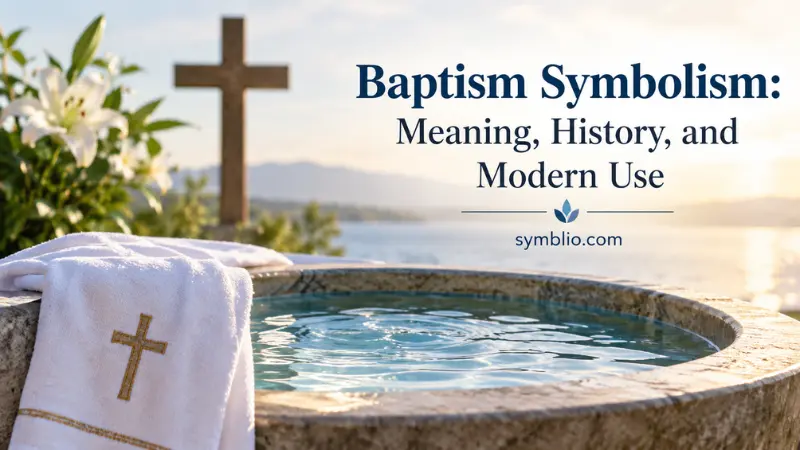
Baptism symbolism centers on water, spiritual cleansing, new life, commitment, and belonging within the Christian faith. For many Christians in the United States, baptism marks an important transition: a person is publicly connected with Christian faith and, depending on the tradition, formally welcomed into the church community.
The ritual can look different from one denomination to another. Some churches immerse a person completely in water, while others pour or sprinkle water over the head. Despite these differences, water remains the central physical sign, connecting baptism with ideas of washing, renewal, death to an old way of life, and beginning again.
Baptism also carries strong family and community meaning in American religious life. Infant baptisms, child dedications, and adult baptisms can represent different theological beliefs, so understanding the symbolism requires looking at both the shared Christian tradition and the differences among denominations.
Quick Answer
Baptism symbolism commonly represents spiritual cleansing, new life, faith, and belonging to the Christian community in modern American culture. Historically, Christian baptism developed around water rituals of repentance and purification and came to symbolize participation in Christ’s death and resurrection.
TL;DR
- Water represents cleansing, renewal, life, and transformation.
- Baptism connects Christian identity with faith and community.
- Early Christian baptism developed from Jewish purification traditions and John’s ministry.
- Immersion can symbolize death and rising to new life.
- Infant and adult baptism carry different meanings across denominations.
- Modern American ceremonies often emphasize faith, family, commitment, and belonging.
What Baptism Looks Like as a Symbol
The most recognizable feature of baptism is water. A person may enter a baptismal pool, stand in a river, sit near a baptismal font, or receive water poured or sprinkled over the head.
The physical action gives the ceremony much of its symbolic language. Water can wash the body, sustain life, and surround a person during immersion. Christian traditions therefore use it to communicate several related ideas rather than a single fixed meaning.
Other objects may accompany the water. Depending on the church, these can include a cross, white clothing, candles, anointing oil, a baptismal font, or a certificate documenting the ceremony.
The white garment often represents a new identity, while a candle can represent Christian light and discipleship. These additional symbols are especially visible in traditions with formal baptismal liturgies.
The Main Meanings of Baptism Today
Four ideas appear repeatedly in Christian explanations of baptism: cleansing, new life, faith, and belonging.
Cleansing refers to forgiveness and turning away from sin. New life describes a changed relationship with God. Faith refers to a person’s commitment to Christian belief. Belonging connects baptism with participation in a Christian community.
These meanings are related but are not identical. Different churches place different emphasis on them. Some traditions describe baptism as a sacrament through which God gives grace, while many Baptist and other evangelical traditions emphasize a believer’s public profession of faith.
That distinction matters because baptism is not interpreted identically across Christianity.
Ancient Roots and Early Christian Practice
Water purification was already familiar within Jewish religious life before Christianity developed. Ritual washing could communicate purification and preparation, and immersion had particular importance in Jewish practice. John the Baptist used baptism as part of his call to repentance in the setting described by the Gospels.
Christian baptism developed within this religious environment but acquired its own identity around Jesus and the early Christian community. The New Testament presents Jesus’ baptism by John and describes baptism as part of the mission given to his followers.
Early Christian evidence also shows that baptism was not limited to one physical method. Historical accounts describe immersion as well as situations in which water was poured over the head. The practical form could change according to circumstances.
This history helps explain why modern Christians can practice baptism differently while still recognizing the same basic ritual.
Water as a Sign of Cleansing and Renewal
Water naturally suggests washing away dirt, which makes it an understandable symbol for spiritual cleansing.
In Christian theology, however, baptism’s meaning goes beyond physical cleanliness. The water represents a person’s movement away from sin and toward a renewed life with God.
Catholic teaching, for example, describes baptism using several related images, including washing, rebirth, enlightenment, and a seal of Christian identity.
The symbolism therefore works on two levels. There is the visible act of washing, and there is the religious meaning attached to that act.
Death and New Life Through Immersion
Immersion gives baptism another important layer of symbolism.
When a person goes beneath the water and then rises again, the movement can represent death and resurrection. In Christian interpretation, this points toward dying to an old life shaped by sin and beginning a new life in Christ.
This symbolism is especially apparent in baptismal practices that involve complete immersion. Christian teaching connects the imagery with participation in Christ’s death and rising to new life.
The physical sequence makes the theological idea easy to visualize: entering the water represents one stage, while emerging represents another.
Baptism and Christian Belonging
Baptism is also a social symbol.
A baptism normally takes place in front of other people, whether in a church congregation, family gathering, or another Christian setting. The ceremony therefore communicates more than an individual’s private belief.
For many Christian traditions, baptism marks entry into the Christian community. Catholic teaching explicitly describes baptism as incorporation into the Church, while other denominations may emphasize the person’s public profession of Christian faith.
This community dimension explains why baptism often becomes an important family event. Parents, relatives, godparents, pastors, and congregations may all participate.
What Baptism Symbolizes in the United States
In the United States, baptism has no single cultural meaning because American Christianity includes many denominations with different practices.
In Catholic, Orthodox, Anglican, Lutheran, Methodist, Presbyterian, and other traditions, infant baptism or baptism of young children can represent God’s grace, Christian initiation, and the family’s intention to raise the child within the faith.
Baptist and some evangelical churches commonly practice believer’s baptism, meaning baptism follows an individual’s profession of faith. The ceremony often functions as a public declaration that the person identifies as a follower of Jesus.
These differences are important. An American who sees a baby baptized and another person baptized as an adult may be witnessing two ceremonies that look different while both belong to the broader Christian tradition.
Infant Baptism and Adult Baptism
Age changes the social and symbolic emphasis of baptism.
For infants, the ceremony commonly emphasizes family, church membership, God’s grace, and the parents’ responsibility to raise the child in the faith. The infant is not making a mature verbal profession of belief.
For older children and adults, baptism can communicate personal conviction and an intentional public commitment. The person may describe the ceremony as a visible expression of faith or a significant turning point in their religious life.
Neither approach should automatically be treated as the universal Christian definition. Different denominations have developed distinct theological reasons for their practices.
| Context | Common Meaning in the USA | Common Associations | Notes |
|---|---|---|---|
| Infant baptism | Christian initiation and family faith | Parents, church, family | Common in several historic denominations |
| Adult baptism | Personal profession of faith | Commitment, testimony | Common in many Baptist and evangelical churches |
| Immersion | Death and new life | Renewal, resurrection | Makes the water imagery especially visible |
| Pouring or sprinkling | Cleansing and initiation | Grace, belonging | Used in several Christian traditions |
| Baptismal celebration | Community and identity | Family, congregation | Often becomes an important family occasion |
Baptism in Christian Scripture
The symbolism of baptism draws heavily from biblical imagery.
The Gospel accounts connect Christian baptism with Jesus and John the Baptist. Other New Testament passages associate baptism with forgiveness, incorporation into the Christian community, and a new relationship with Christ.
Christian interpretation also looks backward to stories in the Hebrew Bible. Water appears in narratives involving creation, the flood, the Israelites crossing the Red Sea, and the crossing of the Jordan.
Catholic teaching specifically identifies these events as biblical prefigurations of baptism, connecting water with life, death, liberation, and entry into a promised future.
These connections help explain why baptism carries several meanings simultaneously rather than representing only “washing.”
The Cross, White Clothing, and Baptismal Candles
Water is the central baptismal symbol, but many ceremonies use additional signs.
The cross connects baptism with Jesus’ death and resurrection. In some traditions, the person being baptized receives the sign of the cross at the beginning of the ceremony.
A white garment can represent a new identity or life in Christ. It visually distinguishes the person participating in the rite and reinforces the idea of renewal.
A candle commonly represents light. In Christian symbolism, light can refer to Christ, faith, guidance, and the responsibility to live according to Christian teachings.
The exact combination varies considerably among churches.
Emotional and Psychological Meaning
Baptism can carry strong emotional meaning because it often represents a significant personal or family transition.
For an adult, the ceremony may express commitment, repentance, gratitude, or a desire to begin a different stage of religious life. For parents, an infant baptism may represent hope, responsibility, family continuity, and a desire to raise a child within a particular faith.
The communal setting can make the experience especially memorable. Family members and friends witness the event, photographs may preserve it, and the date can become part of a person’s family history.
These emotional associations should not be confused with universal psychological effects. People experience baptism differently depending on their beliefs, family background, denomination, and personal circumstances.
Baptism in Weddings, Holidays, and Family Life
Baptism often appears alongside other important family milestones.
A baptism may take place during a regular Sunday service or as a specially arranged ceremony. Some families celebrate afterward with a meal, photographs, gifts, or a gathering of relatives.
In some Christian communities, baptism is also connected with the Easter season. Easter’s focus on death and resurrection makes the symbolism of entering and leaving water especially appropriate.
Baptismal celebrations can therefore combine religious symbolism with ordinary family traditions. The religious meaning remains central, while the social event helps mark the occasion within family memory.
Baptism in Tattoos, Jewelry, and Personal Design
Baptism imagery sometimes appears in contemporary personal style.
A person may choose a cross, baptism date, water imagery, dove, fish, or other Christian design to commemorate baptism or a broader religious commitment. Jewelry may incorporate crosses, baptismal dates, initials, or small water-related motifs.
Tattoos can serve as personal reminders rather than literal representations of the ceremony. For some people, the image marks a religious milestone; for others, it represents family heritage or a continuing Christian identity.
The meaning depends heavily on the person’s own story. A cross or water design cannot automatically be assumed to represent baptism simply because the imagery is compatible with Christian symbolism.
Baptism in Digital Culture and Popular Media
Baptism also appears in photographs, videos, social media posts, church livestreams, and family announcements.
Parents may share photographs from a child’s baptism, while adults may post images from a baptism as part of a personal faith testimony. Churches sometimes publish baptism services or stories about new members.
Popular culture can portray baptism as a dramatic visual event because water creates an immediate before-and-after image. Films and television may use the ceremony to communicate religious identity, transformation, family tradition, or conflict.
These portrayals can simplify theological differences. A fictional baptism may use familiar imagery without accurately representing the practices of a particular denomination.
Cross-Cultural and Interfaith Context
Baptism is specifically associated with Christianity, but ritual washing and immersion are not unique to Christianity.
Judaism has longstanding traditions of ritual immersion, particularly through the mikvah. These practices have their own religious meanings and should not be treated as simply earlier versions of Christian baptism.
Christian baptism developed within a world where ritual washing was already familiar, while its later meaning became specifically connected with Jesus, Christian initiation, repentance, and new life.
This distinction prevents a common mistake: assuming that every religious use of water has the same symbolism. Water is widespread as a religious symbol, but the beliefs attached to it differ across traditions.
Common Misunderstandings About Baptism Symbolism
One common misunderstanding is that every Christian church understands baptism in exactly the same way. Christianity contains substantial denominational diversity, and baptism is one of the areas where theological differences are particularly visible.
Another misconception is that baptism must always involve complete immersion. Historically and today, Christian communities have used immersion, pouring, and sprinkling.
It is also misleading to assume that baptism is merely a symbolic ceremony in every tradition. Some churches teach that baptism is a sacrament through which God gives grace, while others place greater emphasis on baptism as an outward testimony of an inward faith.
Understanding the denomination is therefore essential when interpreting what a particular baptism means.
How the Meaning of Baptism Has Evolved
The central Christian themes of baptism have remained recognizable for centuries, but the way Christians perform and explain the rite has changed.
Early Christian communities used natural bodies of water as well as other settings. Over time, churches developed baptismal fonts, dedicated baptisteries, formal liturgies, special garments, candles, anointing, and other ceremonial elements.
The balance between infant and believer’s baptism also differs among Christian traditions. These differences became particularly significant during the Protestant Reformation and in later American religious history.
Today, American baptism can therefore represent both ancient Christian tradition and a person’s immediate religious community. The same basic rite can function as a sacrament, a public profession of faith, a family ceremony, or several of these at once.
Why Baptism Remains Meaningful Today
Baptism continues to matter because it combines an easily understood physical action with a complex religious message.
Water can represent washing, life, danger, death, and renewal. Christian baptism brings these associations together and places them within a story about faith, repentance, Christ, and belonging.
In modern American life, the ceremony can also connect generations. Parents may baptize children according to a family tradition, adults may choose baptism as a public declaration of faith, and congregations may treat each baptism as an important moment in community life.
Its continued use does not mean every Christian interprets it identically. Instead, baptism remains a shared practice whose details and theological emphasis vary across Christian communities.
FAQs
Baptism commonly symbolizes cleansing from sin, new life, faith, and entry into Christian community. Some traditions also understand it as a sacrament through which God gives grace.
Water can symbolize cleansing, life, renewal, and transformation. In immersion baptism, entering and leaving the water can also represent death and rising to new life with Christ.
Baptism symbolizes Christian initiation and a changed relationship with God. Depending on the denomination, it may emphasize God’s grace, forgiveness, personal faith, or membership in the Church.
In traditions that practice infant baptism, the ceremony commonly represents Christian initiation, God’s grace, family faith, and the parents’ intention to raise the child within the Christian community. The baby is not necessarily making the same personal profession of faith expected in adult baptism.
Adult baptism often represents a conscious profession of Christian faith and a public commitment to follow Christ. In many churches, it follows a period of instruction, personal conviction, or preparation.
Christian traditions developed different practices for administering baptism, including immersion, pouring, and sprinkling. The differences reflect theological, historical, and practical traditions rather than a single universally required method.
Not in every Christian tradition. Some churches describe baptism primarily as a sacrament that actually conveys God’s grace, while others emphasize its role as a symbolic public expression of faith.
Conclusion
Baptism symbolism brings together water, cleansing, renewal, faith, commitment, and belonging. Its central image is simple: a person encounters water as part of a religious act that points toward a changed relationship with God and, in many traditions, a new identity within the Christian community.
In the United States, the meaning varies according to denomination and personal belief. Infant baptism may emphasize family and church initiation, while adult baptism may emphasize personal faith and public commitment. Immersion, pouring, and sprinkling also give the ritual different visual expressions.
The enduring symbolism of baptism comes from the way a familiar element—water—is used to express some of Christianity’s central ideas about repentance, transformation, community, and new life.


