
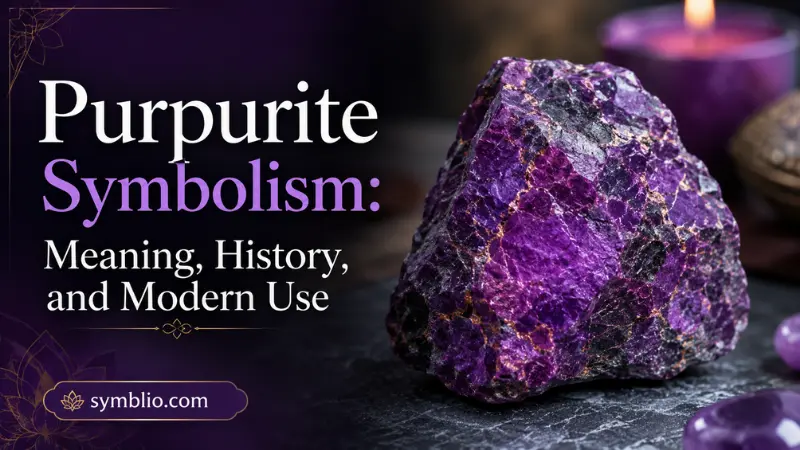
Purpurite is a rare manganese phosphate mineral recognized for its earthy purple to reddish-purple appearance. Unlike many gemstones that have accumulated centuries of religious or folkloric traditions, purpurite’s symbolic reputation is comparatively modern and closely tied to its color, rarity, mineral character, and place in contemporary crystal culture.
That distinction matters when discussing purpurite symbolism. Some meanings commonly attached to purpurite today come from the broader symbolism of purple rather than from an established ancient tradition specifically devoted to purpurite. Understanding the difference makes its symbolism more useful and historically responsible.
In the United States, purpurite is most often encountered as a mineral specimen, collector’s stone, decorative object, or crystal associated with modern spiritual practices. Its unusual color also makes it attractive to people interested in personal style, natural objects, and mineral collecting.
Quick Answer
Purpurite commonly symbolizes introspection, individuality, transformation, and spiritual reflection in modern American crystal culture, largely because of its unusual purple color and association with rare mineral specimens. Historically, however, purpurite itself does not have a long-established symbolic tradition comparable to amethyst, while its modern meanings draw heavily from broader associations with purple, rarity, and personal contemplation.
TL;DR
- Purpurite commonly represents introspection and individuality today.
- Its purple color strongly shapes modern interpretations.
- The mineral was formally described as a distinct species in 1905.
- American symbolism emphasizes collecting, decoration, spirituality, and personal expression.
- Purpurite lacks a major ancient religious tradition of its own.
- Modern crystal meanings should be separated from established mineral history.
What Purpurite Actually Is
Purpurite is a phosphate mineral composed primarily of manganese and phosphate, with the mineral species represented by the formula Mn³⁺PO₄. It belongs to a mineral group associated with related phosphate minerals and is generally found in massive or granular forms rather than as large, transparent gemstone-quality crystals.
Its most recognizable feature is its color. Purpurite can appear dark purple, violet, purplish red, or reddish purple, while altered surfaces may become brown or nearly black. Its surface is commonly earthy or dull, although freshly broken material can have a more satiny appearance.
The mineral is also relatively soft and brittle, measuring around 4 to 4½ on the Mohs scale. That physical character helps explain why purpurite is more commonly treated as a collector’s mineral than as a conventional jewelry gemstone.
Its unusual appearance is therefore central to its symbolism. Purpurite does not communicate meaning through elaborate crystal shapes or transparency. Instead, its symbolism is closely connected to color, rarity, natural alteration, and the experience of encountering an unusual mineral.
What Does Purple Add to Purpurite’s Symbolism?
Purple is one of the most important clues to understanding purpurite’s modern symbolic identity.
Across American visual culture, purple can suggest creativity, individuality, imagination, ceremony, luxury, and spirituality. Those associations are not exclusive to purpurite; they come from the much broader cultural history of purple as a color.
Purpurite inherits some of those associations because its appearance is unmistakably purple. A person who sees a vivid violet mineral may naturally connect it with reflection, creativity, or personal distinction even without knowing its geological history.
The color also separates purpurite from ordinary stones. A gray or brown rock may communicate natural simplicity, while an intense purple specimen immediately attracts attention. That contrast contributes to the modern association between purpurite and individuality.
In symbolic terms, the stone can therefore represent the idea of being unusual without needing to be artificially different.
The Historical Origins of Purpurite
Purpurite does not have the kind of ancient symbolic history associated with minerals such as turquoise, jade, or lapis lazuli.
Modern mineralogical literature identifies purpurite as an approved mineral species whose first publication dates to 1905. Its name comes from the Latin purpura, meaning purple, directly referring to its characteristic color.
This relatively recent scientific history is important. It means claims that purpurite was universally regarded by ancient civilizations as a stone of a particular spiritual quality should be treated cautiously.
Purpurite became better known through mineralogical study, pegmatite exploration, collecting, and the documentation of mineral occurrences. It occurs in association with complex pegmatite environments and alteration products of earlier phosphate minerals.
Its story is therefore primarily a geological and mineral-collecting story, followed later by a symbolic interpretation.
Why Rarity Became Part of Its Meaning
Purpurite is not among the most commonly encountered decorative minerals. High-quality specimens can be difficult to find, and collectors value examples with strong purple coloration.
That rarity can influence symbolism in a straightforward way. Objects that are difficult to obtain often become associated with selectiveness, uniqueness, and individuality.
For an American collector, owning a purpurite specimen may communicate something different from owning a mass-produced decorative object. The mineral can represent an appreciation for geological history and unusual natural forms.
This is one reason individuality is a more defensible modern interpretation than claims that purpurite has a fixed supernatural meaning.
Its scarcity encourages the idea of finding something distinctive rather than simply following a common aesthetic.
Purpurite Symbolism in the United States
In the United States, purpurite is best understood through several overlapping modern contexts: mineral collecting, decorative display, crystal culture, personal spirituality, and visual design.
American crystal culture sometimes assigns emotional or spiritual qualities to minerals. In those settings, purpurite may be associated with insight, focus, contemplation, or personal transformation. These interpretations belong primarily to contemporary metaphysical culture rather than to a documented ancient tradition.
At the same time, many Americans encounter purpurite without assigning any spiritual meaning to it. A geology enthusiast may value it because of its manganese-phosphate composition. A mineral collector may care about locality and specimen quality. A designer may simply appreciate its unusual color.
That variety is significant. Modern American symbolism does not require everyone to interpret purpurite in the same way.
| Context | Meaning in the USA | Common Associations | Notes |
|---|---|---|---|
| Crystal culture | Reflection and personal insight | Spirituality, contemplation | Modern metaphysical interpretation |
| Mineral collecting | Rarity and geological interest | Uniqueness, discovery | Focuses on natural history |
| Home decor | Individuality and visual contrast | Purple, artistry | Primarily aesthetic |
| Jewelry | Personal expression | Distinctiveness, color | Limited by purpurite’s softness |
| Personal symbolism | Transformation and self-reflection | Change, identity | Usually individually defined |
Purpurite and Personal Transformation
Transformation is another modern interpretation that fits purpurite’s physical story.
The mineral can occur as an alteration product within complex geological environments. In other words, its formation is connected with chemical changes affecting earlier minerals.
That geological fact can provide a useful metaphor without turning geology into supernatural evidence.
A person might use purpurite as a reminder that change does not necessarily mean losing one’s identity. Natural materials can change composition, appearance, and condition while remaining part of a much larger geological process.
For modern symbolic use, this makes purpurite suitable for moments associated with transitions: beginning a new phase of life, reconsidering priorities, developing a creative identity, or simply keeping a physical reminder of change.
The symbolism is personal rather than universal.
Purpurite and Introspection
Purple has long been used in settings connected with contemplation, ceremony, and imagination. Purpurite’s dark coloration can reinforce that association.
Unlike bright decorative stones that suggest celebration or energy, a dark purple mineral can create a quieter visual impression. Its earthy surface also keeps the symbolism grounded in nature.
This combination can make purpurite a useful symbol for introspection.
In everyday terms, introspection means taking time to examine one’s thoughts, choices, values, and experiences. Purpurite does not scientifically produce introspection, but people can use an object as a visual reminder to pause and reflect.
That distinction keeps symbolic interpretation separate from claims about proven physical effects.
Creativity, Individuality, and Personal Style
Purpurite’s unusual appearance gives it an obvious connection to creative expression.
Purple has a long history in American fashion, interior design, art, branding, and popular culture. When that color appears naturally in a mineral rather than through paint or dye, it can feel especially distinctive.
For this reason, purpurite can symbolize creative independence.
Someone displaying a purpurite specimen may be signaling an interest in unusual natural forms. Someone incorporating purple minerals into decor may be using them to create contrast. A collector may value a specimen precisely because it does not look like conventional polished gemstones.
The underlying message is not necessarily “I am spiritual.” It can simply be “I appreciate things that are uncommon.”
Purpurite in Jewelry and Decorative Objects
Purpurite occasionally appears in jewelry and lapidary settings, but its physical properties limit its practicality. With a Mohs hardness of roughly 4 to 4½ and brittle tenacity, it requires more care than harder jewelry stones.
For this reason, purpurite is often better suited to protected pieces or display specimens than to jewelry exposed to frequent abrasion.
Its decorative symbolism comes mainly from its visual identity. A purple mineral can introduce a natural accent into a room, collection, desk, or personal display.
In these settings, purpurite can represent appreciation for natural beauty that does not need to be polished into conventional perfection.
Cross-Cultural Perspectives on Purple and Minerals
Purpurite itself does not have a well-established global mythology comparable to some famous historical gemstones.
Purple, however, carries different associations across cultures. In various historical settings, purple has been linked with status, ceremony, authority, mourning, spirituality, or artistic expression. The exact meaning depends heavily on the culture and period.
It is therefore better to say that purpurite participates in the broader symbolism of purple than to assign every historical meaning of purple directly to the mineral.
This distinction is especially important when discussing religious symbolism. There is no widely established religious doctrine that gives purpurite one universal spiritual meaning.
Modern practitioners may create personal associations, but those should not be presented as ancient religious facts.
Emotional and Psychological Meaning
Symbolic objects can influence how people frame their own experiences, even when the object has no scientifically demonstrated psychological power.
Purpurite’s appearance lends itself to several emotional themes:
- Reflection: its dark purple color can serve as a visual cue for quiet thought.
- Individuality: its unusual appearance makes it suitable for personal expression.
- Creativity: purple is strongly associated with artistic and imaginative settings.
- Change: its geological formation can inspire metaphors about transformation.
- Appreciation: its rarity encourages attention to uncommon natural objects.
These meanings describe cultural and personal associations rather than medical or psychological effects.
A person may find a mineral meaningful because of what it reminds them of, not because the mineral itself has a proven ability to produce a particular emotional state.
Purpurite in Modern Crystal Culture
Modern crystal culture has expanded the symbolic vocabulary surrounding many minerals. Purpurite is sometimes described in contemporary spiritual settings as a stone connected with insight, focus, or transformation.
Those descriptions are relatively recent and do not have a single agreed historical origin.
For readers in the United States, it is useful to separate three different layers:
Mineralogy explains what purpurite is and how it forms.
Cultural symbolism explains why purple, rarity, and unusual natural objects can carry certain associations.
Personal spirituality explains why an individual may choose to give the stone a private meaning.
Keeping these categories separate makes the subject more credible while still leaving room for personal interpretation.
Tattoos, Art, and Personal Symbolism
Purpurite is not a major traditional tattoo symbol in American tattoo culture, but its color and mineral appearance can inspire contemporary designs.
A person might use a purple mineral image to represent individuality, creativity, a period of change, or an interest in geology.
The symbolism becomes stronger when purpurite is combined with other visual elements. A mineral alongside mountains can emphasize nature. Paired with stars or abstract shapes, it can take on a more imaginative character. Combined with geological imagery, it may emphasize scientific curiosity rather than spirituality.
The surrounding imagery therefore matters as much as the mineral itself.
Common Misunderstandings About Purpurite
One common misunderstanding is treating every modern crystal claim as ancient knowledge. Purpurite’s documented mineralogical history is relatively recent, and its formal recognition dates to the early twentieth century.
Another problem is confusing purpurite with visually similar minerals, especially heterosite. Mineral specimens can be difficult to distinguish by appearance alone, and some specimens initially identified as purpurite have later been reassessed.
There is also a tendency to treat a symbolic meaning as a scientific property. Saying that a person uses purpurite as a reminder of concentration is very different from claiming that the mineral objectively improves concentration.
A responsible interpretation keeps those statements separate.
How Purpurite’s Meaning Has Evolved
Purpurite’s symbolic development follows an unusual path.
Its earliest modern identity came from mineralogy: a distinctive purple manganese phosphate requiring scientific classification. Its next identity came through mineral collecting, where rarity and appearance made specimens desirable.
More recently, the mineral entered the expanding world of contemporary crystal symbolism. Purple contributed associations with reflection, creativity, and spirituality, while rarity contributed ideas of uniqueness.
The result is a modern symbol rather than an ancient one.
That evolution is part of what makes purpurite interesting. Its meaning demonstrates how people continue to create symbolic relationships with natural objects even when those objects have no long-standing mythology.
What Purpurite Can Represent Today
For a modern American audience, the most grounded interpretations of purpurite include:
Individuality — because its natural purple color makes it visually unusual.
Reflection — because its darker coloration fits quiet, contemplative settings.
Creativity — because purple is strongly connected with artistic expression.
Transformation — because its geological formation provides a natural metaphor for change.
Rarity — because desirable specimens are uncommon and valued by collectors.
Connection with nature — because the mineral’s appeal comes from geological processes rather than manufactured decoration.
None of these meanings has to be treated as permanent. Symbolism works through context, and people can use the same object differently.
FAQs
In modern crystal culture, purpurite is often associated with reflection, insight, focus, and personal transformation. These are contemporary spiritual interpretations rather than meanings established by a major ancient religious tradition.
Yes. Purpurite is considered a relatively rare manganese phosphate mineral, and attractive specimens with strong purple coloration are particularly valued by collectors.
Its characteristic color is related to its manganese-rich mineral chemistry and oxidation state. The name itself comes from the Latin purpura, referring to its purple color.
There is no widely established ancient religious symbolism specific to purpurite. Most spiritual interpretations associated with it today developed through modern crystal culture and broader associations with the color purple.
In the United States, purpurite can represent individuality, creativity, reflection, rarity, and appreciation for unusual natural objects. Its meaning varies between mineral collectors, decorators, spiritual practitioners, and people using it for personal symbolism.
Purpurite can be used in jewelry, but its relatively low hardness and brittle nature make it less resistant to everyday wear than harder gemstones.
No. They are distinct mineral species, although they are closely related and can be difficult to distinguish visually. Purpurite is the manganese-dominant phosphate, while heterosite represents the iron-rich counterpart.
Conclusion
Purpurite is a good example of how symbolism can develop without an ancient mythology behind it. Its dark purple color, rarity, geological formation, and unusual appearance have made it suitable for modern associations with individuality, creativity, reflection, and change.
The most useful way to understand purpurite symbolism is to separate established mineral history from contemporary interpretation. Purpurite is first a geological material; the personal meanings people attach to it come from color, culture, collecting, spirituality, and individual experience.
That makes its modern symbolism flexible rather than fixed: a small purple mineral can represent scientific curiosity to one person, creative identity to another, and a personal reminder of change to someone else.


