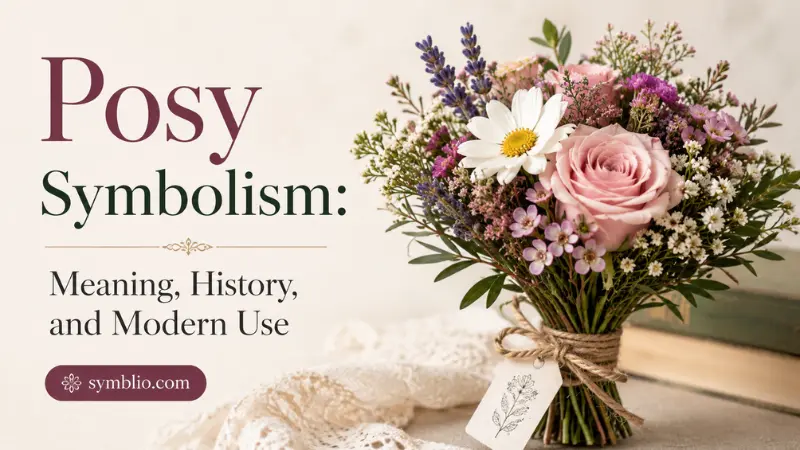
A posy is a small flower or modest bunch of flowers, but the word carries a history that reaches beyond the bouquet itself. Posy symbolism is closely connected with affection, thoughtfulness, remembrance, poetry, and the idea that a carefully chosen flower can communicate something that ordinary conversation does not.
In the United States today, people are more likely to encounter a posy as a small bouquet, garden arrangement, wedding flower, gift, or decorative detail than as a formal symbolic code. Its appeal comes partly from its scale: a posy feels personal rather than grand, making it well suited to gestures of friendship, gratitude, affection, celebration, and remembrance.
The history of the word makes the subject especially interesting. “Posy” originally referred to a short poem, motto, or inscription, particularly one placed inside a ring, before the word also came to describe flowers and small bouquets. That connection between words and flowers helps explain why posies have long been associated with messages and sentiment.
Quick Answer
Posy symbolism commonly represents affection, thoughtfulness, remembrance, and a personal gesture in modern American culture, especially when a small bouquet is given as a gift or used at weddings, celebrations, or memorial occasions. Historically, the word also connected flowers with poetry, romantic messages, and inscribed mottos.
TL;DR
- Posies commonly symbolize affection, thoughtfulness, and personal attention.
- The word originally referred to poetry or an inscribed motto.
- Small bouquets became connected with flower-based messages.
- Victorian floriography gave individual flowers additional symbolic meanings.
- Americans today generally view posies as charming, personal floral gifts.
- Context and flower choice matter more than a fixed universal code.
What Is a Posy?
A posy is generally a small bunch of flowers, although American English can also use the word for a single flower. It is therefore not the name of one particular species. A posy might contain roses, violets, daisies, herbs, wildflowers, or whatever blooms suit the occasion.
That distinction matters when interpreting its symbolism. Unlike a rose or lily, a posy does not possess one botanical identity with a universally agreed meaning. Its symbolism comes from the act of gathering and presenting flowers in a small, intentional arrangement.
The modest size is part of its character. A large floral display can communicate ceremony or public celebration; a posy tends to feel more intimate. It can say, in effect, “I thought of you,” without requiring an elaborate occasion.
The Word Posy Began With Poetry
One of the most revealing facts about the word is that flowers were not its original meaning.
“Posy” developed as a shortened form of poesy, a word associated with poetry and poetic expression. By the late Middle Ages and early modern period, posy could refer to a short verse or motto inscribed on an object, especially a ring. Later, the word came to describe flowers and bouquets, a development associated with the practice of pairing flowers with verses or messages.
This linguistic history gives posy symbolism an unusual foundation. At its earliest level, the concept was about a small, meaningful message. Flowers eventually became another way of carrying that message.
The connection also explains the historical term posy ring: a ring bearing a short inscription, often expressing affection, loyalty, or another personal sentiment. Such rings were particularly associated with courtship and gift-giving in earlier European traditions.
Posy Rings and the Symbolism of Personal Messages
Posy rings provide an important historical bridge between poetry, jewelry, and flowers.
During the late medieval and early modern periods, rings could carry short inscriptions intended to preserve a sentiment in a compact physical form. The message might be romantic, religious, affectionate, or simply expressive of regard. The ring transformed a few words into a lasting personal object.
The symbolism of a posy therefore has an older association with something small that carries a larger message.
That idea remains useful when interpreting a modern posy. The flowers themselves may be temporary, but the gesture communicates attention. A few carefully selected stems can function almost like a handwritten note.
How Flower Language Shaped Posy Symbolism
The nineteenth-century fashion for the “language of flowers,” or floriography, gave posies an additional layer of meaning.
From the 1820s through the late nineteenth century, flower dictionaries became popular in Britain and North America. They assigned meanings to particular plants and encouraged people to create bouquets that conveyed emotions or social messages.
This tradition is sometimes presented today as though every flower had one universally accepted Victorian definition. The historical reality was less tidy. Different flower dictionaries sometimes assigned different meanings to the same plant, so floriography was better understood as a popular cultural practice than as a standardized communication system.
For posies, however, the basic idea was influential: a small arrangement could be selected intentionally to express a feeling.
That is one reason posies became associated with romance, friendship, sentiment, and social occasions.
What Posies Commonly Mean in the United States
Modern American interpretations are usually less formal than Victorian flower symbolism.
A small posy given today commonly suggests:
- affection
- appreciation
- friendship
- congratulations
- remembrance
- tenderness
- welcome
- thoughtfulness
The specific meaning depends heavily on the situation.
A child giving a parent a handful of garden flowers may communicate affection. A friend bringing a small bouquet after a difficult day may express support. A wedding posy may represent love and celebration. Flowers placed at a memorial may emphasize remembrance.
The important point is that Americans generally do not treat “posy” as a rigid symbolic code. The gesture and context usually matter more than a dictionary definition.
Why Smallness Matters Symbolically
The scale of a posy contributes significantly to its emotional character.
A small bouquet is portable, approachable, and easy to give spontaneously. It does not necessarily require an elaborate ceremony, expensive arrangement, or major holiday. That makes it especially compatible with everyday expressions of care.
Symbolically, the small size can suggest sincerity without spectacle.
This does not mean that every posy carries a profound message. Sometimes a posy is simply a pleasant bunch of flowers. But when people intentionally use the word rather than “bouquet,” it can evoke something more informal, old-fashioned, handmade, or personal.
Posy Symbolism in Weddings and Celebrations
Flowers have an established place in American wedding culture, and small arrangements can be particularly appropriate for intimate ceremonies, bridesmaids, flower girls, table settings, or informal celebrations.
Historically, flower symbolism influenced wedding bouquets, although modern couples generally choose flowers for a combination of appearance, season, personal preference, family tradition, and sentiment. Victorian flower meanings can provide inspiration, but they do not dictate contemporary American wedding symbolism.
A posy can therefore represent love expressed through a deliberately personal selection of flowers.
The concept also fits smaller weddings especially well. A compact arrangement can look natural, garden-inspired, or understated rather than formal and monumental.
Posies and Remembrance
Flowers have long appeared in mourning and remembrance traditions, and small bouquets can carry that association without belonging exclusively to grief.
In a memorial setting, a posy may represent remembrance, respect, affection, or the preservation of a personal connection. Its temporary nature can also make it appropriate for moments in which people acknowledge that memories endure even though circumstances change.
It is important, however, not to assign a single “mourning meaning” to every posy. A small bouquet at a gravesite may communicate remembrance, while the same kind of arrangement given to a friend can simply express kindness.
The surrounding ritual determines much of the symbolism.
A Quick Comparison of Posy Meanings
| Context | Meaning in the USA | Common Associations | Notes |
|---|---|---|---|
| Gift to a friend | Appreciation and affection | Friendship, kindness | Usually informal and personal |
| Wedding | Love and celebration | Partnership, happiness | Flower choice may add symbolism |
| Memorial | Remembrance and respect | Memory, affection | Context creates the strongest meaning |
| Garden or home decor | Natural beauty | Simplicity, freshness | Often aesthetic rather than coded |
| Romantic gift | Affection or courtship | Tenderness, admiration | The specific flowers may matter |
Posies Across Cultures and Traditions
The idea of giving flowers as meaningful gifts is widespread, but the symbolism is not identical everywhere.
European traditions contributed strongly to the modern Western association between flowers and coded sentiment. The nineteenth-century language of flowers was particularly influential in Britain, France, and North America. Earlier European customs also connected flowers with religious festivals, courtship, celebration, and remembrance.
Other cultures have their own floral traditions, often involving particular plants, colors, ceremonies, and religious practices. It would therefore be misleading to claim that “the posy” has one universal meaning across cultures.
The safest interpretation is that small floral gifts frequently communicate social and emotional messages, but those messages depend on cultural context.
The Emotional Psychology of a Small Bouquet
A posy can communicate emotion partly because flowers are tangible. Unlike a spoken compliment that disappears immediately, a small bouquet gives the recipient something visible and physical.
The arrangement also requires selection. Someone has chosen flowers, gathered them, and decided to present them together. That act can signal attention even when no elaborate message accompanies it.
This makes the posy particularly compatible with emotions that are difficult to dramatize:
“I remembered you.”
“I appreciate you.”
“I wanted to bring you something.”
Those interpretations are not fixed psychological laws. They are ordinary social meanings built around the practice of giving flowers.
Color and Flower Choice Change the Message
Although “posy” itself has broad symbolism, the individual flowers can introduce additional associations.
A bouquet containing roses may suggest romance or affection, while violets can evoke modesty or sentiment in historical flower-language traditions. Rosemary has been associated with remembrance, while myrtle has connections with love and marriage in Western traditions.
Color can also influence modern interpretation. Red flowers may appear romantic, white flowers may suggest simplicity or solemnity, and bright mixed flowers can create a more cheerful impression.
Still, these associations should be treated as contextual conventions rather than universal rules. Historical flower dictionaries often disagreed, and modern Americans rarely expect a recipient to decode an arrangement according to a nineteenth-century guidebook.
Posy Symbolism in Modern Design and Everyday Life
Today, posy-style arrangements appear in homes, restaurants, events, weddings, photography, stationery, textiles, and floral design.
The aesthetic often emphasizes informality: garden flowers, mixed colors, uneven stems, seasonal blooms, and arrangements that look gathered rather than engineered.
This style works especially well with contemporary preferences for natural-looking decor. A posy can sit in a small vase on a kitchen table or appear as a compact accent at a dinner setting without dominating the room.
In this sense, its modern symbolism is often less about a secret code and more about natural beauty, hospitality, and personal attention.
Posies in Fashion, Tattoos, and Digital Culture
Small floral imagery is also common in contemporary personal style. A posy-inspired motif may appear on clothing, jewelry, stationery, illustrations, tattoos, or social-media graphics.
When someone chooses a small cluster of flowers as a personal image, the symbolism can emphasize delicacy, memory, growth, friendship, or a connection to a particular person or place.
A tattoo, for example, may depict specific flowers associated with a family member, birthday, favorite garden, or meaningful event. In that situation, the personal story usually matters more than a generic flower dictionary.
Digital culture has similarly transformed floral symbolism. An illustrated bouquet can function as a visual expression of congratulations, gratitude, sympathy, affection, or celebration without requiring the sender to explain the gesture.
Common Misunderstandings About Posy Symbolism
The biggest misconception is that every posy has a predetermined symbolic message.
It does not. A posy is a type of small floral arrangement, not a single flower with one universally recognized definition.
Another misconception is that Victorian flower meanings were perfectly standardized. Historical sources show considerable variation between guides, authors, flowers, and editions. The language of flowers was influential, but it was never as precise as a modern dictionary or formal code.
Finally, the historical meaning of the word should not be confused with modern usage. In contemporary American English, most people encountering “posy” will understand it as a flower or small bouquet, while the older meaning involving a poetic inscription is largely archaic.
How Posy Symbolism Has Changed Over Time
The evolution is unusually clear:
Poetry → inscription → personal message → flower gift → bouquet symbolism → modern decorative and emotional gesture.
The earliest sense centered on words. Flowers later became associated with the term because floral gifts could accompany or communicate sentiments. Victorian floriography expanded the idea by assigning meanings to individual plants. Modern culture has retained the emotional appeal while largely abandoning the idea that bouquets must be decoded according to a strict system.
What remains is the underlying principle: a small physical object can carry personal meaning.
That is why the word still feels slightly more sentimental than simply saying “flowers.”
What a Posy Communicates Today
In contemporary American life, a posy generally communicates something warm but not necessarily dramatic.
It can be romantic, but it does not have to be. It can express friendship, but it can also mark a celebration or memorial. It can be decorative, yet its small size often makes it feel more personal than an elaborate floral installation.
The strongest modern interpretation is therefore thoughtful affection expressed through flowers.
The particular blooms, colors, occasion, and relationship between giver and recipient refine that basic message.
FAQs
A posy commonly symbolizes affection, thoughtfulness, appreciation, and remembrance. Its meaning changes with the occasion, and the flowers within it can add more specific associations.
It can. Historically, posies were associated with courtship and sentimental messages, but a modern posy can just as easily represent friendship, gratitude, congratulations, or kindness.
A posy is generally a small bunch of flowers, while “bouquet” is a broader term that can describe arrangements of many sizes. In American English, “posy” can also refer to a single flower.
The word originally referred to a short poem, poetic phrase, or motto, especially one inscribed on a ring. Its flower-related meaning developed later, helping connect the idea of a small bouquet with personal messages.
It can be, particularly when given or displayed in a memorial context. However, remembrance is not an inherent meaning of every posy; the occasion and flower selection determine the interpretation.
No. Victorian flower dictionaries assigned meanings to many flowers, but different guides sometimes disagreed. Modern Americans generally do not expect bouquets to follow a strict Victorian symbolic code.
Conclusion
A posy is more than a small bunch of flowers, but its symbolism is not a rigid code. In modern American culture, it most often suggests thoughtfulness, affection, appreciation, and a personal gesture, with the occasion and flower selection adding further meaning.
The history of the word makes that symbolism especially fitting: it began with poetry and short messages before becoming associated with flowers. Today, posy symbolism survives less as a secret language and more as a simple idea—the smallest floral gesture can still say that someone was remembered, appreciated, or loved.