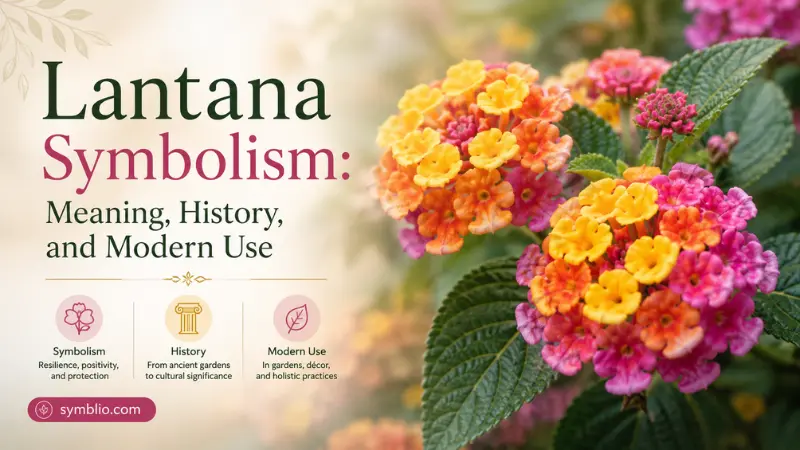
With clusters of yellow, orange, pink, red, purple, and white flowers, lantana often looks as if several stages of bloom are happening at once. Lantana symbolism is commonly interpreted today through the plant’s most recognizable qualities: its toughness, changing colors, long flowering season, and ability to keep growing under hot, dry conditions.
Those characteristics make resilience, adaptability, change, and vitality natural modern meanings for the flower. Yet lantana also has a more specific historical association. In Victorian flower language, it was assigned the meaning “rigour,” a word connected with strictness, firmness, and severity.
That difference matters. Lantana is not a flower with one universal meaning carried unchanged across cultures. Its symbolism has developed from a combination of documented flower language, its physical behavior, American gardening culture, and contemporary personal interpretation.
Quick Answer: What Does Lantana Symbolize?
Lantana symbolism commonly represents resilience, adaptability, transformation, and vitality in modern American interpretation, largely because the plant tolerates heat and drought while producing colorful flowers for a long season. Historically, Victorian flower language associated lantana with rigor, emphasizing firmness or strictness rather than transformation.
TL;DR
- Lantana commonly represents resilience, adaptability, and change.
- Victorian flower language associated lantana with rigor.
- Changing flower colors support modern transformation symbolism.
- U.S. gardeners connect lantana with summer and pollinators.
- Multicolored clusters can suggest variety within unity.
- Invasive lantana adds a cautionary meaning to persistence.
What Lantana Looks Like and Why Its Form Matters
Lantana is best known for rounded flower clusters made from many small, tubular blossoms. Depending on the species or cultivar, these clusters may contain yellow, orange, red, pink, purple, white, or several colors together. Many ornamental varieties flower from spring into fall and attract butterflies and hummingbirds.
Its clustered structure matters symbolically because lantana does not present itself as one large, solitary flower. Dozens of individual florets create a single visual unit.
That appearance lends itself to modern ideas such as community, family, cooperation, and individuality within a group. Those meanings are interpretive rather than traditional, but they arise naturally from what people actually see when looking at the plant.
Color is equally important. Some lantanas display two or more shades within the same cluster, producing a sense of movement rather than visual uniformity.
This unusual appearance helps explain why lantana works particularly well as a symbol of a life that changes without losing continuity.
The Core Meanings of Lantana Today
Modern lantana symbolism is best understood as a group of related meanings rather than one fixed definition.
| Context | Common Meaning | Why It Fits |
|---|---|---|
| Personal growth | Resilience | Lantana tolerates demanding growing conditions |
| Life transitions | Change and adaptation | Some flowers change color as they mature |
| Victorian flower language | Rigor | Historically assigned meaning |
| Bright garden displays | Vitality and warmth | Long-lasting, colorful flowering |
| Family or group symbolism | Unity in diversity | Many individual florets form one cluster |
| Environmental context | Persistence with consequences | Some lantanas spread aggressively |
The most useful interpretation depends on context.
A person choosing lantana after overcoming a difficult period may focus on resilience. Someone interested in historical flower language may choose rigor. A gardener may associate it more strongly with summer, butterflies, and warmth.
Why Lantana Represents Resilience
Resilience is one of lantana’s most convincing contemporary meanings because it comes directly from the plant’s behavior.
Many cultivated lantanas perform well in full sun and tolerate dry conditions once established. Some varieties also handle poor soil, salt exposure, and intense summer heat better than many ornamental flowering plants.
That makes lantana an intuitive symbol for people who continue functioning through difficult circumstances.
It can represent someone who has:
- rebuilt after a setback
- adjusted to an unfamiliar environment
- remained productive under pressure
- started over after major change
- learned to work with difficult circumstances
There is an important difference between resilience and invulnerability. Lantana still requires suitable conditions, just as human resilience does not mean being unaffected by hardship.
For that reason, lantana can symbolize endurance without suggesting that strength means never struggling.
Adaptability and the Meaning of Change
Lantana also lends itself naturally to adaptability.
In the United States, gardeners grow lantana differently depending on the climate. Warm regions allow some varieties to behave as perennial shrubs, while colder states usually treat them as annuals or container plants because winter temperatures limit outdoor survival.
That flexibility supports a modern symbolic idea: thriving does not always require staying exactly the same.
Adaptation may involve changing where, how, or under what conditions growth happens.
For a person moving to a new city, changing careers, rebuilding a routine, or entering a different stage of life, lantana can symbolize the ability to adjust without losing identity.
This interpretation is especially appropriate because adaptation is visible in the plant itself rather than being imposed through an unrelated legend.
Changing Colors and Transformation Symbolism
Some lantana flowers undergo noticeable color changes as they age or after pollination. Research on Lantana camara has documented shifts such as yellow flowers progressing toward orange and scarlet as their pigmentation changes.
That biological feature gives the flower an unusually strong connection with transformation.
Unlike a symbol of sudden reinvention, lantana suggests a process.
One stage remains visible while another appears. A single cluster may contain young and older flowers together, allowing several points in the cycle to coexist.
Symbolically, that can represent:
personal development, emotional maturity, changing priorities, recovery, or moving into a new stage without rejecting the past.
It is a more grounded interpretation of transformation than claims about supernatural “energy” or hidden messages.
The flower changes because it is developing. That alone provides enough symbolic meaning.
The Victorian Meaning of Rigor
The clearest historically documented symbolic association for lantana is rigor.
Kate Greenaway’s nineteenth-century Language of Flowers lists lantana with the meaning “Rigour.”
In this context, rigor suggests firmness, strictness, severity, discipline, or demanding standards.
It should not be automatically rewritten as “strength” or “resilience.” Those ideas can overlap, but they are not identical.
A resilient person adapts and recovers.
A rigorous person or system is strict, exacting, or uncompromising.
That distinction is important because modern flower symbolism often becomes distorted when historical definitions are softened into whatever positive meaning sounds most attractive.
Someone using lantana specifically because of Victorian flower language might therefore choose it to represent discipline, determination, firm standards, or an uncompromising character.
Modern readers, however, are much more likely to interpret lantana through its visual qualities and growth habits.
Lantana Symbolism in the United States
In the United States, lantana has stronger associations with gardening and summer landscapes than with formal ceremonies.
Americans commonly encounter it in flower beds, containers, hanging baskets, borders, butterfly gardens, and sunny landscapes. In colder climates it is often treated as a seasonal plant, while warmer areas can support perennial growth.
That gives lantana a distinctly seasonal character.
It may call to mind:
- summer heat
- patios and porches
- colorful Southern gardens
- drought-tolerant landscapes
- butterflies around flower beds
- long periods of warm-weather bloom
Unlike roses, lilies, or poinsettias, lantana is not strongly tied to a major national holiday or American ceremonial tradition.
Its symbolism is therefore more personal and environmental.
For many Americans, lantana means warmth, persistence, outdoor life, and color during the hottest part of the year.
Butterflies, Hummingbirds, and Connection
Lantana flowers are well known for attracting butterflies, and horticultural sources also note visits from hummingbirds.
This relationship adds another useful modern interpretation: connection.
A blooming lantana rarely feels visually isolated. In a pollinator garden, it becomes part of a larger exchange involving flowers, insects, birds, sunlight, and seasonal change.
For gardeners, this may make lantana symbolic of:
hospitality, interaction, reciprocity, or creating space for other living things.
Butterflies can strengthen the transformation theme when they appear beside lantana in artwork or tattoos, but the two symbols do not need to mean exactly the same thing.
The flower can represent persistence and adaptation, while the butterfly emphasizes visible transformation.
Together, they create a more layered image of change.
Lantana and the Idea of Unity in Diversity
One of lantana’s most visually distinctive traits is that many small flowers form one cluster.
That makes unity in diversity a convincing contemporary interpretation.
Each floret remains separate, yet all contribute to the larger form. In multicolored varieties, their differences become even more obvious.
That makes lantana particularly suitable for representing:
- families with different personalities
- groups united by a shared purpose
- blended families
- friendship circles
- individuality within community
- several parts of one person’s identity
This is not an established Victorian definition. It is a modern symbolic reading based on the structure of the plant.
That distinction does not make it meaningless. Personal symbolism often develops precisely because people recognize a visual pattern that reflects their experience.
For a family planting or tattoo, lantana can express togetherness without requiring sameness.
What Lantana Colors Can Symbolize
There is no historically standardized lantana color code comparable to some traditional rose symbolism. Color meanings are therefore best treated as modern interpretive choices, not fixed rules.
Yellow Lantana
Yellow varieties naturally suggest cheerfulness, friendliness, optimism, and fresh energy.
Their bright appearance works well for celebrations, friendship-themed gardens, or designs centered on hope after change.
Orange Lantana
Orange can emphasize warmth, enthusiasm, creativity, and confidence.
Because orange lantana is especially vivid under strong sunlight, it can also reinforce the plant’s broader connection with summer.
Red Lantana
Red can shift the symbolism toward determination, intensity, courage, or committed affection.
Combined with lantana’s toughness, it can create a particularly strong resilience theme.
Pink Lantana
Pink lends itself to affection, gentleness, gratitude, and emotional warmth.
It can work well in family or friendship symbolism without carrying the romantic intensity often associated with red flowers.
Purple Lantana
Purple may suggest individuality, imagination, dignity, or reflection in modern designs.
The interpretation comes mainly from broader color associations rather than a traditional lantana-specific meaning.
White Lantana
White can suggest simplicity, remembrance, peace, or a new beginning.
In memorial gardens, it may create a quieter message than lantana’s more vivid varieties.
Multicolored Lantana
Multicolored clusters are particularly suited to change, diversity, growth, and multiple life stages.
For lantana specifically, this is one of the most visually grounded color interpretations because several shades can genuinely appear within a single flower cluster.
Lantana Tattoos and Personal Meaning
Lantana is not as common in tattoo culture as roses, lotuses, peonies, or sunflowers. That can make it attractive to someone who wants a floral image whose meaning is more personal.
A lantana tattoo can represent:
- resilience after hardship
- adapting to major life changes
- personal growth over time
- maintaining identity while changing
- family unity
- a connection with gardening or home
- discipline through its historical meaning of rigor
Design choices can make the meaning more specific.
A cluster shifting from yellow to orange and red could emphasize development through different phases. Several clusters in different colors might represent relatives or important relationships.
Lantana paired with a butterfly can strengthen themes of change and movement.
Someone with memories of lantana growing near a childhood home may use the flower simply as a symbol of place and memory. In that case, the personal association may matter more than any dictionary definition.
Lantana as a Gift, Garden Symbol, or Memorial Plant
Lantana is more commonly encountered as a living landscape plant than as a formal cut flower, which makes garden symbolism particularly appropriate.
A lantana plant could be given to someone entering a new stage of life because its modern symbolism supports ideas of adjustment and persistence.
It may suit occasions such as:
moving into a new home, beginning a new career, recovering from a difficult period, or marking a significant personal transition.
In memorial gardens, lantana can represent someone remembered for an energetic personality, determination, love of gardening, or fondness for butterflies.
Its long flowering period can also make it emotionally meaningful in a place intended to be revisited throughout the warmer months.
Plant choice should still account for local ecology. A symbolic planting becomes less thoughtful if the selected variety creates problems in the surrounding landscape.
The Complicated Symbolism of an Invasive Plant
Lantana’s toughness has a less positive side.
Certain cultivated forms can spread aggressively outside gardens. In Florida, for example, UF/IFAS identifies Lantana × strigocamara as invasive and does not recommend it for planting in the state.
This creates an interesting symbolic contradiction.
The same traits that support meanings such as adaptability and persistence can become harmful when growth occurs without limits.
In an environmental context, lantana can therefore symbolize:
persistence without restraint, unintended consequences, or the difference between thriving and taking over.
That does not erase its positive symbolism. Instead, it makes the plant more nuanced.
Strength is not automatically beneficial in every situation. Context matters.
The ecological history of lantana demonstrates that even an admired characteristic such as adaptability can have consequences when a species enters an environment where natural controls are different.
Not Every Lantana Has the Same Ecological Story
Calling all lantanas invasive would also be inaccurate.
Lantana is a genus containing multiple species, and their native status differs by region. The genus itself has a broad native range, while common lantana and related cultivated forms have complicated taxonomic and ecological histories.
The United States also has native lantana species in parts of its southern range. For example, Lantana urticoides occurs naturally from the south-central United States into Mexico.
This matters when interpreting lantana as a symbol of home, belonging, or place.
A plant may be native in one region, harmlessly cultivated in another, and invasive somewhere else.
For gardeners using lantana symbolically, choosing a locally appropriate species or cultivar makes the gesture more consistent with ideas of connection and environmental responsibility.
Cross-Cultural Meaning and a Common Mistake
Lantana is now found far beyond the Americas, but that does not mean every culture shares a traditional symbolic interpretation of it.
Common lantana is native from Mexico into tropical America and was introduced to many other regions.
In some places, people mainly encounter lantana as an ornamental flower. Elsewhere, it is better known as an invasive plant that affects farms, pastures, forests, or native vegetation.
That difference can dramatically change how people perceive it.
For this reason, claims that lantana universally symbolizes spiritual awakening, divine protection, healing, or enlightenment should be treated cautiously unless they are tied to a specific documented tradition.
There is no need to invent an ancient spiritual history for the plant.
Its real story is already interesting: lantana combines a documented Victorian association with rigor, visible biological change, extraordinary persistence, colorful horticultural use, and sometimes difficult ecological consequences.
Emotional and Psychological Meaning
As a personal symbol, lantana works especially well for people who view identity as something capable of changing without disappearing.
The plant does not suggest delicate endurance. Its modern symbolism comes from continuing to flower under conditions that can challenge less heat-tolerant plants.
That gives lantana an emotional message closer to:
“I changed because I had to, but I remained myself.”
It can symbolize someone who has learned to function in a new environment rather than returning to exactly who they were before hardship.
The multicolored clusters reinforce that idea.
Different experiences can remain visible at the same time. A person can be shaped by several chapters of life without needing to reduce those chapters to one simple identity.
For that reason, lantana is particularly suited to transition, recovery, maturity, and adaptive strength.
How Lantana’s Meaning Has Changed Over Time
Lantana provides a useful example of how symbolism evolves.
Its best-known documented flower-language meaning is rigor, reflecting the nineteenth-century practice of assigning plants concise emotional or social messages.
Modern symbolism works differently.
Most people no longer use Victorian flower dictionaries when choosing a garden plant, tattoo, or floral design. Instead, they often interpret plants by observing their colors, forms, environmental behavior, and personal associations.
For lantana, those characteristics naturally produce newer meanings:
resilience from its hardiness, transformation from changing colors, vitality from its bright blooms, unity from clustered flowers, and adaptability from its ability to perform under demanding conditions.
Its ecological behavior adds another dimension, showing that persistence can have both admirable and harmful forms.
Rather than having one permanent definition, lantana demonstrates how symbolism can expand as people understand a plant in new contexts.
FAQs
Lantana is commonly interpreted today as a symbol of resilience, adaptability, change, and vitality because of its hardy growth and colorful flowering. Its historically documented Victorian meaning, however, is rigor, or strict firmness.
Lantana has no single widely established spiritual meaning across major religious traditions. Modern individuals may use it to represent personal growth, perseverance, or transformation, but those meanings are better understood as personal interpretations than ancient doctrine.
A lantana tattoo can symbolize resilience, adaptation, transformation, family unity, or personal growth. Its exact meaning usually depends on the wearer, especially because lantana has no single dominant tattoo tradition.
Love is not lantana’s primary documented historical meaning. However, pink or red lantana may be used in modern personal designs to express affection, commitment, or warmth when those meanings are intentionally chosen.
Victorian flower-language references assigned lantana the meaning “rigour.” The word refers more closely to strictness, severity, discipline, or firmness than to the modern idea of emotional resilience.
It can be either. Lantana’s toughness and colorful blooms support positive meanings such as resilience and vitality, while invasive forms can represent uncontrolled expansion or persistence that causes unintended harm.
Multicolored lantana is well suited to transformation, diversity, evolving identity, and unity despite differences. Because several colors can appear within one cluster, these interpretations come directly from the flower’s visible form.
Conclusion
Lantana symbolism is strongest when it stays connected to the real plant. Its ability to tolerate demanding conditions supports meanings of resilience and adaptability, while its shifting colors provide a natural image of transformation. Its clustered flowers can represent connection, and its Victorian association with rigor adds a more disciplined historical dimension.
Lantana also carries an important contradiction. The persistence admired in a garden can become excessive when invasive forms spread into unsuitable environments. That gives the flower a more thoughtful message than simple “strength.”
Lantana ultimately represents the ability to change, persist, and remain visibly alive through difficult conditions—while reminding us that even persistence needs context and balance.