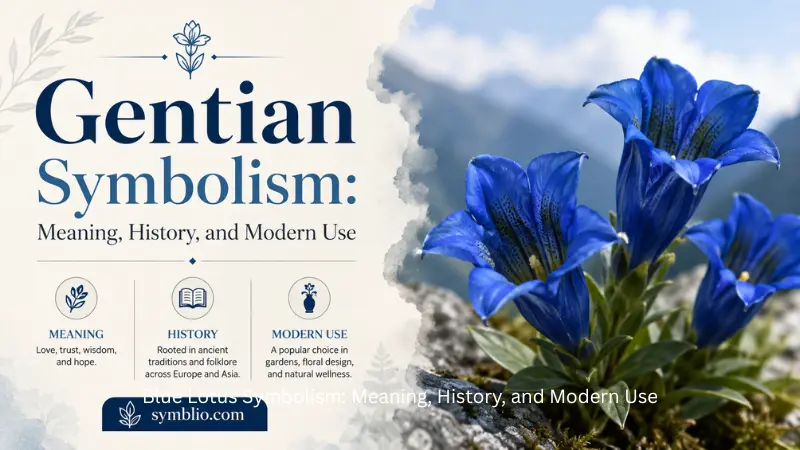
With their vivid blue flowers and preference for mountain meadows, wetlands, and cool landscapes, gentians often look more striking than their modest size suggests. Gentian symbolism is most closely associated with intrinsic worth, resilience, perseverance, hope, and quiet strength, although not all of these meanings come from the same historical tradition.
The distinction matters. Nineteenth-century flower-language sources gave gentian the documented meaning of intrinsic worth, while later literary, botanical, and modern cultural interpretations added ideas such as endurance, hope, and facing difficult transitions with dignity.
For Americans today, the gentian is less familiar than the rose or sunflower, which gives it a more personal quality. It appears in native-plant gardens, mountain imagery, botanical art, tattoos, memorial designs, and floral arrangements where people want a symbol that feels understated rather than obvious.
Quick Answer
Gentian symbolism commonly represents intrinsic worth, resilience, and quiet perseverance in modern American interpretation. Historically, flower-language traditions associated gentian with inner value, while the fringed gentian gained additional American associations with hope, autumn, mortality, and heavenward reflection through poetry.
TL;DR
- Gentian traditionally represents intrinsic worth in flower language.
- Modern meanings include resilience, perseverance, and quiet strength.
- Blue gentians often suggest hope, sincerity, and aspiration.
- Fringed gentians carry a notable American literary association.
- Mountain gentians can represent wildness, endurance, and regional identity.
- Tattoos often use gentians to mark personal survival or self-worth.
What Is a Gentian Flower?
Gentian is a common name for plants belonging to the gentian family, Gentianaceae, especially members of the genus Gentiana. The genus occurs across temperate Eurasia, mountain regions of Asia, North and Central America, and parts of South America.
Many familiar gentians have upright, trumpet-shaped or bell-shaped flowers. Blue is the color most strongly associated with them, although yellow, white, purple, and other shades also occur among different species.
The term “gentian” can also include closely related plants outside the genus Gentiana. The American fringed gentians, for example, are generally classified in the genus Gentianopsis.
That botanical difference is important because symbolic meanings often developed around a particular species or cultural context, not around every plant casually called a gentian.
In the United States, people may encounter gentians in wildflower areas, wetlands, native gardens, botanical illustrations, parks, and mountain landscapes.
Core Gentian Meanings at a Glance
The gentian does not have one universal meaning. Its symbolism changes according to history, species, color, and personal use.
| Context | Common Meaning | Why It Fits | Historical Status |
|---|---|---|---|
| Traditional flower language | Intrinsic worth | Value that exists without display | Historically documented |
| Modern personal symbolism | Resilience | Surviving demanding conditions | Modern interpretation |
| Blue gentian | Hope and sincerity | Blue color and upward-facing blooms | Mostly modern/literary |
| Fringed gentian | Hope amid mortality | Strong American poetic association | Literary tradition |
| Mountain gentian | Endurance and wildness | Connection with alpine landscapes | Cultural interpretation |
| Gentian tattoo | Quiet strength | Personal survival and self-worth | Contemporary meaning |
The safest way to interpret gentian is to separate documented historical meanings from meanings that developed later through poetry, color associations, habitat, and personal symbolism.
Intrinsic Worth: The Strongest Historical Meaning
One of the clearest historical meanings connected with gentian is intrinsic worth.
A nineteenth-century language-of-flowers dictionary lists “Gentian” with this meaning. The phrase describes value that belongs to something by its own nature rather than because other people praise, reward, or recognize it.
This makes gentian unusually relevant to modern ideas about self-respect.
A gentian does not have the immediate cultural visibility of a red rose. Many species grow in specialized habitats, and some bloom among grasses, wetlands, rocky slopes, or fading late-season vegetation.
Symbolically, that contrast can suggest:
Your value does not depend on being noticed.
This interpretation works especially well for someone who identifies with quiet competence, understated confidence, or personal worth that exists independently of status.
It also explains why gentian can feel appropriate as a gift for someone whose effort or character is more important than public recognition.
Why Gentian Represents Resilience and Perseverance
Resilience is a widely used modern interpretation of the gentian, although it should not be confused with a fixed ancient flower-language definition.
The association comes partly from the environments in which many gentians are encountered. Numerous species grow in temperate, alpine, subalpine, meadow, or other demanding habitats. Some North American gentians also thrive in wetlands or moist grasslands.
A flower emerging from an exposed mountain landscape naturally encourages people to read endurance into it.
Gentian therefore works as a symbol for someone who has:
- recovered after a setback
- continued through a difficult period
- rebuilt a life or career
- adapted without losing personal identity
- completed something that required patience
There is also a useful nuance here.
Gentians are not plants that flourish everywhere. Different species can have very specific environmental requirements. Their symbolism therefore does not have to mean “I can survive anything.”
A more realistic interpretation is knowing what allows you to thrive and continuing despite difficult conditions.
That makes the flower’s resilience symbolism more grounded than simple toughness.
Blue Gentian Meaning: Hope, Sincerity, and Aspiration
Blue is one of the gentian’s most recognizable features.
In modern American visual culture, blue often suggests trust, calmness, sincerity, reflection, openness, and distance. When that color appears in a wildflower, especially one growing against green grass or gray rock, the effect can feel unusually clear and focused.
Some gentian flowers also face upward.
Together, the color and form can support meanings such as:
hope, aspiration, emotional clarity, honesty, and looking beyond present circumstances.
Blue gentian is particularly suitable when someone wants a flower symbol that feels hopeful without being cheerful in an exaggerated way.
Its message is quieter than the bright optimism often attached to sunflowers or daisies.
For this reason, blue gentian can work especially well in memorial imagery, recovery tattoos, reflective artwork, or gifts marking a difficult but meaningful transition.
The Fringed Gentian in American Poetry
The fringed gentian has a special place in American literary symbolism because of William Cullen Bryant’s poem To the Fringed Gentian.
Bryant describes a blue flower blooming late in the year, when much of the earlier floral season has already passed. He then uses its upward-looking form to reflect on mortality and the hope of facing death while still looking toward heaven.
That literary treatment adds several meanings that are not identical to the old flower-language definition:
late hope, acceptance of mortality, spiritual reflection, dignity at life’s end, and courage during transition.
The timing of the flower matters.
Spring flowers often represent beginnings because they appear when the growing season is returning. Bryant’s gentian appears much later.
Its hope is therefore not the optimism of someone who has never faced difficulty. It is closer to hope that remains after experience, aging, uncertainty, or loss.
That gives the fringed gentian an unusually mature symbolic character in American literature.
Why Late Blooming Changes the Flower’s Meaning
The idea of the late bloomer fits gentian especially well.
Several gentians flower during later parts of the growing season, and fringed gentians are strongly associated with late-summer or autumn landscapes.
Symbolically, a late flower can represent something valuable arriving after the expected time.
That makes gentian suitable for experiences such as:
starting a new career later in adulthood, finding love after disappointment, graduating after delays, rebuilding after grief, developing confidence slowly, or succeeding after repeated setbacks.
The gentian does not need to suggest that lateness is automatically better.
Instead, it can communicate a more useful message: being late does not make an achievement less valuable.
This interpretation connects naturally with the older idea of intrinsic worth. A person’s progress does not become meaningless simply because it happens on a different timetable.
The Ancient Name and Medicinal History of Gentian
The name Gentiana has traditionally been connected with Gentius, an Illyrian king of the second century BCE.
Historical medicinal traditions credited Gentius with recognizing the usefulness of gentian, although the details belong partly to ancient tradition and should not be treated as fully verifiable modern biography. Later medical and botanical literature continued to associate the plant’s name with him.
The best-known medicinal gentian is yellow gentian, Gentiana lutea.
Its root is intensely bitter and has long been used in European herbal preparations, bitters, and beverages.
This history sometimes leads modern websites to claim that gentian universally symbolizes “healing.”
That goes too far.
Gentian certainly has a medicinal history, but a medicinal use does not automatically establish a traditional symbolic meaning.
A more careful interpretation is that the plant can evoke usefulness beneath an austere exterior, endurance, and value that may not be immediately obvious.
The bitter root and brilliant flowers create an interesting contrast: what looks delicate above ground belongs to a plant long valued for something hidden below it.
What Gentian Commonly Means in the United States
Gentian does not have one instantly recognized meaning in American culture.
Most Americans would probably recognize the symbolism of a red rose before they could explain the meaning of a gentian. That lack of a fixed popular code gives gentian more flexibility.
In contemporary U.S. use, the flower can represent:
- inner worth
- resilience after hardship
- understated confidence
- connection with wild landscapes
- late-blooming success
- sincerity
- hope during change
- remembrance
The historical meaning of intrinsic worth provides the strongest foundation.
The other meanings usually arise from a combination of flower color, ecology, poetry, seasonal timing, and personal interpretation.
This makes gentian especially useful when someone wants a symbol that feels individual rather than culturally predetermined.
Gentian and American Wild Landscapes
Gentians also carry meaning through their connection with American landscapes.
Native gentians occur in different regions of the United States, including eastern woodlands, prairies, wet meadows, mountain areas, and wetlands.
A notable example is the Rocky Mountain fringed gentian, Gentianopsis thermalis, which the National Park Service identifies as Yellowstone’s park wildflower.
That association gives the flower a distinctly American environmental dimension.
For visitors who encounter gentians while hiking, the flower may symbolize:
wild places, conservation, seasonal change, mountain memories, or attachment to a particular landscape.
In this context, its meaning does not come from Victorian flower language at all.
It comes from experience.
Someone who sees gentians during an important trip to Yellowstone or another wild area may later associate the flower with freedom, family memories, solitude, or respect for nature.
Personal symbolism often develops this way: the place becomes part of the flower’s meaning.
Alpine Gentians and European Mountain Identity
In Europe, gentians are especially associated with the Alps and other mountain regions.
Their vivid blue flowers regularly appear in imagery connected with alpine meadows, hiking, regional design, tourism, and mountain culture.
Here the symbolic emphasis is often less about a secret floral message and more about belonging to a landscape.
An alpine gentian may therefore evoke:
- mountain heritage
- endurance
- regional pride
- natural beauty
- high-altitude landscapes
- attachment to home
This association has helped shape modern perceptions of gentian as a hardy flower.
Still, it is inaccurate to say that every European culture historically used gentian to mean exactly “strength” or “perseverance.”
Those are broad modern interpretations built partly from the plant’s mountain identity.
Gentian in Japanese Culture and Heraldry
Gentian also has a distinct cultural history in Japan, where the flower is known as rindō.
Rindō is associated with autumn and is grown as an ornamental and cut flower. Gentian imagery also appears in traditional Japanese crest designs.
One well-known heraldic form is sasa-rindō, a design combining gentian with leaf forms and associated with Japanese family-crested traditions.
This context should not be interpreted through nineteenth-century Western flower language.
A Japanese crest containing gentian is not simply another way of saying “intrinsic worth.”
Traditional heraldic imagery can communicate family identity, lineage, historical affiliation, and continuity.
That distinction is important whenever symbolism crosses cultures.
The same flower can participate in several traditions without carrying one universal definition.
Emotional Meaning: Quiet Strength Rather Than Display
Gentian is particularly suited to people who prefer quiet strength over dramatic symbolism.
A lion, eagle, or sword communicates strength immediately. A gentian does something subtler.
Its message can be:
I continued. I know my worth. I do not need to make it obvious.
That emotional tone makes the flower relevant to people who have experienced private struggles that others may not fully understand.
It can symbolize recovery that happened quietly, grief carried privately, confidence developed gradually, or success achieved without public attention.
Gentian can also represent emotional maturity.
Its strongest interpretations do not deny difficulty. Instead, they acknowledge that hardship, aging, disappointment, and uncertainty exist while still leaving room for dignity and hope.
This is one reason the flower works so well in reflective art and tattoos.
Gentian Tattoo Meaning
A gentian tattoo usually has a more personal meaning than a familiar floral design such as a rose.
One of the most historically grounded interpretations is intrinsic worth.
Someone may choose the flower as a reminder that their value does not depend on approval, relationships, career status, appearance, or recognition.
Other gentian tattoo meanings include:
- surviving hardship
- rebuilding after loss
- late-blooming success
- hope after a difficult period
- love of mountains
- connection with a specific wild place
- remembrance
- personal dignity
- calm determination
Design choices can change the message.
A blue gentian pointing upward may emphasize hope or aspiration.
A fringed gentian can carry stronger American literary associations with autumn and mortality.
Gentian paired with mountains may emphasize wilderness, travel, or endurance.
A gentian with a date or name can turn the flower into memorial imagery.
Because there is no single universally recognized gentian tattoo meaning, the wearer’s own story usually matters most.
Gentian in Gifts, Memorials, Weddings, and Decor
Gentians can also communicate different meanings depending on where they are used.
As a Gift
Gentian works well for recognizing someone whose strength is easy to overlook.
Its association with intrinsic worth can make it suitable for a friend, mentor, family member, or partner whose character matters more than public achievement.
In Memorials
The fringed gentian’s literary connection with mortality and looking heavenward can make it meaningful in memorial gardens, botanical artwork, or remembrance tattoos.
It does not traditionally mean death itself.
Instead, it can represent hope while acknowledging loss.
At Weddings
Blue gentians can appear in weddings because of their distinctive color.
In an American ceremony, they may function as an unusual interpretation of “something blue” or as a symbol of sincerity and steady commitment.
These meanings are largely modern rather than fixed wedding traditions.
In Home Decor
Gentian prints and botanical illustrations usually communicate nature, blue color, alpine scenery, or botanical elegance.
Sometimes a flower is chosen because it is beautiful rather than because it carries a coded message. Both uses are valid.
Common Misunderstandings About Gentian Meaning
Several claims about gentians are repeated online more confidently than the historical record supports.
“Gentian has one universal meaning.”
It does not.
Different species and cultures developed different associations.
“Fringed gentian traditionally means intrinsic worth.”
This needs qualification.
Historical flower-language material documents gentian with the meaning intrinsic worth. The fringed gentian has a separate and especially important American literary history.
Combining those traditions can create a reasonable modern interpretation, but they should not be presented as identical historical evidence.
“Gentian is an ancient symbol of healing.”
Gentian has a long medicinal history, particularly through its roots.
That fact does not prove that ancient societies universally used the flower as a symbolic emblem of healing.
“All blue gentians mean spirituality.”
Blue can encourage associations with sky, contemplation, or heaven, especially in art and literature.
That does not make spirituality a universal botanical meaning.
“Japanese gentian symbolism is the same as Western flower language.”
It is not.
Japanese ornamental and heraldic traditions developed within their own cultural contexts and should be interpreted separately.
These distinctions make the flower’s history more accurate without taking away its modern personal meaning.
How Gentian Meaning Has Changed Over Time
Gentian meaning did not develop from one event.
Instead, several layers accumulated.
First came the plant’s practical importance, especially the medicinal reputation of bitter gentian roots.
Later, European mountain culture made blue gentians strongly associated with alpine landscapes.
Flower-language traditions then assigned gentian the idea of intrinsic worth.
In the United States, William Cullen Bryant’s treatment of the fringed gentian gave the flower another symbolic layer: late-season beauty, mortality, heavenward hope, and dignity during life’s final transition.
Modern tattoo, design, gardening, and digital culture have expanded the flower’s meaning again.
Today, people may use gentian for resilience, recovery, authenticity, wilderness, late success, self-respect, or remembrance.
The evolution shows why it is misleading to reduce the flower to one definition.
Its most convincing modern interpretation brings several layers together: worth that remains present even when it is overlooked, tested, or revealed later than expected.
FAQs
What does a gentian flower symbolize?
Gentian most strongly symbolizes intrinsic worth, with modern interpretations also including resilience, perseverance, sincerity, and hope. The exact meaning depends on whether the flower is being interpreted through historical flower language, literature, color, or personal use.
What does a blue gentian symbolize?
A blue gentian commonly suggests hope, sincerity, calmness, and aspiration in modern symbolism. Its vivid blue color and the upward-facing form of some species can also encourage associations with sky, reflection, and looking beyond present difficulties.
What does a gentian tattoo mean?
A gentian tattoo can represent self-worth, quiet strength, survival, recovery, or late-blooming success. Mountain imagery, dates, names, or other flowers can give the design a more specific personal meaning.
Does gentian symbolize death?
Gentian is not primarily a symbol of death. However, the fringed gentian has an American literary connection with mortality because William Cullen Bryant used the flower to reflect on facing life’s end with hope.
Is gentian a spiritual flower?
Gentian is not a universal religious symbol. Blue and upward-facing gentians can be interpreted as symbols of heaven, hope, or spiritual reflection, but those meanings depend largely on literary, artistic, or personal context.
Does gentian mean resilience?
Yes, resilience is a common modern interpretation of gentian. It comes largely from the flower’s association with mountain environments, specialized habitats, late blooming, and its broader image of continuing under difficult conditions.
What is the traditional meaning of gentian?
A documented nineteenth-century flower-language meaning for gentian is intrinsic worth. Modern meanings such as perseverance and quiet strength developed through later cultural, ecological, literary, and personal interpretations.
Conclusion
Gentians carry several layers of meaning, but the most historically defensible starting point is intrinsic worth. From there, their mountain habitats, blue coloring, late flowering, medicinal history, and place in American poetry have encouraged additional associations with resilience, hope, sincerity, mortality, and perseverance.
What makes gentian symbolism distinctive is its restraint. The flower does not suggest strength through dominance or attention; it suggests value that remains intact whether or not anyone immediately recognizes it.
For someone choosing a gentian for a tattoo, memorial, garden, gift, or piece of art, that may be its clearest message: worth can be quiet, progress can arrive late, and hope can remain even when the season is changing.