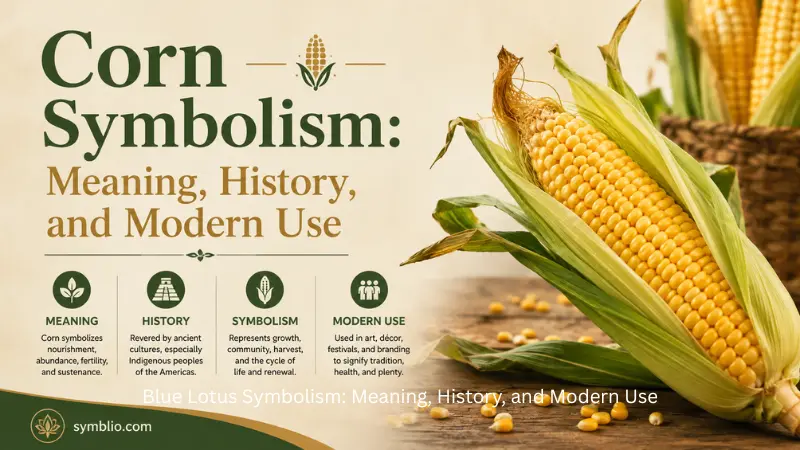
Corn is one of the most familiar crops in the United States, yet its meaning extends far beyond food and farming. Corn symbolism commonly centers on abundance, nourishment, harvest, growth, community, and the relationship between people and the land.
These meanings make sense when we look at the plant itself. A single stalk can produce ears filled with many kernels, while saved seed from one harvest can begin the next growing season. Because of this natural cycle, corn often represents provision, continuity, patience, and successful effort.
Its cultural meaning also reaches far back into the history of the Americas. Indigenous peoples developed maize thousands of years before the United States existed, and many Native communities continue to hold distinct cultural, agricultural, and ceremonial relationships with corn today.
In modern American life, corn appears in autumn decorations, Thanksgiving imagery, farming communities, artwork, tattoos, festivals, and regional identity. Its symbolism changes depending on context, but ideas of nourishment and harvest remain central.
Quick Answer
Corn symbolism commonly represents abundance, nourishment, harvest, growth, prosperity, and rural life in modern American culture. Historically, maize has also carried meanings connected with creation, community, regeneration, agriculture, ancestry, and relationships with the land in different Indigenous traditions of the Americas.
TL;DR
- Corn commonly symbolizes abundance, nourishment, harvest, and prosperity.
- Indigenous meanings differ across nations and cultural traditions.
- Maize was domesticated in the Americas thousands of years ago.
- American fall imagery strongly connects corn with seasonal harvest.
- Corn can represent patience, community, and successful effort.
- Modern uses include tattoos, decor, festivals, and regional identity.
What Corn Represents as a Symbol
Corn can carry several meanings at once because people encounter it in many forms.
A green stalk may suggest growth, development, and work still in progress. A mature ear can represent achievement, productivity, and abundance. Dried corn often points toward autumn, harvest, preparation, and the end of a growing season.
A field of corn can communicate something broader. Instead of focusing on one person’s growth, an entire field may represent agriculture, collective labor, rural life, economic productivity, or dependence on natural conditions.
Because corn is both a food and a cultivated crop, its symbolism usually stays connected to practical human needs. It is less often a symbol of luxury and more often a symbol of having enough.
What Corn Commonly Means in the United States
In modern American culture, corn most often represents harvest and abundance.
The association comes naturally from agriculture. A mature crop signals that months of planting, care, weather, and labor have finally produced something useful. Corn therefore becomes an image of results after sustained effort.
It can also suggest nourishment, prosperity, gratitude, productivity, family provision, and rural identity.
| Context | Meaning in the USA | Common Associations | Notes |
|---|---|---|---|
| Fall decor | Harvest | Autumn, farms, seasonal change | Often shown dried |
| Thanksgiving | Abundance | Food, gratitude, gathering | Common seasonal symbol |
| Farming communities | Livelihood | Work, land, rural identity | Strong in agricultural regions |
| Personal symbolism | Growth | Patience, effort, achievement | Seen in art and tattoos |
| Indigenous contexts | Culture-specific meaning | Land, ceremony, community | Meanings vary by nation |
The same image can therefore mean different things to different people. A decorative ear on a front porch may simply represent autumn, while corn used within an Indigenous cultural tradition may carry much more specific meaning.
Ancient Origins and the Development of Maize
Corn’s symbolic history begins with its agricultural history.
Modern maize developed from teosinte, a wild grass native to what is now Mexico. Indigenous farmers gradually selected plants with desirable traits over many generations, eventually producing the larger ears and kernels associated with maize today.
This process began thousands of years ago and became one of the most important agricultural developments in the Americas.
As maize cultivation spread, communities adapted it to different climates and growing conditions. Corn eventually became an important food source across many parts of North America.
Its value was not only nutritional. Corn could be dried, stored, transported, ground into meal, cooked in many ways, and saved as seed for future planting.
These qualities naturally encouraged symbolic associations with survival, continuity, preparation, and community stability.
Indigenous Meanings Are Diverse
There is no single universal “Native American meaning” for corn.
Native nations have distinct languages, traditions, histories, environments, farming practices, and ceremonial systems. Corn holds major cultural importance in some communities, while other Indigenous peoples historically depended more heavily on different foods and landscapes.
For several Pueblo peoples, including Hopi communities, corn has long been closely tied to agriculture, identity, land, responsibility, and ceremonial life.
In Haudenosaunee traditions, corn is especially important within the agricultural relationship commonly known as the Three Sisters.
Other Native communities maintain their own varieties, planting traditions, foods, stories, and cultural teachings involving maize.
Because of these differences, it is more accurate to discuss a specific tradition when possible instead of claiming that corn has one meaning across all Indigenous cultures.
The Three Sisters and Interdependence
One of the best-known agricultural relationships involving corn is the Three Sisters, commonly associated with corn, beans, and squash.
The crops can support one another when planted together. Corn provides a structure for climbing beans. Squash spreads across the soil, helping shade the ground, while beans contribute to the larger garden system.
The relationship is not simply a gardening trick. In Haudenosaunee culture, the Three Sisters also belong to a broader world of stories, food traditions, community knowledge, gratitude, and cultural teaching.
Symbolically, this makes corn part of a larger message about interdependence.
No single crop represents the whole system. Each contributes something different, creating an image of cooperation and mutual support.
That interpretation makes corn especially meaningful in discussions of community, shared responsibility, and survival through relationships rather than individual effort alone.
Corn, Creation, and Regeneration
Maize carries strong creation and renewal symbolism in several Mesoamerican traditions.
In K’iche’ Maya tradition, maize appears in accounts of human creation, reflecting the crop’s central place in cultural life and identity.
Corn also naturally lends itself to symbolism involving death and regeneration. A mature plant eventually dries and dies, yet its kernels can become seed for another generation.
This visible agricultural cycle helps explain why maize could become connected with renewal, ancestry, continuity, and rebirth.
The symbolism does not require an abstract or mystical interpretation. It comes directly from farming experience.
A crop grows, matures, produces seed, disappears, and returns again through cultivation.
That cycle makes corn a grounded symbol of continuity across generations.
Why Corn Symbolizes Abundance
A full ear of corn visually communicates plenty.
Instead of containing one seed or fruit, an ear carries rows of kernels packed closely together. This natural multiplication makes corn an easy symbol of successful production, food security, and abundance.
However, abundance does not always mean wealth.
Historically, a successful harvest could mean that a household or community had enough food to store for periods when fresh crops were unavailable. In that sense, corn symbolizes security more than luxury.
This distinction still makes sense today.
When corn appears in harvest decorations, it often communicates ideas such as having enough, giving thanks, sharing food, and preparing for the future.
Its symbolism therefore tends to focus on practical prosperity rather than extravagance.
Harvest, Thanksgiving, and Autumn
Corn has become one of the most recognizable symbols of fall in the United States.
Dried stalks, ornamental ears, pumpkins, hay bales, gourds, and autumn leaves often appear together outside homes, stores, farms, schools, and seasonal events.
Corn mazes also transform working or specially planted fields into popular fall attractions.
Thanksgiving strengthens the connection between corn and harvest imagery. Decorative displays often use corn to suggest food, gratitude, seasonal abundance, and agricultural plenty.
Still, Thanksgiving imagery can oversimplify history when it turns Native peoples into decorative figures within an idealized colonial story.
A more careful interpretation recognizes two things at once: corn can represent gratitude and harvest in modern seasonal culture, while Indigenous history and colonial history remain much more complex.
That distinction allows the symbol to be appreciated without flattening the past.
Corn as a Symbol of Rural America
Corn also represents American agricultural life.
Large cornfields are especially associated with the Midwest and other farming regions. In these places, corn is not merely a decorative fall image. It is part of local economies, family histories, landscapes, and daily work.
Grain elevators, combines, farm equipment, county fairs, seed businesses, and roadside fields all reinforce this regional identity.
For someone who grew up around agriculture, corn may symbolize home more strongly than prosperity.
It can bring to mind grandparents, family farms, harvest machinery, summer work, school trips, local fairs, or long drives through farmland.
Corn can therefore function almost like a regional emblem.
In personal art or design, it may communicate pride in farming heritage, attachment to a hometown, or respect for agricultural work.
Growth, Patience, and Earned Results
Corn can also represent the relationship between effort and outcome.
Planting begins with something small. The grower must then wait while the crop depends on soil, water, weather, knowledge, timing, and continued care.
A mature ear becomes the visible result of that process.
Because of this, corn works well as a symbol of patience, persistence, and earned progress.
It does not suggest instant success. Instead, it points toward development that happens in stages.
This meaning can apply to education, work, relationships, creative projects, business goals, or personal growth.
Someone might choose a growing corn stalk to represent progress that is still underway. A harvested ear may instead symbolize reaching the end of a demanding period and finally seeing results.
Emotional Meaning: Home, Security, and Belonging
Corn often carries warm emotional associations because it is closely connected with food and seasonal routines.
For some people, it brings back memories of family meals, gardens, farm stands, fairs, autumn festivals, school activities, or harvest time.
In agricultural communities, the sight of a cornfield may communicate familiarity and belonging.
That emotional meaning can be stronger than any formal symbolic definition.
Corn also suggests security because food production has always been tied to survival. A successful harvest means preparation for future needs.
As a result, corn can represent reassurance, stability, and provision.
Its emotional symbolism is usually practical and familiar rather than dramatic.
Green, Yellow, and Dried Corn Meanings
The appearance of corn can change its symbolic message.
Green Corn
Green stalks represent active growth, youth, development, and work that has not yet reached completion.
They can suit themes involving hope, learning, progress, or future potential.
Yellow or Golden Corn
Golden corn commonly suggests maturity, harvest, warmth, nourishment, and abundance.
Its color also fits easily with mainstream American autumn imagery.
Multicolored Corn
Corn can naturally appear in white, blue, red, purple, yellow, and mixed varieties.
In modern decor, multicolored ears are often appreciated for visual beauty and seasonal interest.
However, specific corn colors may hold distinct cultural meanings within particular Indigenous traditions. Those meanings should not be generalized into universal color symbolism.
Dried Corn
Dried ears and husks often represent harvest completion, preservation, seasonal transition, and preparation.
They are especially common in fall displays.
Corn in Tattoos and Personal Symbolism
A corn tattoo can carry several personal meanings.
Someone from a farming family may choose it to represent heritage, work, or connection to the land. Another person may use it as a symbol of growth, perseverance, nourishment, or completing a difficult stage of life.
The design affects interpretation.
A seed can represent beginnings or potential. A young stalk suggests development. A mature ear can symbolize achievement and abundance.
Some people may also choose corn because it connects them with a particular cultural background.
When a tattoo copies ceremonial imagery or symbols from a specific Indigenous community, greater care is appropriate. General corn imagery is different from using a sacred or community-specific design without understanding its meaning.
The safest personal symbolism usually comes from defining what the plant means in one’s own life.
Corn in Art, Decor, and Popular Culture
Corn appears widely in modern American visual culture.
In home decor, dried corn commonly marks the fall season. Farmhouse-style artwork may use stalks or fields to suggest simplicity, rural tradition, or agricultural life.
In painting and photography, cornfields can represent openness, productivity, isolation, or home depending on composition and context.
Film and television sometimes use tall cornfields very differently.
Because mature stalks can block visibility, a field can create tension, confusion, or fear. Horror stories may use cornfields as places where characters become lost or cannot see what is nearby.
This is almost the opposite of harvest symbolism.
The contrast shows why context matters. A bright field under an open sky may represent prosperity or home, while the same field at night may represent uncertainty and concealment.
Religious Meaning and the Biblical “Corn” Confusion
Corn may appear in modern Christian harvest celebrations as a symbol of food, gratitude, creation, and agricultural provision.
However, older English Bible translations can create confusion.
The word corn historically had a broader meaning in British English. It could refer generally to cereal grain rather than specifically to American maize.
Therefore, biblical passages that mention “corn” in older translations are not describing the plant commonly called corn in the United States today.
Maize originated in the Americas, so modern ears of corn should not be projected backward into biblical agriculture.
Churches can still use corn as a modern harvest symbol. The symbolism simply comes from contemporary ideas of food, farming, gratitude, and provision rather than from maize being a biblical crop.
Common Misunderstandings About Corn Symbolism
One common mistake is saying that corn always symbolizes wealth or fertility.
Both interpretations can make sense in certain contexts, but neither explains the full range of meanings.
Corn is also connected with nourishment, labor, food security, community, identity, harvest, continuity, and agricultural responsibility.
Another mistake is treating all Indigenous traditions as one cultural system.
A meaning associated with Hopi traditions should not automatically be labeled as Cherokee, Haudenosaunee, Maya, or broadly “Native American.”
Specific cultural meanings deserve specific identification.
Modern decorative imagery can also create confusion. An ornamental ear displayed for autumn does not carry the same meaning as corn used in ceremony or community tradition.
Recognizing that difference makes interpretation more accurate and respectful.
How Corn’s Meaning Has Changed Over Time
Corn symbolism has expanded as the crop’s role has changed.
Its earliest meanings developed through Indigenous cultivation, food systems, ceremony, stories, community life, and relationships with particular lands.
As maize spread across the Americas, different societies gave it meanings shaped by their own histories and environments.
European colonization changed its economic and cultural context. Maize later spread around the world and became a major global crop.
Within the United States, industrial agriculture added new associations.
Corn increasingly represented large-scale farming, productivity, livestock feed, food manufacturing, the Midwest, and agricultural economics.
Popular culture added another layer by turning dried corn into a familiar autumn decoration.
Today, all of these meanings can exist at the same time.
Corn may be food, a commodity, a regional emblem, a seasonal decoration, a family memory, or part of a living cultural tradition.
FAQs
Corn can be interpreted as a positive symbol because it represents successful harvests, nourishment, and abundance. Its traditional meaning is usually closer to prosperity and security than to random luck.
A corn tattoo can represent growth, agricultural heritage, patience, nourishment, resilience, or the reward of sustained effort. Its exact meaning depends on the design and the person’s own connection to the plant.
Corn can symbolize fertility because each mature ear contains many seeds capable of producing new plants. However, fertility is only one possible interpretation and should not be presented as the universal meaning of corn.
There is no single spiritual meaning. Depending on the tradition, corn may be connected with creation, ancestry, land, community, renewal, gratitude, or sustaining life.
In modern Thanksgiving imagery, corn usually represents harvest, food, gratitude, and seasonal abundance. Its use should still be separated from oversimplified stories about Indigenous peoples and colonial history.
A cornfield can symbolize agriculture, productivity, patience, home, collective labor, or dependence on nature. In darker fiction, it may also represent isolation or uncertainty because tall stalks limit visibility.
Yes, corn is strongly associated with the American Midwest because farming and cornfields shape much of the region’s landscape and identity. It can symbolize rural life, family farming, agricultural work, and attachment to place.
Conclusion
Corn carries meaning because people have relied on it for food, farming, family livelihoods, and cultural continuity for thousands of years. Its familiar associations with harvest and abundance are only part of the story.
Understanding corn symbolism also means recognizing the crop’s Indigenous origins and the fact that its cultural meanings differ across communities. In modern America, it can represent nourishment, patience, rural identity, seasonal gratitude, home, and the reward of sustained work.
Its symbolism remains convincing because it comes from something tangible: seeds are planted, plants are cared for, and a successful harvest provides both food for the present and possibilities for the future.