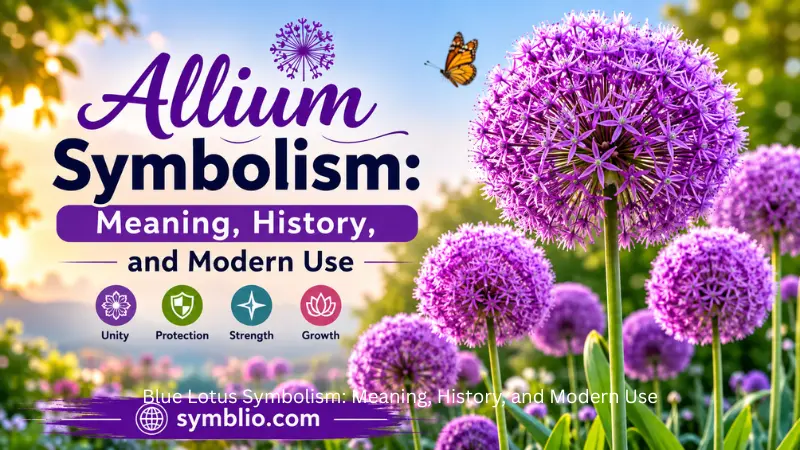
Alliums are among the most distinctive flowers found in modern gardens. Their tall stems support round flower heads made up of dozens, sometimes hundreds, of tiny star-shaped blooms. Allium symbolism grows naturally from this structure: many separate flowers come together to form one complete shape.
Today, alliums are commonly associated with unity, patience, prosperity, resilience, and good fortune. These meanings make the flowers especially suitable for weddings, friendship gifts, gardens, floral arrangements, and personal designs.
The symbolism also has an older layer. Ornamental alliums belong to the same botanical genus as onions, garlic, leeks, shallots, and chives. Those useful plants have long histories in food, traditional medicine, and folklore, contributing additional associations with endurance and protection.
Quick Answer
Allium symbolism commonly represents unity, patience, prosperity, and good fortune in modern American culture. Its many small blossoms forming one globe make it a natural symbol of togetherness, while the wider history of onions and garlic adds associations with endurance, usefulness, and protection.
TL;DR
- Alliums commonly symbolize unity, patience, prosperity, and good fortune.
- Their clustered flowers make them natural symbols of togetherness.
- Garlic traditions add older associations with protection and courage.
- Alliums are popular in weddings, gardens, gifts, and floral design.
- Purple varieties often suggest dignity, creativity, and admiration.
- Flower meanings vary by culture, period, color, and personal interpretation.
What Does an Allium Flower Look Like?
The name Allium refers to a large group of plants that includes both ornamental flowers and familiar foods such as onions, garlic, chives, shallots, and leeks.
Ornamental alliums are especially recognizable because of their unusual flower heads. Many varieties produce a long, upright stem topped by a round or nearly spherical cluster of small flowers. The individual blooms often look like tiny stars arranged around a central point.
Purple is the color most people associate with ornamental alliums, although varieties can also produce pink, white, yellow, lavender, and blue-toned flowers.
Their distinctive structure has shaped much of their modern symbolism. One small flower alone may appear delicate, but hundreds of blossoms together create a dramatic form. That visual relationship makes ideas such as cooperation, community, connection, and shared strength especially fitting.
Large varieties can also rise above neighboring plants, creating the appearance of floating flower globes. This architectural quality has made alliums popular in both formal and informal American garden design.
Unity Is the Allium’s Strongest Symbolic Meaning
Unity is one of the clearest meanings associated with the allium flower.
Each flower head contains many individual blossoms, yet they work together visually as one complete sphere. The structure creates an easy metaphor for people remaining individuals while still belonging to something larger.
That makes allium especially meaningful in relationships.
It can represent spouses building a shared life, relatives maintaining close family ties, friends supporting one another, or members of a community working toward a common purpose.
The meaning is particularly suitable for weddings because the flower suggests connection without erasing individuality. Two people can become partners while still remaining distinct personalities with their own experiences, interests, and identities.
The same idea can apply beyond romance. A group of alliums may symbolize a family, team, friendship circle, or community whose strength comes from connection.
Patience and Perseverance
Patience is another common modern interpretation of allium.
Many ornamental alliums grow from bulbs planted well before their flowering season. For gardeners, their eventual blooms can therefore represent the reward that follows preparation and waiting.
Symbolically, patience does not mean simply doing nothing. It can represent allowing a relationship, career, creative project, or personal goal enough time to develop.
Perseverance is closely related.
Alliums often produce tall, upright stems that hold their flower heads above surrounding foliage. Their appearance can suggest steadiness and composure, particularly when the plant remains standing through changing garden conditions.
For this reason, an allium can make a thoughtful symbol for someone working toward a long-term goal, completing a difficult project, or entering a new stage that requires persistence.
Prosperity and Good Fortune
Alliums are also associated with prosperity and good fortune in modern flower symbolism.
The connection likely comes partly from visual abundance. A single flower head contains numerous blossoms, creating an impression of fullness, growth, and successful development.
Prosperity in this context does not have to mean financial wealth.
It may represent a flourishing household, successful relationships, professional progress, creative growth, or a generally hopeful future.
That makes alliums suitable for occasions such as graduations, new jobs, housewarmings, business milestones, and major life transitions.
Giving alliums to someone starting a new chapter can communicate a simple wish: may what you are building continue to grow.
Humility and Collective Strength
Allium is sometimes associated with humility, and its structure helps explain why.
The individual flowers are usually small. None dominates the entire flower head. Instead, the dramatic appearance comes from many modest blossoms working together.
That creates an interesting balance between humility and strength.
The plant can symbolize the idea that an individual does not need to dominate a group in order to make an important contribution. Each part matters because the overall form depends on all of them.
This interpretation works especially well in professional, family, and community settings. It can represent teamwork, cooperative leadership, shared achievement, or the value of contributing without constantly seeking personal recognition.
Ancient Roots of the Allium Family
The broader history of Allium plants is much older than the modern symbolism attached to ornamental flowers.
Humans have used onions, garlic, leeks, and related plants for thousands of years as food, seasoning, and traditional remedies. These useful plants became part of daily life across many regions and naturally accumulated cultural meanings over time.
Garlic, in particular, became associated in several traditions with strength, courage, and protection.
However, it is important to distinguish between the symbolism of edible alliums and the meanings now assigned to ornamental globe-shaped flowers.
There is little reason to assume that ancient societies looked at decorative purple alliums and interpreted them exactly as modern flower guides do.
Meanings such as unity and prosperity are better understood as later interpretations influenced by the flower’s visible structure, floral traditions, gardening culture, and contemporary symbolism.
How Flower Language Influenced Allium Meaning
The practice of assigning messages to flowers became especially fashionable in Europe and the United States during the nineteenth century.
Flowers were sometimes presented as a symbolic vocabulary. Different plants could communicate affection, admiration, friendship, grief, remembrance, modesty, or other emotions.
This practice is commonly known as floriography, or the language of flowers.
Flower meanings were never completely standardized. Different books and traditions could assign different meanings to the same plant. A flower that represented one idea in one source might receive another interpretation elsewhere.
That history helps explain why allium symbolism includes several meanings rather than one fixed definition.
Unity, patience, prosperity, humility, and good fortune can all appear in modern interpretations. Rather than treating them as strict rules, it is more accurate to see them as overlapping symbolic traditions shaped by appearance, cultural associations, and personal use.
Protection and the Connection to Garlic
Protection is sometimes included among the symbolic meanings of allium, but this association comes most clearly from garlic.
Garlic has a long history in folklore as a plant believed to guard against danger, illness, harmful influences, or supernatural threats.
European folklore eventually made the connection especially famous through stories in which garlic was used to repel vampires and other frightening beings.
Because garlic belongs to the Allium genus, its protective reputation sometimes extends to ornamental allium flowers in modern symbolism.
The distinction matters.
A purple ornamental allium does not automatically carry the same historical meaning as a clove of garlic. Still, someone choosing the flower for a tattoo, bouquet, or garden may reasonably combine modern themes of unity with the older protective associations of the plant family.
What Allium Symbolizes in the United States
In the United States, alliums are primarily encountered as ornamental garden plants, cut flowers, and decorative elements rather than formal religious symbols.
American gardeners often grow them in perennial borders, cottage gardens, contemporary landscapes, and pollinator-friendly spaces. Their spherical flowers provide strong visual contrast against softer foliage and more traditional flower shapes.
This gardening context has strengthened their associations with growth, community, and balance.
Alliums can also suggest coexistence because flowering plants may attract bees and other pollinating insects. For environmentally conscious gardeners, they may represent a landscape designed to support both human enjoyment and local wildlife.
That ecological interpretation is modern rather than traditional, but it reflects the way Americans increasingly connect garden plants with ideas about habitat, biodiversity, and responsible landscaping.
Allium Symbolism in Weddings and Relationships
Alliums work particularly well as relationship symbols because unity is built into their physical structure.
In a wedding bouquet or floral arrangement, they can represent two people creating a shared future. Their many florets can also symbolize families and communities coming together around a marriage.
Unlike flowers strongly associated with romantic passion, allium offers a quieter message centered on partnership, cooperation, and lasting connection.
For anniversaries, patience and perseverance can become equally important.
A long relationship is not simply about affection. It also depends on communication, adaptation, shared effort, and the ability to remain connected through change.
An allium can therefore symbolize a relationship that has developed gradually rather than one defined only by intense emotion.
Alliums as Gifts
Alliums can carry different messages depending on the occasion.
A bouquet given to a close friend might communicate loyalty, connection, and appreciation. For someone beginning a new career or business, prosperity and patience may be more appropriate.
At a housewarming, alliums can suggest hopes for a flourishing home and strong relationships.
They can also work as encouragement for someone pursuing a long-term goal. Their symbolism of patience and perseverance makes them more meaningful than a simple congratulatory flower.
| Context | Common U.S. Meaning | Why It Fits |
|---|---|---|
| Wedding | Unity and partnership | Many florets form one complete flower head |
| Anniversary | Enduring connection | Suggests patience and lasting commitment |
| Housewarming | Prosperity and growth | Abundant blooms suggest flourishing |
| Friendship gift | Loyalty and togetherness | Separate flowers remain visibly connected |
| Graduation | Progress and perseverance | Fits long-term effort and achievement |
| Garden planting | Community and balance | Repeated blooms create coordinated structure |
Allium Tattoo Meaning
An allium tattoo can represent unity, family, friendship, patience, resilience, prosperity, or belonging.
Its distinctive geometry makes it especially suitable for botanical tattoo designs. Some people choose a detailed flower head showing dozens of individual florets, while others prefer a minimalist outline of the tall stem and round bloom.
The number of flowers can also affect personal meaning.
A single allium might represent individuality balanced with connection. Several stems may symbolize family members, close friends, or important relationships.
Someone who has gone through a difficult transition might choose the flower as a reminder that progress can be gradual.
Others may focus on community, using the clustered blossoms to represent the idea that personal strength can grow through supportive relationships.
As with most tattoos, personal meaning matters more than any fixed flower dictionary definition.
Allium Color Meanings
Color can add another layer of interpretation to allium symbolism.
Purple Allium
Purple is the most familiar ornamental allium color. It can suggest dignity, admiration, creativity, elegance, and individuality.
Combined with the flower’s association with unity, a purple allium can represent a strong relationship built between confident individuals.
White Allium
White alliums can suggest simplicity, peace, sincerity, and new beginnings.
Their clean appearance makes them especially appropriate for weddings, minimalist floral arrangements, and occasions connected with fresh starts.
Pink Allium
Pink alliums tend to feel warmer and more affectionate.
They can represent friendship, appreciation, tenderness, affection, or gentle romantic feelings.
Blue Allium
Blue-toned alliums may suggest calmness, reflection, individuality, and peace.
Because naturally blue flowers are comparatively unusual, these varieties can also feel distinctive or unconventional.
Yellow Allium
Yellow alliums can communicate optimism, cheerfulness, friendship, and positive energy.
Their bright color makes them especially appropriate for celebratory or uplifting arrangements.
These color meanings should be treated as modern associations rather than universal rules.
Emotional and Psychological Symbolism
The allium’s structure gives it a strong psychological appeal.
Its flower head is highly organized. Numerous small blossoms radiate from a central point while maintaining a balanced overall shape.
That visual order can suggest harmony, stability, and the ability to bring separate parts together.
For some people, the flower may represent balancing different areas of life: career, family, friendships, personal goals, and individual identity.
It can also express healthy interdependence.
The individual blossoms remain clearly visible even though they form a larger whole. That makes the flower a useful metaphor for relationships in which people support each other without losing their independence.
This idea can be especially meaningful during life transitions such as marriage, relocation, graduation, career change, or joining a new community.
Native Alliums and North American History
North America has native Allium species commonly known as wild onions.
Indigenous peoples in different regions used native onions and related plants as foods, seasonings, and practical seasonal resources long before ornamental alliums became common features of American gardens.
These traditions should be discussed carefully.
There was never one universal Indigenous interpretation of allium. Native nations have distinct cultures, languages, landscapes, and relationships with plants.
It is therefore more accurate to recognize that wild alliums formed part of specific local foodways and ecological knowledge rather than claiming that all Native American cultures assigned the plant one symbolic meaning.
This history adds an important American layer to the plant’s story. The Allium genus was part of human life in North America long before today’s dramatic ornamental varieties became popular in landscaping.
Alliums in Modern Garden and Interior Design
Alliums fit especially well into contemporary design because their shapes are both natural and geometric.
A single flower head creates a strong focal point. Several plants repeated through a garden create rhythm and visual continuity.
Their narrow stems also contrast with the large spherical flowers above them, giving the plants an almost sculptural appearance.
Florists use alliums for similar reasons. Their unusual forms can add height and structure to arrangements that might otherwise contain softer, more conventional flowers.
Some varieties also retain attractive seed heads after flowering. Dried allium heads can remain decorative long after their fresh color has faded.
That quality can inspire another personal interpretation: continuity after change.
A dried flower head still holds its recognizable structure even after its blooming period is over. In decor or personal symbolism, that can represent memory, transition, or the ability to keep something meaningful from an earlier stage of life.
Common Misunderstandings About Allium Symbolism
One common mistake is treating every modern flower meaning as an ancient belief.
Allium has a genuinely old human history, but most ancient connections involve edible onions, garlic, and related plants rather than the large ornamental flower heads common in modern gardens.
Another mistake is combining unrelated traditions.
Garlic folklore, ornamental flower symbolism, Victorian flower language, color symbolism, and Indigenous plant use come from different cultural settings. They should not be presented as though they all describe the same tradition.
Allium also does not have one universal religious meaning.
Someone may personally interpret its round form as spiritual wholeness or connection, but that does not make those ideas official teachings shared across religions.
Finally, symbolism is not a rigid code. A flower may carry several accepted associations while still having a highly personal meaning for the person giving, growing, or wearing it.
How Allium Meaning Has Changed Over Time
Allium symbolism developed in layers rather than appearing all at once.
The earliest layer was practical. Humans valued onions, garlic, wild onions, and other members of the genus because they could be eaten, stored, seasoned, and used in traditional remedies.
Folklore later gave some species, especially garlic, protective and defensive associations.
Flower-language traditions added emotional meanings to plants and encouraged people to view flowers as symbolic messages.
As ornamental alliums became popular garden plants, their physical appearance created new possibilities for interpretation. Their spherical flower heads encouraged ideas about unity, completeness, cooperation, and community.
Modern American culture has added still more meanings.
Gardeners may associate alliums with pollinators and ecological balance. Couples may use them as symbols of partnership. Tattoo wearers may connect them with family, resilience, or belonging.
The meaning continues to evolve because the plant’s structure lends itself naturally to ideas about individuals functioning as part of a larger whole.
FAQs
Allium commonly symbolizes unity, protection, patience, prosperity, and lasting strength. Its globe-shaped flower head, made from many small blossoms, also makes it a natural symbol of togetherness and harmony.
Spiritually, allium can represent protection, inner strength, positive energy, and personal growth. Modern interpretations often connect its strong upright stem and clustered flowers with resilience and unity.
Allium flowers consist of many individual blooms gathered into one rounded flower head. Because separate flowers form a single striking shape, allium is often interpreted as a symbol of community, cooperation, connection, and unity.
Yes. Plants in the Allium genus, including garlic and onions, have long been associated with protective traditions in different cultures. This history helps explain why ornamental alliums can carry symbolic meanings of security and protection today.
Purple allium is commonly associated with dignity, admiration, elegance, success, and spiritual awareness. Combined with the flower’s broader symbolism, it can also represent strength and unity.
Giving allium flowers can communicate admiration, encouragement, unity, and wishes for success. They can be meaningful gifts for celebrations, new beginnings, achievements, or someone going through an important life change.
Conclusion
The allium’s most convincing meaning comes directly from its appearance. Many small flowers create one balanced form, making unity, cooperation, and lasting connection natural interpretations. Patience, prosperity, perseverance, and good fortune add further meanings suited to relationships, personal milestones, and new beginnings.
Its broader history adds useful context without requiring exaggerated claims. Garlic folklore contributes ideas of protection, older edible alliums reflect usefulness and endurance, and modern ornamental varieties have become symbols in weddings, tattoos, gardens, and floral design.
For a modern American audience, allium symbolism is especially meaningful as an image of people growing together while remaining distinct individuals. That balance between individuality and connection is what gives the flower its clearest modern message.