
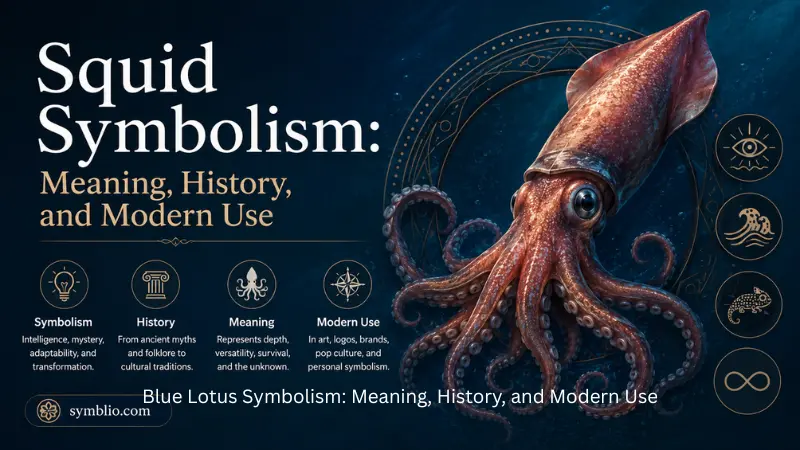
Squid are unusual enough to invite interpretation. Their flexible bodies, color-changing skin, clouds of ink, rapid movement, large eyes, and life beneath the ocean surface have all contributed to squid symbolism in modern art, tattoos, maritime imagery, and personal expression.
Unlike animals such as eagles or doves, squid do not carry one universally recognized symbolic meaning in American culture. Most modern interpretations come from observing how real squid survive, communicate, and move through their environment, combined with older stories about giant creatures hidden in the sea.
That distinction matters. Adaptability and self-protection have clear connections to squid behavior, while associations with monsters, danger, and supernatural forces are more strongly shaped by folklore, literature, and human fear of unexplored oceans.
Quick Answer
Squid symbolism commonly represents adaptability, intelligence, self-protection, rapid change, and the unknown in modern American culture. Historically, giant squid also became associated with dangerous seas, hidden forces, and human fear of unexplored ocean depths.
TL;DR
- Squid often symbolize adaptability because they can rapidly change appearance.
- Ink represents defense, privacy, boundaries, and strategic escape.
- Deep-sea squid can symbolize mystery and unexplored territory.
- Fast movement suggests decisiveness, survival, and quick response.
- Squid tattoos often represent resilience, independence, or personal transformation.
- Squid and octopus symbolism should not automatically be treated as identical.
What a Squid Looks Like and Why Its Appearance Matters
Squid belong to the cephalopod group of mollusks, alongside octopuses, cuttlefish, and nautiluses. A typical squid has a long mantle, two prominent eyes, eight arms, two longer feeding tentacles, fins, a beak, and a funnel used for jet propulsion.
That anatomy creates much of the animal’s visual impact. The streamlined body suggests speed rather than heaviness, while the spreading arms and tentacles create a sense of motion, reach, and complexity.
Many squid can also change aspects of their coloration through specialized skin structures. These changes may help with camouflage, communication, courtship, or warning displays. Some deeper-water species can produce or use light in striking ways.
These are biological adaptations rather than symbolic messages. Still, they provide a clear foundation for human associations with transformation, concealment, communication, adaptability, and survival.
Core Squid Meanings at a Glance
Squid do not have one fixed symbolic meaning. Their interpretation changes depending on whether an image emphasizes camouflage, ink, movement, deep water, or enormous size.
| Context | Meaning in the USA | Common Associations | Notes |
|---|---|---|---|
| Changing color | Adaptability | Flexibility, adjustment | Inspired by real camouflage behavior |
| Releasing ink | Self-protection | Boundaries, escape | Often interpreted as defensive symbolism |
| Fast movement | Decisive action | Survival, reaction | Suggests responding quickly |
| Deep-sea squid | The unknown | Mystery, discovery | Connected with hidden environments |
| Giant squid | Awe or fear | Uncertainty, scale | Shaped partly by sea-monster traditions |
| Squid tattoo | Personal resilience | Change, individuality | Meaning depends on the wearer |
The broad pattern is straightforward: a squid may appear resourceful, intelligent, and adaptable in one context, yet secretive, unsettling, or unknowable in another.
Adaptability and the Meaning of Camouflage
Adaptability is one of the strongest modern squid meanings because it has an observable basis.
Squid can alter their appearance quickly. Depending on the species and situation, changes in color and pattern may help them blend into their surroundings, interact with other squid, respond to threats, or participate in courtship.
As a human symbol, this ability can represent knowing when to stand out and when to remain unnoticed.
Someone may choose squid imagery to represent living through changing circumstances without becoming helpless. In this sense, adaptability does not mean changing personality merely to please other people. It suggests responding intelligently to the environment while keeping a sense of direction.
There is also a more cautionary interpretation. Constant camouflage can represent emotional guardedness, hiding one’s true intentions, or changing outward behavior too often.
For that reason, squid symbolism can reflect both healthy flexibility and excessive self-concealment.
Intelligence, Awareness, and Communication
Squid are part of a group of animals known for complex nervous systems and sophisticated behavior.
Their visual signaling is especially interesting. Some squid communicate through combinations of body position, movement, color, and pattern. These signals may play roles in courtship, competition, warning, or social interaction.
That behavior contributes to modern associations with awareness, observation, quick thinking, and strategic communication.
A squid can therefore symbolize someone who reads the room carefully before acting. It may represent social intelligence, mental flexibility, or the ability to communicate without revealing everything at once.
However, squid should not simply inherit every symbolic meaning commonly associated with octopuses. The two animals are related, but their behavior, body structure, and cultural representation differ.
When discussing squid specifically, communication, reaction, perception, and adaptability are usually more grounded themes than simply calling the animal a universal symbol of wisdom.
Ink as a Symbol of Defense and Personal Boundaries
A cloud of ink is one of the squid’s most recognizable defensive behaviors.
When threatened, many squid can release ink into the surrounding water. This may confuse a predator, reduce visibility, or create an opportunity for escape.
Symbolically, that behavior naturally connects with self-protection.
A squid does not need to overpower every threat directly. Instead, it can create distance, disrupt the situation, and leave.
That makes squid ink a useful metaphor for knowing when confrontation is unnecessary. Someone may interpret it as setting boundaries, protecting privacy, leaving a harmful environment, or refusing to remain exposed to danger.
There is also a negative interpretation. Ink may represent confusion, secrecy, avoidance, or deliberately obscuring the truth.
The difference depends on context. Concealment can be a sensible survival strategy, but it can also become a way of avoiding responsibility.
Speed, Escape, and Strategic Movement
Squid move through water using jet propulsion. By forcing water through a specialized funnel, they can accelerate rapidly and change position with impressive speed.
That movement contributes to symbolism involving reaction, escape, survival, and decisive action.
Where a turtle may represent patience and an anchor may suggest stability, a squid can represent the opposite response: conditions have changed, so movement is necessary.
This interpretation may appeal to people going through relocation, career changes, emotional recovery, personal reinvention, or any period in which staying still feels more dangerous than choosing a new direction.
The meaning is not necessarily about running away from problems.
Instead, it can symbolize recognizing when persistence and confrontation are less useful than changing position quickly.
The Deep Ocean and the Symbolism of the Unknown
Squid symbolism becomes darker when attention moves from ordinary coastal species to animals living far below the ocean surface.
Deep water already carries psychological associations with uncertainty because humans cannot naturally breathe there, see far into it, or easily explore its full depth.
A squid living in that environment can therefore become a symbol of what remains hidden from ordinary view.
It may represent unexplored territory, uncertainty, concealed emotions, unanswered questions, scientific curiosity, or circumstances whose full scale has not yet become visible.
This interpretation becomes especially strong with giant squid.
For centuries, people knew relatively little about these enormous animals. Their bodies were occasionally found, but encounters with living individuals were rare. That combination of real evidence and limited understanding helped giant squid occupy a cultural space between natural history and imagined monsters.
Today, that same secrecy can symbolize not only fear but also discovery.
Giant Squid, Sea Monsters, and Maritime Fear
Stories about enormous tentacled creatures existed long before marine biology could explain what sailors occasionally encountered.
Strange carcasses, brief sightings, storms, unfamiliar animals, and exaggeration could easily merge into stories about sea monsters.
Over time, the giant squid became strongly associated with this tradition.
The familiar image of a massive tentacled creature attacking a ship belongs more to folklore, literature, illustration, and popular entertainment than to normal squid behavior. Still, it shaped how Western audiences came to imagine giant cephalopods.
This is one reason squid can symbolize forces that seem too large to control.
A giant squid may represent overwhelming problems, fear of uncertainty, hidden danger, or an encounter with something far beyond ordinary experience.
At the same time, scientific understanding changed this meaning.
The giant squid gradually shifted from suspected monster to documented animal. As a result, modern symbolism includes wonder and discovery alongside fear.
What Squid Commonly Means in the United States
Squid do not have one established ceremonial meaning in American culture.
Americans encounter squid through seafood, aquariums, museums, marine documentaries, fishing, coastal communities, horror movies, fantasy art, tattoos, science education, and ocean-themed design.
Because of that, squid symbolism in the United States tends to be personal rather than traditional.
A marine enthusiast may associate the animal with curiosity and exploration. Someone who has survived a difficult period may see resilience and adaptability. A tattoo wearer may emphasize independence or transformation.
In horror and fantasy imagery, the same animal may instead represent chaos, danger, or something hidden beneath the surface.
This flexibility explains why squid imagery works across very different settings.
There is no single American interpretation that overrides all others. The meaning depends strongly on how the animal is presented and why someone chooses it.
Squid Symbolism Across Cultures
Cross-cultural interpretations require care because squid are often confused with octopuses, kraken-like creatures, or generic tentacled sea monsters.
Northern European maritime stories contributed heavily to the modern image of enormous ocean creatures capable of threatening ships. Later generations frequently connected those stories with giant squid and other large cephalopods.
In Japan, squid have a different cultural presence. They are strongly connected with cuisine, fishing communities, coastal life, seasonal food traditions, and marine environments.
Some species, including bioluminescent squid, are especially memorable because their natural appearance creates dramatic glowing displays in the water.
However, cultural importance does not automatically mean one abstract symbolic definition exists.
A food tradition, local fishing identity, folk story, and spiritual symbol are different categories. Claims that an entire culture believes squid universally represent one specific idea should therefore be treated cautiously.
The safest interpretation is to recognize that squid can carry different meanings depending on regional history, environment, folklore, and modern artistic use.
Emotional and Psychological Meaning
Squid work well as personal symbols because they combine visibility and concealment.
A squid may display striking colors, disappear through camouflage, create a defensive cloud, accelerate away from danger, or live in water that humans cannot easily explore.
Those traits lend themselves to several psychological interpretations.
For someone who values privacy, the squid may represent choosing how much of oneself to reveal. For a person navigating constant change, it may stand for adaptation without surrender.
For others, deep-sea squid may symbolize thoughts, fears, memories, or ambitions that remain below the surface.
The emotional meaning can also be darker.
Squid may represent secrecy, avoidance, overstimulation, uncertainty, or fear of an unpredictable environment.
These interpretations are metaphors rather than psychological diagnoses. Their usefulness comes from the way people connect observable animal behavior with personal experience.
Squid Tattoos and Their Personal Meanings
Squid tattoos are highly customizable because the animal can be portrayed in dramatically different ways.
A streamlined swimming squid may symbolize freedom, movement, or independence.
A squid releasing ink can suggest surviving danger, maintaining boundaries, or leaving behind a difficult situation.
A color-changing squid may represent adaptability, reinvention, or the ability to function in different environments.
A giant squid wrapping its tentacles around a ship creates a much darker message. That design may represent chaos, confrontation, overwhelming challenges, danger, or the struggle between humans and forces beyond their control.
Deep-sea squid tattoos can also include stars, dark water, glowing details, diving imagery, or scientific illustrations.
For some people, no metaphor is necessary. A squid tattoo may simply express love of marine biology, ocean life, fishing, diving, unusual animals, or coastal culture.
Personal meaning should always take priority over generalized tattoo dictionaries.
Squid in Art, Fashion, Jewelry, and Pop Culture
Squid have a visually flexible form that artists can reinterpret in many ways.
Their long bodies provide a strong central shape, while their arms and tentacles create movement around the composition. Depending on the style, the same animal can appear elegant, strange, humorous, threatening, futuristic, or scientific.
Jewelry and clothing designs may use tentacles to communicate ocean identity, movement, or unconventional personal style.
Scientific illustration emphasizes anatomy and natural history.
Fantasy and horror art often exaggerate scale, darkness, and aggression, drawing on the long connection between giant cephalopods and sea-monster imagery.
Science fiction frequently pushes the squid toward alien imagery because its large eyes, unusual body plan, color changes, and possible bioluminescence already look unfamiliar to many people.
This makes squid particularly effective in art concerned with transformation, the unknown, deep water, or nonhuman intelligence.
Positive and Negative Squid Meanings
Squid can carry both encouraging and unsettling interpretations.
Positive meanings often include adaptability, quick thinking, communication, self-preservation, awareness, flexibility, curiosity, resilience, and independence.
Negative meanings are more likely to emphasize secrecy, concealment, avoidance, uncertainty, fear, confusion, or hidden threats.
Size also changes the interpretation.
A small glowing squid may look delicate, strange, and fascinating. A gigantic squid emerging from dark water can evoke danger and overwhelming force.
Neither interpretation is automatically more correct.
The meaning depends on context, visual treatment, and the reason the symbol is being used.
How Squid Symbolism Has Changed Over Time
One of the most interesting changes in squid symbolism is the movement from fear toward knowledge.
People once encountered enormous squid without understanding what they were. Limited sightings and incomplete specimens made exaggeration easy, especially in cultures already familiar with stories about dangerous sea creatures.
Scientific study gradually changed that picture.
Giant squid became recognized as extraordinary animals rather than supernatural monsters. Modern underwater cameras and marine research have helped reveal behaviors that earlier generations could only imagine.
As knowledge increased, symbolism expanded.
Fear and danger remained useful themes in horror and fantasy, but wonder, adaptation, intelligence, marine science, and exploration became equally plausible meanings.
The squid shifted from being only a creature imagined in darkness to an animal capable of representing discovery itself.
Common Misunderstandings About Squid Symbolism
One common mistake is claiming that squid have a single ancient spiritual meaning shared by many cultures.
There is little reason to treat squid that way.
Another problem is confusing squid with octopuses, cuttlefish, or legendary sea monsters simply because all of them can appear tentacled.
Their symbolism may overlap visually, but stories about one animal should not automatically be transferred to another.
It is also wise to be skeptical of claims that squid universally represent prophecy, divine protection, immortality, psychic power, or a particular deity unless the claim belongs to a clearly documented cultural tradition.
A more grounded interpretation begins with observable traits.
Squid change appearance, communicate visually, move quickly, defend themselves effectively, and inhabit environments that humans have historically struggled to explore.
Those characteristics already provide enough material for meaningful symbolism without inventing ancient traditions.
FAQs
What does a squid symbolize?
A squid commonly symbolizes adaptability, intelligence, mystery, transformation, and survival. Its ability to change color, release ink, and move quickly through the ocean makes it a natural symbol of flexibility and self-protection.
What is the spiritual meaning of a squid?
Spiritually, a squid may represent intuition, emotional depth, adaptability, and navigating the unknown. Because it lives in the ocean, it is often associated with hidden feelings, subconscious thought, and unexplored parts of life.
What does seeing a squid mean?
Seeing a squid can symbolically suggest a need to adapt to changing circumstances, trust your instincts, or protect your boundaries. The meaning depends on the situation and the personal associations you have with the animal.
What does a squid symbolize in dreams?
In dreams, a squid may represent complex emotions, hidden fears, flexibility, or feeling overwhelmed by several responsibilities at once. Its many arms can also suggest being pulled in different directions.
What does a squid tattoo symbolize?
A squid tattoo can represent intelligence, resilience, adaptability, mystery, independence, and strength under pressure. Some people also choose squid imagery because of its connection with the deep ocean and the unknown.
Is squid symbolism positive or negative?
Squid symbolism can be both. Positive meanings include resourcefulness, intelligence, creativity, and adaptability, while darker interpretations may involve secrecy, confusion, fear, or hidden threats. Context usually determines the intended meaning.
Conclusion
Squid are most convincingly interpreted as symbols of adaptability, strategic self-protection, quick response, communication, and life beyond ordinary human sight. Giant species add another layer by connecting the animal with uncertainty, awe, fear, and the long human fascination with unexplored oceans.
What makes squid symbolism especially useful is the contrast between concealment and expression. The same animal can change color, communicate visually, disappear through camouflage, release ink when threatened, or move quickly away from danger.
Its modern meaning does not need invented mysticism to be interesting. The real squid already offers a clear symbolic lesson: adapt when circumstances change, protect yourself intelligently, and keep moving when remaining still is no longer the best option.