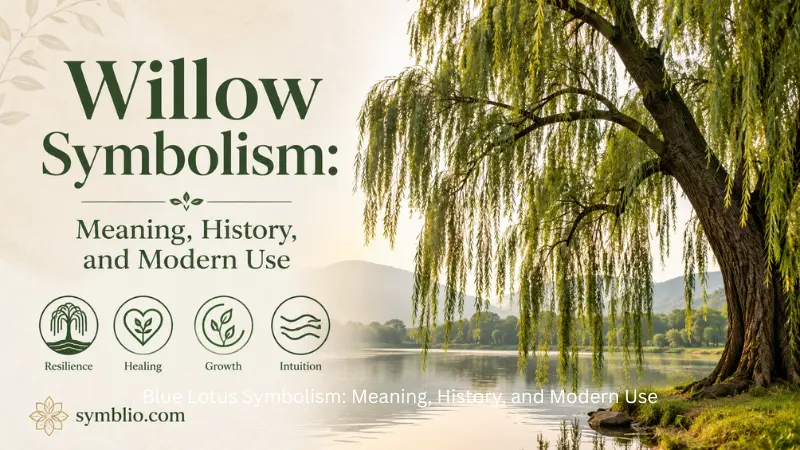
A willow is one of the easiest trees to recognize, especially when its long branches sweep toward the ground or hang over a quiet pond. That distinctive appearance has shaped willow symbolism for generations, connecting the tree with grief, remembrance, resilience, emotional flexibility, and renewal.
In the United States, the weeping willow is especially associated with mourning. During the late eighteenth and nineteenth centuries, its drooping branches appeared in memorial art, cemetery carvings, embroidery, and other images connected with death and remembrance.
Yet sorrow is only one part of the willow’s meaning. Willows also grow readily near water, bend in strong winds, recover from cutting, and adapt to changing conditions. Those natural qualities have encouraged modern associations with survival, personal growth, adaptability, and emotional recovery.
The willow also carries distinct meanings in literature, religion, East Asian art, Indigenous traditions, tattoo culture, and contemporary design. Understanding those separate histories gives the tree a more accurate and interesting meaning than treating it as one universal symbol.
Quick Answer
Willow symbolism commonly represents grief, remembrance, resilience, and emotional flexibility in modern American culture. Historically, willow trees have also been associated with lost love, religious ritual, healing, renewal, and life beside water.
TL;DR
- Weeping willows commonly symbolize grief, mourning, and remembrance.
- Their flexible branches also represent resilience and adaptability.
- Waterside growth connects willows with reflection, emotion, and change.
- Willow branches have roles in Jewish and Buddhist traditions.
- Tattoos often use willow imagery for survival and personal recovery.
- Not every modern Celtic willow claim reflects ancient tradition.
What a Willow Tree Looks Like and Why Its Shape Matters
Willow refers to a large group of trees and shrubs rather than one single species. Many grow naturally near streams, rivers, wetlands, floodplains, and lakes.
The best-known symbolic image is the weeping willow. Its long, narrow branches curve downward toward the ground, sometimes reaching the surface of nearby water.
That shape strongly influences how people interpret the tree.
A tall oak often looks firm, upright, and immovable. A willow looks softer and more responsive to its surroundings. Its branches move easily in wind, while its hanging form can resemble bowed shoulders or tears.
Because of that appearance, the willow can communicate sorrow without any additional imagery. At the same time, its ability to move rather than resist has helped it become a symbol of flexibility and survival.
What Willow Commonly Means in the United States
Willow symbolism in American culture comes from several overlapping traditions rather than one fixed definition.
Its strongest historical meaning is mourning, especially when the tree is shown in cemetery or memorial imagery. In modern personal symbolism, however, resilience and healing are nearly as important.
| Context | Meaning in the USA | Common Associations | Notes |
|---|---|---|---|
| Memorials | Grief and remembrance | Graves, urns, lost loved ones | Strong historical association |
| Tattoos | Resilience and survival | Hardship, recovery, change | Usually personal in meaning |
| Waterside imagery | Reflection and emotion | Lakes, rivers, solitude | Influenced by natural habitat |
| Spiritual designs | Renewal and healing | Growth, recovery, transition | Modern interpretation |
| Romantic imagery | Lost or lasting love | Separation, longing | Connected with older literature |
| Home decor | Calm and natural beauty | Gardens, ponds, retreats | May carry no spiritual meaning |
These meanings often overlap.
Someone may choose a willow tattoo because it reminds them of a family member who died while also seeing the tree as a symbol of their own ability to recover after loss.
That combination of sorrow and endurance is one reason willow imagery remains emotionally useful today.
Why the Weeping Willow Became a Symbol of Mourning
The connection between weeping willows and grief became especially visible in Western culture during the eighteenth and nineteenth centuries.
The tree’s appearance made it naturally suitable for mourning imagery. Its branches bend downward rather than rising toward the sky, giving the impression that the tree itself is bowing or grieving.
The word “weeping” strengthened that interpretation even further.
In early American memorial art, willow trees often appeared beside urns, graves, monuments, and mourners. The image became familiar enough that viewers could understand its emotional meaning almost immediately.
Cemetery carvings also used willow-and-urn designs to represent grief, remembrance, and continuing attachment to the dead.
For that reason, an old willow carved on a gravestone usually means more than simple sadness. It can represent grief that remains connected with memory.
The tree expresses loss without necessarily suggesting hopelessness.
Willow Symbolism in Love and Literature
Willow symbolism also has an older association with disappointed or abandoned love.
European literary traditions used willow imagery in stories about longing, rejection, separation, and lovers who had been left behind. Shakespeare drew on this association in his plays, where willow songs and references appear in situations involving sorrowful or unreturned love.
That literary background explains why a willow can sometimes feel romantic rather than purely funerary.
A lone person sitting beneath a willow may represent the death of a loved one, but the same image can also suggest the end of a relationship, emotional distance, or longing for someone who is absent.
Modern tattoo art continues to use that ambiguity.
For some people, the willow represents a relationship that ended. For others, it stands for love that remains meaningful even after separation.
Why Water Is So Important to Willow Symbolism
Willows are closely associated with water because many species naturally grow along rivers, streams, marshes, ponds, and other wet environments.
That physical relationship has influenced their symbolism.
Water is constantly moving, changing shape, and reflecting what surrounds it. In modern art and personal symbolism, those qualities are often connected with emotion, memory, transition, and introspection.
A willow beside a lake can therefore suggest stillness and reflection.
Beside a flowing river, the same tree may symbolize change or acceptance.
Its roots remain anchored while the branches move with wind and water. That contrast makes the willow especially suitable for representing people who remain grounded while adapting to difficult circumstances.
The water connection is not one ancient universal belief. It is largely a modern symbolic interpretation based on the tree’s real environment and appearance.
Willow as a Symbol of Resilience and Flexibility
Modern willow symbolism often focuses on resilience.
The idea comes partly from the tree’s physical characteristics. Willow branches can be highly flexible, which is why willow has historically been useful for weaving baskets, fences, and other objects.
Many willow species also tolerate disturbance well. They can survive flooding, cutting, wind, browsing, and changing river conditions.
That has encouraged the familiar idea of bending without breaking.
As a symbol, the willow represents a form of strength that differs from hardness or rigidity.
A person represented by an oak might be seen as standing firm against pressure. A person represented by a willow may survive by adjusting to circumstances.
That distinction makes the willow especially meaningful after emotional hardship.
Its message is not that difficult experiences leave no effect. Instead, it suggests that adapting to change can itself be a form of strength.
Renewal, Healing, and New Growth
Willows can also symbolize renewal.
Many species root easily from cut branches and produce new growth after damage. This ability to regenerate has made the tree a natural metaphor for starting again.
In modern spiritual and personal symbolism, willow imagery may represent recovery after grief, rebuilding life after a difficult period, or finding a new direction after major change.
The tree also has an old connection with medicinal use.
Willow bark has a long history in traditional remedies, and compounds found in willow helped contribute to the later development of salicylate medicines.
That history adds another layer to the tree’s association with healing.
However, symbolic healing should be understood separately from medical treatment. A willow tattoo or piece of jewelry may represent emotional recovery without making any claim about the medicinal effectiveness of willow itself.
Willow Symbolism in American Memorial Art
The willow became particularly recognizable in American mourning culture during the late eighteenth and nineteenth centuries.
Memorial embroidery from this period often showed a grieving figure standing beside an urn or grave under a drooping willow.
These images were not random landscape decoration.
The tree helped create an emotional vocabulary that viewers understood. Its lowered branches visually reinforced the sorrow of the person shown beneath it.
Willows also appeared on gravestones and cemetery monuments.
Over time, the image became closely associated with remembrance, especially the continuing emotional bond between the living and the dead.
Modern memorial tattoos often follow the same basic visual language.
A willow may be paired with initials, dates, birds, water, names, or silhouettes of family members.
The medium has changed, but the emotional idea remains familiar: grief exists, yet memory continues.
Willow Symbolism in Jewish Tradition
Willow branches also have an important place in Jewish religious practice.
During Sukkot, willow branches are included among the Four Species used in ritual observance. Willow also plays a role in traditions associated with Hoshana Rabbah, the final major day of Sukkot.
In this setting, willow symbolism should not be reduced to generic spirituality.
It belongs to a specific living religious tradition.
Jewish teachings have offered different interpretations of the Four Species, including explanations that connect their physical qualities with different types of people within a community.
For American Jewish communities, the willow therefore carries a meaning that differs considerably from the mourning symbolism found in old cemeteries or modern tattoos.
This distinction matters because symbols can belong to multiple traditions without meaning the same thing in each one.
Willow in Buddhist and East Asian Symbolism
The weeping willow itself has East Asian origins, and willow imagery appears in several artistic and religious traditions from that region.
In Buddhist art, willow branches can appear with Guanyin, the bodhisattva associated with compassion and mercy in East Asian Buddhism.
In that setting, the branch may communicate compassionate care rather than sadness.
Willows also appear frequently in Chinese landscape art, poetry, gardens, and visual culture.
Their graceful movement and close relationship with water made them suitable for scenes involving departure, seasonal change, beauty, and emotional reflection.
For American viewers, this creates an important cultural distinction.
A willow shown beside an old American gravestone may represent mourning. A willow branch shown in Buddhist religious art can carry an entirely different meaning.
The plant is the same, but the cultural context changes the interpretation.
Willow in Indigenous North American Traditions
There is no single universal “Native American willow meaning.”
Indigenous peoples across North America belong to many different nations, languages, environments, and cultural traditions. Their relationships with willow vary greatly.
What can be said with confidence is that willow has had major practical and cultural importance in many communities.
Flexible branches and stems have been used in basketry, structures, tools, household objects, and other forms of traditional material culture.
Different communities have also used willow in traditional plant knowledge.
These relationships may include spiritual or ceremonial meanings in particular cultures, but those meanings should be described specifically rather than generalized across all Indigenous peoples.
That distinction prevents cultural traditions from being flattened into a single modern symbolism chart.
Willow, Ogham, and Celtic Associations
Willow does have a historical connection with the Irish Ogham writing tradition.
One of the Ogham letter names is traditionally associated with willow.
That genuine connection has led to many modern spiritual interpretations involving Celtic tree symbolism.
However, not every detailed claim found online comes directly from ancient Celtic tradition.
Modern sources sometimes assign willow a fixed personality type, lunar correspondence, spiritual element, calendar period, or detailed set of magical properties.
Some of these ideas belong to modern Pagan, Neo-Druidic, or New Age systems rather than securely documented ancient Celtic religion.
That does not make contemporary practices invalid for the people who follow them.
It simply means modern belief and historical evidence should not be presented as the same thing.
Willow Tattoos and Their Modern Meanings
Willow tattoos are popular because the tree can express both pain and recovery in one image.
A full weeping willow may represent mourning for someone who died. Dates, names, birds, or empty swings can strengthen that memorial meaning.
Other people choose the tree to represent resilience.
Its bending branches can symbolize surviving pressure without becoming rigid or emotionally closed.
New leaves, sunlight, birds, or flowing water can shift the design toward healing and renewal.
A bare or dark willow often creates a more somber feeling, while a leafy tree may suggest recovery and continued life.
Because the image is highly personal, there is no single correct willow tattoo meaning.
Its strongest interpretations usually involve grief, endurance, emotional change, remembrance, and growth after hardship.
Willow in Jewelry, Decor, and Personal Style
Willow symbolism extends beyond tattoos.
In jewelry, a willow branch or leaf may serve as a quiet symbol of adaptability, remembrance, or personal growth.
A person grieving someone may choose it as a private memorial rather than wearing a more obvious symbol of loss.
In home decor, the meaning is often less emotional.
Willow artwork can simply create a feeling of calm, softness, and connection with nature.
Its association with ponds and rivers also makes it common in peaceful landscape designs.
Some people use willow imagery in weddings to represent flexibility or enduring commitment. However, this is not a standardized American wedding tradition.
The meaning usually comes from the couple’s personal interpretation rather than a fixed cultural rule.
Common Misunderstandings About Willow Symbolism
One common misunderstanding involves the name “Babylon willow.”
The scientific name of the famous weeping willow can suggest a connection with ancient Babylon, but the tree is actually native to parts of East Asia.
The name should not be treated as proof that the species originated in Mesopotamia.
Another misconception involves decorative Willow Pattern ceramics.
These familiar blue-and-white designs feature bridges, birds, buildings, and willow trees that appear Chinese. However, the popular pattern was developed by British manufacturers using Chinese-inspired imagery.
Its famous romantic story was added later rather than simply copied from an ancient Chinese legend.
A broader mistake is assuming that every willow tradition comes from one ancient spiritual meaning.
American cemetery symbolism, Jewish ritual, Buddhist art, Indigenous material traditions, Celtic associations, and modern tattoos each developed in different contexts.
They should be understood individually before being compared.
How Willow Symbolism Changed Over Time
Willow symbolism developed gradually rather than beginning with one original meaning.
In many cultures, people first valued willow for practical reasons. Its flexible branches could be woven, its growth near water made it easy to find, and different species had important material uses.
Religious and cultural traditions later gave willow specific ritual roles.
Literature added associations with longing, abandoned love, and sorrow.
In the United States, nineteenth-century memorial culture made the weeping willow especially recognizable as a symbol of grief.
Modern interpretation then broadened the meaning.
People still notice that the branches appear to weep, but they also notice that those same branches bend.
The tree survives changing water levels, produces new growth, and adapts to disturbance.
As a result, contemporary willow symbolism often combines grief with resilience.
The tree no longer represents only what has been lost. It can also represent the ability to continue living after loss.
FAQs
What does a willow tree symbolize?
A willow tree commonly symbolizes grief, healing, resilience, flexibility, renewal, and emotional strength. Its ability to bend without easily breaking makes it a natural symbol of adapting to difficult circumstances while continuing to grow.
What does the weeping willow symbolize?
The weeping willow is strongly associated with mourning, sadness, remembrance, and loss because of its drooping branches. It can also represent recovery and hope, showing that sorrow and new growth can exist together.
Is the willow tree a symbol of strength?
Yes. Willow symbolism often includes quiet strength and resilience. Rather than representing strength through rigidity, the willow suggests that flexibility and the ability to adapt can help a person survive hardship.
What is the spiritual meaning of a willow tree?
Spiritually, the willow is often connected with intuition, emotional healing, renewal, and connection with nature. Because willows frequently grow near water, they may also symbolize emotions, reflection, and changing life circumstances.
What does willow symbolize in love?
In romantic symbolism, willow can represent deep emotion, devotion, longing, and enduring attachment. In some contexts, however, it can also suggest heartbreak, separation, or memories of a relationship that has ended.
What does a willow tattoo mean?
A willow tattoo may symbolize resilience, healing after loss, personal growth, remembrance, or emotional strength. The exact meaning depends on the wearer and any additional elements included in the tattoo design.
Is willow symbolism positive or negative?
Willow symbolism can be both. It may represent grief, mourning, and sadness, but it also carries positive meanings such as healing, adaptability, renewal, endurance, and hope after difficult experiences.
Conclusion
Willows carry an unusual combination of meanings because their appearance and natural behavior suggest different emotional ideas at the same time. Their drooping branches explain their historical association with mourning, while their flexibility, regrowth, and relationship with water support modern meanings of adaptation and renewal.
At the same time, willow symbolism should not be reduced to one universal definition. American memorial culture, Jewish ritual, Buddhist art, Indigenous traditions, European literature, and modern personal symbolism each add different layers to the tree’s meaning.
What makes the willow especially relevant today is its ability to represent grief without ending with grief. It can acknowledge loss while still suggesting flexibility, recovery, and continued growth.