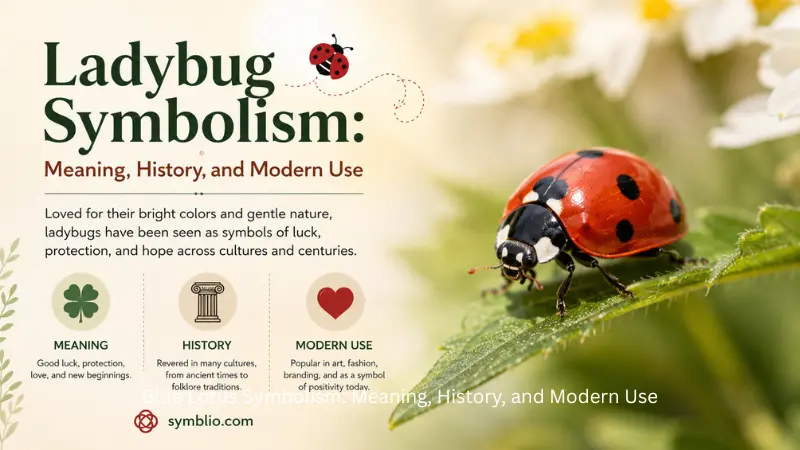
Ladybug symbolism is most closely associated with good luck, protection, hope, and positive change. In the United States, these small spotted beetles are usually welcomed rather than feared, appearing in gardens, children’s designs, jewelry, tattoos, greeting cards, and cheerful home decor.
Their positive reputation is not based on appearance alone. Many ladybug species feed on aphids and other insects that damage plants, making them valuable visitors to gardens and farms. That practical benefit helped create an image of the ladybug as a tiny protector that arrives when it is needed.
Older European folklore added ideas of blessing, favorable fortune, and religious protection. Over time, those traditions blended with modern interpretations, giving the ladybug one of the most consistently positive reputations in insect symbolism.
Quick Answer
Ladybug symbolism most commonly represents good luck, protection, hope, and favorable change in modern American culture. Historically, the insect’s usefulness in protecting crops and its connection with European Christian folklore also linked it with blessing, abundance, and relief from difficulty.
TL;DR
- Ladybugs commonly symbolize luck, hope, protection, and positive change.
- Their pest-eating behavior helped create their favorable reputation.
- European folklore connected ladybugs with blessing and protection.
- Americans commonly view them as cheerful garden visitors.
- Tattoos may represent optimism, resilience, love, or renewal.
- Spot numbers and colors do not predict someone’s future.
What a Ladybug Looks Like and Where It Appears
The familiar ladybug is a small, rounded beetle with a dome-shaped body. The version most people imagine has bright red or orange wing covers marked with black spots, although real ladybug species vary considerably.
Some are yellow, orange, brown, black, or even pinkish. Certain species have many spots, others have only a few, and some have no obvious spots at all.
Ladybugs are often found around gardens, fields, shrubs, flowers, and crops where aphids or other small insects are present. Their compact shape and vivid coloring also make them easy to turn into a recognizable graphic symbol.
A simple red oval, dark head, and a handful of black dots can immediately suggest a ladybug. This visual simplicity explains why the insect appears so often on clothing, children’s products, garden decorations, stationery, jewelry, and digital illustrations.
What Ladybugs Commonly Symbolize in the United States
For most Americans, a ladybug carries a welcoming and optimistic meaning. Unlike many insects that may cause fear or discomfort, ladybugs are commonly treated as harmless visitors.
Their strongest modern associations include:
| Context | Common Meaning in the USA | Typical Association | Notes |
|---|---|---|---|
| Gardens | Protection | Healthy plants | Connected with eating plant pests |
| Gifts | Good fortune | Happiness and encouragement | Often used as a friendly lucky symbol |
| Tattoos | Resilience | Renewal and optimism | Meaning varies by wearer |
| Jewelry | Luck | Protection and affection | Often worn like a small charm |
| Children’s designs | Joy | Nature and friendliness | Usually playful rather than spiritual |
| Unexpected encounters | Hope | A fortunate moment | Cultural interpretation, not prediction |
Good luck remains the most familiar meaning, but protection, happiness, affection, and new beginnings are also common.
The ladybug’s appearance reinforces these ideas. Its small size feels harmless, while its bright coloring makes it noticeable without appearing threatening.
Why Ladybugs Became Symbols of Good Luck
The ladybug’s lucky reputation probably developed through several overlapping traditions rather than one single historical event.
Its agricultural usefulness provides one of the clearest explanations. Many ladybugs feed on aphids and other small creatures that damage plants. For farmers and gardeners, finding ladybugs among crops could therefore mean fewer harmful pests.
A useful insect arriving at the right moment naturally encourages ideas of good fortune.
European folk traditions strengthened that association. Stories developed in which ladybugs appeared during agricultural trouble and helped protect crops. Some versions described their arrival as an answer to prayers.
Such stories belong to folklore rather than verifiable historical events, but they show how people interpreted the insect’s real ecological role through religious and cultural beliefs.
Over generations, the practical idea of a helpful beetle became the symbolic idea of luck arriving unexpectedly.
The Religious History Behind the Name “Ladybug”
The English name itself preserves an older religious association.
The “lady” in ladybug traditionally referred to the Virgin Mary. The related British word ladybird developed from the same cultural background, and several European languages historically used names for the insect that also connected it with Mary or religious blessing.
This association likely strengthened ideas of protection, mercy, favorable fortune, and divine care.
Older European imagery sometimes linked the insect’s red color with Mary’s clothing or interpreted its markings through Christian symbolism. However, many highly specific claims about exact spot numbers representing particular religious events are later interpretations rather than universal Christian teachings.
Modern Americans usually use the word ladybug without thinking about religion at all.
The original religious reference has largely faded from everyday speech, while the positive emotional tone remains.
How Its Role in Gardens Shaped the Symbolism
Ladybug symbolism is unusual because several of its meanings are supported by observable behavior.
Many ladybug species prey on plant pests. Aphids are among their best-known food sources, although different species may also consume mites, scales, insect eggs, and other small organisms.
That biological role supports several symbolic ideas.
Protection comes from their ability to reduce populations of insects that harm plants.
Abundance develops from their connection with healthier crops and gardens.
Balance reflects the natural predator-prey relationship in which one species helps prevent another from becoming too numerous.
Timely help comes from the common experience of seeing ladybugs where pest populations are already present.
These meanings show how symbolism can emerge from everyday observation rather than pure imagination.
The ladybug became a lucky creature partly because, in the right setting, its presence really can be beneficial.
Ladybugs as Symbols of Protection
Protection is one of the ladybug’s most meaningful secondary associations.
A ladybug looks delicate, but it is not completely defenseless. Its bright coloring can warn predators that it may be unpleasant to eat, and some species release defensive fluids when threatened.
This contrast makes the insect an appealing symbol of quiet strength.
Its symbolism does not suggest domination or aggression. Instead, it represents the ability to protect oneself while remaining gentle and approachable.
For someone choosing ladybug imagery for personal reasons, this can represent resilience without hardness.
A small ladybug tattoo, charm, or piece of jewelry may therefore symbolize the idea that being kind or soft does not mean being helpless.
What Ladybug Colors Symbolize
The classic red-and-black ladybug has become so familiar that its colors often contribute to its symbolic appeal.
Red commonly suggests warmth, vitality, affection, and energy in American design. Black creates contrast and gives the insect its instantly recognizable pattern.
Together, the colors create an image that feels lively and cheerful.
Real ladybugs, however, are not limited to red and black.
Orange, yellow, dark brown, black, and other color variations occur naturally among different species. Modern spiritual websites sometimes assign separate meanings to each color, but there is no single historical system establishing that an orange ladybug means one thing and a yellow one another.
Color interpretations are therefore best treated as personal symbolism rather than fixed cultural rules.
An unusual ladybug color is not automatically a warning, omen, or prediction.
What the Spots Mean—and What They Do Not Mean
Ladybug spots have inspired many folk beliefs.
Some people count the spots while making a wish. Others believe the number predicts months of good luck, future children, money, romance, or important life events.
These traditions can be fun, but they should not be confused with biology.
Ladybugs do not receive an additional spot every year. Spot patterns are largely determined by species and genetics.
A seven-spotted species has its characteristic markings because of what it is, not because it has lived for seven years.
Numbers can still carry personal symbolism. Someone may connect seven ladybug spots with completeness or luck because seven already has those associations in Western culture.
That meaning belongs to human interpretation, however, not to the insect’s age or behavior.
Hope, Happiness, and Emotional Meaning
Ladybugs often represent a quiet form of optimism.
A ladybug encounter is usually small and unexpected. Finding one on a leaf, windowsill, sleeve, or hand can create a brief moment of attention and pleasure.
That everyday quality makes the insect an effective symbol of noticing something positive during an ordinary day.
Ladybug imagery may therefore communicate encouragement during difficult periods.
A charm can serve as a reminder to expect better circumstances.
A greeting card can express good wishes without becoming overly sentimental.
A tattoo may mark recovery, emotional growth, or a decision to approach life with renewed optimism.
Ladybugs also carry childhood associations for many people. Memories of watching one crawl across a hand or fly away can connect the symbol with curiosity, innocence, and time spent outdoors.
Ladybug Symbolism in Love and Relationships
Ladybugs are sometimes associated with love, although romance is not their primary historical meaning.
Their bright red coloring fits naturally into modern imagery connected with affection. When combined with their traditional reputation for good luck, the result is often interpreted as good fortune in relationships.
Ladybug charms may be given between partners, friends, parents, and children.
Two ladybugs placed together can symbolize companionship or a close bond. Several ladybugs in one design may represent members of a family.
Wedding decorations and romantic gifts occasionally use the insect to express the wish for a happy future together.
Claims that a ladybug predicts marriage, identifies a soulmate, or guarantees that a former partner will return are modern forms of fortune-telling rather than established symbolism.
Its romantic meaning is better understood as affection combined with good wishes.
Change, Growth, and New Beginnings
Ladybugs can also symbolize transformation because their life cycle involves major physical changes.
Like other beetles, they develop through egg, larval, pupal, and adult stages. A ladybug larva looks very different from the rounded adult beetle recognized by most people.
This makes the insect suitable as a metaphor for personal growth.
Someone entering a new career, recovering from a difficult experience, ending a relationship, moving somewhere new, or rebuilding after a setback may choose the ladybug as a reminder that unfamiliar stages can lead somewhere positive.
Its symbolism differs slightly from that of the butterfly.
Butterflies are strongly defined by transformation. Ladybugs are primarily associated with luck and protection, with renewal functioning as an additional meaning.
That combination makes the ladybug especially suitable for representing a hopeful fresh start.
Ladybug Tattoos and Their Personal Meanings
Ladybug tattoos are usually small, colorful, and highly personal.
The most common meanings include good luck, hope, protection, resilience, love, and a fresh beginning.
Placement and surrounding imagery can change the message.
A tiny ladybug on the wrist or ankle may function almost like a permanent lucky charm.
A ladybug beside flowers can emphasize nature, growth, beauty, or gardening.
Several ladybugs may represent children, siblings, close friends, or meaningful life stages.
Adding a date, name, initial, or specific flower can make the symbolism more personal.
The important point is that tattoo meaning ultimately belongs to the wearer. General symbolism can provide context, but it should not be used to make assumptions about someone’s private story.
Ladybugs in Jewelry, Gifts, and Home Decor
Ladybug imagery works particularly well in objects intended to communicate happiness or encouragement.
Small pendants, bracelets, earrings, pins, keychains, and charms often use the beetle as a symbol of good fortune.
Its compact shape makes it suitable for understated jewelry, while the red-and-black pattern keeps it visually recognizable.
Ladybugs also appear frequently in garden decorations, flowerpots, wall art, children’s rooms, classroom materials, greeting cards, and seasonal crafts.
In these settings, the symbolism is usually uncomplicated.
The ladybug communicates friendliness, nature, cheerful energy, or a simple wish for good luck.
This versatility gives it an advantage over symbols with strongly religious or ceremonial meanings. Someone can give a ladybug gift without needing to know whether the recipient follows a particular spiritual tradition.
Ladybugs in Children’s Culture and Popular Media
Ladybugs have become especially prominent in children’s culture.
Their rounded bodies are easy to turn into friendly cartoon characters. The strong contrast between red and black remains recognizable even in simplified illustrations.
As a result, ladybugs frequently appear in picture books, costumes, toys, school materials, nursery decor, cartoons, and children’s games.
Popular entertainment has also expanded their symbolic associations.
Ladybug-themed heroes and characters often combine the insect’s traditional associations with newer ideas such as courage, confidence, intelligence, and protection.
For younger audiences, the ladybug may therefore represent more than luck. It can also suggest an active protector or cheerful hero.
This illustrates how symbols continue to change as new generations encounter them through different forms of media.
European Folklore and Cross-Cultural Meaning
The strongest historical background for modern English-language ladybug symbolism comes from Europe.
Christian naming traditions connected the insect with the Virgin Mary, while agricultural folklore treated it as a beneficial creature capable of protecting crops.
Children’s rhymes and folk customs added another layer.
In several traditions, a ladybug landing on someone could inspire a wish or playful prediction. Children might watch where the insect flew or count its spots while imagining future good fortune.
As these traditions traveled through immigration, literature, language, and family customs, their religious details often became less important.
The lucky association survived.
This helps explain why many Americans today instinctively regard a ladybug as fortunate even if they have never heard the older stories behind that belief.
It is safer, however, to avoid claiming that every culture interprets ladybugs in exactly the same way. Symbolic traditions vary by place, period, and community.
Common Myths and Misunderstandings
Ladybugs attract several popular misconceptions.
One is the belief that the number of spots indicates age. It does not.
Another is that every unusual ladybug color carries a specific supernatural message. Different colors and patterns frequently occur naturally among different species.
Some people also believe that killing a ladybug automatically causes bad luck. This idea belongs to folklore rather than an established religious rule or observable fact.
There is also an important practical complication.
Certain lady beetles may gather around houses in large numbers and enter buildings while looking for protected places to spend colder months. When this happens, an insect associated with good fortune can become an unwanted household visitor.
These situations do not erase the traditional symbolism. They simply show that cultural meanings and biological realities are not always identical.
How Ladybug Meaning Has Evolved
Ladybug meaning has gradually shifted from agricultural and religious associations toward broader personal symbolism.
In earlier European traditions, its image was strongly influenced by farming, crop protection, Christian language, and folklore.
As those traditions entered American culture, good luck became the easiest meaning to preserve.
Religious associations became less visible, while the image expanded into children’s products, gardening culture, gifts, decor, jewelry, and entertainment.
More recently, tattoos and personalized accessories have added meanings such as emotional recovery, resilience, family connection, self-protection, and starting over.
The interpretation has widened, but its general emotional direction has remained remarkably consistent.
A ladybug still tends to represent something welcome.
FAQs
What does a ladybug symbolize?
A ladybug commonly symbolizes good luck, protection, happiness, love, and positive change. Its bright appearance and helpful role in gardens have made it a hopeful symbol in many traditions.
Is seeing a ladybug a sign of good luck?
Yes. In popular folklore, seeing a ladybug is often considered a sign of good fortune. Some traditions also connect it with blessings, favorable changes, and protection.
What does a ladybug mean spiritually?
Spiritually, a ladybug is often associated with renewal, trust, protection, gratitude, and personal growth. These interpretations are symbolic beliefs rather than fixed or universal meanings.
What does it mean when a ladybug lands on you?
A ladybug landing on you is traditionally viewed as a positive omen connected with luck, happiness, or an encouraging change. The exact interpretation varies by culture and personal belief.
What does a red ladybug symbolize?
A red ladybug can symbolize love, vitality, courage, protection, and good fortune. Its red-and-black coloring also makes it a memorable symbol of energy and confidence.
What does a ladybug symbolize in love?
In romantic symbolism, ladybugs may represent new love, harmony, affection, and good fortune in relationships. They are sometimes interpreted as hopeful signs for emotional beginnings.
What does a ladybug tattoo symbolize?
A ladybug tattoo often represents luck, protection, optimism, resilience, love, or a fresh start. Its meaning can also reflect a personal memory or an important period of positive change.
Conclusion
Ladybug symbolism combines good luck, protection, hope, and positive change with an unusually practical foundation. The beetle’s role as a predator of plant pests helped make it welcome in gardens, while European religious traditions and folklore strengthened its association with blessing and favorable fortune.
Modern American culture has expanded those meanings into tattoos, jewelry, gifts, children’s imagery, home decor, and personal reminders of resilience or renewal. Not every encounter needs to be treated as an omen, and not every color or spot pattern carries a hidden message.
The ladybug remains meaningful because its symbolism matches the way people often experience the insect itself: small, unexpected, helpful, and usually welcome.