
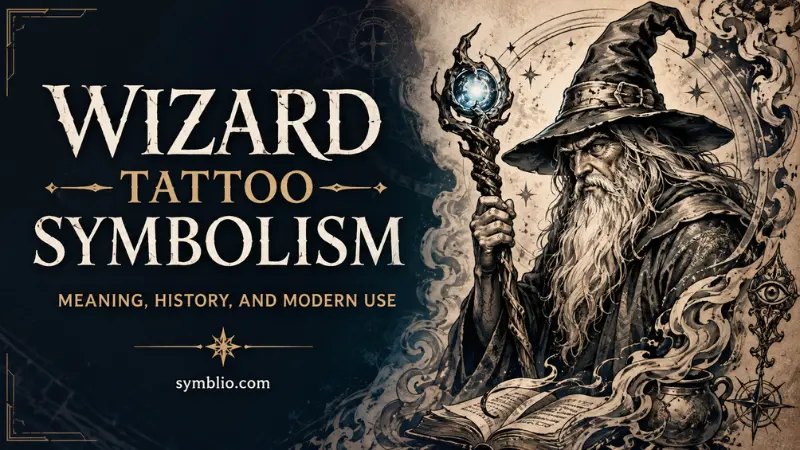
A wizard tattoo can turn a familiar fantasy figure into a personal statement about wisdom, imagination, independence, or the search for knowledge. In wizard tattoo symbolism, the figure often represents someone who understands forces that other people cannot easily see or explain.
The image is usually recognizable: a robed older figure, often carrying a staff, holding a book, wearing a pointed hat, or surrounded by stars, moons, flames, or magical symbols. Yet the meaning depends heavily on the character and design chosen.
In the United States, wizard imagery has been shaped by medieval folklore, Arthurian literature, fantasy novels, movies, role-playing games, and modern tattoo culture. For some people, the design celebrates fantasy itself; for others, it represents learning, creativity, personal transformation, or the feeling of being different from the crowd.
Quick Answer
Wizard tattoo symbolism commonly represents wisdom, knowledge, imagination, and personal independence in modern American culture, especially among people drawn to fantasy, storytelling, gaming, and magical imagery. Historically, wizard figures were associated with prophecy, learned knowledge, supernatural abilities, and the complicated relationship between wisdom and power.
TL;DR
- Wizards commonly symbolize wisdom, knowledge, creativity, and independence.
- Medieval wizard figures developed from older traditions of prophets, sages, and magicians.
- Merlin strongly influenced the modern Western image of the wizard.
- American culture often connects wizards with fantasy literature and entertainment.
- Tattoo details can shift a wizard from benevolent wisdom toward darker themes.
- Modern designs usually express personal identity rather than literal magical belief.
What Does a Wizard Represent?
At its simplest, a wizard represents knowledge that ordinary people do not possess.
The traditional wizard is not merely physically strong. His advantage comes from learning, observation, experience, and unusual abilities. That makes the figure particularly useful as a symbol of intellectual power.
A wizard tattoo can therefore suggest:
- Wisdom
- Curiosity
- Knowledge
- Imagination
- Creativity
- Independence
- Transformation
- Mystery
- Personal power
- A fascination with fantasy
The word itself has an interesting history. In American English, wizard can mean a magician or sorcerer, but it can also describe someone exceptionally skilled at something. The older meaning of wizard was connected with the idea of a wise person or sage. That association helps explain why the figure can symbolize intelligence as much as supernatural ability.
How Wizard Imagery Became a Symbol
The modern wizard did not emerge from one single ancient tradition.
European folklore contains many different figures associated with magic, prophecy, healing, astrology, alchemy, and supernatural knowledge. Over time, literature blended these traditions into recognizable fictional archetypes.
The wizard became particularly prominent in medieval and later European storytelling. Rather than simply being a villain, the magical scholar could act as a counselor, prophet, teacher, trickster, or guardian of forbidden knowledge.
This distinction matters when interpreting a tattoo. A wizard does not automatically symbolize evil or occult practice. The same basic figure can represent either benevolent wisdom or dangerous ambition depending on the story surrounding it.
Merlin and the Western Wizard Archetype
Few characters have influenced the modern Western image of a wizard more than Merlin.
Merlin’s literary development began in medieval Britain. Geoffrey of Monmouth introduced Merlin in the 12th century by combining traditions associated with Welsh figures and presenting him as a prophetic supernatural character. Later writers expanded him into the famous adviser and magician connected with King Arthur.
That evolution helped establish several characteristics now associated with wizards: unusual knowledge, prophecy, magical ability, mentorship, and a relationship with political power.
As a tattoo subject, Merlin can therefore communicate more than “magic.” A Merlin-inspired design may suggest guidance, foresight, learning, or the responsibility that comes with knowledge.
What Wizard Tattoos Mean in the United States
American interpretations are strongly influenced by popular culture.
The United States has embraced wizard imagery through fantasy novels, movies, television, comics, tabletop gaming, video games, Halloween traditions, and children’s literature. Characters such as Gandalf and Albus Dumbledore have made the benevolent wizard particularly familiar to American audiences.
This means a wizard tattoo does not necessarily communicate a religious or spiritual belief. Someone may choose one simply because fantasy stories played an important role in their childhood or because the character represents qualities they admire.
For an American tattoo wearer, the design might say:
“I value imagination.”
Or:
“Learning changed who I became.”
It might also commemorate a favorite fictional world, a creative hobby, or an important period of personal growth.
Wizard Tattoos and Wisdom
Wisdom is one of the strongest meanings attached to the traditional wizard.
The stereotypical wizard is often portrayed as older, experienced, and surrounded by books or artifacts. His age is significant because it visually suggests accumulated knowledge.
A wizard holding a book can emphasize learning and knowledge.
An open scroll may instead suggest discovery, study, or the pursuit of hidden information.
When the figure gazes toward the stars, the design can represent curiosity about the universe and a desire to explore the unknown.
A wizard portrayed as a teacher often conveys guidance, mentorship, and the wisdom gained through experience.
This makes wizard imagery particularly appropriate for someone who sees education and experience as important parts of identity.
The symbolism does not require the wearer to consider themselves exceptionally intelligent. It can simply express respect for learning and curiosity.
Wizard Tattoos as Symbols of Imagination
The wizard also represents the ability to imagine worlds beyond ordinary experience.
That interpretation became especially important as fantasy fiction developed into a major part of American popular culture. Wizards appear in stories where impossible things become possible, ordinary characters encounter hidden worlds, and knowledge opens doors to unfamiliar realities.
A tattoo can preserve that idea long after childhood.
A playful wizard might represent creativity and wonder. A highly detailed fantasy wizard may celebrate an entire fictional tradition. A minimalist wizard silhouette might express a quieter attachment to imagination.
In this context, the tattoo is less about supernatural power and more about the value of imagination itself.
Knowledge, Power, and Responsibility
Wizard symbolism has another side: knowledge can create power, and power can create responsibility.
This tension appears repeatedly in stories about magical characters. The wizard knows something others do not, possesses abilities others cannot easily match, and must decide how that knowledge should be used.
Merlin is a classic example because his relationship with kings and political authority makes knowledge inseparable from power. Modern fantasy continues the pattern with wizards who must choose between selfish ambition and helping others.
For a tattoo, this can create a more mature interpretation. The image may represent the idea that having knowledge is not enough; how someone uses it matters too.
Common Wizard Tattoo Designs and Their Meanings
Different visual elements can change the message of the tattoo considerably.
| Design Element | Common U.S. Interpretation | Symbolic Association | Typical Effect |
|---|---|---|---|
| Wizard with staff | Guidance or authority | Wisdom, leadership | Traditional |
| Wizard with book | Learning and curiosity | Knowledge, study | Intellectual |
| Wizard with stars | Wonder and exploration | Cosmos, imagination | Mystical |
| Young wizard | Growth and discovery | Potential, learning | Playful |
| Dark-robed wizard | Mystery or moral ambiguity | Power, secrecy | Dramatic |
| Merlin-inspired wizard | Guidance and foresight | Arthurian legend | Literary |
The details matter because viewers often read the entire composition rather than the character alone.
Why People Choose Wizard Tattoos
A wizard tattoo can have a highly personal meaning.
Someone may choose one because fantasy stories were important during childhood. Another person may associate the image with creativity, writing, gaming, reading, or art.
For someone who has gone through a major change, a wizard can symbolize learning to understand oneself differently. The magical transformation found in fantasy stories can become a metaphor for personal development without implying literal supernatural transformation.
Others simply enjoy the visual possibilities. Wizards can be drawn in traditional tattoo styles, blackwork, illustrative styles, cartoon forms, realistic portraiture, or highly detailed fantasy art.
The symbolism therefore comes partly from the wearer’s relationship with the image.
Wizard Tattoos and Fantasy Culture
Modern wizard tattoos are closely connected to fantasy culture.
The growth of fantasy literature and entertainment in the United States gave the wizard a much broader cultural vocabulary. The figure can now refer to Arthurian legend, epic fantasy, children’s stories, tabletop role-playing, video games, animation, and countless original interpretations.
This also means a wizard tattoo can function as a community signal. Someone familiar with the same fictional tradition may immediately recognize the reference.
At the same time, a generic wizard does not automatically identify the wearer with a particular fandom. A person can use the archetype without referencing one specific story.
Religious and Spiritual Interpretations
Wizard imagery should not automatically be treated as a religious symbol.
Different cultures and religions have traditions involving prophets, sages, diviners, healers, astrologers, magicians, or supernatural beings, but those figures are not interchangeable. A European fantasy wizard, a biblical wise man, and a figure from an Indigenous spiritual tradition belong to very different cultural contexts.
In contemporary American tattoo culture, the generic wizard is usually understood through folklore and fantasy rather than formal religious symbolism.
Someone may nevertheless give the image a personal spiritual meaning, such as wisdom, contemplation, or a search for understanding. That interpretation belongs to the individual rather than being a universal religious definition.
The Emotional Meaning Behind a Wizard Tattoo
Wizard imagery can communicate several emotional qualities at once.
A friendly, smiling wizard may suggest comfort, humor, imagination, or childhood nostalgia.
An elderly wizard with a book may communicate patience and accumulated experience.
A solitary wizard beneath a night sky may suggest independence and contemplation.
A dramatic wizard surrounded by magical effects can communicate ambition, confidence, or fascination with the unknown.
This emotional flexibility is one reason the archetype works well as tattoo art. The same basic figure can feel warm, humorous, intellectual, adventurous, or ominous.
Dark Wizard Symbolism
Not every wizard tattoo has a positive meaning.
Dark robes, skull imagery, sinister facial expressions, aggressive poses, or shadow-heavy compositions can shift the interpretation toward secrecy, ambition, danger, or forbidden knowledge.
This does not mean the wearer supports harmful behavior. Dark fantasy frequently uses frightening imagery for artistic reasons.
The important distinction is between aesthetic darkness and actual ideological meaning. A fictional villain-inspired tattoo may simply celebrate a story, character, or visual style.
Viewers should therefore avoid assuming someone’s beliefs solely from a wizard tattoo.
Wizard Symbolism in American Holidays and Decor
Wizard imagery is especially visible around Halloween in the United States.
During October, witches, wizards, ghosts, magical creatures, and fantasy props become common decorations. Wizard imagery can therefore carry a seasonal association with Halloween even when a tattoo has nothing to do with the holiday.
Outside Halloween, wizard designs appear in children’s rooms, fantasy-themed parties, books, games, costumes, artwork, and entertainment merchandise.
The American cultural context has helped turn the wizard from a specialized folklore figure into a broadly recognizable fantasy character.
How Wizard Meaning Has Changed Over Time
The wizard has shifted from a figure associated with prophecy and supernatural knowledge to a flexible modern symbol of imagination and identity.
In medieval stories, magical knowledge could be treated seriously and connected with prophecy, religion, politics, and supernatural forces. Merlin’s development illustrates this transition particularly well: his character changed substantially as different writers adapted him for new audiences.
Modern fantasy separated the wizard further from historical ideas about magic. The character became a storytelling device: mentor, hero, villain, comic figure, scholar, or adventurer.
That evolution explains why a wizard tattoo can now mean something quite different from what a medieval audience might have understood by a magician.
Common Misunderstandings About Wizard Tattoos
One common mistake is assuming that every wizard tattoo represents occult practice.
In contemporary America, wizard imagery is frequently connected with fantasy entertainment, literature, gaming, Halloween, and personal creativity. The tattoo may have no religious meaning whatsoever.
Another misunderstanding is that all wizard designs symbolize wisdom. A particular design might instead represent a fictional character, humor, nostalgia, creativity, or a specific story.
The safest interpretation is to consider the surrounding imagery and, when appropriate, the wearer’s own explanation.
Choosing the Meaning That Fits the Design
Because wizard imagery is so flexible, the surrounding elements should support the intended message.
The goal is not to follow a fixed dictionary of meanings. Tattoo symbolism works best when the visual design and personal story point in the same direction.
FAQs
A wizard tattoo commonly symbolizes wisdom, knowledge, imagination, and independence. Depending on its design, it can also represent creativity, personal growth, fantasy fandom, or a fascination with storytelling.
Not necessarily. Wizards appear as heroes, mentors, villains, comic characters, and morally complicated figures, so the meaning depends on the particular design and cultural reference.
A Merlin-inspired tattoo can represent wisdom, prophecy, mentorship, and knowledge. Because Merlin became closely connected with King Arthur in medieval literature, the design may also suggest guidance and legendary storytelling.
Usually, a generic wizard tattoo is associated with folklore and fantasy rather than a specific religion. Individual wearers may give the image a spiritual meaning, but that interpretation is personal rather than universal.
A wizard holding a book commonly emphasizes learning, knowledge, curiosity, and intellectual discovery. The book can make the design feel more scholarly than purely magical.
Yes. Fantasy stories often portray magical characters as agents of change, so a wizard can become a personal metaphor for learning and transformation. The meaning is especially clear when the design includes imagery associated with growth or discovery.
Many are, but not all. Some people choose wizard imagery because they enjoy fantasy, while others simply connect with its themes of wisdom, creativity, independence, or imagination.
Conclusion
The meaning of a wizard tattoo depends on more than the image of a magical figure. In American culture, the wizard can represent knowledge, imagination, creativity, independence, mentorship, or fascination with fantasy, while historical traditions add associations with prophecy and supernatural learning.
That flexibility is what makes wizard tattoo symbolism useful for personal expression. A book can turn the figure toward scholarship, stars can suggest exploration, and a familiar character can preserve a connection to a favorite story.
Ultimately, the most meaningful wizard tattoo is usually the one whose details explain why the wearer chose the figure in the first place.


