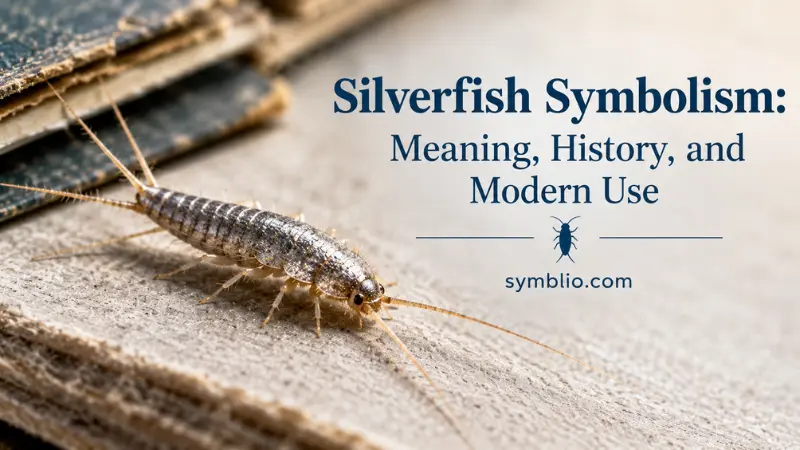
Silverfish symbolism often centers on hidden problems, neglected spaces, adaptability, and the things that remain unnoticed until they come into view. These small, silvery insects move quickly, prefer dark environments, and frequently appear in bathrooms, basements, closets, and storage areas. Their unusual appearance and secretive behavior make them interesting subjects for symbolic interpretation.
In the United States, silverfish are generally considered household pests rather than traditional spiritual symbols. They can damage paper, books, photographs, and certain fabrics, so an unexpected encounter may remind someone of clutter, preservation, or the need to pay attention to overlooked parts of life.
Yet a silverfish does not have one universally recognized symbolic meaning. Its interpretation depends on the setting, the observer’s emotional response, and whether the insect appears in a dream, a story, a work of art, or an ordinary home. Exploring these differences helps separate practical associations from personal beliefs and established cultural traditions.
Quick Answer
Silverfish symbolism commonly represents hidden concerns, neglected details, and the need to examine parts of life that receive little attention in modern American interpretations. Their ability to survive in concealed environments can also inspire personal associations with adaptability, persistence, and quiet endurance, although these meanings are interpretive rather than established universal traditions.
TL;DR
- Silverfish can represent overlooked problems and neglected responsibilities.
- Their survival skills suggest adaptability and quiet persistence.
- Household encounters often bring attention to storage, preservation, and maintenance.
- Dream meanings depend on personal emotions and circumstances.
- No universal religious tradition assigns silverfish one fixed meaning.
- Modern interpretations are largely personal rather than historically standardized.
What Silverfish Look Like and Why Their Appearance Matters
Silverfish are small, wingless insects with elongated, flattened bodies, long antennae, and three tail-like appendages. Their fine scales create a silvery or pearl-gray appearance, while their quick, twisting movements can make them look as though they are swimming across a surface.
That appearance provides several starting points for personal symbolism. Their metallic color may suggest age, quietness, or something concealed beneath an ordinary surface. Their movement can evoke restlessness, while their preference for hidden spaces invites comparisons with private thoughts and overlooked responsibilities.
These associations come from human interpretation, not from a universal symbolic system. The insect itself has no established intention or spiritual message.
The Core Symbolic Meanings of Silverfish
Silverfish can be interpreted through several connected themes, each based on a different aspect of their behavior or appearance.
Hidden concerns are among the most intuitive associations. Because silverfish usually avoid open, brightly lit spaces, they can represent matters that remain unnoticed until circumstances bring them into view.
Neglect and deterioration form another interpretation. Silverfish may feed on paper, book bindings, adhesives, and certain fabrics. Symbolically, this behavior can suggest the gradual consequences of ignoring something important.
Adaptability and endurance offer a more positive perspective. Silverfish have survived for an exceptionally long evolutionary period, and some can live for extended periods without food. Their persistence can inspire reflections on flexibility and survival under changing conditions.
Finally, attention to detail fits the way people discover these insects. A silverfish may appear when someone opens an old box, moves stored belongings, or examines a rarely used room. The encounter can serve as a personal reminder to look more closely at what has been overlooked.
None of these meanings is mandatory. A person who finds silverfish fascinating may associate them with resilience, while someone who dislikes household insects may connect them with discomfort or unwanted surprises.
Ancient Origins and the History of Silverfish Symbolism
Silverfish belong to an ancient lineage of insects. Their distant relatives appeared hundreds of millions of years ago, long before modern human societies developed their religious systems, folklore, and written literature.
That biological history makes the insect an interesting subject for reflection on survival and continuity. However, the age of a species does not establish that people have assigned it a particular symbolic meaning throughout history.
Unlike butterflies, bees, and scarab beetles, silverfish do not have a widely documented, continuous symbolic tradition in major religious or mythological systems. There is no strong historical basis for claiming that ancient civilizations universally regarded them as omens, spiritual messengers, or signs of transformation.
Their practical relationship with human possessions provides a more defensible historical connection. As people stored books, manuscripts, textiles, and food, insects that fed on these materials became concerns for households and institutions responsible for preserving them.
Over time, the silverfish’s association with concealed spaces and vulnerable paper goods offered material for modern symbolic interpretation. The connection to preservation and gradual loss arises from observable behavior rather than a single ancient legend.
What Silverfish Symbolism Means in the United States
In contemporary American culture, silverfish are primarily known as household pests. They are not widely recognized as national symbols, holiday emblems, or established spiritual signs.
Their symbolic associations therefore tend to emerge from ordinary experiences. Finding one in a bathroom may bring attention to moisture. Discovering several near old books may prompt concern about storage conditions. Encountering one in a neglected closet might encourage someone to reconsider how they maintain that space.
These experiences can acquire personal significance without requiring a supernatural explanation.
For example, someone sorting through family photographs might see a silverfish as a reminder of how easily treasured objects can deteriorate when left unprotected. Another person restoring an old house might associate it with the importance of maintaining hidden areas rather than concentrating only on visible improvements.
American homeownership culture also places considerable emphasis on upkeep, repairs, organization, and protecting personal belongings. Within that context, silverfish can become a useful metaphor for small problems that grow more noticeable when ignored.
The distinction matters: a silverfish sighting does not prove that a person has neglected an area of life, experienced bad luck, or received a spiritual warning. Any such interpretation belongs to the observer.
Silverfish as Symbols of Hidden Problems and Neglected Details
The silverfish’s preference for concealed places makes hidden problems one of its most natural symbolic associations.
People often pay attention to what is immediately visible: a clean kitchen counter, an organized desk, or a freshly painted wall. Less visible matters, such as unresolved disagreements, forgotten paperwork, or unfinished responsibilities, may receive less attention.
A silverfish can serve as a metaphor for these overlooked concerns. The comparison is particularly fitting when something seems insignificant at first but reveals a larger maintenance issue.
Imagine opening a storage cupboard and finding damaged paper or signs of insects. The discovery may prompt a closer inspection of the surrounding space. As a personal metaphor, that moment can encourage a similar approach to life: investigate small signs of trouble before assuming they mean nothing.
This interpretation is not about expecting disaster. It is about developing a habit of noticing what deserves attention.
In relationships, the same idea might involve addressing a minor misunderstanding before it becomes a source of resentment. In school or work, it could mean checking a small error before submitting an important project.
The silverfish does not predict these problems. Its symbolic value comes from the comparison between hidden insects and easily overlooked responsibilities.
Silverfish and the Symbolism of Decay, Memory, and Preservation
Silverfish have a practical relationship with paper and adhesives, materials that often hold personal and historical value. They may damage books, stored documents, photographs, wallpaper, and other objects containing suitable food sources.
This behavior creates a meaningful connection with preservation.
A handwritten letter can carry memories of a family member. An old book may represent years of learning. A photograph may preserve a moment that cannot be recreated. When an insect damages such objects, the loss can feel greater than the material damage alone.
In symbolic terms, silverfish may represent the gradual weakening of things people assume will last forever. The association can extend beyond physical belongings to traditions, family stories, and personal memories that require active care.
This does not mean the insect symbolizes death in a fixed or prophetic sense. Rather, it can prompt reflection on the relationship between time and preservation.
The interpretation also has a constructive side. Recognizing that valuable things can deteriorate encourages people to protect them, share their stories, and make copies of important records when appropriate.
Seen this way, silverfish symbolism is less about doom than about responsibility toward the things people wish to keep.
The Positive Meaning: Adaptability and Quiet Persistence
Although silverfish often receive negative interpretations because of their association with household damage, their biological characteristics also support more positive readings.
They are agile, can move rapidly into narrow spaces, and are capable of surviving in conditions that allow them access to suitable shelter and food. Some species can live for long periods without eating, although their survival depends on the circumstances.
These characteristics can inspire associations with persistence, resourcefulness, and adaptability.
A person facing a difficult transition might use the silverfish as a private reminder that progress does not always need to be dramatic or visible. Sometimes persistence means adjusting to new conditions, protecting essential resources, and continuing steadily through an uncertain period.
The insect’s small size also provides an interesting contrast with its survival abilities. It demonstrates, in a purely biological sense, that an organism does not need an imposing appearance to persist.
However, this interpretation should not be confused with a traditional belief that silverfish bring success or protection. It is a modern metaphor built around the insect’s observable traits.
Silverfish in Dreams and Their Possible Meanings
Dreaming about silverfish can feel unsettling, particularly for people who associate insects with contamination, damage, or loss of control. Others may simply find the appearance unusual or memorable.
There is no scientifically established dream dictionary that assigns silverfish one reliable meaning. Dream interpretation varies according to personal experience, emotional associations, and the circumstances represented in the dream.
Several reflective interpretations may nevertheless be useful.
- Seeing silverfish in a house: You might consider whether an everyday concern has been receiving too little attention.
- Finding them near books or papers: The dream may bring to mind memories, learning, unfinished work, or concern about losing something valuable.
- Watching a silverfish disappear: This could reflect uncertainty about an issue that feels difficult to identify or resolve.
- Feeling calm around the insect: You might be reconsidering something you previously regarded as unpleasant or unimportant.
- Seeing many silverfish: The scene could reflect feeling overwhelmed by several small responsibilities at once.
These are possibilities for personal reflection, not predictions or diagnoses. A dream about insects does not establish that a hidden threat exists or that an unfortunate event is approaching.
The most useful question is often simple: What did the insect make you feel, and does that feeling connect with anything happening in your waking life?
Silverfish in Spiritual and Religious Interpretations
People who approach everyday experiences spiritually may interpret an unexpected animal encounter as an invitation to pause, reflect, or reconsider their surroundings. Silverfish can fit into this personal practice because they are easy to overlook and often appear in quiet parts of a home.
One person might interpret the encounter as a reminder to care for their possessions. Another might connect it with humility, patience, or the value of attending to ordinary responsibilities.
Such interpretations can be personally meaningful without being universal religious teachings.
There is no widely established Christian, Islamic, Jewish, Hindu, or Buddhist doctrine that gives the silverfish one standard spiritual meaning applicable to all believers. Individual teachers, writers, or contemporary spiritual communities may offer their own interpretations, but these should not be presented as shared teachings without supporting evidence.
It is also important to distinguish religious symbolism from practical observations. Silverfish often appear in areas with moisture, suitable food, and places to hide. Their presence does not demonstrate negative spiritual energy, divine displeasure, or a supernatural warning.
For someone who values spiritual reflection, the encounter can still inspire a useful question: Is there something in my surroundings or daily routine that deserves more care?
Silverfish Symbolism Across Cultures
Insect symbolism differs considerably between cultures. Bees, butterflies, cicadas, and scarab beetles have well-documented associations in various traditions, but those meanings cannot automatically be transferred to silverfish.
In some cultural settings, insects are associated with productivity, renewal, fertility, or the relationship between humans and nature. In others, insects that damage food or belongings may evoke contamination, inconvenience, or loss.
Silverfish are less prominent in widely documented mythology and religious iconography than many other insects. Their meaning is therefore better understood through local experience and individual interpretation than through broad claims about ancient cultural beliefs.
Modern online spirituality sometimes assigns specific meanings to nearly every animal that appears in a home. These interpretations may be interesting as contemporary belief, but popularity on the internet does not prove historical origin or cultural consensus.
A respectful cross-cultural approach acknowledges the limits of the evidence. It avoids attributing a universal message to an insect simply because similar symbolic themes appear elsewhere.
Emotional and Psychological Associations
The emotional meaning of silverfish often begins with a person’s reaction to discovering one.
For some people, the insect produces disgust because it appears unexpectedly in a private space. For others, its quick movement creates a sense of surprise or unease. Someone interested in entomology may respond with curiosity instead.
These reactions influence the symbolism people create around the experience.
A silverfish might represent a loss of control when it appears in a carefully maintained room. It might evoke vulnerability when discovered near treasured possessions. Alternatively, its ability to remain unnoticed may prompt curiosity about the parts of an environment that people rarely examine.
The setting matters as much as the insect. Finding one beside a damp storage box may bring practical concerns to mind, while encountering one during a late-night reading session might make it memorable for entirely different reasons.
This is one reason fixed interpretations are unreliable. Personal associations are shaped by memory, experience, and cultural expectations.
Rather than assuming an insect carries an objective psychological message, consider the emotions it brought up and whether those emotions reflect an existing concern.
Silverfish in Art, Stories, and Modern Design
Silverfish are not common decorative symbols in mainstream American culture. Unlike butterflies or dragonflies, they rarely appear as familiar motifs in jewelry, clothing, wedding decorations, or popular tattoo designs.
Their unusual shape and metallic appearance can nevertheless interest artists who explore overlooked creatures, domestic environments, decay, or the contrast between beauty and discomfort.
In illustration, a silverfish might appear in a work about neglected archives or the vulnerability of old books. In a surreal story, its movement through cracks and dark rooms could create an atmosphere of secrecy or quiet unease.
The insect can also serve as a metaphor in environmental art. Its presence near damaged paper might help an artist explore the relationship between preservation and deterioration, especially when a work focuses on the passage of time.
These are creative possibilities rather than established conventions. There is no single recognized silverfish design that communicates a universal message to American audiences.
When interpreting a silverfish in a painting, story, or film, the surrounding details usually offer better clues than the insect alone. Its meaning depends on what the creator places beside it and how the scene develops.
Silverfish Tattoos and Personal Identity
Silverfish tattoos are uncommon compared with designs featuring snakes, moths, butterflies, or other insects with more established visual traditions.
Someone who chooses a silverfish tattoo may be drawn to its distinctive shape, subtle appearance, or unusual place in the natural world. The choice might reflect an interest in insects, unconventional art, or creatures that are often dismissed as undesirable.
Possible personal meanings include adaptability, persistence, hidden complexity, or an appreciation for overlooked forms of life. Someone else might choose the insect for humorous reasons or because it reminds them of a memorable experience.
The design alone cannot establish what the wearer believes. A silverfish tattoo does not automatically communicate a spiritual message, negative personality trait, or connection to a particular subculture.
For an artist creating such a design, the visual treatment can shape the interpretation. A scientific illustration may emphasize curiosity and observation, while a surreal composition might focus on secrecy or decay.
Ultimately, personal explanation matters more than assumptions based on the insect’s reputation.
Common Misunderstandings About Silverfish Symbolism
Silverfish attract speculative interpretations because their behavior seems unusual and their appearance is associated with hidden corners of the home. Several misunderstandings can arise when those associations are treated as established facts.
A silverfish always represents bad luck. There is no universal cultural rule supporting this claim. Its negative associations usually arise from the practical damage it can cause or the discomfort it produces.
Finding one proves that a home is dirty. Silverfish can enter a variety of buildings and survive wherever suitable conditions exist. Their presence is not a reliable judgment of a household’s cleanliness or the character of its occupants.
A silverfish is a supernatural warning. This is a personal belief, not an established fact. An ordinary insect encounter does not demonstrate that an event has been predicted.
Silverfish symbolize the same thing in every culture. Their symbolic status is not sufficiently standardized to support this claim. Meanings vary with context, and many interpretations are modern or individual.
Their presence means something valuable will be lost. Although silverfish can damage certain materials, a sighting does not predict future loss. If important papers or books are nearby, practical inspection is more useful than assuming an omen.
Understanding these distinctions allows people to explore symbolism without confusing metaphor, folklore, and evidence.
Silverfish Symbolism at a Glance
| Context | Possible symbolic meaning | Important distinction |
|---|---|---|
| Household encounter | Hidden concerns or neglected details | A practical pest sighting is not an omen |
| Old books and papers | Memory, preservation, and gradual loss | Damage is a real possibility, not a prediction |
| Personal reflection | Adaptability and persistence | These are individual interpretations |
| Dream imagery | Anxiety, overlooked responsibilities, or curiosity | Dreams do not have fixed universal meanings |
| Art and tattoos | Unconventional identity or appreciation for overlooked life | Meaning depends on the creator or wearer |
How Silverfish Symbolism Has Evolved in Modern Life
The meaning people attach to silverfish reflects a broader modern tendency to find personal significance in ordinary encounters with nature.
Historically, the insect’s relationship with stored goods and household environments made it relevant for practical reasons. Today, online discussions of animal symbolism and spiritual interpretation give people additional ways to consider what such encounters might mean to them.
This shift does not establish a new universal tradition. Instead, it allows older themes such as persistence, vulnerability, and the passage of time to be applied to a creature that rarely receives symbolic attention.
Contemporary interpretations may also reflect changing attitudes toward small or unpopular animals. Some people view silverfish exclusively as pests, while others become interested in their biology and ecological role. That difference can change the metaphor from unwanted intrusion to curiosity about overlooked life.
In 2025 and 2026, as in earlier years, personal symbolism remains distinct from documented cultural history. The most responsible interpretation recognizes both the insect’s real characteristics and the freedom people have to draw individual lessons from them.
FAQs
A silverfish sighting has no universally accepted spiritual meaning. Symbolically, you might use it as a reminder to examine overlooked details, while practically, you may want to check for moisture or damage to stored materials.
Neither interpretation is universally established. People may associate silverfish with bad luck because they are household pests, or with persistence because they survive in concealed environments, but these are personal associations rather than reliable predictions.
A silverfish in a dream might bring to mind hidden concerns, neglected tasks, or worries about preserving something valuable. The most relevant interpretation depends on your feelings during the dream and your current circumstances.
The silverfish does not have a widely recognized, specific biblical symbolism. Readers may draw personal spiritual lessons from its behavior, but those reflections should be distinguished from meanings explicitly established in biblical passages.
Some people interpret a silverfish as a reminder to practice patience, notice overlooked matters, or care for their surroundings. There is no universally accepted spiritual teaching that assigns the insect one fixed message.
They can represent change in an individual’s creative or spiritual interpretation, particularly when the encounter prompts reflection on changing habits or circumstances. However, transformation is not a widely established traditional meaning specifically associated with silverfish.
Repeated sightings are better treated as a practical household concern than as a symbolic warning. Check for suitable hiding places, moisture, and possible damage to paper or other stored materials, and consider appropriate pest-management measures if the problem continues.
Conclusion
Silverfish symbolism centers on the meanings people draw from an insect that lives quietly out of sight. Hidden concerns, neglected details, preservation, and persistence are all reasonable interpretations, but none represents a universal spiritual rule or a documented message carried by every silverfish.
In modern American culture, the insect’s strongest associations come from household experience and its relationship with books, paper, and concealed spaces. Those connections can inspire useful reflection without turning an ordinary encounter into a prediction.
Ultimately, silverfish symbolism is most meaningful when it helps someone pay attention to the world around them. Sometimes the simplest lesson is to notice what has gone unseen and decide what deserves care.