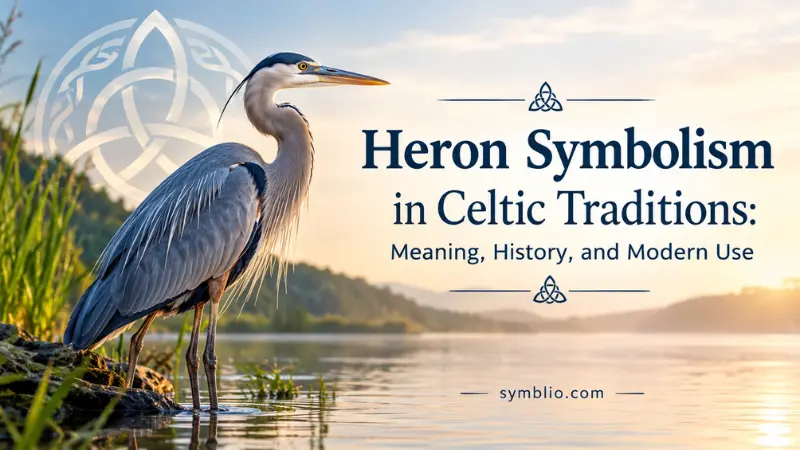
Heron symbolism in Celtic traditions is often connected with wetlands, patience, observation, and the relationship between the natural world and human life. The heron’s quiet presence beside rivers, lakes, and marshes makes it a compelling bird to explore through Celtic folklore, art, and modern interpretations. However, it is important to distinguish meanings supported by historical evidence from symbolic associations developed more recently.
The Celtic world was not a single, uniform culture. It included communities across parts of ancient Europe and the British Isles, with different languages, customs, religious practices, and relationships with local landscapes. Ireland, Scotland, Wales, Brittany, and other Celtic regions each developed their own traditions, so no single interpretation of the heron applies everywhere.
Today, people may associate herons with independence, calm observation, adaptability, or a connection to water. These interpretations can be meaningful, especially for people interested in Celtic heritage, wildlife, nature-inspired art, and personal symbolism. Understanding their limits makes the subject more interesting: the heron has a recognizable natural character, but not every modern meaning can be traced to an ancient Celtic belief.
Quick Answer
Heron symbolism in Celtic traditions is commonly interpreted today as representing patience, independence, observation, and a close relationship with nature. Although these meanings fit the bird’s behavior and the importance of wetlands in Celtic landscapes, there is limited evidence for one universal, ancient Celtic doctrine specifically defining the heron as a symbol.
TL;DR
- Herons suggest patience because they often wait quietly before striking.
- Wetlands connect the bird with water, wildlife, and changing landscapes.
- Celtic beliefs varied across Ireland, Scotland, Wales, and other regions.
- Modern interpretations often emphasize independence, balance, and self-reliance.
- Heron tattoos and artwork can express a personal connection to nature.
- Not every modern heron meaning comes from ancient Celtic tradition.
What a Heron Represents in Modern Symbolism
A heron is a long-legged wading bird with a pointed bill, a long neck, and broad wings. Depending on the species, its plumage may be gray, white, blue-gray, or mixed with darker markings. It is often seen standing motionless in shallow water or moving slowly through a marsh while searching for prey.
These habits help explain many modern symbolic interpretations. The heron appears attentive rather than hurried. It can stand alone for long periods, react quickly when an opportunity arises, and move between water, land, and air with ease. Observers may associate these qualities with patience, independence, focus, and adaptability.
In modern spiritual writing and nature-inspired design, the bird can also represent knowing when to act and when to wait. This is a reasonable interpretation of its behavior, but it should not automatically be presented as a documented belief held by all ancient Celtic communities.
For people drawn to Celtic-inspired symbolism, the heron can serve as a reminder to pay attention to the surroundings, respect natural cycles, and make decisions without unnecessary haste.
Ancient Celtic Bird Lore and the Heron’s Place in It
Birds appear in many stories from medieval Irish and Welsh literature, where they may carry messages, signal changes, or take part in transformations between human and animal forms. Such stories reflect a world in which animals were not merely background details. Their behavior and presence could help shape the atmosphere of a tale or signal that something unusual was happening.
Still, ancient Celtic traditions did not treat every bird as having one fixed symbolic meaning. The significance of a bird depended on the story, its setting, and the role it played. A bird associated with a supernatural event in one narrative might appear as an ordinary creature in another.
The heron presents a particular challenge for modern readers because older Celtic-language terms did not always distinguish clearly between herons, cranes, and related long-legged wading birds. Irish words such as corr and Scottish Gaelic terms built around corra could refer to more than one kind of bird. This makes it difficult to assign every old reference to a modern species with certainty.
Irish Heritage News
That distinction matters when interpreting Celtic symbolism. A story involving a crane should not automatically be described as a story about a heron. The two birds share certain physical traits, but their identities in a particular legend need to be established before drawing conclusions.
The most responsible approach is to explore the heron alongside the wider bird traditions of Ireland and Scotland while recognizing where the evidence becomes uncertain.
The Heron, the Crane, and the Otherworld
The Otherworld is an important concept in several medieval Irish narratives. Depending on the story, it may appear as a supernatural realm associated with extraordinary beings, enchanted places, or experiences beyond ordinary human life. Water, islands, distant shores, and unusual encounters can help establish the boundary between familiar surroundings and the supernatural.
Because herons and cranes inhabit the edges of water, modern writers sometimes connect them with this boundary between worlds. The interpretation makes visual sense: a bird standing where land meets water occupies a setting that can feel separate from everyday life.
However, the idea that the heron was universally recognized as a Celtic guardian of the Otherworld is too broad. Specific bird-related stories offer firmer ground than general claims about a single Celtic belief system. The Irish tale of Manannán mac Lir and the magical crane-skin bag, for example, is associated with the crane in later accounts; it should not be treated as conclusive proof of an ancient heron cult.
For a modern reader, the heron can still represent a threshold or transition. It may suggest the moment between uncertainty and understanding, solitude and connection, or observation and action. These are contemporary interpretations inspired by the bird and its habitat, rather than established meanings shared by all Celtic communities.
Water, Wetlands, and the Natural World
Water is a useful starting point for understanding the heron’s appeal in Celtic-inspired symbolism. The bird commonly feeds along rivers, lakes, estuaries, marshes, and bogs. These environments were familiar parts of life in Ireland, Scotland, and other regions with Celtic cultural histories.
Wetlands offered food and materials, shaped travel and settlement, and influenced local economies. They could also be difficult places to cross or cultivate. Their seasonal changes made them practical environments that required knowledge and careful attention.
A heron standing in shallow water naturally belongs to this landscape. Its presence may bring to mind the relationship between people and their surroundings, including the need to notice changes in weather, water levels, and wildlife.
In modern symbolism, this relationship often becomes a message about living with greater awareness of the natural world. A heron image may appeal to someone who enjoys fishing, birdwatching, walking beside rivers, or protecting wetlands.
These associations are especially suitable for Celtic-inspired artwork when the design includes a recognizable local landscape. A heron beside an Irish bog or a Scottish loch can evoke a specific environment more convincingly than an abstract claim that the bird possesses a universal spiritual meaning.
Patience, Timing, and Focus
One of the most recognizable modern meanings of the heron is patience. The bird may remain still for a long time before moving quickly to catch a fish or another small animal. Its apparent stillness is not inactivity; it is part of an attentive hunting strategy.
This behavior provides a clear basis for interpreting the heron as a reminder to wait for the right moment. Instead of acting simply because an opportunity appears, a person can observe, assess the situation, and respond when the timing is appropriate.
In a Celtic-inspired context, patience can be presented as a personal value rather than an ancient doctrine. Someone might use the heron as a symbol while learning a skill, making a difficult decision, or working toward a long-term goal.
The bird also suggests that quietness and effectiveness are not opposites. A person does not always need to announce a plan or move quickly to make progress. Careful preparation can be useful even when it is invisible to others.
That interpretation should not be confused with passivity. Herons are capable of swift action, and their stillness serves a practical purpose. The symbolism is most convincing when it includes both sides: knowing when to wait and recognizing when it is time to act.
Independence and Solitude
Herons are often seen alone while feeding, although they may nest in colonies and gather in suitable habitats. Their solitary appearance makes independence an understandable modern association, but it does not mean that the birds are always isolated or avoid social contact.
As a symbol, the heron can represent comfort with one’s own company. It may appeal to someone who values time for reflection, prefers to make decisions independently, or wants to maintain a sense of identity while belonging to a larger community.
This interpretation can be particularly meaningful in personal artwork. A single heron standing against a broad stretch of water may communicate self-reliance without suggesting hostility toward others.
Independence, however, does not have to mean refusing support. The heron can just as reasonably remind someone to trust their judgment while remaining open to advice and cooperation. Its solitary appearance is one part of its natural behavior, not a complete model for human relationships.
There is no need to claim that ancient Celtic people universally viewed the heron as a symbol of independence. The association works as a modern reading of the bird’s visible behavior and can be used honestly as such.
Weather Omens in Irish Folklore
Not every traditional association with the heron is positive. Irish folklore collected in more recent centuries includes beliefs connecting the bird’s movements and calls with approaching weather. Some accounts describe its direction of flight in relation to rain or fair conditions, while others associate its cry with an approaching storm. Certain local traditions also treated a heron passing over a house as an unfavorable sign.
Irish Heritage News
These examples show why heron symbolism cannot be reduced to patience, wisdom, and independence. Traditional beliefs often grew from practical observation, local storytelling, and attempts to make sense of uncertain events.
A bird’s behavior may change with weather conditions, water levels, prey availability, or seasonal patterns. People who watched wildlife closely could notice these relationships, even if they explained them through a mixture of observation and superstition.
Such beliefs varied by location and storyteller. They should not be presented as rules followed by every Irish household, much less by all Celtic peoples.
For modern readers, these stories offer a glimpse into the ways communities interpreted their surroundings. They also provide an important reminder that a symbol can carry reassuring, neutral, or unsettling meanings depending on the tradition in which it appears.
Heron Symbolism in Ireland and Scotland
Ireland and Scotland share linguistic and cultural connections, but their local folklore is not identical. Their traditions also developed over long periods, shaped by changes in religion, settlement, language, and contact with neighboring communities.
In Ireland, the grey heron is a familiar bird around rivers, canals, lakes, bogs, and coastal areas. Irish folk names for the bird include forms that refer to marshes, its long neck, and its association with fish. These names reveal how closely people observed the bird and connected it with the landscape.
Irish Heritage News
Scottish Gaelic also has names for the heron that overlap linguistically with terms for cranes. This overlap can complicate the interpretation of older stories and place names. A reference to a long-legged bird in a historical text does not always provide enough information to identify the species confidently.
For this reason, it is better to discuss herons within the wider bird traditions of Ireland and Scotland than to claim that both cultures assigned the bird exactly the same meaning.
A modern Celtic-inspired design might draw on Irish wetlands, Scottish coastal scenery, or the Gaelic names of local wildlife. Such details give the artwork a more grounded connection to place and language than simply labeling the heron an ancient Celtic spiritual emblem.
Celtic Art, Patterns, and Heron Imagery
Celtic art is often associated today with interlacing patterns, spirals, knotwork, and stylized animals. These designs appear in manuscripts, metalwork, stone carving, jewelry, and contemporary decorative art. Their historical forms vary by period and region, so not every modern design described as Celtic reproduces an ancient pattern accurately.
A heron can be incorporated into this visual tradition without claiming that it was a standard motif in all ancient Celtic art. An artist might shape the bird’s long neck into a flowing curve, frame its body with interlacing lines, or place it among reeds and waves.
The resulting image can combine the bird’s natural appearance with design features inspired by Celtic artistic traditions. The bird may communicate patience or a connection to wetlands, while the knotwork provides a separate visual link to Celtic-inspired aesthetics.
This distinction is useful when choosing artwork or creating a personal design. A contemporary illustration can be inspired by Celtic history without being presented as an archaeological reconstruction.
For a historically minded design, it helps to identify the particular artistic tradition being referenced. Early medieval Irish manuscript art, for example, should not be treated as interchangeable with every later Scottish or Welsh decorative style.
Heron Symbolism in Modern American Culture
In the United States, herons are commonly encountered around wetlands, lakes, rivers, coastal marshes, and urban ponds. Great blue herons are especially recognizable because of their size, long legs, and blue-gray coloring.
American interpretations of the bird often develop through wildlife observation, nature photography, conservation, and landscape art. A heron photographed beside a quiet lake may suggest solitude or attentiveness, while an image of one catching a fish can emphasize precision and timing.
For Americans interested in Celtic ancestry, the bird may also serve as a personal connection to Irish or Scottish family history. A heron can appear alongside a place name, a landscape associated with relatives, or a design inspired by Gaelic art. That personal meaning is valid even when the exact symbolic association cannot be traced to an ancient tradition.
It is useful, however, to distinguish Celtic heritage from a general appreciation of nature. Someone who chooses a heron because of its behavior or appearance does not need to assign it a Celtic meaning. Likewise, a Celtic-inspired image does not automatically represent a traditional religious belief.
The most meaningful interpretation often comes from the combination of the bird, the setting, and the reason someone chooses it.
Emotional and Psychological Associations
People often attach meaning to animals through the qualities they notice in their behavior. The heron’s stillness, alert posture, and ability to move quickly after waiting can make it an appealing image during periods of change or uncertainty.
For some, it represents a preference for thoughtful decisions over impulsive reactions. For others, it suggests the value of quiet time, independence, or paying attention to details that might otherwise be overlooked.
The bird’s connection to water can also prompt reflection. A heron standing at the edge of a lake may evoke calm, contemplation, or a desire to spend more time outdoors. These are personal responses to an image, not universal psychological effects or proven properties of the symbol.
A Celtic-inspired interpretation may add another layer by connecting the image with family history, language, or a particular landscape. That combination can make the bird feel personally significant without requiring a claim that it carries supernatural powers.
Ultimately, the emotional meaning of a heron depends on the person interpreting it. Its symbolism can offer a useful prompt for reflection, but it does not determine someone’s character or predict what will happen in their life.
Heron Tattoos, Jewelry, and Home Decor
Herons work well in modern designs because their silhouettes are distinctive. Their long legs, curved necks, pointed bills, and broad wings remain recognizable in both detailed illustrations and simple outlines.
Heron tattoos
A heron tattoo can represent patience, self-reliance, personal growth, or an attachment to a particular landscape. Adding Celtic-inspired knotwork or a meaningful place name can make the design more personal.
Jewelry
A pendant, pin, or small bird motif can serve as a reminder to remain observant and patient. A Gaelic inscription or family-related detail may connect the piece with heritage.
Home decor
Heron prints, sculptures, and nature-inspired textiles suit spaces designed around water, plants, and wildlife. Their appeal may come from the bird’s appearance as much as from any symbolic meaning.
For a Celtic-inspired tattoo or decorative object, it is worth checking whether the included patterns have a clear cultural or historical basis. Contemporary knotwork can be beautiful, but it should not automatically be marketed as an authentic ancient heron symbol.
Common Misunderstandings About Celtic Heron Symbolism
One frequent misunderstanding is the belief that all Celtic peoples shared a single system of animal symbolism. Celtic-speaking communities occupied different regions and experienced different historical developments. Their stories, customs, and local beliefs varied.
Another mistake is treating the heron and crane as interchangeable in every historical account. Older names sometimes covered more than one species, and later writers may have translated or interpreted them differently. A story about a crane should not be assigned to the heron without evidence that the bird was actually a heron.
Modern symbolism websites may also describe the heron as the sacred animal of a particular deity or claim that it universally represents magic, sovereignty, or feminine power. Such claims require careful checking. A modern interpretation can be interesting without proving that an entire historical culture held the same belief.
Finally, a bird’s appearance should not be treated as a reliable prediction of personal events. Historical weather omens are part of folklore, not dependable methods of forecasting an individual’s future.
Respectful interpretation means allowing the evidence to remain complex. The heron has a meaningful place in the natural world, and its presence in local traditions is worth exploring without turning every association into an ancient universal rule.
How Heron Symbolism Has Evolved
The meaning people attach to herons has changed as their relationships with wildlife have changed. In rural communities, the bird could be noticed for its fishing behavior, calls, seasonal movements, or apparent relationship with the weather. It also appeared in practical discussions of fishing, farming, and local wildlife.
In modern life, many people encounter herons through photographs, nature programs, conservation projects, artwork, and visits to wetlands. These experiences encourage associations with wildlife appreciation, environmental awareness, and quiet observation.
Celtic-inspired art adds another dimension. People interested in Irish or Scottish heritage may combine the bird with regional landscapes, Gaelic language, or decorative patterns. These combinations can create meaningful contemporary designs, even when no direct historical example survives.
The evolution of symbolism is not a simple progression from superstition to a single modern meaning. Older beliefs may remain important within families or local communities, while new interpretations develop alongside them.
The heron therefore has no single meaning that every person must accept. Its symbolism reflects both what people know about the bird and what they bring to the image themselves.
Heron Symbolism at a Glance
| Context | Common interpretation | Historical caution |
|---|---|---|
| Natural behavior | Patience, focus, timing | Based largely on observation of the bird |
| Wetlands and waterways | Connection to nature and changing environments | A landscape-based interpretation, not one universal Celtic doctrine |
| Irish folklore | Weather signs and local omens | Beliefs varied by location |
| Celtic-inspired art | Heritage, reflection, and natural beauty | Modern designs may combine unrelated traditions |
| Tattoos and jewelry | Independence and personal meaning | Meaning depends on the wearer |
| Crane-related legends | Possible links to supernatural bird traditions | Older bird names may not identify the species precisely |
FAQs
Today, people often interpret the heron as a symbol of patience, independence, observation, and connection to nature. These associations fit the bird’s behavior, but there is limited evidence for one universal ancient Celtic meaning.
It is difficult to establish that the heron was universally sacred across Celtic societies. Some bird traditions involve supernatural themes, but older references can be ambiguous about whether they describe herons, cranes, or other birds.
Irish folklore includes local beliefs connecting the heron’s movements and calls with weather changes. Some accounts also treat the bird as an unfavorable omen, demonstrating that traditional interpretations were not always positive.
A heron tattoo may express patience, self-reliance, observation, or an attachment to Irish or Scottish heritage. Its meaning depends on the design and the wearer’s personal reasons for choosing it.
Modern interpretations sometimes connect herons with boundaries between the natural and supernatural worlds because they inhabit the edges of water. However, claims that the heron was universally recognized as an Otherworld guardian go beyond what the historical evidence can firmly establish.
Some people regard a heron sighting as a personal reminder to pause, observe, or reflect. Others simply appreciate seeing wildlife, and there is no reliable evidence that a sighting predicts a particular event.
Yes, although the two birds share similar features and older Celtic-language names sometimes referred to either species. Their meanings should be distinguished whenever a particular story or historical source identifies one bird more clearly than the other.
Conclusion
Heron symbolism in Celtic traditions brings together the bird’s natural behavior, the landscapes of Ireland and Scotland, and the varied ways communities have interpreted wildlife. Patience, independence, and close observation are useful modern associations, while Irish weather lore and crane-related stories offer more specific historical connections that require careful interpretation.
For modern readers, the heron can be a meaningful emblem of thoughtful action, respect for nature, or a personal connection to Celtic heritage. Its meaning is strongest when the bird’s real characteristics, the historical context, and the individual’s own interpretation remain distinct rather than being treated as one unquestioned tradition.