
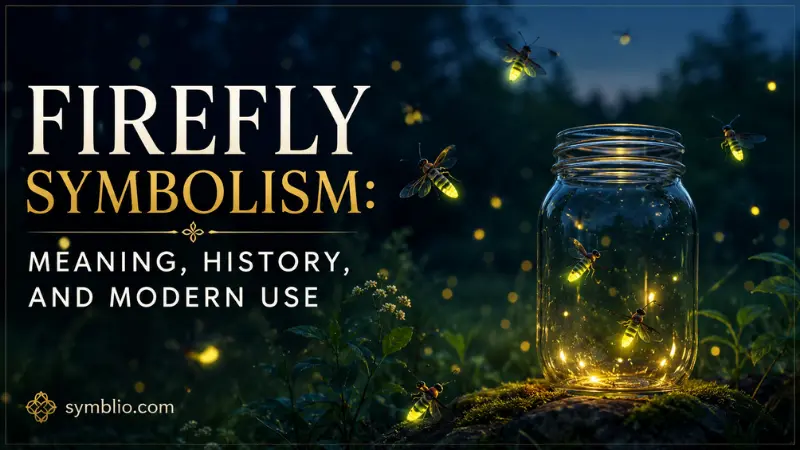
Fireflies are small beetles known for producing flashes of light on warm evenings. In the United States, seeing them often brings to mind summer, childhood, quiet outdoor spaces, and the brief beauty of a night that will not last forever. Their light is not produced by fire but through bioluminescent chemical reactions inside the insect’s abdomen.
That unusual combination of darkness and light has made the firefly a natural symbol. People use it to express ideas about hope, memory, attraction, communication, individuality, and the value of small moments. The meanings are not universal rules, however. A firefly can represent something different in a poem, tattoo, memorial image, children’s story, or conservation campaign.
In modern American culture, the firefly has a particularly strong connection with summer evenings and remembered childhood. At the same time, its declining habitat and sensitivity to artificial light have given the insect a newer association with environmental awareness and the protection of darkness.
Quick Answer
Firefly symbolism commonly represents hope, memory, fleeting beauty, and small sources of light in modern American culture, especially in childhood memories, art, tattoos, and summer imagery. Historically, fireflies have also appeared in Asian literature and visual culture as symbols connected with love, seasonal beauty, longing, and nighttime illumination.
TL;DR
- Fireflies commonly symbolize hope, memory, communication, and fleeting beauty.
- In America, they strongly evoke summer nights and childhood.
- Their flashing light naturally connects them with communication and attraction.
- Japanese art has long used fireflies in seasonal and romantic imagery.
- Tattoos often turn the firefly into a personal symbol of resilience.
- Conservation has added environmental meaning to modern firefly imagery.
What Fireflies Physically Represent
A firefly is actually a beetle belonging to the family Lampyridae, not a true fly. Different species produce different patterns of light, including flashes, glows, and other signals. In many North American species, the light is involved in communication and mate attraction.
That biology helps explain why fireflies carry such distinctive symbolic associations.
The insect does not illuminate the entire landscape. Instead, it produces a small point of light against darkness. Symbolically, that creates an appealing contrast: something physically small can become visually important when everything around it is dark.
The firefly therefore lends itself to meanings involving small acts of hope, quiet individuality, communication, and finding one’s way through uncertainty.
Its seasonal appearance matters too. For many Americans, fireflies are associated with particular evenings rather than everyday life. That makes them especially suitable as symbols of memories and experiences that are temporary but memorable.
What Fireflies Commonly Mean in the United States
The most recognizable American interpretation is summer nostalgia.
A field dotted with fireflies can recall childhood evenings, family gatherings, outdoor play, camping, or time spent in a backyard after sunset. Fireflies have become culturally connected with those experiences strongly enough that conservation organizations describe them as insects that commonly evoke warm childhood memories.
Several related meanings follow naturally:
- Hope: a small light appearing in darkness.
- Memory: a seasonal sight associated with earlier life.
- Joy: the excitement of watching flashes appear unexpectedly.
- Freedom: the insect’s movement through open nighttime spaces.
- Communication: flashing signals between fireflies.
- Fleeting beauty: the brief seasonal appearance of adults.
- Individuality: one small light standing out among many others.
These meanings overlap, but they are not interchangeable. Someone choosing a firefly for a tattoo may emphasize personal resilience, while a children’s book may use it simply to represent wonder and summer.
Why Light Became the Firefly’s Central Symbol
The firefly’s symbolism begins with its most obvious physical feature: light.
Unlike a lamp or candle, a firefly carries its light with it. It can disappear into darkness and then flash again. That pattern naturally encourages comparisons with perseverance and hope.
The comparison becomes especially clear when the firefly appears alone. One tiny light against a dark background can suggest that even limited resources can make a visible difference.
Yet the symbolism should not be overstated. A firefly does not biologically represent hope or courage. Those are human interpretations created from observing its behavior.
Its actual flashes function as communication signals, with species-specific patterns. Some species even synchronize their displays, producing large coordinated flashes.
That scientific reality gives the symbolic idea of communication a particularly strong foundation.
Fireflies and the Meaning of Communication
Firefly light is a form of biological signaling.
For many species, males and females use recognizable flash patterns to locate one another. The timing and appearance of the flashes can carry information that another firefly must recognize.
This makes the firefly an unusually fitting symbol for being seen, sending a message, and finding connection.
In human contexts, the image can suggest:
- reaching out to someone;
- finding people who understand you;
- expressing feelings without words;
- recognizing another person among many;
- signaling that you are present.
This interpretation works particularly well in visual art. A single glowing insect may represent an individual trying to communicate, while a group of fireflies can suggest community or shared understanding.
The symbolism is therefore not only about light. It is also about light being used as a message.
Firefly Symbolism and Memory
Few insects have such a strong connection with personal memory in American culture.
A person who grew up seeing fireflies may associate them with a particular house, neighborhood, summer vacation, relative, or stage of childhood. The insect becomes less important as an animal than as a trigger for remembered experiences.
This is why firefly imagery frequently works in nostalgic design. A glowing insect can communicate “summer” without showing a calendar, beach, or fireworks.
It can also represent the idea that certain moments cannot be permanently preserved. The flashes appear, disappear, and return. That rhythm resembles memory itself: something from the past may be absent for years and then suddenly return through a sound, smell, place, or image.
In this sense, fireflies often symbolize memories that remain visible even after the original moment has passed.
Fireflies in Japanese Art and Literature
Firefly symbolism is not exclusively American.
In Japan, fireflies have a long presence in literature and visual art. The Japanese word hotaru is associated with the insect, which became a recognizable seasonal subject in poetry, paintings, prints, and other forms of cultural expression.
The firefly appears in The Tale of Genji, an eleventh-century Japanese literary classic. Later Japanese artists continued to depict fireflies as part of summer imagery. The Metropolitan Museum of Art, for example, holds an 18th-century print pairing a firefly with another garden insect, while another Japanese painting depicts fireflies over the Uji River and explicitly connects the subject with The Tale of Genji.
Fireflies could also carry romantic associations. An Edo-period Japanese artwork in the Smithsonian collection shows a woman surrounded by fireflies alongside a poem expressing a lover’s wish to become a firefly.
This history shows why it is misleading to claim that fireflies have one universal symbolic meaning. In different cultural settings, the same insect can suggest seasonal beauty, romantic longing, literary refinement, or nostalgia.
Fireflies and Romantic Symbolism
Fireflies can carry romantic meaning because their light is connected to attraction and courtship in many species.
That biological fact has encouraged human artists to use fireflies as images of attraction, flirtation, longing, and nighttime intimacy. Japanese visual culture provides particularly clear historical examples.
In contemporary American culture, however, the romantic meaning is usually softer.
A pair of fireflies may represent two people finding each other. A glowing field can suggest an evening shared with someone important. A single firefly can symbolize a memorable person or relationship without requiring overt romantic imagery.
For that reason, fireflies can fit both romantic and non-romantic contexts. Their meaning depends heavily on the surrounding imagery.
Firefly Symbolism in American Childhood and Summer Culture
The firefly may be one of the clearest visual symbols of an American summer evening.
Children catching fireflies in yards and fields has become a familiar cultural image. The glass jar filled with tiny lights appears in illustrations, stories, advertisements, paintings, and nostalgic references to childhood.
The image works because it combines discovery with participation. Children are not merely watching the night; they are interacting with it.
That memory has become part of the broader American idea of an uncomplicated summer: warm evenings, grass, outdoor games, family gatherings, and time spent away from screens.
Today, the symbolism can feel especially nostalgic because many people encounter fewer fireflies in heavily developed or brightly lit environments. Light pollution can interfere with the signals fireflies use to communicate, while habitat loss and other environmental pressures affect their populations.
As a result, the firefly increasingly represents not just childhood itself, but a kind of childhood experience that people want to preserve.
Fireflies, Hope, and Emotional Resilience
The firefly is often used as a symbol of hope because its light appears in darkness.
This interpretation is straightforward rather than mystical. Darkness creates the visual condition that makes the light noticeable. The firefly therefore becomes a useful metaphor for a person, memory, relationship, or idea that remains meaningful during a difficult period.
A firefly tattoo, illustration, or piece of jewelry might communicate:
- “I found light during a difficult period.”
- “I want to remember where I came from.”
- “Small things can matter.”
- “I want to keep moving forward.”
- “Someone’s memory still matters to me.”
These interpretations are personal rather than fixed cultural definitions. A firefly does not automatically signify resilience simply because it glows.
The surrounding design often provides the real clue.
Firefly Symbolism in Tattoos and Personal Style
Firefly tattoos are especially adaptable because the insect can be depicted realistically or transformed into a more personal image.
A single firefly may suggest individuality or a private memory. Several fireflies can symbolize friendship, family, community, or a group of people connected by a shared experience.
Common design combinations can change the interpretation:
| Context | Meaning in the USA | Common Associations | Notes |
|---|---|---|---|
| Single firefly | Individuality and hope | Light, independence | Often works as a personal symbol |
| Group of fireflies | Connection and community | Friendship, family | Flashing together suggests shared presence |
| Firefly with flowers | Growth and seasonal beauty | Nature, renewal | Softer and more decorative |
| Firefly with stars or moon | Guidance and wonder | Night, imagination | Often emphasizes the contrast of light and darkness |
| Firefly with a date or initials | Personal memory | Milestones, remembrance | Meaning comes primarily from the personal context |
Unlike symbols with strict religious or institutional meanings, firefly tattoos are generally open to individual interpretation.
Fireflies in Home Decor, Fashion, and Digital Culture
Firefly imagery has become useful in decorative design because it creates a recognizable nighttime atmosphere without requiring a dark or gloomy mood.
Illustrations may show fireflies around flowers, trees, jars, ponds, or summer landscapes. Decorative lights sometimes imitate the appearance of firefly flashes. Clothing and accessories may use glowing insects as playful nature motifs.
In digital culture, fireflies can serve a similar purpose. An illustration of glowing insects may communicate calm, nostalgia, nighttime creativity, or a peaceful outdoor setting.
The symbol is particularly flexible because it can appear in children’s design, romantic artwork, nature photography, environmental campaigns, or minimalist personal graphics.
Its meaning changes with the visual environment.
Fireflies and Environmental Awareness
One of the most significant modern developments in firefly symbolism is the connection with conservation.
Fireflies depend on particular environmental conditions, including suitable habitat and darkness. Artificial light can interfere with the visual signals used by many species. Habitat loss, pesticides, poor water quality, climate-related changes, and other pressures also pose concerns.
This gives the firefly a newer symbolic role: the fragile beauty of an ecosystem that humans can either protect or disrupt.
A firefly image used in environmental communication can therefore mean more than “nature is beautiful.” It may represent the importance of preserving wetlands, meadows, forests, dark skies, and other habitats.
That shift is important because it turns nostalgia into responsibility. Instead of simply remembering childhood fireflies, people can begin asking why those insects appear less often in some places and what conditions they require.
Why Darkness Matters to Firefly Symbolism
Fireflies offer an unusual lesson about darkness: darkness is not necessarily the enemy of light.
The insect’s display only becomes visible because the surrounding environment is dark enough to reveal it. Excessive artificial lighting can actually make natural firefly signals harder for the insects to detect.
Symbolically, this creates a useful distinction.
A firefly does not represent eliminating darkness. Instead, it can represent finding something visible within darkness.
That interpretation makes the symbol more nuanced than the simple phrase “light over darkness.” The surrounding darkness gives the firefly’s light its meaning and visibility.
For artists and writers, this is one reason fireflies can communicate quiet hope rather than triumph.
Common Misunderstandings About Firefly Symbolism
One common mistake is treating a single symbolic meaning as universal.
There is no official symbolic dictionary in which every firefly must mean hope, love, or transformation. Symbolism develops through cultural traditions, literature, personal experience, visual context, and repeated artistic use.
Another misunderstanding is assuming that fireflies are universally associated with supernatural beings or spirits. Some folklore does connect glowing insects with unusual or otherworldly ideas, but those beliefs vary by place and period.
It is also important not to confuse the firefly with every glowing insect. “Firefly,” “lightning bug,” and “glowworm” are sometimes used differently in different regions, and not every member of the broader group produces the same type of light. Fireflies themselves are beetles in the Lampyridae family.
Finally, their symbolic beauty should not erase their ecological reality. Fireflies are living organisms with specific habitat needs, not merely decorative lights.
How Firefly Meaning Has Evolved
The firefly’s symbolism has changed as people have changed their relationship with nighttime environments.
Older literary and artistic traditions often emphasized seasonal beauty, romance, longing, and the unusual sight of living light. Japanese art provides extensive examples of this approach.
In the United States, fireflies became closely associated with childhood and summer memory. The insect’s presence in backyards and fields made it part of ordinary seasonal experience.
Today, those older meanings remain, but conservation has added another layer. The firefly can now represent disappearing habitat, dark skies, biodiversity, and the desire to preserve familiar natural experiences for future generations.
The result is a symbol with both personal and environmental meaning: something remembered emotionally and valued ecologically.
What a Firefly Can Symbolize in Different Contexts
The most useful way to interpret firefly imagery is to examine what surrounds it.
A firefly beside a child usually emphasizes childhood or discovery. Beside flowers, it may suggest summer and natural beauty. With a moon or stars, it can suggest nighttime wonder or guidance. With a person’s name or date, it may become a private remembrance.
In environmental artwork, the same insect can represent habitat protection and the preservation of darkness.
This contextual approach prevents symbolism from becoming a list of rigid definitions. The firefly’s meaning comes from the relationship between its natural characteristics and the human story attached to it.
FAQs
In spiritual or reflective contexts, a firefly may symbolize hope, guidance, awareness, or a small source of light during uncertainty. These are interpretive meanings rather than universal religious teachings, so the intended message depends on the tradition and context.
A firefly tattoo can represent personal growth, hope, individuality, childhood memories, or an important relationship. Some people choose the image because its small light represents something meaningful that they want to carry with them.
They can be. Fireflies have been connected with romantic attraction and longing in artistic traditions, particularly in Japanese literature and visual culture, while modern American interpretations often use them more gently to represent shared summer memories or finding someone special.
In the United States, fireflies are strongly linked with outdoor summer experiences, including backyard play and catching fireflies. Because these encounters often occur during childhood, the insect has become a common symbol of nostalgia and remembered summer evenings.
Yes, in modern symbolic use they commonly can represent hope because their small flashes are visible against darkness. The association is a metaphor based on the insect’s appearance rather than a fixed historical or religious definition.
A group of fireflies can suggest community, connection, shared experience, or communication. Their coordinated flashing can make the image particularly appropriate for themes involving people finding one another or working together.
Increasingly, yes. Their dependence on suitable habitat and darkness has made fireflies useful symbols for conservation, especially campaigns addressing light pollution, habitat loss, and the protection of nighttime ecosystems.
Conclusion
Firefly symbolism is built around a simple natural fact: a small beetle can create its own visible light in darkness. In American culture, that sight has become closely associated with summer, childhood, memory, hope, communication, and fleeting moments of beauty.
The meaning continues to evolve. What once functioned mainly as a seasonal and nostalgic image can now also represent environmental responsibility and the importance of preserving the habitats and darkness that fireflies need. Firefly symbolism therefore works on two levels at once: it can recall something personal and familiar while also pointing toward the natural world that makes that memory possible.
A firefly does not need to dominate the darkness to be noticed; its meaning comes from the small light it contributes.


