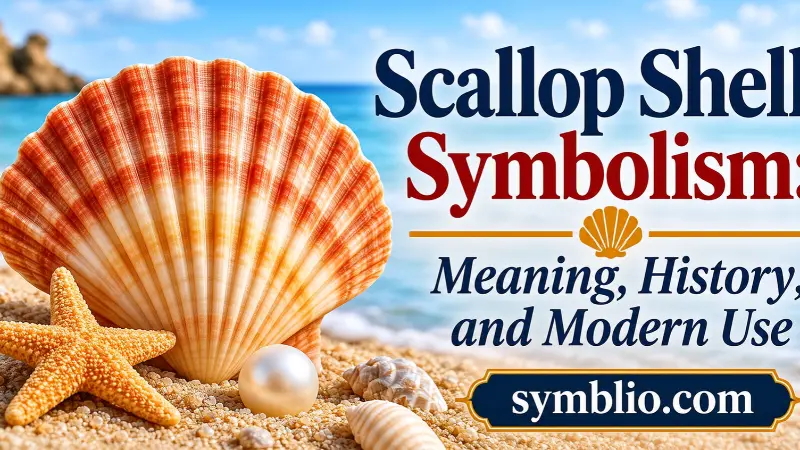
The scallop shell is more than a familiar object found along the shore. With its fan-shaped outline, delicate ridges, and rounded edges, it has appeared in ancient artwork, religious traditions, decorative architecture, jewelry, and personal keepsakes. Scallop shell symbolism brings together several ideas, including beauty, protection, fertility, spiritual journeys, and new beginnings.
In the United States, people may recognize the scallop shell from coastal decorations, beach-themed jewelry, tattoos, and images of the goddess Venus. Others associate it with Christianity and the historic Camino de Santiago pilgrimage in Spain. Its meaning depends on where it appears and which tradition gives it context.
Understanding this symbol requires looking beyond its attractive shape. Its history connects the natural world with ancient mythology, medieval religious practice, and modern expressions of identity.
Quick Answer
Scallop shell symbolism commonly represents beauty, renewal, protection, and a connection to the sea in modern American culture. Historically, it was associated with Aphrodite and Venus in ancient art and became an important emblem of Christian pilgrimage, particularly the journey to Santiago de Compostela.
TL;DR
- Scallop shells often represent beauty, renewal, and the natural world.
- Ancient Greek and Roman art connected the shell with Aphrodite and Venus.
- Christianity adopted it as an emblem of pilgrimage and spiritual devotion.
- Its protective shape can suggest safety and shelter.
- American jewelry and coastal decor use it to express seaside connections.
- Tattoos may represent personal growth, travel, faith, or meaningful memories.
What a Scallop Shell Looks Like and Why Its Shape Matters
A scallop shell comes from a marine mollusk belonging to the family Pectinidae. Its most recognizable feature is its fan-like shape, with a series of raised ridges extending from a narrow hinge toward a wider, curved edge. These ridges create a pattern that is both balanced and distinctive.
The shell’s natural design helps explain its symbolic appeal. Its rounded form can suggest openness, while its hard outer surface provides protection for the animal inside. The ridges create an impression of movement radiating from a single point, making the shell visually suitable for ideas about direction, connection, and journeys.
People encounter scallop shells in several settings:
- On beaches and in coastal collections.
- In paintings and sculptures inspired by classical mythology.
- In Christian pilgrimage imagery.
- In jewelry, decorative objects, and architectural details.
- In tattoos and personal artwork.
Not every shell carries a specific symbolic message. Sometimes people simply appreciate its natural pattern, texture, or association with a memorable visit to the coast.
The Main Symbolic Meanings of the Scallop Shell
The scallop shell has accumulated several meanings across different periods and cultures. Some come from its physical characteristics, while others developed through mythology, religion, and artistic traditions.
Beauty and love are among its best-known historical associations. Ancient artists used the shell in representations of Aphrodite and Venus, connecting it with attraction, femininity, and the natural world.
Renewal and new beginnings come partly from its association with birth and the sea. The shell appears in classical images of a goddess emerging from the water, making it an appropriate symbol for beginnings and transformation.
Protection and shelter relate to the shell’s natural function. It forms a covering around a living creature, which makes it a useful visual expression of safety, comfort, and security.
Faith and pilgrimage developed through Christian traditions in medieval Europe. The shell became a recognizable sign of travelers journeying toward Santiago de Compostela in Spain.
Connection and direction are especially relevant to pilgrimage imagery. The shell’s ridges meet at one point, creating a pattern that can represent different paths leading toward a shared destination.
These meanings do not have equal importance in every setting. A shell used in a religious artwork communicates something different from one worn as a beach souvenir.
Ancient Greek and Roman Connections to Aphrodite and Venus
One of the most recognizable historical associations of the scallop shell comes from ancient Mediterranean art.
In Greek mythology, Aphrodite was the goddess of love and beauty. One well-known account describes her emerging from the sea foam. Over time, artists developed visual representations of the goddess rising from the water, sometimes placing her inside or above a large shell.
The Roman goddess Venus inherited many of Aphrodite’s characteristics and became closely associated with love, beauty, and fertility. The shell consequently became part of the visual language used to represent these qualities.
An important example is Sandro Botticelli’s Renaissance painting The Birth of Venus. The goddess stands on a large shell as she arrives from the sea. Although Botticelli painted the work many centuries after ancient Greek and Roman civilization, the composition draws on classical mythology and helped preserve the shell’s association with beauty and divine birth.
The Archaeological Museum of Thessaloniki also documents ancient objects shaped like scallop shells and explains their connection with Aphrodite, fertility, and funerary symbolism. ARCHAEOLOGICAL MUSEUM OF THESSALONIKI+1
The historical meaning is important because it shows that the shell was not simply a decorative choice. Its association with the sea, birth, and feminine beauty developed through recognizable artistic and religious traditions.
Christian Symbolism and the Camino de Santiago
The scallop shell has a particularly important place in Christian pilgrimage history. It became the emblem most closely associated with the Camino de Santiago, a network of routes leading to the shrine of Saint James in Santiago de Compostela, Spain.
By the medieval period, pilgrims wore scallop shells on their clothing, hats, or bags. The shell identified them as travelers who had completed, or were undertaking, the pilgrimage. It also served as a practical object that could be used to collect food or water during a journey.
Several interpretations developed around its shape. The ridges were understood as different routes coming together at a common destination. Another Christian interpretation compared the shell’s open form to a hand, connecting it with charity and good works.
The shell also became associated with Saint James through medieval traditions and legends. Over time, it appeared on religious objects, buildings, badges, and other items connected with the pilgrimage.
Today, the scallop remains a familiar emblem of the Camino. It can be seen on route markers and carried by modern walkers who want to express their participation in the journey. Fundación Jacobea+3
For Christians and other travelers, the shell can represent more than reaching a destination. It may communicate commitment, patience, faith, generosity, and the willingness to continue through a difficult journey.
What the Scallop Shell Represents in American Culture
In the United States, the scallop shell does not have one universally recognized meaning. Its interpretation usually depends on the setting.
For many Americans, it first brings to mind beaches, coastal towns, ocean vacations, and summer memories. It appears in home decorations, framed artwork, souvenirs, and accessories designed around seaside life.
Its classical associations also remain visible. People familiar with Greek mythology or Renaissance art may recognize the shell as an emblem of Aphrodite or Venus. In that context, it suggests beauty, love, femininity, and the relationship between nature and artistic expression.
Religious meaning is another part of its American presence. Churches may use shell-shaped baptismal objects or imagery connected with Christian pilgrimage. People familiar with the Camino de Santiago may recognize the shell immediately as a sign of the historic walking routes.
The shell can therefore communicate different things to different audiences:
- A coastal homeowner may see it as a reminder of the ocean.
- An art enthusiast may associate it with Venus and classical beauty.
- A Christian traveler may recognize pilgrimage and devotion.
- Someone wearing a shell pendant may value a personal memory or connection to nature.
This variety is part of its appeal. The shell is familiar enough to feel approachable but has enough historical associations to carry more than one interpretation.
Protection, Shelter, and the Feeling of Safety
The shell’s protective function provides one of its most understandable symbolic meanings.
In nature, a shell acts as a protective covering for a marine animal. Its firm structure separates the creature from the surrounding environment. People can easily connect this natural feature with the human desire for safety, privacy, and a secure place to belong.
In decorative art, a scallop shell may suggest a welcoming space or a sheltered interior. Its curved shape can resemble a small canopy, which is one reason shell motifs have appeared in architectural decoration and ornamental design.
As a personal symbol, it may represent:
- Feeling safe during a period of change.
- Protecting personal boundaries.
- Finding comfort in familiar surroundings.
- Remembering someone who offered support.
- Creating a sense of home and belonging.
These are personal interpretations rather than fixed historical definitions. Someone who chooses a scallop shell because it reminds them of a supportive family member may give it a meaning that differs from its classical or religious associations.
Renewal, Birth, and the Possibility of Change
The scallop shell’s association with renewal is closely connected to its place in ancient representations of Aphrodite and Venus.
Images of the goddess emerging from the sea present birth as an arrival into a new world. The shell becomes part of that scene, giving artists a recognizable way to connect the ocean with creation and new beginnings.
The sea itself has long served as an image of change. It can be calm or unsettled, familiar or unpredictable. A shell brought from the shoreline may remind someone of the movement of life and the possibility of beginning again.
In modern personal symbolism, the shell can therefore represent:
- Starting a new chapter.
- Recovering confidence after a difficult period.
- Moving to a different place.
- Discovering a new interest or direction.
- Accepting that personal growth takes time.
Its connection with renewal does not mean that change is always easy. Rather, it offers a visual reminder that new experiences can follow periods of uncertainty.
Scallop Shells in Other Cultures and Religious Traditions
The scallop shell has appeared in more than one cultural setting, but its meanings should not be treated as identical everywhere.
In ancient Greek and Roman traditions, its association with Aphrodite and Venus made it a recognizable image of beauty, love, fertility, and birth. These interpretations spread through art and later European artistic movements.
In medieval Christianity, the shell became especially connected with pilgrimage, Saint James, and the Camino de Santiago. Its use also extended to other pilgrimage sites, showing how a symbol could move beyond its original religious setting. London Museum+1
In European decorative traditions, the shell became an ornamental motif. Artists and designers used its symmetrical ridges and curved outline in furniture, architecture, ceramics, and other decorative objects.
In modern international travel culture, the shell remains recognizable as a sign of the Camino. It can identify a route, a traveler, or a connection with the experience of walking long distances toward a shared destination.
It is important not to assume that every coastal community or religious tradition assigns the scallop shell the same meaning. A shell can be valued for practical, artistic, cultural, or personal reasons without carrying a formal spiritual message.
The Emotional and Psychological Meaning of the Shell
Symbols often work because people connect visible objects with experiences and feelings. The scallop shell is especially suitable for personal interpretation because it combines a protective structure with an open, radiating design.
Its hard exterior can suggest security, while its fan-like shape may communicate openness and connection. These qualities allow people to use it as a reminder of balancing personal protection with a willingness to experience the world.
The shell can also bring back specific memories. Someone who collected shells during a family vacation may associate one with childhood, relatives, or a place they no longer visit. Another person may connect it with a meaningful journey or a period of personal change.
Its emotional associations can include:
Nostalgia: A shell may preserve memories of a beach, holiday, or important family experience.
Calm: Its connection with the ocean can remind people of quiet coastal settings and time spent away from everyday responsibilities.
Belonging: A shell collected from a meaningful location can become a reminder of home or a community.
Hope: Its association with birth and renewal can express the possibility of moving forward.
Devotion: In a Christian context, it may represent faith and commitment to a spiritual journey.
There is no universal psychological meaning attached to the object. Its emotional value depends on the person, the experience, and the context in which it is used.
Scallop Shells in Jewelry, Fashion, and Home Decor
The scallop shell is popular in decorative design because its shape is immediately recognizable and works well in both simple and elaborate styles.
Jewelry
Necklaces, pendants, earrings, bracelets, and rings sometimes feature scallop-shaped designs. A person may choose one because of its connection with the ocean, its classical associations, or a memory of a particular place.
Gold and silver versions can give the shell a traditional appearance, while natural materials and simple designs often create a more casual coastal look.
Home decor
Scallop motifs appear in mirrors, picture frames, trays, ceramics, lamps, and decorative objects. They are especially common in interiors influenced by coastal design.
A shell-shaped object can add a seaside reference without requiring an entire room to follow a beach theme. Its symmetrical form also makes it useful as an architectural or ornamental detail.
Fashion
The shell appears in prints, accessories, hair ornaments, and clothing details. In these settings, it generally communicates a connection with summer, the ocean, or relaxed coastal style rather than a specific religious or historical belief.
For many Americans, these uses are primarily aesthetic. The design may carry personal meaning, but it does not automatically indicate that the wearer identifies with a particular tradition.
Why People Choose Scallop Shell Tattoos
A scallop shell tattoo can express several ideas without relying on an elaborate design. Its shape is simple enough to work as a small outline, yet its history provides plenty of room for personal interpretation.
Some people choose it because of its connection with the ocean. Others appreciate its association with beauty, renewal, protection, or spiritual travel.
Common personal interpretations include:
- Travel: A reminder of an important trip or a journey that changed someone’s outlook.
- Faith: A reference to Christian pilgrimage or a personal spiritual commitment.
- New beginnings: A marker of a major life transition.
- Family memories: A lasting reminder of time spent near the coast with loved ones.
- Protection: A visual expression of security, resilience, or personal boundaries.
- Classical beauty: An appreciation of Aphrodite, Venus, and the history of art.
Design choices can change how a tattoo is understood. A shell combined with a walking path may suggest pilgrimage, while one surrounded by waves may emphasize a connection with the sea. A shell paired with a classical figure may refer to ancient mythology.
People should not assume that every scallop shell tattoo has a religious meaning. The person wearing it is the best source of information about its intended message.
Positive and Negative Interpretations
The scallop shell is generally associated with positive ideas, including beauty, protection, faith, and renewal. However, its meaning can become more complicated depending on the artwork or setting.
In classical mythology, its connection with Aphrodite and Venus includes themes of sexuality and fertility. These ideas were part of ancient representations of the goddess and should be understood in their historical context rather than treated as the only meaning of the shell.
In funerary art, shells could also appear in connection with death and rebirth. The image might suggest a transition into another state of existence rather than simply celebrating life. The Archaeological Museum of Thessaloniki notes that scallop-shaped objects were associated with both fertility and the cycle of life and death. ARCHAEOLOGICAL MUSEUM OF THESSALONIKI+1
A shell can also carry sadness for someone who associates it with a lost loved one or a place they can no longer visit. That emotional meaning comes from personal experience, not from a universally negative interpretation.
The important distinction is between the symbol’s historical associations and the feelings a person attaches to it. Neither should automatically be assumed from the object alone.
Common Misunderstandings About Scallop Shell Symbolism
The shell’s long history has produced several interpretations that can become confused when separated from their original settings.
It does not always represent Christianity. The scallop became a major Christian pilgrimage emblem, but its classical associations existed much earlier.
It is not exclusively a symbol of Aphrodite or Venus. The goddess is one of its most famous historical associations, but the shell also appears in religious, decorative, and personal contexts.
Every scallop shell is not a Camino symbol. A shell on a beach decoration or piece of jewelry may simply represent coastal life.
Its meanings are not universal. Different communities and individuals may understand it in different ways.
It does not automatically communicate a particular identity. Wearing a shell necklace or displaying a shell in a home is not proof of someone’s religious beliefs or personal history.
Understanding the context prevents a simple decorative object from being assigned a meaning it may not have been intended to carry.
How the Symbol Has Changed Over Time
The scallop shell’s meaning developed through several major periods.
In ancient Mediterranean art, it became associated with the sea, Aphrodite, Venus, beauty, and birth. Artists used its shape to create recognizable images of the goddess and her connection with the ocean.
During the medieval period, Christian pilgrims adopted the shell as an emblem of the journey to Santiago de Compostela. It became a visible sign of religious travel and eventually spread into other pilgrimage traditions.
During later European artistic periods, the shell appeared in paintings, architecture, furniture, and decorative objects. Its attractive shape allowed it to move beyond religious imagery and become a widely used design motif.
In modern American culture, its meanings are more varied. It may represent a beach vacation, classical art, faith, travel, protection, or personal memories. The same object can serve as a decorative accessory for one person and a meaningful reminder of a life experience for another.
This evolution shows how symbols gain new meanings without necessarily losing their older associations.
Scallop Shell Symbolism in Different Contexts
The following table summarizes several common interpretations and the settings in which they are most likely to appear.
| Context | Common Meaning | Main Association |
|---|---|---|
| Ancient mythology | Beauty, love, and birth | Aphrodite and Venus |
| Christian pilgrimage | Faith, devotion, and good works | Camino de Santiago |
| Coastal decor | Ocean connection and relaxation | Beaches and seaside living |
| Jewelry | Personal memories and natural beauty | Individual expression |
| Tattoos | Renewal, travel, or protection | Personal experience |
| Funerary art | Rebirth and the cycle of life | Ancient artistic traditions |
The context matters more than the shell’s appearance alone. A shell on a pilgrimage marker has a different purpose from one used as a decorative pattern on a mirror.
FAQs
Spiritually, a scallop shell is often associated with faith, protection, renewal, and pilgrimage. In Christianity, it is especially connected with the Camino de Santiago and the journey toward Santiago de Compostela.
Ancient and later artistic traditions depicted Aphrodite emerging from the sea in connection with a shell. This imagery linked the object with the goddess’s associations with love, beauty, fertility, and birth.
A scallop shell tattoo may represent travel, personal growth, faith, protection, or a meaningful connection with the ocean. Its meaning depends on the wearer’s experience and the other elements included in the design.
Yes, it is an established Christian symbol, particularly associated with pilgrimage to Santiago de Compostela and Saint James. It also has older connections with ancient Mediterranean mythology, so its meaning is not exclusively Christian.
It can represent protection because a natural shell provides shelter for the creature inside it. In personal artwork or jewelry, people may use that feature to express safety, comfort, or emotional security.
In American home decor, it most often suggests coastal living, the ocean, and a relaxed seaside atmosphere. Depending on the design, it can also reference classical art or the traditional beauty of natural forms.
It can represent new beginnings because of its association with birth and renewal in classical imagery. People may also choose it as a reminder of a fresh start, a personal journey, or an important life transition.
Conclusion
The scallop shell carries several meanings shaped by nature, mythology, religion, and personal experience. Its associations with Aphrodite and Venus connect it with beauty and birth, while its role in Christian pilgrimage gives it a lasting place in religious history. Its natural structure also makes it an understandable image of shelter and protection.
Today, scallop shell symbolism remains relevant in American jewelry, tattoos, coastal decor, art, and travel culture. Some people see it as a reminder of the ocean, while others connect it with faith, renewal, or an important journey. Its meaning is ultimately shaped by the story behind the object and the person who chooses to keep it.