Linden tree symbolism is commonly associated with love, peace, friendship, protection, and community. Known for its heart-shaped leaves, fragrant flowers, and broad canopy, the linden tree has played an important role in European folklore and cultural traditions.
Linden trees belong to the genus Tilia, which includes several species native to Europe, Asia, and North America. In the United States, the American basswood (Tilia americana) is also known as the American linden. It is valued for its attractive appearance, useful wood, and flowers that provide nectar for pollinators.
The tree has a particularly interesting cultural history. In parts of Europe, people gathered beneath linden trees for celebrations, public meetings, and community discussions. Some traditions also connected the tree with romantic devotion, hospitality, and fairness.
Today, the linden remains a familiar feature of parks, gardens, and residential landscapes. Its historical associations and natural characteristics make it a meaningful symbol of lasting relationships, belonging, and peaceful surroundings.
Quick Answer: What Does Linden Tree Symbolism Mean?
Linden tree symbolism commonly represents love, peace, friendship, protection, and community. Historically, European traditions also associated the tree with justice, hospitality, marriage, and public gatherings, while modern American interpretations often connect it with natural beauty, shelter, and environmental care.
TL;DR: Key Meanings of the Linden Tree
- Love: Represents affection, devotion, and lasting relationships.
- Peace: Reflects harmony, reconciliation, and calm surroundings.
- Protection: Its broad canopy suggests shelter and security.
- Community: Historically served as a gathering place for villages.
- Justice: European traditions connected it with public meetings and fairness.
- Renewal: Its seasonal growth represents continuity and new beginnings.
What a Linden Tree Looks Like and Why Its Appearance Matters
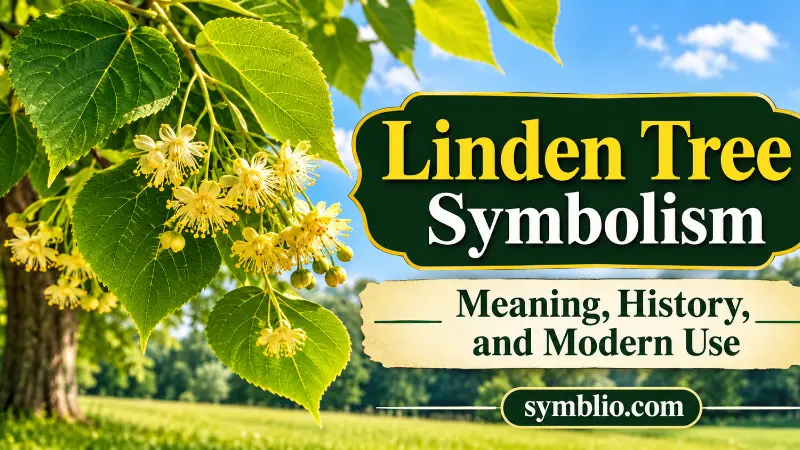
A linden tree is a deciduous tree recognized by its broad crown, spreading branches, and distinctive heart-shaped leaves. Depending on the species, it can grow into a large shade tree that creates a comfortable space beneath its branches.
Its small, pale yellow flowers usually appear in clusters during late spring or summer. They release a pleasant fragrance that attracts bees and other pollinators. After flowering, the tree produces small nut-like fruits attached to narrow, leaf-like bracts.
Several physical characteristics contribute to its symbolic associations.
Heart-shaped leaves: These naturally suggest affection, kindness, and emotional connection. Their distinctive shape makes the tree an appealing representation of love and relationships.
Broad canopy: Its branches provide shade and shelter, making protection and hospitality natural associations.
Fragrant flowers: Their pleasant scent suggests warmth, comfort, and appreciation of nature.
Long-lasting growth: Mature lindens can remain part of a landscape for generations, connecting them with continuity, family history, and community memories.
These characteristics help explain why the linden has become associated with welcoming places and meaningful relationships.
Love and Lasting Relationships
Love is one of the best-known traditional meanings associated with the European linden tree. Its connection with affection developed through mythology, poetry, folklore, and customs surrounding marriage.
In European traditions, couples sometimes met beneath linden trees to exchange promises or spend time together. The tree’s shade provided a natural gathering place, while its fragrant flowers and heart-shaped leaves made it an appealing representation of romantic affection.
An important literary example appears in Ovid’s Metamorphoses, which tells the story of Philemon and Baucis. The elderly couple welcomes two disguised gods into their modest home when others refuse to help them. Their kindness and devotion earn divine favor. After their lives, they are transformed into two trees growing together: an oak and a linden.
The story became an enduring representation of loyalty, hospitality, and companionship.
In modern American interpretations, the linden can represent:
- Commitment between long-term partners.
- Affection built through shared experiences.
- Marriage and emotional loyalty.
- Family relationships that endure through change.
- A welcoming home built on mutual care.
The tree does not represent romantic love alone. It can also symbolize friendship, family devotion, and relationships that provide stability throughout life.
Peace, Harmony, and Reconciliation
The linden tree has a strong association with peace and harmony, particularly in Central European village traditions.
Its historical role as a gathering place helps explain this meaning. People met beneath mature trees to talk, celebrate, exchange news, and resolve disagreements. These shared spaces encouraged communication and cooperation.
In some German communities, village lindens became important locations for festivals, dancing, and public celebrations. Their presence became part of local identity, and the trees represented places where residents could come together.
This history gives the linden a meaning beyond personal relaxation. It can represent rebuilding understanding between individuals or groups.
In the United States, a similar interpretation appears in neighborhood parks and other public spaces. A large tree can become a meeting point where families gather and neighbors spend time together.
The linden may therefore symbolize:
- Reconciliation after disagreements.
- Respect between different people.
- Calmness during difficult periods.
- Cooperation and shared responsibility.
- A peaceful relationship with nature.
Its symbolism suggests that peace involves creating spaces where people feel comfortable listening to and understanding one another.
Protection, Shelter, and Security
A mature linden tree can provide substantial shade, making protection one of its most recognizable symbolic associations.
Its wide branches offer relief from direct sunlight and create a comfortable environment for people, birds, and other wildlife. This physical characteristic has helped connect the tree with shelter and security.
European folklore also attributed protective qualities to lindens. Some communities believed that planting or preserving these trees near homes could help protect households from harmful influences. Such ideas belong to traditional folklore rather than established scientific fact.
In contemporary American culture, protection associated with the linden is often understood more practically. A shade tree can make an outdoor space more comfortable, support urban greenery, and provide habitat for wildlife.
People may use the tree as a personal symbol of:
- Feeling safe and supported.
- Creating a welcoming home.
- Protecting family relationships.
- Finding comfort during uncertainty.
- Caring for the natural environment.
The linden’s protective meaning comes from both its physical characteristics and the cultural stories connected with it.
Community, Friendship, and Belonging
The linden tree has an especially strong connection with community life in European history.
In many German-speaking villages, a large linden stood near the center of the settlement. It provided a recognizable meeting place where residents could exchange information, hold celebrations, and participate in public activities.
Some were known as village lindens, dance lindens, or court lindens, depending on their local purpose.
These trees became familiar landmarks. Residents associated them with important events, family memories, and the history of their communities.
This tradition illustrates how a natural feature can become part of a shared cultural identity. People may remember a village not only through its buildings and streets but also through an old tree that has witnessed generations of everyday life.
In American settings, a similar meaning appears around neighborhood parks, courthouse grounds, university campuses, and historic public spaces.
The linden can symbolize:
- Friendship built through shared experiences.
- A sense of belonging.
- Cooperation among neighbors.
- Family and community traditions.
- Respect for local history.
Its community symbolism is particularly relevant because public gathering places help connect people from different backgrounds.
Justice, Truth, and Fairness in European Traditions
One of the more distinctive meanings of the linden tree comes from its historical association with justice and public decision-making.
In parts of medieval Germany, community courts and local assemblies sometimes met outdoors beneath large linden trees. These locations provided recognizable public spaces where people gathered to hear disputes and participate in civic matters.
The practice connected the tree with fairness, truth, and accountability.
Some later traditions also associated the linden with female figures in Germanic mythology, particularly goddesses connected with love and fertility. However, specific religious associations vary across historical periods and regions, so they should not be treated as universal beliefs.
The court-tree tradition is especially important because it gives the linden a civic meaning.
Rather than representing only affection or natural beauty, it could also stand for the responsibility of making fair decisions within a community.
Today, Americans may interpret this symbolism through broader ideas such as:
- Equal treatment.
- Honest communication.
- Responsible leadership.
- Respect for public institutions.
- Accountability within a community.
The linden is not an official American emblem of justice, but its European history gives it a meaningful connection with fairness and public life.
Historical Origins of Linden Tree Symbolism
The cultural history of the linden extends across several European regions and developed through different local traditions.
The genus Tilia includes numerous species, and people have used its wood, bark, leaves, and flowers for practical purposes over many centuries.
In European communities, the tree became associated with everyday social life. Its wide canopy made it suitable for gatherings, while its relatively soft wood made it useful for carving and other crafts.
In Germanic and Slavic traditions, lindens also acquired cultural and religious associations. Some communities treated particular trees as important landmarks and connected them with protection, fertility, community well-being, and local identity.
The tree’s meaning developed through several influences.
Village customs: Public gatherings helped establish associations with belonging and social harmony.
Folklore: Traditional stories connected lindens with protection, love, and good fortune.
Literature: Medieval poetry and later musical works helped preserve the tree’s romantic associations.
Practical value: Its useful wood and valuable flowers made it an important part of daily life.
These influences explain why the linden developed several related meanings instead of one fixed symbolic definition.
Linden Tree Symbolism in Norse and Slavic Traditions
Linden trees appear in different European cultural traditions, although their meanings are not identical everywhere.
In Norse-related interpretations, the tree has sometimes been connected with female deities, including Frigg and Freya. These associations link the linden with affection, fertility, domestic life, and protection.
However, surviving historical evidence does not establish one universal Norse religious meaning for the tree. Later folklore and regional traditions have contributed to some of the associations commonly repeated today.
The linden also holds an important place in Slavic cultural heritage.
In several Slavic languages, the tree is known as lipa. It has been associated with village life, hospitality, community protection, and national or regional identity.
The linden is particularly recognizable in Slovak cultural traditions, where it represents peace, unity, and shared heritage.
In some Central and Eastern European communities, linden trees became important meeting points and recognizable features of settlements.
These traditions demonstrate how one tree can acquire related but distinct meanings across neighboring cultures.
For American readers, the cultural lesson is that the linden represents more than a general idea of nature. It also carries memories of particular communities, languages, customs, and historical experiences.
Linden Tree Symbolism in American Culture
In the United States, the linden tree is appreciated primarily as a beautiful shade tree with practical environmental and landscaping value.
The American basswood, Tilia americana, is native to eastern and central North America. It grows in woodland environments and is also planted in residential neighborhoods, parks, and urban landscapes.
Unlike some European traditions, American culture does not have one widely established national folklore system centered on the linden. Its meaning is more closely connected with its appearance, usefulness, and place in everyday outdoor environments.
Several American interpretations stand out.
Natural comfort: Its broad crown creates shade, suggesting relaxation and a connection with outdoor living.
Environmental responsibility: Its flowers attract pollinators, particularly bees, making it an example of the relationship between trees and healthy ecosystems.
Family and neighborhood life: Mature trees in residential areas can become part of family memories and neighborhood identity.
Historical continuity: Old trees near schools, parks, and public buildings can represent the preservation of local heritage.
Craftsmanship: American basswood has a long history of practical use, including wood carving, furniture, and other wooden products.
Native American communities and European settlers used the tree’s fibrous inner bark for materials such as rope, mats, baskets, and other useful items. Its soft wood also became valued for carving.
These practical connections make the American linden an interesting symbol of usefulness, environmental connection, and community life.
Emotional and Psychological Meaning of the Linden Tree
The linden tree can communicate several emotional ideas through its appearance and cultural history.
Its broad canopy suggests a place of rest. Its seasonal flowers introduce pleasant sensory experiences, while its long-term presence in a landscape can create a sense of familiarity.
These characteristics help explain why people may associate it with emotional comfort.
A sense of safety: The shade and shelter provided by mature branches can suggest a dependable environment.
Emotional connection: Its heart-shaped leaves make it a natural visual association for affection and care.
Stability: A mature tree can represent patience, continuity, and the ability to remain established through changing seasons.
Belonging: Its traditional role as a village meeting place connects it with friendship and shared identity.
Renewal: Fresh leaves and seasonal flowering can suggest new opportunities and personal development.
These interpretations are personal rather than established psychological findings. A person’s emotional response to a linden may depend on childhood memories, family traditions, cultural background, or experiences in nature.
For someone who grew up near a large linden, the tree might represent home. Another person may associate it with a meaningful friendship or a peaceful place visited during an important period of life.
Its emotional symbolism is strongest when connected with real experiences rather than assumed universal meanings.
Linden Tree Symbolism in Tattoos, Art, and Personal Style
Although the linden is not among the most recognizable mainstream tattoo subjects in the United States, its distinctive leaves and cultural associations make it an interesting choice for botanical artwork.
People who choose tree tattoos often want an image connected with personal history, relationships, or their connection with nature.
A linden design can communicate several ideas.
Love and devotion: A small branch with heart-shaped leaves can represent affection for a partner, family member, or close friend.
Family heritage: Someone with Central or Eastern European ancestry may choose the tree as a reference to cultural roots.
Peace and healing: A mature tree design can represent a preference for calm, balance, and emotional stability.
Community: A tree with spreading branches may represent belonging and the importance of supportive relationships.
Environmental appreciation: A botanical illustration can express an interest in trees, wildlife, and conservation.
Artists can represent the linden in different ways. A detailed design may include its flowers and characteristic bracts, while a simpler illustration might focus on a single heart-shaped leaf.
In paintings and decorative artwork, the tree can also communicate natural elegance, traditional European settings, and the atmosphere of an established garden.
Its meaning ultimately depends on the person’s intention and the details included in the design.
The Linden Tree in Literature, Music, and European Art
The linden has appeared in European literature and music as an image of love, memory, and familiar places.
One particularly recognizable example is the German song Der Lindenbaum, associated with Franz Schubert’s song cycle Winterreise. The text, written by Wilhelm Müller, uses a familiar tree as a setting for memory and emotional reflection.
The tree becomes more than part of the landscape. It represents a place connected with earlier experiences and the desire to return to something familiar.
Medieval German poetry also used the linden as a setting for romantic encounters. The tree’s shade offered a natural backdrop for courtship and personal relationships.
These literary appearances helped strengthen its association with affection and remembrance.
In visual art, linden trees often appear in European village scenes, gardens, and landscapes. Their wide canopies create a recognizable setting for outdoor life.
American audiences may encounter these traditions through classical music, European literature, landscape painting, and cultural exhibitions.
The tree’s artistic meaning often depends on its surroundings. A linden in a village square can suggest community, while one standing alone in a landscape may communicate memory, solitude, or reflection.
Modern Uses of Linden Trees and Their Symbolic Meaning
Today, lindens are valued for their practical benefits as well as their attractive appearance.
In the United States, American basswood and other linden species are planted in parks, residential landscapes, and suitable urban environments.
Their uses help maintain the tree’s connection with comfort, environmental responsibility, and community spaces.
Common modern uses include:
- Landscaping: Mature lindens provide shade and attractive seasonal foliage.
- Pollinator gardens: Their flowers supply nectar for bees and other insects.
- Woodworking: Basswood is appreciated for its soft texture and suitability for carving.
- Traditional herbal preparations: Linden flowers are used in herbal tea traditions.
- Public spaces: Their canopies make them suitable for selected parks and outdoor gathering areas.
- Decorative artwork: Their leaves and flowers appear in botanical illustrations and nature-inspired designs.
Linden flowers also have a history of use in traditional herbal preparations. Linden tea is familiar in several European cultures and is appreciated for its mild floral character.
These practical applications contribute to a modern understanding of the tree as something that supports both human activities and natural ecosystems.
Its symbolic meaning remains connected with the qualities people value in a healthy environment: shade, biodiversity, beauty, and shared outdoor spaces.
Positive and Negative Interpretations of the Linden Tree
The linden tree is generally associated with positive qualities, but its interpretation can change depending on the story, artwork, or personal experience surrounding it.
Its most common positive meanings include love, peace, friendship, shelter, and belonging.
In historical European literature, however, the tree could also become a setting for sadness, longing, or memories of something that had been lost.
Schubert’s Der Lindenbaum, for example, uses the familiar tree in a more complicated emotional setting. It is associated with earlier happiness but also with longing and emotional distance.
This illustrates an important distinction: a symbol does not always communicate only one feeling.
| Context | Positive Meaning | Alternative Interpretation |
|---|---|---|
| Love and relationships | Devotion and affection | Longing or separation |
| Community | Friendship and belonging | Memories of a changing community |
| Protection | Shelter and comfort | Dependence on familiar surroundings |
| Nature | Renewal and environmental care | Awareness of environmental loss |
| Literature | Happiness and remembrance | Nostalgia and sadness |
There is no widely recognized tradition in which the linden is inherently an evil or negative tree.
Its less cheerful interpretations usually come from literary context or personal associations rather than a universal cultural belief.
Common Misunderstandings About Linden Tree Symbolism
Several misconceptions can make the cultural history of the linden difficult to understand.
Every linden has the same symbolic meaning.
Different regions and historical periods have developed their own interpretations. European village traditions, Norse-related folklore, and modern American landscaping do not share one identical symbolic system.
The linden is exclusively a romantic symbol.
Love is an important association, but the tree has also represented community, justice, protection, and hospitality.
The American basswood and every European linden are the same species.
They belong to the same genus, Tilia, but different species have distinct botanical characteristics and geographical distributions.
Traditional protective beliefs are scientific facts.
Some communities believed lindens could protect homes from harmful influences. These are cultural beliefs, not scientifically established protective properties.
The tree has an official universal religious meaning.
Its cultural and spiritual associations vary. It should not be treated as a universal sacred symbol across all European or American traditions.
Understanding these distinctions makes it easier to appreciate the linden without assigning it meanings that do not fit its actual history.
Linden Tree Symbolism Compared With Other Trees
Trees frequently represent life, stability, wisdom, and the passage of time. However, individual species can develop distinctive cultural associations.
The linden is particularly connected with love, peace, and community, while other familiar trees have different symbolic histories.
| Tree | Common Symbolic Meaning | Traditional Association |
|---|---|---|
| Linden | Love, peace, and community | European village life and folklore |
| Oak | Strength and endurance | Ancient European traditions |
| Willow | Grief and reflection | Mourning and emotional expression |
| Olive | Peace and reconciliation | Mediterranean and biblical traditions |
| Cedar | Protection and longevity | Religious and cultural traditions |
These comparisons show that tree symbolism often develops through a combination of physical characteristics, traditional uses, literature, and cultural beliefs.
The linden stands out for its connection with welcoming public spaces and lasting relationships.
FAQs
The linden tree is traditionally associated with peace, love, protection, fertility, and community harmony. In some European folklore, it was also connected with sacred spaces and protective household traditions.
Yes. The linden has a long association with romantic affection and lasting relationships, particularly in European folklore and literature. The story of Philemon and Baucis is one well-known example connecting the tree with devoted companionship.
In the United States, the American linden is appreciated for its shade, attractive appearance, and environmental value. It can represent natural comfort, neighborhood life, environmental awareness, and continuity.
Linden trees provided shade and created convenient outdoor gathering places. Some communities used them for public meetings, celebrations, dancing, and local court proceedings.
Yes. Its broad canopy naturally suggests shelter, while European folklore sometimes associated it with protection from harmful influences. These traditional beliefs are separate from its practical environmental benefits.
A linden tree tattoo can represent love, friendship, peace, family heritage, and a connection with nature. Its meaning usually depends on the individual’s personal experiences and cultural background.
Yes. European traditions have connected the linden with romantic relationships, marital affection, and companionship. The story of Philemon and Baucis provides a recognizable literary connection with lasting devotion.
Conclusion
The linden tree carries several connected meanings, including love, peace, protection, friendship, justice, and community. Its cultural history shows how a tree can become more than a natural feature of the landscape. Through folklore, literature, public gatherings, and everyday uses, it has developed associations with the relationships and places people value.
In the United States, the linden is especially appreciated for its shade, fragrant flowers, environmental benefits, and presence in public and residential landscapes. Its European heritage adds historical associations with hospitality, devotion, and shared community life.
Ultimately, linden tree symbolism reminds us of the importance of creating welcoming spaces, maintaining meaningful relationships, and respecting the natural environments that connect generations.