
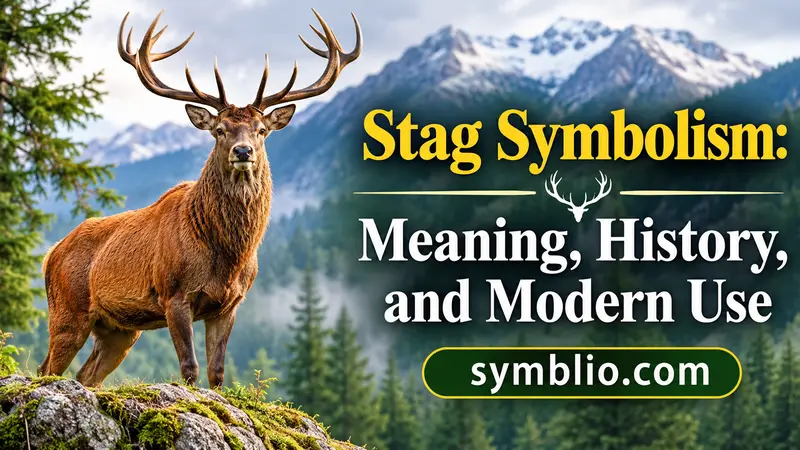
The stag is a mature male deer recognized by its branching antlers, alert posture, and impressive presence in the natural world. In stag symbolism, these features often represent strength, dignity, independence, leadership, and renewal. Its image appears in ancient artwork, European folklore, religious traditions, family crests, wildlife imagery, and modern decorative designs.
For many Americans, the stag represents a connection to nature and the outdoors. Its antlers suggest maturity and authority, while its ability to shed and regrow them provides a natural association with renewal and personal growth. The animal also appears in hunting traditions, wildlife photography, rustic home decor, and outdoor-inspired fashion.
However, the stag does not carry one universal meaning. Its interpretation changes depending on its appearance, cultural background, religious setting, and the way people use its image. Understanding these differences helps explain why this animal has remained an important figure in art, folklore, and contemporary American culture.
Quick Answer
Stag symbolism commonly represents strength, dignity, independence, leadership, and renewal in modern American culture, particularly in nature-inspired art, personal identity, and outdoor imagery. Historically, the stag has also represented kingship, spiritual guidance, fertility, and divine connection in European mythology, medieval Christianity, and other cultural traditions.
TL;DR
- The stag commonly represents strength, dignity, independence, and leadership.
- Its growing antlers symbolize renewal, maturity, and natural cycles.
- Celtic folklore connects the stag with wilderness and spiritual guidance.
- Christian art sometimes uses the stag to represent devotion to God.
- American culture associates deer with wildlife, outdoor heritage, and conservation.
- Modern stag imagery appears in tattoos, jewelry, artwork, and home decor.
What a Stag Looks Like and Why Its Antlers Matter
A stag is an adult male deer, particularly a red deer in European terminology. In North American everyday language, people often use the word buck for a male white-tailed deer or mule deer. The two terms overlap in general conversation, although they do not always describe the same species.
The stag’s most recognizable feature is its antlers. Unlike permanent horns, antlers are shed and regrown as part of the animal’s natural annual cycle. They develop from living tissue, grow beneath a protective covering called velvet, and eventually become hardened structures.
Their branching shape makes them visually distinctive. In paintings and decorative designs, antlers can resemble a crown, a tree, or an elaborate set of branches. This appearance helps explain their association with authority, natural abundance, and maturity.
The stag’s physical behavior contributes to its symbolism too. It can move quickly through wooded environments, remain alert to danger, and compete with other males during the breeding season. Artists and storytellers have used these characteristics to portray confidence, vigilance, and physical strength.
The Main Symbolic Meanings of the Stag
The stag carries several related meanings, but some are more common than others. Its mature appearance and antlers make it a natural symbol of strength and authority, while its seasonal changes support associations with renewal.
Strength and resilience: A mature stag represents physical capability and the ability to endure challenging conditions. Its image can communicate determination without necessarily suggesting aggression.
Dignity and leadership: Its upright posture and antlers create an impression of authority. This explains why the animal appears in heraldry, formal artwork, and designs associated with heritage.
Independence: Stags are frequently depicted standing alone in forests or open landscapes. This imagery can suggest self-reliance, freedom, and confidence.
Renewal and growth: The annual antler cycle provides a visible example of natural regeneration. It can represent personal development, recovery, and the beginning of another stage of life.
Connection with nature: As a woodland animal, the stag represents wilderness, ecological balance, and respect for the natural world.
These meanings are not fixed rules. A stag depicted with its head lowered may communicate determination or confrontation, while one standing peacefully beneath trees may suggest solitude and harmony.
Antlers as Symbols of Renewal and Maturity
The antlers are arguably the most important feature in stag imagery. They distinguish a mature male deer from a doe or young deer and give the animal much of its recognizable appearance.
Their annual growth cycle has inspired interpretations involving renewal and the passage of time. Each year, the stag develops a new set of antlers, eventually shedding them and beginning the process again.
For this reason, antlers can represent several stages of personal development:
- Letting go of an earlier stage of life.
- Developing new abilities and confidence.
- Accepting changes that come with maturity.
- Beginning again after a difficult period.
- Recognizing that growth happens through natural cycles.
The crown-like shape of antlers also contributes to their association with leadership. In decorative art, a large antler arrangement can make the stag appear regal without requiring additional symbols.
However, antler size should not be treated as a simple measurement of personal worth or authority. In nature, antler development depends on factors such as age, nutrition, genetics, and overall condition.
Ancient Origins of Stag Symbolism
Human relationships with deer extend far into prehistory. Deer appear in prehistoric European cave art, including the famous animal imagery at Lascaux in France. These representations show that deer held a place in early human visual culture, although their exact meanings cannot always be established.
Deer were important animals for practical reasons. Their meat provided food, while hides, bones, and antlers could be used for clothing, equipment, and other everyday objects. Over time, the animal also became part of stories, ceremonial imagery, and religious traditions.
In ancient European societies, the stag’s antlers and physical presence helped distinguish it from other animals. Its association with forests, seasonal change, and reproduction made it suitable for stories about the natural world.
The animal’s meaning developed differently across regions. Some traditions emphasized fertility and abundance, others connected it with divine figures, and medieval storytellers increasingly used the stag as a guide or sign of spiritual transformation.
It is important not to assume that every ancient deer image represented the same belief. Archaeological artwork can establish that people valued the animal, but it cannot always reveal precisely what an individual artist or community intended.
Stag Symbolism in Celtic Traditions
Celtic-related imagery provides some of the best-known historical examples of the antlered stag as a spiritual figure.
One important figure is Cernunnos. He is commonly called the Horned One and appears in ancient continental European imagery with antlers. One particularly recognizable representation appears on the Gundestrup Cauldron, an elaborate decorated silver vessel.
Cernunnos is frequently associated by modern scholars and interpreters with animals, nature, fertility, abundance, and the relationship between humans and the wilderness. His antlers connect his image directly with the natural world.
However, the surviving historical evidence is limited. His name appears on a small number of ancient inscriptions, and scholars cannot confidently reconstruct every aspect of his worship or beliefs.
In modern Celtic-inspired artwork, the stag often represents:
- Harmony between humanity and nature.
- Respect for wildlife and the forest.
- Fertility and natural abundance.
- Independence and personal sovereignty.
- Spiritual awareness and transformation.
The stag is also popular in contemporary Celtic-inspired jewelry, decorative carvings, and nature-themed artwork. These modern interpretations often combine historical motifs with newer ideas about environmental responsibility and personal identity.
Stags in Greek and Roman Mythology
In Greek and Roman mythology, deer frequently appear in stories connected with hunting, wilderness, and divine protection.
The Greek goddess Artemis and her Roman counterpart Diana are closely associated with deer. Their connection reflects the animal’s place in forests and its relationship with hunting.
One famous Greek myth involves Actaeon, a hunter who encounters Artemis while she is bathing. After seeing the goddess, he is transformed into a stag and eventually killed by his own hunting dogs. The story explores themes of boundaries, punishment, and the consequences of violating divine privacy.
Another well-known myth involves the Ceryneian Hind, a sacred deer associated with Artemis and one of the tasks assigned to Hercules. Unlike an ordinary hunting animal, this creature is protected by its divine association.
These stories show that deer imagery could represent both reverence and danger. The animal was not simply a symbol of strength; it could also mark the boundary between human activity and the protected world of the gods.
Christian Interpretations of the Stag
Christian art and literature developed several important meanings for the stag, particularly through biblical imagery.
One of the most recognizable connections comes from Psalm 42, which compares a soul longing for God to a deer searching for water. The image presents spiritual devotion as a thirst that requires nourishment.
In this context, the stag can represent:
- Longing for a closer relationship with God.
- Spiritual devotion and faith.
- The search for guidance.
- Renewal through religious belief.
- The desire for spiritual nourishment.
Another important story concerns Saint Eustace. According to Christian legend, he was a Roman soldier and hunter who experienced a vision of Christ appearing between the antlers of a stag. This experience led to his conversion. The story became an established subject in Christian art, including paintings depicting the cross-bearing stag. National Gallery, London+2
The association also appears in medieval religious artwork, where the stag could serve as an image of spiritual transformation.
These interpretations remain relevant to Christian readers today, although a stag does not automatically represent a religious belief whenever it appears in artwork.
What the Stag Represents in Native American Cultures
Deer have a long and varied history among Indigenous peoples of North America. However, their meanings differ between nations, communities, and individual traditions. There is no single Native American interpretation of the stag.
For many Indigenous communities, deer were important sources of food, clothing, tools, and other materials. White-tailed deer were particularly significant in the eastern and southeastern regions of North America.
Archaeological evidence from southeastern Native American communities shows that deer antlers and bones served practical purposes while also participating in cultural relationships, social identity, and traditional practices. Deer were also connected with community structures, including clan identities among some peoples. ckwri.tamuk.edu+2
Some Ojibwe traditions recognize deer as sacred animals and emphasize respectful hunting practices, prayers, and taking only what is needed. Harvard Divinity Bulletin
For contemporary readers, this history offers an important distinction: Indigenous relationships with deer cannot be reduced to a collection of generalized spiritual meanings. They involve specific cultural knowledge, responsibilities, and relationships with the natural environment.
What the Stag Means in American Culture
In the United States, the stag is commonly understood through nature, wildlife, outdoor traditions, and personal identity.
The white-tailed deer is especially familiar to Americans because it lives throughout much of the continental United States. People encounter deer in forests, parks, rural communities, suburban neighborhoods, and wildlife photography. National Park Service
The mature male deer, often called a buck in American English, frequently appears in outdoor-inspired imagery. Its antlers make it recognizable in hunting-related designs, sporting decorations, and rustic home interiors.
Several associations are particularly common in American culture.
Outdoor heritage: The stag represents a connection with forests, mountains, wildlife, and rural life.
Personal independence: Its solitary appearance in nature-inspired artwork can communicate self-reliance and freedom.
Family heritage: Deer imagery sometimes appears in family decorations, regional artwork, and designs representing rural traditions.
Wildlife appreciation: Photography and nature documentaries present the deer as an important part of American ecosystems.
Environmental awareness: Deer imagery can encourage interest in habitat protection, responsible wildlife management, and conservation.
American interpretations are not limited to hunting communities. Someone who enjoys hiking, wildlife photography, or woodland landscapes may appreciate the same animal for entirely different reasons.
The Stag as a Symbol of Wilderness and Freedom
The stag is frequently portrayed in a forest, standing beneath tall trees or looking across an open landscape.
This setting contributes significantly to its symbolic meaning. Forests often represent places outside everyday human routines, where wildlife follows natural patterns and the environment remains less controlled by people.
A stag moving through such a landscape can represent freedom, independence, and a connection with the outdoors.
Its alert behavior also makes it a suitable symbol of awareness. Deer must pay attention to their surroundings, recognize potential threats, and respond quickly when conditions change.
In paintings and decorative designs, these qualities can communicate:
- Independence without isolation.
- Confidence without aggression.
- Awareness of one’s surroundings.
- Respect for natural boundaries.
- A preference for a simpler connection with nature.
This interpretation is especially common in American rustic and wilderness-inspired aesthetics.
Emotional and Psychological Meaning of the Stag
People often respond emotionally to the stag because its appearance combines physical strength with a relatively peaceful presence.
Unlike predators that are frequently associated with aggression, the stag can appear powerful without looking threatening. Its posture, antlers, and connection with the forest create an image of controlled strength.
Psychologically, different aspects of the animal may suggest different personal qualities.
Confidence: A mature stag standing upright can represent confidence and self-respect.
Patience: Its presence in quiet woodland scenes can suggest observation and thoughtful decision-making.
Resilience: The antler cycle provides a natural comparison for adapting to change.
Self-reliance: A stag standing alone can represent independence and the ability to make personal decisions.
Personal growth: The development of antlers can represent gaining experience and reaching a new stage of maturity.
These are interpretations rather than established psychological diagnoses or universal human responses. Personal experiences, family traditions, and cultural backgrounds influence how someone understands the image.
For one person, a stag may represent confidence after overcoming a difficult period. For another, it may simply remind them of peaceful walks through the countryside.
Why People Choose Stag Tattoos
Stag tattoos are popular among people who appreciate wildlife imagery, woodland aesthetics, and animal symbolism.
The design can be highly detailed or relatively simple. Some people choose a realistic deer portrait, while others prefer an antler outline, geometric illustration, or silhouette against a forest background.
The meaning often depends on the design.
| Tattoo Design | Common Interpretation | Additional Association |
|---|---|---|
| Full stag portrait | Strength and dignity | Confidence |
| Large branching antlers | Leadership and maturity | Personal development |
| Stag with trees | Connection with nature | Wilderness |
| Stag with mountains | Independence | Freedom |
| Stag with a forest moon | Reflection and renewal | Natural cycles |
A stag tattoo may also represent family heritage, an appreciation of wildlife, or a personal connection with a particular landscape.
Some people select the design to commemorate a meaningful life transition. Others simply enjoy the animal’s appearance.
It is worth considering the cultural background of a specific design. For example, an antlered deity inspired by ancient Celtic imagery communicates something different from a realistic American white-tailed buck.
The most meaningful tattoo is one whose imagery and interpretation genuinely reflect the wearer’s intentions.
Stag Symbolism in Jewelry, Fashion, and Home Decor
The stag has a recognizable shape that works particularly well in decorative objects.
Its antlers create an interesting outline, making the animal suitable for pendants, engraved accessories, clothing designs, and wall decorations.
Jewelry: Stag pendants and antler-shaped accessories can represent independence, strength, or an appreciation for wildlife. Silver and bronze finishes often complement the natural appearance of the animal.
Home decor: Stag illustrations frequently appear in rustic interiors, woodland-themed rooms, and traditional countryside decorations. They can create a connection with nature without requiring actual wildlife materials.
Fashion: Deer silhouettes and antler designs appear in outdoor-inspired clothing, embroidered accessories, and graphic prints.
Artwork: Painters and photographers often use the stag to represent the atmosphere of forests and the beauty of wildlife.
Color can also change the impression of the design. Natural brown and green tones emphasize woodland associations, while gold can suggest dignity and distinction. Black-and-white illustrations often create a more traditional or minimalist appearance.
The Special Meaning of the White Stag
The white stag has a different history from the ordinary brown or reddish-brown deer.
In European folklore, a white stag frequently appears as an unusual animal that guides hunters, travelers, or legendary heroes toward unexpected discoveries.
In some medieval romances, encountering a white stag begins a journey that takes the characters beyond familiar surroundings. The animal can represent a challenge, an important transition, or the discovery of something previously unknown.
White deer also appear in Irish and British folklore, sometimes as guides connected with supernatural or otherworldly events. Springer Nature+1
In modern artwork, the white stag commonly represents:
- Spiritual guidance.
- Purity and innocence.
- Unusual opportunities.
- Transformation and discovery.
- The beauty of rare wildlife.
However, the white stag does not have one universally accepted meaning. Some stories portray it as a helpful guide, while others treat its appearance as a warning or an invitation to enter unfamiliar territory.
There is also a biological distinction worth understanding. A white-looking deer may have leucism or albinism, which are different conditions affecting pigmentation. Its unusual appearance does not establish that it has supernatural qualities.
Common Misunderstandings About Stag Symbolism
Although the stag has many positive associations, some interpretations oversimplify its historical and cultural background.
Every stag represents masculinity. The mature male deer is frequently associated with masculine qualities because of its antlers and physical appearance. However, its symbolism also includes nature, renewal, spirituality, and independence.
All antlered gods belong to Celtic mythology. Cernunnos is an important Celtic-related figure, but antlered imagery appears in other historical and cultural settings. Similar appearances do not necessarily indicate the same religious tradition.
A stag always represents leadership. Its crown-like antlers can suggest authority, but the animal can also represent solitude, vulnerability, wilderness, or spiritual searching.
Native American traditions share one deer belief. Indigenous nations have distinct histories and cultural practices. Their relationships with deer should not be treated as interchangeable.
The white stag always means good luck. European folklore includes different versions of the white stag story. Its appearance can indicate a challenge or journey rather than guaranteed good fortune.
Understanding these differences makes the symbol more meaningful and prevents modern interpretations from being mistaken for historical facts.
How the Meaning of the Stag Has Changed Over Time
The stag’s symbolism has developed through changing relationships between people, animals, and the natural environment.
In prehistoric communities, deer were important animals represented in artwork and valued for practical resources. Their presence in early visual culture reflects the importance of wildlife to human life.
In ancient European traditions, the stag became connected with religious figures, hunting, fertility, and the natural world. Celtic antlered imagery provided one example of its association with divine or supernatural figures.
During the medieval period, Christian artists and writers used the stag to communicate spiritual devotion, religious conversion, and moral lessons. The animal also appeared in stories about kings, noble hunts, and miraculous encounters.
In later European decorative traditions, the stag became associated with aristocratic estates, hunting culture, and heraldic imagery.
In the United States, its meaning developed through a different combination of influences. Native American relationships with deer, European settlement, wildlife traditions, rural culture, and modern environmental awareness all contributed to the animal’s place in American life.
Today, the stag can represent a personal connection with nature just as easily as it can communicate traditional ideas about strength and dignity.
Stag Symbolism in Modern Art and Digital Culture
Modern visual culture has made the stag accessible to audiences who may have little connection with traditional mythology or religious art.
Its distinctive silhouette works well in digital illustrations, posters, profile pictures, landscape photography, and graphic designs.
Artists often combine the stag with other natural elements to create more specific interpretations.
A stag surrounded by trees may emphasize wilderness and environmental connection. A geometric stag can communicate structure, confidence, and modern personal style. A stag beneath a night sky may suggest reflection, solitude, or a connection with the natural cycles of life.
Social media has also helped popularize woodland aesthetics, wildlife photography, and minimalist animal illustrations.
However, not every modern stag image carries a historical or spiritual message. Sometimes the animal is simply chosen because its antlers create an attractive design or because the artist appreciates deer.
This distinction matters when interpreting contemporary imagery: visual appeal and symbolic intention can exist together, but they are not necessarily the same thing.
Stag Symbolism Compared With Other Deer
Although people sometimes use stag and deer interchangeably, different members of the deer family can suggest different ideas in art and symbolism.
| Animal | Common Symbolic Meaning | Visual Association |
|---|---|---|
| Stag | Strength, dignity, leadership | Mature antlers |
| Doe | Gentleness, care, motherhood | Graceful appearance |
| Fawn | Innocence, childhood, new beginnings | Youthful features |
| White stag | Spiritual guidance, transformation | Unusual white appearance |
| Reindeer | Endurance, adaptation, seasonal traditions | Cold-weather environments |
These distinctions are useful when interpreting animal artwork.
For example, a stag standing alone may communicate independence, while a doe with a fawn more naturally suggests nurturing and family relationships.
The context and composition matter as much as the animal itself.
FAQs
A stag can symbolize spiritual devotion, renewal, guidance, and a connection with nature. In Christian traditions, it is sometimes associated with the soul seeking God, while certain Celtic-related interpretations connect antlered imagery with the natural world.
Yes. The stag commonly represents strength, dignity, confidence, and resilience. Its mature appearance, physical capabilities, and impressive antlers contribute to these associations.
A stag tattoo often represents independence, leadership, maturity, and personal growth. Depending on the design, it can also communicate a connection with wildlife, family heritage, or woodland environments.
In Celtic-related traditions, the stag is associated with wilderness, fertility, natural abundance, and spiritual connections. The antlered figure Cernunnos is one of the best-known examples of this imagery.
Some European folktales portray encountering a stag, particularly a white stag, as an unusual or significant event. However, there is no universal belief that seeing one guarantees good luck.
A white stag commonly represents spiritual guidance, transformation, purity, and unusual opportunities in European folklore and modern artistic interpretations. Its meaning depends on the particular story or cultural tradition.
Male deer naturally shed and regrow their antlers through recurring seasonal cycles. This process makes antlers an understandable symbol of regeneration, adaptation, maturity, and new beginnings.
Conclusion
The stag represents a combination of strength, dignity, independence, renewal, and connection with the natural world. Its antlers contribute to associations with maturity and authority, while its woodland environment gives it a place in stories about freedom, wilderness, and spiritual discovery.
Historically, the animal has appeared in Celtic-related imagery, Greek and Roman mythology, medieval Christian art, and Indigenous North American cultural relationships with deer. In modern American culture, it remains recognizable in wildlife photography, tattoos, jewelry, decorative artwork, and outdoor-inspired design.
Ultimately, stag symbolism is not limited to one interpretation. It brings together the physical qualities of an animal and the meanings people have developed around it. Whether represented as a forest-dwelling animal, a religious image, or a personal emblem, the stag offers a recognizable reminder of nature, maturity, and the possibility of renewal.


