
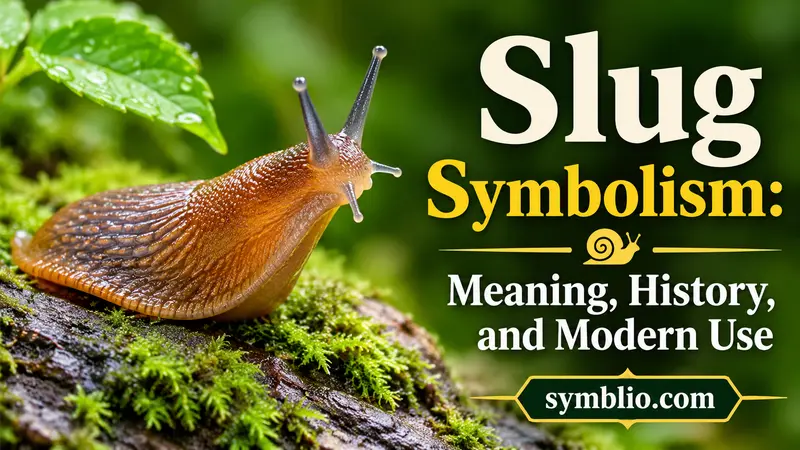
Slug symbolism is often associated with patience, vulnerability, persistence, adaptability, and the ability to survive in difficult conditions. Although slugs rarely receive the positive attention given to butterflies, birds, or other familiar animals, their unusual appearance and quiet way of moving offer interesting ways to think about human behavior and the natural world.
A slug is a soft-bodied terrestrial mollusk that moves without legs and usually has no external shell. It leaves a trail of mucus as it travels and prefers damp environments where its body can remain moist. People commonly encounter slugs in gardens, forests, flower beds, and other humid places, particularly after rainfall.
In American culture, slugs often have a mixed reputation. Gardeners may see them as unwanted visitors because some species damage vegetables and ornamental plants. Others appreciate them as small but important members of natural ecosystems. These contrasting reactions make slug symbolism especially interesting: the animal can represent both the challenges of living in nature and the value of overlooked creatures.
Understanding its symbolism requires separating established cultural traditions from modern personal interpretations. Unlike animals with extensive religious or mythological histories, the slug does not have one universally recognized symbolic meaning.
Quick Answer
Slug symbolism commonly represents patience, persistence, vulnerability, adaptability, and survival in modern American interpretations. Its slow movement and ability to thrive in moist environments also make it a personal symbol of taking life gradually, accepting limitations, and finding ways to continue through challenging circumstances.
TL;DR
- Slugs commonly represent patience, persistence, and adaptability.
- Their soft bodies suggest vulnerability and sensitivity.
- Their slow movement encourages deliberate living.
- Their survival abilities reflect resilience and resourcefulness.
- Garden associations connect them with nature and ecological balance.
- Modern interpretations appear in art, tattoos, and personal storytelling.
What a Slug Looks Like and Why Its Appearance Matters
A slug has an elongated, soft body, a broad muscular underside, and small tentacles extending from its head. Depending on the species, its coloring may range from pale cream and yellow to brown, gray, orange, or nearly black. Some species have distinctive patterns, stripes, or spots.
Unlike a snail, a typical land slug does not carry a large external shell. Some species retain a small internal shell or a reduced shell structure beneath their mantle, but it does not provide the visible protection associated with a snail’s shell.
These physical characteristics influence how people interpret the animal.
Its slow movement suggests patience and deliberate progress. Its exposed body can represent vulnerability, while its mucus trail provides a useful metaphor for leaving evidence of one’s journey.
The slug’s preference for damp surroundings also connects it with environmental sensitivity. It depends on conditions that support its survival rather than moving freely through every environment.
In visual art and storytelling, these characteristics can communicate an unusual combination of fragility, persistence, and independence.
The Core Symbolic Meanings of a Slug
Slug symbolism does not come from one established religious or historical tradition. Instead, its modern meanings largely develop from observing the animal’s behavior and appearance.
Several interpretations appear naturally when people consider how slugs live.
Patience
A slug moves slowly and does not appear to hurry toward its destination. This makes it a natural metaphor for patience.
Its movement can remind people that progress does not always happen quickly. Some personal goals require steady attention rather than immediate results.
For someone navigating a difficult period, a slug may represent the importance of allowing time for improvement.
Persistence
Although a slug moves gradually, it continues traveling in search of food, moisture, and shelter.
This behavior can symbolize persistence. It suggests that consistent effort matters even when progress seems modest.
Vulnerability
A slug lacks the obvious protective covering found on a snail. Its soft body is exposed to environmental conditions and potential predators.
Symbolically, this can represent emotional openness, sensitivity, and the experience of living without complete protection.
Adaptability
Slugs survive in different terrestrial environments, provided their basic needs are met.
Their ability to adjust to available conditions can represent flexibility and resourcefulness.
Simplicity
Slugs have a relatively uncomplicated appearance compared with many visually striking animals. This can make them symbols of modesty, simplicity, and an existence that does not depend on outward decoration.
These meanings are interpretations rather than universal rules. A person who associates slugs with unpleasant garden experiences may understand the animal differently from someone who appreciates its ecological role.
Ancient Origins and Historical Interpretations
The historical symbolism of slugs is less extensively documented than that of animals such as lions, snakes, eagles, or horses.
Ancient societies encountered shell-less mollusks in gardens, fields, and natural habitats. However, surviving cultural records do not establish one widely shared symbolic system specifically devoted to slugs.
It is also important to distinguish slugs from snails when discussing historical animal symbolism.
Snails have a visible shell that has inspired associations with protection, the home, circular patterns, and withdrawal. Slugs lack that prominent feature, so interpretations based on carrying a protective home do not apply in the same way.
In European medieval and early modern imagery, snails sometimes appeared in religious art, manuscripts, and unusual scenes involving knights. These images have attracted several scholarly interpretations, including associations with slowness, weakness, and moral behavior. They should not automatically be treated as evidence of an established slug tradition.
The distinction matters because older writing sometimes used animal terminology less consistently than modern zoology.
A cautious interpretation is therefore more useful: the slug’s historical associations developed through everyday encounters, natural observation, and occasional literary or artistic representation rather than a single ancient symbolic doctrine.
What Slug Symbolism Means in the United States
In the United States, the slug is most familiar as a garden animal rather than a religious or national emblem.
American gardeners frequently encounter slugs around lettuce, strawberries, seedlings, and other plants. Some species feed on living vegetation, while others consume decaying organic material.
This practical relationship influences public attitudes.
For many homeowners, a slug represents a gardening problem. For naturalists and wildlife enthusiasts, it represents an overlooked part of the ecosystem.
The animal also fits into broader American ideas about individuality and unconventional identity. Because slugs are not traditionally considered attractive or prestigious animals, choosing one as a personal symbol can communicate a willingness to appreciate things outside conventional standards.
In art and informal design, slugs may appear as humorous characters, unusual nature illustrations, or representations of slow living.
They can also remind people that not every valuable contribution to nature is visually appealing.
There is no widely recognized American holiday, national tradition, or mainstream religious ceremony centered on slug symbolism. Its cultural meaning remains largely personal, ecological, and creative.
Slugs as Symbols of Resilience and Survival
Resilience is one of the most meaningful modern interpretations of a slug.
The animal does not have the speed, strength, or protective equipment associated with many other creatures. Nevertheless, it survives through physical adaptations that allow it to navigate its surroundings.
Its muscular foot produces the movement needed to travel across surfaces, while mucus helps reduce friction and prevents its body from drying out. Many terrestrial slugs also become more active during damp weather because moisture is essential to their survival.
These characteristics provide a natural comparison with people who learn to work within their circumstances.
A person does not always need exceptional strength or speed to overcome difficulties. Sometimes the ability to adjust, conserve energy, and continue gradually makes the greatest difference.
As a personal symbol, the slug can represent someone who has experienced setbacks but continues moving toward meaningful goals.
It also challenges the assumption that resilience must look impressive. Quiet determination can be just as important as visible achievement.
Emotional and Psychological Meaning of the Slug
The slug can represent several emotional experiences because its appearance and behavior create contrasting impressions.
Its soft body suggests sensitivity. Its slow movement suggests calmness, while its preference for protected, moist environments can evoke the need for comfort and security.
For some people, the animal represents the experience of feeling exposed or misunderstood. They may identify with its unusual appearance or its tendency to remain hidden during unfavorable conditions.
Others associate it with emotional patience. Rather than demanding immediate solutions, the slug encourages a more measured approach to personal challenges.
There is also an interesting connection with self-acceptance.
Slugs are not conventionally attractive animals, and many people react negatively when they encounter them. Choosing to appreciate a slug can represent looking beyond appearance and recognizing value in something unfamiliar.
This interpretation can apply to personal identity, social acceptance, and the experience of feeling different from others.
However, slug symbolism does not have a scientifically established psychological meaning. These associations are reflective interpretations, not diagnostic signs or universal descriptions of personality.
The Slug as a Symbol of Slow Living
Modern American culture often emphasizes productivity, speed, achievement, and constant activity. Against this background, the slug offers an unusual image of slower movement.
Its pace can represent the idea that life does not need to be treated as a race.
Slow living is a lifestyle approach that encourages people to pay attention to everyday experiences, make deliberate decisions, and avoid unnecessary pressure. It does not mean abandoning ambition or refusing to work toward goals.
Instead, it places value on choosing a sustainable pace.
The slug fits this interpretation because its movement is gradual and closely connected to its physical needs and environment.
Someone who uses a slug as a personal emblem might associate it with:
- Taking time before making important decisions.
- Appreciating small accomplishments.
- Avoiding unnecessary competition.
- Respecting personal boundaries.
- Finding satisfaction in ordinary experiences.
This interpretation is particularly relevant in conversations about mindfulness and work-life balance.
The slug does not literally practice mindfulness, but its behavior offers a recognizable visual metaphor for moving through life without constant urgency.
Slug Symbolism in Different Cultures
Unlike the dragon, phoenix, or elephant, the slug does not have a consistent symbolic identity across major world cultures.
Its interpretation depends heavily on local folklore, environmental relationships, literature, and artistic traditions.
In parts of northern Europe, slugs have appeared in traditional children’s rhymes, folk observations, and practical household knowledge. Historical accounts from Sweden and neighboring regions describe children’s interactions with these animals and beliefs connected with their behavior.
These traditions demonstrate that slugs were not always treated simply as unpleasant garden creatures. They could also become familiar subjects of play, storytelling, and everyday observation.
In other European contexts, shell-less mollusks have sometimes been grouped with snails in discussions of slowness, humility, or undesirable behavior.
In modern ecological thinking, however, slugs are more often understood through their environmental roles.
They consume decaying organic matter, contribute to nutrient cycling, and serve as food for other animals. Their presence can therefore be interpreted as part of the interconnected natural world.
It is important not to assign the same meaning to every cultural tradition. A European folk belief, a modern American garden interpretation, and an individual’s personal experience are different forms of symbolism.
Religious and Spiritual Interpretations
The slug does not have a prominent, universally accepted role in major American religious traditions.
Christianity, Judaism, Islam, Hinduism, and Buddhism do not share a single established teaching that assigns the slug one specific spiritual meaning.
Some people may interpret its gradual movement as a reminder of patience, humility, or appreciation for creation. These are personal reflections rather than formal religious doctrines.
In Christian discussions, for example, people sometimes connect small creatures with the idea that every part of creation has a place. However, that broader theological principle should not be mistaken for a traditional Christian teaching specifically about slugs.
Similarly, someone interested in nature-based spirituality may view the animal as a reminder to respect living things that are often ignored or disliked.
Its dependence on moisture and favorable environmental conditions can also encourage reflection on the relationship between living organisms and their surroundings.
The most responsible approach is to distinguish personal spiritual interpretation from documented religious symbolism.
Ecological Symbolism: What the Slug Represents in Nature
Slugs have an important role in many terrestrial ecosystems.
Although some species damage cultivated plants, others feed heavily on decaying leaves, fungi, and other organic material. Their feeding activities contribute to decomposition and the movement of nutrients through natural environments.
They also provide food for birds, amphibians, reptiles, mammals, and certain invertebrates.
This ecological role gives the slug another possible symbolic meaning: interconnectedness.
A creature that appears insignificant when viewed alone may still contribute to the health of a larger environment.
The slug can therefore represent the importance of overlooked contributions. Not every organism needs to be large, attractive, or powerful to have ecological value.
It can also symbolize balance between human activity and the natural world.
For American gardeners, this interpretation introduces an important distinction. A slug may be unwanted in a vegetable patch while remaining a useful member of a nearby woodland ecosystem. Its value depends partly on the environment being considered.
Rather than describing every slug as either beneficial or harmful, it is more accurate to recognize that different species have different ecological effects. Missouri Department of Conservation+1
What Does a Slug Represent in Dreams and Personal Encounters?
Some people look for symbolic meaning when they dream about an animal or encounter one unexpectedly.
A slug may become a personal symbol of patience, discomfort, vulnerability, or the need to slow down.
For example, someone who sees a slug in a dream might associate it with a situation that seems to be progressing more slowly than expected. Another person might connect it with a desire for privacy or a need to feel more comfortable in unfamiliar surroundings.
The emotional atmosphere of the experience matters more than any universal interpretation.
A slug that appears harmless and interesting may create a different personal association from one that causes discomfort.
Similarly, encountering a slug in a garden does not establish that something supernatural is happening. Slugs commonly appear when moisture, temperature, shelter, and food conditions are suitable.
Personal reflection can make an ordinary encounter meaningful without treating it as a prediction or a guaranteed message.
Slug Symbolism in Tattoos, Jewelry, and Personal Art
Although slugs are less common tattoo subjects than butterflies, snakes, or flowers, their unusual appearance makes them interesting choices for unconventional artwork.
A slug tattoo can communicate several personal ideas depending on its design.
Patience and persistence: A simple crawling slug may represent steady progress and the decision to continue despite obstacles.
Self-acceptance: Someone may choose the animal because it is unconventional and challenges traditional ideas about beauty.
Connection with nature: A slug surrounded by leaves, mushrooms, flowers, or moss can represent appreciation for small organisms and natural environments.
Vulnerability: Its exposed body can express sensitivity, openness, or an acceptance of personal imperfections.
Humor and individuality: A colorful cartoon slug can communicate a playful personality and a preference for unusual subjects.
Design choices also influence the overall message.
A realistic slug may emphasize natural beauty and ecological awareness. A minimalist outline can suggest simplicity, while a whimsical illustration may make the subject more approachable.
Slug jewelry and decorative objects can carry similar personal meanings. However, there is no established American tradition assigning specific meanings to slug-shaped jewelry.
The symbolism usually comes from the wearer’s own interpretation.
Negative Meanings and Common Misunderstandings
Not all slug associations are positive.
In gardening and popular conversation, slugs are frequently connected with unwanted damage, damp conditions, and unpleasant textures.
Some people also use the word slug metaphorically to describe someone who is inactive or unmotivated. This negative association comes from human judgments about slow movement rather than any reliable description of the animal’s behavior.
Several misunderstandings deserve attention.
Slugs are not simply useless pests. Some species consume living garden plants, but others contribute to decomposition and serve as food for wildlife.
Slugs and snails are not identical symbols. Snails carry visible shells, while typical terrestrial slugs do not. Interpretations involving the snail’s shell as a home or protective covering should not automatically be transferred to slugs.
Slugs do not universally symbolize laziness. Their movement reflects their biology, not a lack of purpose.
A slug encounter is not a supernatural prediction. Finding one near a home or garden usually reflects environmental conditions.
These distinctions prevent a narrow cultural stereotype from becoming an inaccurate symbolic definition.
Slug Symbolism in Modern American Art and Popular Culture
In contemporary American creative culture, slugs can function as unusual characters, nature-inspired illustrations, and humorous visual motifs.
Their recognizable shape makes them suitable for children’s artwork, educational materials, animation, stickers, and playful designs.
Artists may use a slug to challenge conventional expectations about attractive subjects. Instead of choosing an elegant bird or colorful butterfly, they focus on a creature that is often ignored.
This choice can communicate originality and an appreciation for overlooked forms of life.
Slugs also fit into broader creative themes involving gardens, environmental awareness, slow living, and unconventional beauty.
On social media, illustrated slugs may appear as cute characters or humorous representations of everyday experiences. Their slow movement and unusual appearance make them easy subjects for playful storytelling.
These modern uses do not necessarily reflect ancient beliefs. They show how an ordinary animal can acquire new associations through design, humor, and individual creativity.
How Slug Symbolism Has Changed Over Time
The meaning of the slug has developed primarily through changing relationships between people and nature.
Historically, people encountered slugs as familiar creatures in agricultural areas, gardens, and damp natural environments. Their practical effects on plants often shaped how they were viewed.
Later, scientific observation helped explain their biological characteristics and ecological functions.
Modern environmental awareness has encouraged more people to consider the importance of organisms that may appear unattractive or inconvenient.
At the same time, contemporary personal symbolism has created additional interpretations involving resilience, individuality, vulnerability, and self-acceptance.
The shift is not a complete replacement of negative meanings with positive ones. Both perspectives continue to exist.
A gardener may still regard certain slugs as a problem, while an artist may celebrate the same animal as an example of unconventional natural beauty.
That difference illustrates how symbolism changes with context.
Comparing Slug Symbolism Across Different Contexts
The following table summarizes how the slug’s appearance and behavior can influence its interpretation.
| Context | Symbolic Meaning | Common Association |
|---|---|---|
| Personal growth | Patience and persistence | Gradual progress |
| Emotional life | Vulnerability and sensitivity | Openness and protection |
| Nature | Ecological connection | Decomposition and food webs |
| Personal identity | Individuality and acceptance | Unconventional beauty |
| Garden culture | Conflict and coexistence | Plant damage and wildlife |
These interpretations are not fixed cultural rules. They provide different ways to understand an animal whose reputation depends greatly on the observer’s experience.
FAQs
A slug can represent patience, vulnerability, adaptability, and appreciation for small forms of life. Some people interpret its gradual movement as a reminder to approach personal challenges with calmness and persistence.
There is no widely established tradition identifying slugs as universal good-luck symbols. However, individuals may associate them with positive ideas such as resilience, environmental awareness, and personal growth.
A slug tattoo can represent patience, individuality, self-acceptance, or perseverance. Its meaning depends on the design and the personal experiences of the person wearing it.
Some people associate slugs with laziness because of their slow movement. However, this is a human judgment rather than an accurate interpretation of their natural behavior, which is adapted to their physical needs and environment.
Snails are commonly associated with protection, home, and carrying one’s own shelter because of their external shells. Slugs are more naturally connected with vulnerability, adaptability, persistence, and sensitivity.
A slug near your house usually means that environmental conditions are suitable for it, particularly moisture, shelter, and available food. Symbolically, you may personally associate the encounter with patience or appreciation for nature, but it does not predict future events.
A slug can represent personal change and adaptation through its ability to respond to different environmental conditions. However, transformation is a modern personal interpretation rather than a widely documented traditional meaning.
Conclusion
Slug symbolism offers an unusual perspective on patience, persistence, vulnerability, and adaptability. Its slow movement and soft body make it a natural representation of gradual progress and sensitivity, while its ability to survive in different environments provides an example of resilience.
In the United States, the slug has a mixed reputation. Gardeners may consider it an unwanted visitor, while nature enthusiasts appreciate its contribution to ecosystems. Artists and individuals can also use it to express originality, self-acceptance, and respect for overlooked creatures.
Ultimately, the slug reminds us that value does not always come from speed, appearance, or strength. Sometimes the smallest and least celebrated creatures offer the most interesting ways to think about persistence and the natural world.


