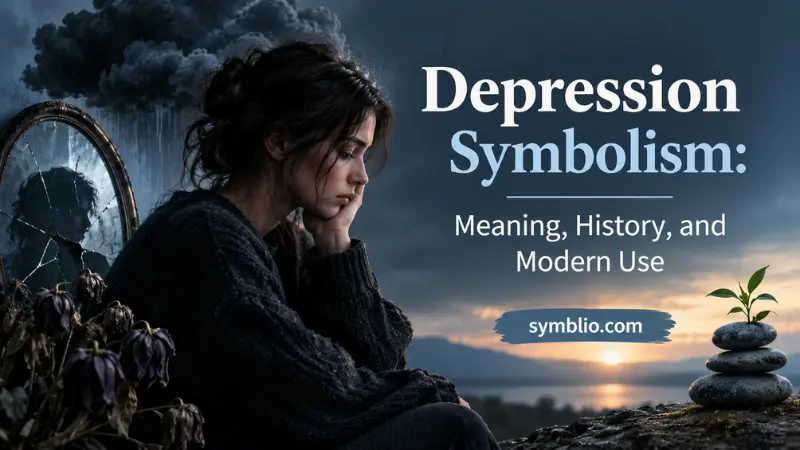
Depression symbolism uses colors, images, objects, and creative expressions to communicate the emotional experiences associated with depression. Common examples include gray skies, fading flowers, empty rooms, heavy clouds, and figures separated from their surroundings. These images can represent sadness, exhaustion, isolation, emotional numbness, or the difficulty of finding hope during a challenging period.
The meaning of these symbols depends on context. A wilted flower might represent grief in a painting, a difficult chapter in someone’s life, or the possibility of renewal. A dark room might communicate loneliness in a novel, while a small window of sunlight could suggest comfort or connection without implying that recovery happens quickly.
In the United States, these visual and literary representations appear in paintings, films, poetry, music, tattoos, social media, and mental health awareness campaigns. They give people ways to express experiences that can be difficult to explain in ordinary conversation. However, no single image captures everyone’s experience, and depression should not be reduced to sadness or a particular aesthetic.
Understanding depression symbolism means looking beyond the images themselves to consider their cultural origins, emotional associations, and the messages they communicate about mental health.
Quick Answer
Depression symbolism commonly represents emotional pain, isolation, exhaustion, and the struggle to feel connected to everyday life in modern American culture. Images such as gray skies, wilted flowers, empty spaces, and fading light have also developed broader associations with grief, hardship, vulnerability, and the possibility of change.
TL;DR
- Gray often represents emotional heaviness, uncertainty, or numbness.
- Wilted flowers can symbolize neglected needs, grief, or interrupted growth.
- Empty rooms and solitary figures frequently communicate isolation.
- Dark skies and fading light can express emotional difficulty.
- Art and literature offer different ways to communicate experiences of depression.
- Modern mental health awareness emphasizes understanding, compassion, and support.
What Depression Symbolism Represents
Depression does not have one universal symbol. Artists, writers, and individuals use different images to communicate experiences that may include persistent sadness, emotional numbness, fatigue, disconnection, and difficulty imagining a better future.
Several recurring themes help explain why certain images appear so often.
Isolation describes feeling separated from other people, even when surrounded by friends, family, or coworkers. Artists might express this feeling through a solitary figure, an empty chair, or a person standing behind a window.
Emotional heaviness suggests that ordinary responsibilities require unusual effort. A storm cloud, a burden carried on someone’s shoulders, or a landscape beneath a low sky can convey that weight.
Disconnection appears when familiar surroundings seem distant or unfamiliar. A busy street with one isolated figure, for example, can show the contrast between the activity of the outside world and someone’s private experience.
Loss of interest can appear through neglected gardens, unopened letters, or musical instruments left untouched. These images suggest a change in someone’s relationship with activities that once mattered.
Hope and renewal may emerge through a new leaf, a break in the clouds, or light entering a darkened room. Such images do not promise an immediate resolution; they simply leave room for change.
These meanings are interpretive rather than diagnostic. A person who enjoys dark art, prefers gray clothing, or draws empty landscapes is not necessarily experiencing depression.
The Historical Roots of Melancholy and Emotional Darkness
Long before depression became a modern medical term, people used stories, paintings, poetry, and religious imagery to describe prolonged sorrow and emotional suffering.
In ancient Greek medicine, melancholia was associated with the theory of bodily humors, particularly black bile. This explanation differs from contemporary medical understanding, but it influenced how later European thinkers discussed sadness, temperament, and mental distress.
During the Middle Ages and Renaissance, melancholy appeared in religious writing, philosophical reflection, and visual art. Artists sometimes portrayed sorrow through bowed heads, withdrawn figures, subdued colors, or solitary settings. These images could communicate mourning, spiritual reflection, or dissatisfaction with worldly life rather than clinical depression as understood today.
The Renaissance and early modern periods also developed a strong association between melancholy and contemplation. In some intellectual traditions, the melancholic figure became an image of a person absorbed in thought, aware of uncertainty, or burdened by difficult questions.
By the eighteenth and nineteenth centuries, Romantic literature and art increasingly explored isolation, grief, alienation, and the emotional force of nature. Stormy landscapes, deserted places, and figures facing vast scenery could express the limits of human control and the distance between inner experience and the outside world.
These traditions helped establish a visual vocabulary for emotional distress. However, historical melancholy and modern clinical depression are not interchangeable. Their meanings overlap, but their cultural and medical contexts differ.
What Gray and Black Mean in Depression Symbolism
Color is one of the most familiar ways to communicate difficult emotions. Gray and black appear frequently in visual representations of depression, but neither color has a fixed psychological meaning.
Gray often suggests uncertainty, emotional flatness, muted feelings, or a lack of contrast. In artwork, a gray palette can make a familiar setting seem distant or subdued. Some people also associate gray with neutrality, sophistication, or peaceful weather, so the color does not automatically imply sadness.
Black can represent grief, absence, uncertainty, or the feeling that something important is difficult to reach. In American culture, black clothing is also strongly associated with mourning and formal dress. These established associations make it useful for artists who want to communicate loss or emotional seriousness.
Blue sometimes represents sadness or loneliness in American expressions and popular culture. The phrase “feeling blue,” for instance, connects the color with a low mood. Yet blue also appears in images of trust, calm, open skies, and peaceful water.
White can suggest emptiness, distance, silence, or a blank emotional space. In other contexts, it may suggest cleanliness, innocence, or a fresh start.
Color meanings depend on combinations and context. A black background with a small warm light communicates something different from an entirely black image. Likewise, a pale blue room may feel restful to one viewer and lonely to another.
There is no single color that identifies depression, and personal color preferences do not establish a person’s mental health.
Depression Symbolism in American Art and Literature
American audiences encounter representations of depression through novels, paintings, memoirs, poetry, film, and television. These works use symbols to make an internal experience visible without assuming that every person experiences it in the same way.
One useful literary example is The Bell Jar by Sylvia Plath. The bell jar becomes a metaphor for separation from the ordinary world. Its transparent walls suggest that a person may see life continuing around them while feeling unable to participate fully. The image also conveys confinement, making it more specific than a general picture of darkness.
Memoir offers another approach. William Styron’s Darkness Visible uses darkness as a central image for the experience of severe depression. The metaphor communicates how an internal condition can dominate perception even when its causes and effects are not obvious to other people.
In visual art, an isolated person in a crowded setting can communicate alienation without requiring a literal explanation. Artists may also use distorted perspectives, limited color palettes, repeated patterns, or unusually large areas of empty space to suggest how a person’s surroundings feel to them.
American film and television often rely on changes in lighting, sound, pacing, and composition. A lively setting may appear muted during a character’s difficult period, or everyday sounds may recede as the character becomes withdrawn. Such techniques help viewers understand the contrast between external appearances and internal experience.
These artistic choices are not simply illustrations of a medical condition. They are interpretations shaped by the creator’s experience, the story’s purpose, and the audience’s cultural expectations.
Depression Symbolism in Modern American Culture
In the United States, depression is represented in a culture where conversations about mental health occur in schools, workplaces, entertainment, online communities, and public awareness campaigns.
Some representations focus on visible sadness: tears, rain, dark clothing, or a person sitting alone. Others emphasize the less obvious aspects of depression, such as exhaustion, difficulty concentrating, emotional numbness, or a loss of interest in familiar activities.
This second approach matters because depression does not always look dramatic. Someone may continue attending school, working, socializing, or caring for others while struggling internally. An image of an ordinary daily routine can sometimes communicate that contrast more effectively than a dramatic storm.
Contemporary American mental health communication also increasingly emphasizes compassion and access to support. Images of people listening to each other, open doors, supportive hands, or light entering a room may represent connection and the possibility of getting help.
There is no officially recognized universal visual emblem for depression. Different organizations and individuals choose different designs depending on their purpose. A public awareness graphic may prioritize clarity, while a personal artwork may communicate an emotion that the creator cannot easily describe.
The most useful representations leave room for varied experiences instead of suggesting that every person with depression feels or behaves alike.
Emotional and Psychological Meanings Behind the Images
Symbolism can help communicate emotions that are difficult to put into words. For some people, a visual metaphor offers a starting point for discussing experiences that feel confusing or private.
A heavy object might represent the effort involved in completing everyday tasks. The image turns an invisible sense of exhaustion into something a viewer can understand.
A foggy landscape may suggest difficulty concentrating, uncertainty, or an inability to see the next step clearly. Its indistinct outlines communicate confusion without implying that the person lacks intelligence or ability.
A stopped clock can suggest that time feels slow, repetitive, or disconnected from ordinary expectations. The image may reflect how difficult days can seem when motivation and enjoyment are reduced.
A distant crowd may represent feeling disconnected from others. It can communicate loneliness even when the person is not physically alone.
A closed door might suggest privacy, withdrawal, or a barrier between someone and the support available to them. Its meaning changes if another person stands nearby or if the door begins to open.
These interpretations are not universal psychological rules. They are possibilities shaped by personal associations, culture, and artistic choices.
It is also important to distinguish symbolic expression from diagnosis. A drawing of a foggy road cannot establish whether someone has depression, and a cheerful painting cannot prove that someone is feeling well. Depression is a health condition assessed through symptoms, their duration, their impact on daily life, and a qualified professional’s evaluation when needed.
How Nature Represents Depression and Recovery
Nature offers a flexible vocabulary for describing difficult emotional periods because its cycles include growth, decline, dormancy, and renewal.
Winter can represent withdrawal, stillness, or a period when ordinary life seems less active. In some contexts, it also suggests rest and preparation for a different season.
Bare trees may symbolize vulnerability, loss, or exposure. Their lack of leaves creates a stark visual contrast with the fuller appearance of trees in spring and summer.
Rain frequently represents sorrow or emotional release in literature and film. However, rain also sustains life, refreshes landscapes, and provides relief from heat, so its meaning depends on how the scene is presented.
Seeds and new growth can suggest gradual change. A seed does not become a mature plant immediately, making it a useful image for processes that take time and require suitable conditions.
Sunrise can represent a new beginning, renewed connection, or a willingness to consider possibilities. It need not imply that every difficulty has been resolved.
These natural images can communicate change without dividing experience into a simplistic contrast between darkness and happiness. A person may experience difficult emotions and moments of connection at the same time. Nature-based symbolism can reflect that complexity.
Religious and Cross-Cultural Interpretations
Ideas about sadness, suffering, isolation, and renewal appear in many religious and cultural traditions. However, these traditions do not share one universal symbol for depression, and their teachings should not be treated as interchangeable.
In Christianity, images of darkness, wilderness, lament, and waiting appear in different biblical passages and devotional traditions. They may express grief, uncertainty, spiritual struggle, or a longing for comfort. These images have religious meanings beyond modern mental health language.
In Buddhist traditions, teachings about suffering, attachment, impermanence, and compassion offer ways to reflect on difficult experiences. It would be inaccurate, however, to treat Buddhist concepts as direct equivalents of clinical depression or to assume that all Buddhist communities interpret suffering identically.
In many literary and artistic traditions, changing seasons, empty landscapes, and solitary figures communicate loss or reflection. The details vary according to local beliefs, historical circumstances, and artistic conventions.
Cultural context also affects how people express distress. Some individuals describe emotional pain openly, while others communicate it through physical sensations, family relationships, religious language, or artistic work.
Respectful interpretation requires attention to the particular tradition and the person using the symbol. A dark image should not automatically be interpreted as spiritual failure, and depression should not be presented as evidence of weak faith or insufficient gratitude.
Depression Symbolism in Tattoos, Jewelry, and Personal Style
People sometimes use personal symbols to express an experience that has shaped their lives. Tattoos, jewelry, clothing, and small decorative objects can become private reminders of a difficult period, a supportive relationship, or a change in perspective.
A wilted flower may represent a time of emotional difficulty or the recognition that a person needs care and understanding. Another person may choose a flower beginning to bloom to represent renewal.
A cloud can express uncertainty, a low mood, or the recognition that difficult periods occur. Paired with a clear sky, it may suggest that different emotional experiences can coexist.
A small light or lantern may represent connection, guidance, or support during an uncertain time. For someone else, it may simply be an image they find comforting.
A broken circle might represent disruption or a change in one’s sense of identity. It can also suggest openness or an unfinished process, depending on the design.
Personal meaning is more important than a supposed universal definition. A tattoo does not have to communicate a diagnosis to other people, and someone is not required to explain the private story behind a piece of jewelry or artwork.
It is also worth remembering that dark clothing, subdued designs, or certain aesthetic preferences do not indicate that a person is depressed. Style alone is not a reliable measure of emotional well-being.
Depression Symbolism on Social Media
Digital culture has made symbolic expressions of emotion easy to share. Photographs of rainy windows, muted landscapes, lonely city streets, and handwritten reflections frequently serve as visual shorthand for difficult moods.
These posts can help people feel understood. A person who struggles to explain an experience may find it easier to share an image that captures part of what they feel. Art and online communities can also create opportunities for empathy and thoughtful conversations about mental health.
At the same time, online representations can become overly simplified. If depression is always presented as a beautiful rainy scene, a sad playlist, or a dark visual aesthetic, viewers may miss its less visible effects on concentration, sleep, energy, relationships, and everyday responsibilities.
Some online content also treats depression as a personality type or an indicator of artistic depth. That framing can make a health condition seem like a lifestyle identity rather than a complex experience that deserves understanding and appropriate support.
A balanced approach allows people to express themselves creatively without assuming that every dark image signals illness or that suffering is necessary for creativity.
How the Meaning Changes Across Different Contexts
A symbol’s meaning becomes clearer when its setting, purpose, and surrounding details are considered together.
| Symbol | Common interpretation | Alternative meaning | Context to consider |
|---|---|---|---|
| Gray sky | Emotional heaviness or uncertainty | Calm, neutrality, reflection | Weather, lighting, and mood |
| Wilted flower | Grief, exhaustion, or neglected needs | Natural change or the end of a season | The surrounding story |
| Empty room | Isolation or withdrawal | Privacy, rest, or simplicity | Whether the space feels safe or lonely |
| Rain | Sadness or emotional release | Renewal, relief, or nourishment | What happens before and after the rain |
| Sunrise | Possibility or a fresh start | Passage of time or ordinary routine | Whether the image suggests change or simply a new day |
| Closed door | Separation or a barrier | Privacy, boundaries, or protection | Who controls the door and why |
The table illustrates why symbols should not be interpreted in isolation. A closed door may represent unwanted separation in one story and a healthy personal boundary in another.
For depression-related art, the surrounding details often determine whether an image suggests distress, rest, reflection, or recovery.
Common Misunderstandings About Depression Symbolism
One common misunderstanding is that depression always looks dark. In reality, someone experiencing depression may continue to laugh, attend events, complete responsibilities, and enjoy occasional positive moments. A visual representation cannot capture every aspect of the condition.
Another misconception is that sadness and depression are identical. Sadness is a normal human emotion that can arise in response to loss or disappointment. Clinical depression involves a broader pattern of symptoms that can affect mood, interest, thinking, physical functioning, and daily life.
People also sometimes assume that a particular color or object has an official meaning. There is no universal depression color, flower, animal, or tattoo. Interpretations vary between individuals and cultures.
A further misunderstanding is that recovery symbols should always look cheerful. Some people prefer subtle images of connection, patience, or gradual change rather than bright colors and triumphant scenes. A restrained image can communicate hope without minimizing the difficulty of the experience.
Finally, artistic expression should not be treated as proof of illness. A writer can create a convincing character experiencing depression without having depression themselves, just as someone living with depression may create work that appears cheerful or playful.
These distinctions help preserve the value of symbolism while avoiding stereotypes about people and mental health.
How Depression Symbolism Has Evolved
The language used to represent emotional suffering has changed alongside medicine, literature, and public attitudes toward mental health.
Earlier European traditions often discussed melancholy through religious, philosophical, or bodily explanations. Artistic images of isolation, darkness, and contemplation reflected those historical frameworks.
Nineteenth-century literature and art gave greater attention to individual experience, alienation, and the emotional effects of social change. Writers and painters used landscapes, solitude, and shifts in atmosphere to explore states that were not always visible to other people.
During the twentieth century, memoirs, novels, film, and psychological writing expanded the ways depression could be described. Personal narratives gave readers access to experiences that conventional public language often struggled to convey.
In contemporary American culture, symbolism serves several purposes at once. It may help a person communicate privately, support an educational campaign, create a character in a film, or start a conversation about mental health.
There is also greater recognition that depression can affect people across different ages, backgrounds, and circumstances. As a result, modern representations increasingly benefit from showing varied experiences rather than relying exclusively on a solitary, visibly sad figure.
The evolution continues as artists and communities find new ways to describe emotions, challenge stereotypes, and make room for individual differences.
Using Depression Symbolism With Care and Understanding
Thoughtful use of depression symbolism begins with recognizing the difference between representing distress and romanticizing it.
An artist can portray sadness honestly without presenting depression as attractive, inevitable, or necessary for meaningful creative work. A writer can depict isolation while also showing that relationships, treatment, and practical support matter. An awareness campaign can use subdued colors without implying that darkness defines every person who experiences depression.
When interpreting someone else’s artwork or social media post, it is better to remain curious than to make assumptions. An image might communicate a personal memory, an artistic preference, grief, or a feeling that has little to do with a clinical condition.
For someone who wants to express a difficult experience, symbols can provide useful language. A drawing, poem, photograph, or object may help start a conversation, but it does not need to explain everything. Personal expression and professional mental health care serve different purposes, and one does not replace the other.
If persistent low mood, loss of interest, or other changes are interfering with everyday life, talking with a trusted adult or qualified health professional can be an important step. Art may help people communicate what they are experiencing, while appropriate support can address the condition itself.
FAQs
There is no universally accepted symbol for depression. Gray skies, dark clouds, wilted flowers, and isolated figures are common artistic representations, but their meanings depend on personal and cultural context.
Gray, black, and blue are frequently associated with depression in art and popular American culture. However, none is an official or reliable indicator of depression, and each color has other meanings in different settings.
A wilted flower may represent emotional exhaustion, grief, interrupted growth, or a need for care. When shown beside new growth or a healthy flower, it may also communicate change and the possibility of renewal.
A depression-related tattoo may represent a personal experience, a period of difficulty, a supportive relationship, or a reminder of change. Its meaning depends on the person who chooses it rather than a universal symbolic rule.
Religious writing and art may use darkness, wilderness, lament, waiting, or images of comfort to explore suffering and uncertainty. These symbols have meanings within particular faith traditions and should not be treated as direct substitutes for a medical understanding of depression.
Can a dark aesthetic mean someone has depression?
No. Dark colors, melancholy music, solitary imagery, or interest in sad artwork do not establish whether someone has depression. The condition involves a broader pattern of symptoms and their effects on daily functioning.
Can symbols help people communicate depression?
Yes. Art, poetry, photographs, and visual metaphors can help people describe feelings that are difficult to explain directly. They can support communication and understanding, although they cannot diagnose depression or replace appropriate care.
Conclusion
Depression symbolism offers a visual and literary language for experiences such as isolation, emotional exhaustion, grief, and disconnection. Gray skies, empty rooms, fading flowers, and distant figures appear frequently because they can make private feelings easier to imagine and discuss. Their meanings remain flexible, shaped by the creator, the audience, and the context.
In modern American culture, depression symbolism is most useful when it encourages understanding rather than stereotypes. It can make room for difficult emotions while recognizing that depression does not look the same for everyone. Ultimately, these symbols are ways of communicating an experience, not definitions of the people who live through it.