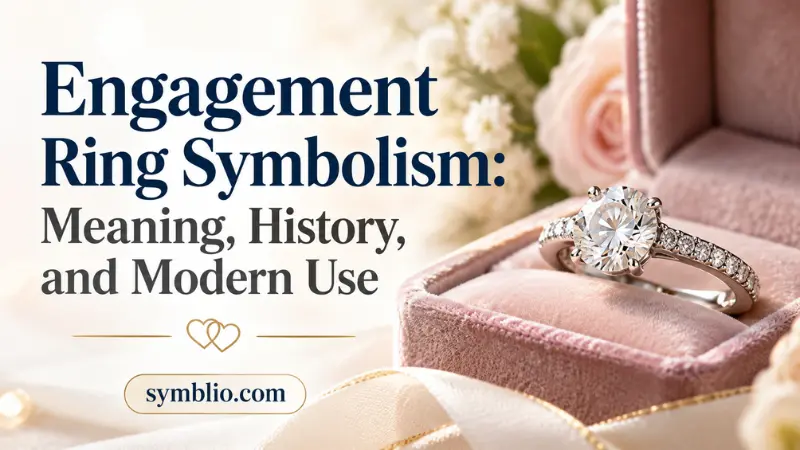
Engagement ring symbolism centers on love, commitment, and the intention to build a future together. In the United States, an engagement ring often marks a proposal and makes a private promise visible to family, friends, and the wider community. Its meaning, however, goes beyond the gemstone or the amount spent on it.
A simple gold band, a diamond solitaire, a vintage ring, and a colorful gemstone can all express commitment. Some couples choose rings because they appreciate their history, while others select a design that reflects their personalities, family traditions, or shared experiences. The object becomes meaningful through both its cultural associations and the relationship it represents.
The custom also has a complicated history. Rings have served as tokens of betrothal, marriage agreements, affection, and social status in different periods. The modern expectation that a diamond ring should accompany a proposal became especially influential in American culture during the twentieth century, shaped by advertising as well as older traditions.
Understanding these layers helps explain why an engagement ring can feel deeply personal without having one universal meaning or requiring a particular price, gemstone, or design.
Quick Answer
An engagement ring most commonly symbolizes love, commitment, and the intention to marry in modern American culture. Its circular shape is often associated with continuity, while gemstones and family heirlooms can express personal values, shared memories, and traditions that have evolved over centuries.
TL;DR
- Engagement rings traditionally mark a promise to marry.
- Their circular shape often represents continuity and an enduring bond.
- Diamonds became especially prominent through twentieth-century American advertising.
- Gemstones, settings, and engravings can express individual stories.
- Family heirlooms connect relationships across generations.
- A ring’s emotional meaning does not depend on its price.
What an Engagement Ring Represents
An engagement ring is a visible sign that two people have agreed to pursue marriage. In many American relationships, it marks the transition from dating to a formal engagement and communicates that intention to others.
The ring can represent several related ideas:
- Commitment: A shared decision to work toward a future together.
- Love: Affection and the emotional bond between partners.
- Trust: Confidence in the promise being made.
- Partnership: The intention to make important decisions as a team.
- Continuity: The hope that the relationship will endure through change.
These meanings often overlap, but they are not identical. Love describes an emotional connection, while commitment concerns the choices and responsibilities that support a relationship. An engagement ring can represent both.
Its meaning also depends on the couple. Some people regard the ring as an essential part of a proposal, while others prefer a private conversation, a different piece of jewelry, or no ring at all. The symbol has cultural importance, but couples can decide how it fits their own lives.
Why the Ring’s Circular Shape Matters
A circle has no obvious beginning or ending, which makes it a natural image for continuity. In engagement and wedding traditions, the ring’s shape is often interpreted as a wish for a lasting relationship.
This association is symbolic rather than a guarantee. A ring cannot promise that a relationship will remain unchanged, and the shape itself does not determine the strength of a couple’s commitment. Instead, the circle offers a simple visual expression of an intention to continue choosing one another.
The design also makes the ring easy to recognize. A small band worn on the hand can carry a message without requiring words, which helps explain why rings have become established markers of engagement and marriage in many communities.
Some people connect the circle with eternity, unity, or wholeness. Others simply appreciate its clean shape and practical design. Both responses are valid; the meaning comes from the traditions and personal associations attached to it.
The Historical Origins of Engagement Rings
The practice of using rings to mark a relationship developed over many centuries, and its history is not a single uninterrupted story. Ancient Egyptian, Greek, and Roman societies used rings in different personal, legal, and marital contexts. Roman betrothal rings could be made from iron or other materials, while more valuable metals also appeared in jewelry associated with status and commitment.
In some historical settings, a ring communicated an agreement between people or families. That function was not always identical to the modern idea of a romantic proposal. Marriage could involve financial arrangements, family expectations, and legal or social obligations alongside affection.
Medieval and Renaissance Europe brought additional developments in ring design. Some rings carried inscriptions, clasped-hand motifs, or gemstones. These details could express faithfulness, affection, or a promise, allowing the object to communicate more than its material value.
It is important not to project modern expectations backward onto every earlier ring. The historical meaning of a betrothal token varied by community and period. Today’s engagement ring draws on this long history, but its familiar role in American courtship developed through later social customs and commercial influences.
When Diamonds Became the Expected Choice
Diamonds are now strongly associated with engagement in the United States, but they were not always the automatic choice for a proposal. Earlier rings could feature other gemstones, precious metals, inscriptions, or designs without a central diamond.
One famous early example dates to 1477, when Archduke Maximilian of Austria gave Mary of Burgundy a diamond betrothal ring. The event helped establish a precedent among European elites, although diamond engagement rings remained far from a universal custom.
Diamond popularity expanded as cutting techniques improved and supplies became more available. In the United States, the twentieth century brought a major shift: advertising increasingly presented a diamond as the expected expression of serious romantic commitment.
In 1947, the diamond company De Beers introduced the slogan “A Diamond Is Forever.” Its advertising associated the stone’s durability with lasting love and helped reinforce the diamond engagement ring as a cultural ideal.
This history does not make the meaning of a diamond ring false or insincere. Advertising helped popularize a particular tradition, but couples have since attached genuine memories and personal values to it. It does show, however, that what feels like an ancient universal custom can also be shaped by modern culture.
What Engagement Rings Mean in American Culture
In the United States, an engagement ring often serves as both a personal keepsake and a public signal. Someone wearing one may be understood to be engaged, although not every person chooses to wear a ring or follow the same customs.
Proposals can take place at home, in a favorite restaurant, during a trip, or in front of family and friends. The ring may become part of the story people share afterward, especially when its design or the way it was presented has personal significance.
American culture also connects engagement rings with wedding planning, family celebrations, photographs, and announcements. A ring may appear in engagement pictures or become a treasured item that a couple remembers when marking anniversaries.
At the same time, the tradition is not uniform. Some couples shop for a ring together, while others prefer a surprise. Some exchange rings regardless of gender, and others choose matching bands or alternative symbols of commitment.
The important distinction is between a widely recognized custom and an obligation. In American life, the engagement ring is familiar, but no single ring style or proposal ritual defines a genuine relationship.
The Symbolism of Different Gemstones
The stone at the center of a ring can add a personal layer of meaning. Some associations come from longstanding gemstone traditions, while others reflect modern color symbolism or the wearer’s own preferences.
Diamond — endurance and commitment
Diamonds are often associated with durability, clarity, and lasting love. Their prominence in American engagement customs also reflects twentieth-century advertising and changing jewelry fashions.
Sapphire — loyalty and sincerity
Blue sapphires are often chosen for their associations with faithfulness, wisdom, and calm. They also appeal to people who want a distinctive color or a family connection to a particular gemstone.
Ruby — passion and devotion
Its red color is commonly linked with romance, vitality, and strong affection. A ruby may suit someone who prefers a vivid stone over a traditional colorless diamond.
Emerald — renewal and growth
Green is often associated with nature, freshness, and new beginnings. An emerald ring can express the idea of growing together while creating a distinctive personal style.
These associations are interpretations, not fixed rules. A person may choose a gemstone because it is a favorite color, matches another piece of jewelry, represents a birth month, or belonged to someone in the family. Personal meaning can be just as important as traditional symbolism.
How Ring Settings and Designs Communicate Meaning
The setting affects how a ring looks and can influence what it represents to the wearer. A solitaire, which features one central stone, often emphasizes simplicity and focus. Some people interpret the single stone as a symbol of one shared commitment.
Halo settings surround a central gemstone with smaller stones. They may appeal to someone who enjoys a bright, decorative look or wants to incorporate a vintage-inspired design. Three-stone rings can be interpreted as representing a couple’s past, present, and future, although this meaning depends on the story attached to the ring rather than on a universal rule.
Vintage rings may evoke continuity, family history, or appreciation for craftsmanship. A ring with engraved details or floral patterns can reflect a preference for intricate design and the traditions associated with heirloom jewelry.
Modern minimalist rings often communicate a different aesthetic: understated, practical, and personal. They may be chosen by people who prefer jewelry that fits everyday life rather than a dramatic centerpiece.
No setting has one compulsory meaning. A design can carry a traditional association, but the wearer’s reasons for choosing it help determine what it represents in a particular relationship.
The Meaning of the Metal
The metal can contribute to the ring’s appearance and personal significance. Gold, platinum, and other materials have different colors, properties, and histories, but none is inherently a better measure of love.
Yellow gold often evokes classic jewelry and traditional wedding bands. Its warm color may appeal to people who prefer a familiar look or want their engagement ring to coordinate with family jewelry.
White gold offers a light-colored appearance that works with many gemstone styles. It is often chosen for a contemporary look, although its popularity has changed with fashion over time.
Platinum is valued for its durability and naturally pale color. Some couples prefer it because it suits their lifestyle or the appearance they want, rather than because it carries a special romantic meaning.
Rose gold has a pinkish tone that can feel distinctive or vintage-inspired. Its color may suggest warmth or tenderness to an individual wearer, though those associations are subjective.
The metal can also reflect practical considerations such as maintenance, comfort, budget, and skin sensitivity. These everyday factors do not diminish symbolism. Choosing something that fits real life can itself reflect a thoughtful approach to partnership.
Wearing the Ring on the Left Hand
Many Americans wear engagement and wedding rings on the fourth finger of the left hand. This custom is commonly linked to an old belief that a vein ran directly from that finger to the heart. The supposed vein, sometimes called the vena amoris, is not anatomically accurate, but the story helped give the finger a romantic association.
The custom is not universal. In some countries and communities, engagement or wedding rings are worn on the right hand. People may also change hands for practical, cultural, religious, or personal reasons.
In the United States, the left-hand ring finger is widely recognized as a sign of engagement or marriage, but wearing a ring there does not have the same meaning for everyone. Some people use that finger for other jewelry, while others do not wear rings at all.
The important point is that the finger’s symbolism comes from convention, not from a physical connection to the heart. Its meaning remains recognizable because generations have continued to use the same custom.
Emotional and Psychological Meaning
An engagement ring can become a reminder of a specific moment: the proposal, a conversation about the future, or a decision made together. The object may be small, but its personal associations can grow over time.
For one person, the ring may symbolize feeling understood and valued. For another, it may represent a promise to handle difficult decisions as a team. A family ring can add memories of parents, grandparents, or relatives whose relationships influenced the wearer.
Jewelry can also make an abstract idea tangible. Commitment is not something another person can see directly, but a ring offers a visible object connected to that intention. This can help explain its emotional importance without suggesting that the ring itself creates trust or guarantees a lasting partnership.
Its meaning may also change over time. A ring that begins as a symbol of a proposal may later remind its wearer of a shared home, children, travel, challenges overcome, or years spent supporting one another.
These associations are personal rather than universal. The ring can serve as a meaningful reminder, but the relationship’s quality depends on how the people involved treat each other, communicate, and honor their commitments.
Family Heirlooms and the Connection Between Generations
An engagement ring passed down through a family can carry two stories at once: the commitment of the couple receiving it and the experiences of the people who wore it before them.
A grandmother’s ring, for example, may remind a family of a long marriage, a particular place, or a relative’s personality. Its value may come from the memories attached to it rather than from the stone or metal. Even a modest ring can become treasured when it connects people across generations.
Heirloom rings can also bring family expectations into an engagement. Some couples appreciate continuing a tradition, while others prefer a new design that reflects their own relationship. Neither choice has to be a rejection of the past.
When a ring is inherited, its history should be understood as part of its personal meaning rather than proof that the same symbolism applies to every family. A ring may have been chosen for its appearance, given during a difficult period, or redesigned over time. Learning its story can make the object more meaningful than relying on a general interpretation of its style.
Religious and Cross-Cultural Interpretations
Engagement rings are used in many cultural settings, but their significance differs across religions, communities, and families. In some Christian wedding traditions, rings feature in ceremonies as visible signs of vows and fidelity. Other couples may include religious inscriptions or select designs that reflect their beliefs.
Jewish wedding customs traditionally give particular importance to the wedding ring during the marriage ceremony. The details of the ring and the ceremony follow religious requirements and community practice, so an engagement ring should not be assumed to have the same role in every Jewish tradition.
In other communities, engagement may be marked by gifts, family gatherings, clothing, ceremonies, or exchanges involving both families. A ring may be part of these practices, but it is not the only way to communicate a serious intention to marry.
The distinction matters because the modern American diamond engagement ring is not a universal cultural standard. Couples may follow a religious tradition, combine customs from different backgrounds, or create a practice that reflects their own values.
Respectful interpretation begins with the people involved. Rather than assuming that one ring design represents love in exactly the same way everywhere, it is more accurate to recognize that symbols gain meaning within specific cultural and personal contexts.
Social Pressure, Cost, and Misunderstandings
Engagement rings can be associated with joy and commitment, but they can also bring social pressure. Advertising, celebrity proposals, social media photographs, and popular wedding content sometimes present expensive rings as proof of how much someone is loved.
That message can confuse financial spending with emotional commitment. A costly ring does not automatically indicate a healthier relationship, and a simple ring does not imply less affection. Couples have different incomes, priorities, and ideas about what matters.
The expectation that a diamond must be used is also a relatively modern cultural norm rather than a requirement that applies to every engagement. Colored gemstones, family jewelry, plain bands, and other meaningful choices can represent the same intention.
Another misconception is that a ring must be a surprise. Some people enjoy a traditional proposal, while others prefer to choose the ring together. Discussing style, budget, and practical needs can be a sensible part of making a shared decision.
The ring’s meaning should not be used to measure a person’s worth or the seriousness of a relationship. Its most useful role is to represent a commitment that the couple themselves understands and accepts.
Engagement Ring Symbolism at a Glance
| Ring feature or context | Common symbolic association | Important note |
| Circular band | Continuity and lasting commitment | A symbol of intention, not a guarantee |
| Diamond | Endurance and lasting love | Its modern popularity was shaped partly by advertising |
| Colored gemstone | Individuality and personal meaning | Associations vary by stone and wearer |
| Family heirloom | Memory and generational connection | Its story is specific to the family |
| Engraving | A private promise or shared memory | The words or symbols give it personal context |
| Simple band | Understated commitment | A modest design can carry great meaning |
How Engagement Ring Symbolism Continues to Change
The meaning of engagement rings continues to evolve as relationships and social expectations change. Couples may choose rings together, wear matching styles, use alternative gemstones, or select jewelry made from recycled materials. Some prefer lab-grown diamonds, while others prioritize family history, durability, or a design that feels different from conventional styles.
These choices can express values beyond romance. A ring might reflect environmental concerns, a commitment to buying thoughtfully, or a preference for practical jewelry that suits everyday life. The central idea remains the intention to marry, but the way people communicate that intention is becoming more varied.
The symbolism has also become less tied to one particular relationship model. Men and people of different genders may wear engagement rings, and couples can decide what engagement jewelry means to them without following a single prescribed custom.
Social media has made ring designs more visible, but visibility can encourage comparison. A more personal approach asks what the ring means to the couple, rather than whether it matches a trend.
As customs change, the engagement ring remains recognizable because people continue to use it to mark a meaningful decision. Its enduring role comes not from one required gemstone or price, but from the promise people choose to associate with it.
FAQs
An engagement ring most commonly represents love, commitment, and an intention to marry. For many couples, it also becomes a keepsake associated with the proposal and the beginning of a new stage in their relationship.
Diamonds became especially popular in American engagement customs during the twentieth century, partly because of successful advertising campaigns. Their durability also made them an appealing symbol of lasting commitment, but diamonds are not required for an engagement ring to be meaningful.
Some people view an engagement ring as a reminder of a shared promise, faithfulness, or a relationship guided by religious values. Spiritual meaning depends on personal beliefs and cultural traditions rather than on the ring having an inherent supernatural property.
No. A ring’s cost does not reliably measure affection, trust, or commitment. Its meaning comes from the intention behind the gift and the relationship it represents, not from a particular price tag.
A family heirloom can represent continuity, remembrance, and a connection between generations. Its meaning may become more personal when the couple knows who previously wore it and why it was treasured.
Yes. A plain band, sapphire, ruby, emerald, or another design can represent the same intention to marry. Couples can choose a ring based on personal taste, family history, cultural customs, or practical considerations.
No. The left-hand ring finger is a familiar custom in the United States, but ring placement varies among cultures and individuals. The couple can follow a tradition that matters to them or choose a different arrangement.
Conclusion
Engagement ring symbolism brings together love, commitment, continuity, and the intention to build a future together. Historical betrothal customs, the circular shape of the band, gemstone traditions, and modern American culture have all influenced what the ring means today. Yet no single material, style, or price defines its significance.
For some couples, a diamond solitaire reflects a familiar tradition; for others, a colored stone, simple band, or family heirloom tells a more personal story. The most meaningful ring is one that reflects the people who choose it and the promise they want it to represent.