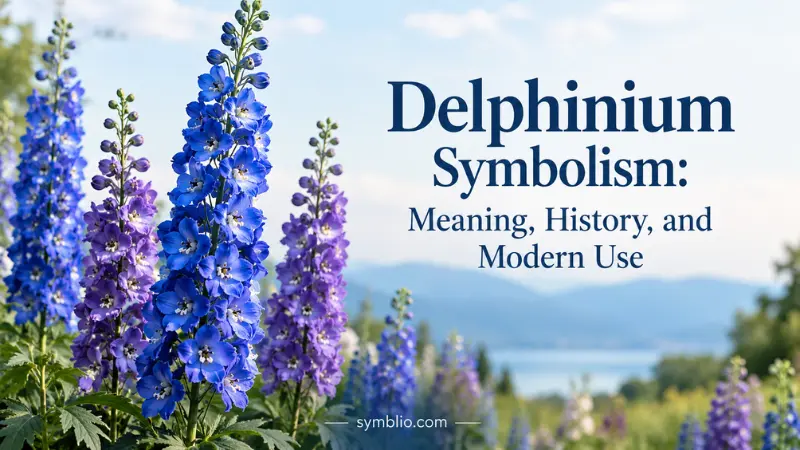
Delphinium symbolism connects a striking garden flower with ideas of openheartedness, affection, lightness, and positive feeling. Known for tall flower spikes in blue, purple, pink, and white, delphiniums are especially recognizable in summer gardens, bouquets, weddings, and decorative arrangements.
The flower also has an interesting history behind its name and symbolism. Its botanical name comes from the Greek word associated with a dolphin, while the common name larkspur refers to the flower’s spur-like structure. Over time, botanical tradition, European flower language, gardening culture, and modern floral design have contributed to the meanings people attach to it.
In the United States, delphiniums are often appreciated less as a fixed symbolic code and more as flowers that communicate warmth, admiration, celebration, and an open spirit. Their tall form and vivid colors also make them particularly effective when a bouquet needs height and visual emphasis.
Quick Answer
Delphinium symbolism commonly represents an open heart, affection, lightness, and positive feeling in modern American flower culture. Historically, its associations developed through flower-language traditions, while its name and appearance also connect it to older Greek and European botanical traditions.
TL;DR
- Delphiniums commonly suggest openness, affection, and cheerful feeling.
- The name comes from a Greek word associated with dolphins.
- Larkspur and delphinium names are closely connected but botanically complicated.
- Blue varieties often suit weddings, celebrations, and formal arrangements.
- July birth-flower traditions frequently associate larkspur with delphinium.
- Modern symbolism depends heavily on color and personal context.
What Delphinium Looks Like and Why Its Shape Matters
Delphiniums are members of the buttercup family, Ranunculaceae. Many cultivated varieties produce tall stems covered with numerous individual flowers, creating an upright spike that can become a strong focal point in a garden or floral arrangement.
The flowers may appear in shades of blue, violet, purple, pink, and white. Some varieties have relatively open flowers, while others produce fuller, more densely packed spikes.
One distinctive feature is the elongated spur extending from the flower. That structure helps explain both the botanical name and the common name associated with the plant.
The genus name Delphinium comes from the Greek word for dolphin, traditionally connected with the shape of part of the flower. The common name larkspur refers to a different resemblance: the flower’s spur has been compared with the claw or spur of a lark.
This unusual combination of names gives the flower a symbolic character based partly on observation. Its meaning did not come from one single ancient tradition; rather, different names and later flower-language systems added layers of interpretation.
The Main Symbolic Meaning of Delphiniums
The most useful way to understand delphinium symbolism is to focus on emotional openness and positive attachment.
Older flower-language traditions associated larkspur with ideas such as lightness, levity, an open heart, and affection. Modern floral interpretations often broaden those ideas into friendliness, admiration, encouragement, and a generous spirit.
That makes delphiniums particularly suitable when someone wants flowers that feel positive without carrying the highly specific romantic message associated with red roses.
A bouquet of blue delphiniums, for example, can look appropriate at a wedding, graduation, anniversary, or celebration of an accomplishment. The same flower can also work in a friendship bouquet because its symbolism does not have to be exclusively romantic.
The important distinction is that flower symbolism is interpretive rather than universal. Different dictionaries and traditions have assigned different meanings to the same flower, so delphinium should not be treated as having one mandatory definition.
Ancient Roots Behind the Name
The history of the plant’s name reaches back to Greek botanical writing. The genus name Delphinium is connected with delphis, meaning dolphin, because the flower’s structure was thought to resemble the animal.
This does not mean that ancient Greeks used delphiniums with the exact symbolic meanings found in modern flower-language guides. That distinction matters.
A plant can have an ancient name origin without having a continuous ancient symbolic tradition. In the case of delphinium, the dolphin connection is primarily an explanation of its botanical name and appearance.
Later European naming traditions introduced another layer through the name larkspur. The two terms are closely associated in everyday horticultural language, although botanical classification is more complicated than simply saying they are always identical. Some plants called larkspur belong to Delphinium, while the name has also historically been applied to Consolida.
How Victorian Flower Language Shaped Its Meaning
The modern idea that individual flowers carry specific emotional messages owes much to floriography, commonly called the language of flowers.
The tradition became particularly fashionable in Britain and America during the nineteenth century. Its roots can be traced to France, where Charlotte de la Tour’s 1819 Le langage des fleurs helped popularize the practice. By the Victorian period, people could use bouquets to communicate feelings indirectly.
Larkspur appeared in these flower-language traditions with meanings connected to lightness and an open or affectionate spirit. Modern lists do not always agree on the exact wording, which is one reason it is better to describe delphinium symbolism as a group of related associations rather than a single fixed definition.
This historical background explains why modern flower-meaning articles sometimes give different interpretations. Flower symbolism was never governed by one universal dictionary.
What Delphinium Symbolizes in the United States
In contemporary American culture, delphiniums are usually encountered as garden flowers and decorative cut flowers, rather than as formal symbolic codes.
Their symbolism is therefore often communicated through context.
At a wedding, their tall stems can suggest celebration, openness, and a graceful beginning. At a graduation or achievement ceremony, blue or purple delphiniums can complement themes of confidence and admiration. In a friendship bouquet, their bright vertical blooms can create a cheerful and generous impression.
The flower is also associated with July through popular birth-flower traditions. Larkspur is commonly listed as one of July’s birth flowers, although birth-flower lists are customs rather than scientific classifications.
For Americans choosing flowers today, the occasion, color, and relationship usually matter more than a strict historical definition.
Delphinium Symbolism by Color
Color can change how a delphinium arrangement feels. These associations are modern interpretations rather than universal rules.
| Color | Common U.S. Association | Typical Context | Overall Impression |
|---|---|---|---|
| Blue | Trust, calm, admiration | Weddings, congratulations, formal bouquets | Serene and confident |
| Purple | Distinction, admiration, elegance | Ceremonies and special occasions | Refined and expressive |
| Pink | Affection, warmth, appreciation | Birthdays and friendship | Soft and friendly |
| White | Purity, sincerity, remembrance | Weddings and memorial settings | Clean and restrained |
| Lavender | Grace and gentleness | Decor and thoughtful gifts | Delicate and calm |
Blue receives particular attention because blue delphiniums are among the flower’s most recognizable forms. Their tall spikes can give an arrangement a formal appearance without making it feel heavy.
At the same time, color symbolism should not be treated as a strict code. A person may choose blue simply because it is their favorite color or because it matches an event’s design.
Delphiniums and Weddings
Delphiniums have a practical and symbolic role in wedding flowers.
Their vertical growth creates height and structure, making them useful in bouquets, ceremony arrangements, table displays, and larger floral installations. Blue varieties can complement white flowers particularly well, while purple and pink forms create a softer palette.
Symbolically, the flower can fit weddings because ideas such as openheartedness, affection, optimism, and positive attachment suit the emotional character of the occasion.
However, there is no universal rule stating that a bride or groom must use delphiniums to communicate a particular message. Contemporary weddings are highly personalized, and couples commonly choose flowers based on color, season, availability, family associations, or visual style.
The symbolism works best as an added layer rather than the sole reason for choosing the flower.
Delphinium as a July Birth Flower
Larkspur is widely recognized as a July birth flower, and many modern birth-flower references connect larkspur with Delphinium.
That makes delphinium an appealing choice for July birthdays, especially when someone wants a floral gift with a seasonal connection.
The association also gives the flower a slightly different meaning from ordinary bouquet symbolism. Instead of representing a particular relationship, the flower can become a marker of birth, identity, celebration, and personal connection to a month.
It is worth remembering that birth flowers are cultural customs rather than official botanical designations. Different calendars may assign more than one flower to the same month.
Emotional and Psychological Associations
Delphiniums naturally lend themselves to uplifting visual associations.
Their stems grow upward, their flowers are displayed prominently along the stalk, and many varieties have vivid blue or purple coloration. As a result, people may perceive them as energetic, optimistic, open, or celebratory.
That does not mean the flower has a scientifically established psychological effect. Instead, the emotional response comes from a combination of color, shape, cultural association, and personal experience.
Blue may suggest calm or reliability to many Americans, while purple can feel formal or distinctive. Pink can make an arrangement seem warmer and more affectionate. White often creates a cleaner or more restrained appearance.
The same flower can therefore communicate different emotions depending on how it is presented.
Delphiniums in Memorial and Remembrance Settings
Delphiniums are not exclusively celebratory flowers.
White and blue flowers can appear in remembrance arrangements because their restrained colors can suit settings where people want to express respect without creating an overly romantic tone.
The flower’s historical associations with affection and an open heart can also take on a different meaning in memorial contexts. Instead of communicating romantic attachment, those qualities may represent lasting affection, appreciation, or remembrance of someone important.
This is an example of why symbolic meaning depends on context. A flower does not carry one emotional message in every situation.
Why Delphiniums Appear in Gardens and Home Decor
Delphiniums have long been valued as ornamental plants because their tall flower spikes create strong vertical lines in garden beds.
In American gardens, that makes them useful for adding height behind shorter flowers. Cut stems can perform a similar function indoors, where they provide a vertical accent in vases and larger arrangements.
Their symbolism complements this visual role. The upward-growing shape can be read informally as a representation of aspiration, optimism, or reaching toward something, although these interpretations are modern visual associations rather than established historical definitions.
In home decor, the flower can therefore communicate a mood without requiring the owner to follow a traditional flower-language system.
Delphinium in Tattoos, Jewelry, and Personal Style
Delphinium tattoos are less standardized than rose, lotus, or sunflower tattoos, which gives people more freedom to personalize their meaning.
Someone might choose a delphinium to represent a July birthday, an open heart, affection, a memorable garden, or a connection to a particular person. Blue or purple flowers can also be selected primarily because of their visual appeal.
A delphinium motif in jewelry can similarly function as a birth-flower reference or a decorative botanical design. In these settings, personal symbolism generally outweighs historical flower dictionaries.
That distinction is important: modern tattoo symbolism is often autobiographical. The flower’s traditional meaning may provide inspiration, but the wearer ultimately determines what the design represents.
Cross-Cultural and Mythological Associations
Delphinium symbolism should not be reduced to one Greek myth.
The strongest ancient connection is linguistic and botanical: the Greek-derived name refers to a dolphin-like feature of the flower. Later European traditions developed their own naming and flower-language associations.
There are also stories connecting larkspur-like flowers with Greek mythology, particularly the story of Ajax and the flowers associated with his death. However, the identification of the specific flower in ancient and later retellings is not consistently straightforward, and larkspur has sometimes been confused with other flowers in these traditions.
For that reason, it is better to present the Ajax story as a later literary and mythological association with larkspur, not as definitive proof that ancient Greeks assigned modern delphinium symbolism to the plant.
This cautious approach keeps mythology interesting without turning uncertain identifications into historical facts.
Common Misunderstandings About Delphinium Symbolism
One common misunderstanding is that delphinium and larkspur are always exactly the same plant. Everyday usage often treats the names as interchangeable, but botanical classification is more complicated, and larkspur has also been used for plants outside Delphinium.
Another misconception is that every color has one universally accepted meaning. Historical flower-language dictionaries differ, and modern florists often use broader color associations.
It is also important not to confuse beauty with safety. Delphinium and larkspur plants contain toxic alkaloids, and USDA research identifies larkspur as a significant poisonous-plant problem for livestock in parts of the western United States.
That toxicity does not create a standard symbolic meaning such as danger or death. It is a botanical characteristic, not the flower’s conventional cultural message.
How Delphinium Meaning Has Changed Over Time
The symbolism surrounding delphinium has shifted from relatively formal flower-language systems toward more flexible personal interpretation.
During the nineteenth century, flower dictionaries attempted to assign specific emotional messages to individual plants. A bouquet could therefore function almost like a coded letter.
Modern Americans rarely rely on such a strict code. Instead, delphiniums are interpreted through several overlapping influences: color psychology, birth-flower traditions, gardening culture, wedding design, personal memories, and contemporary floral aesthetics.
The older meanings have not disappeared, but they have become less rigid. An open heart, affection, optimism, admiration, or celebration can all fit the flower without requiring the sender to follow a Victorian dictionary exactly.
What Delphiniums Can Represent Today
In modern use, delphiniums can represent different ideas depending on the situation:
- Openheartedness — connected to older flower-language traditions.
- Affection — suitable for friendship, family, or romantic relationships.
- Joy and lightness — associated with older larkspur meanings.
- Admiration — especially fitting for congratulations and milestones.
- Celebration — common in weddings, birthdays, and formal events.
- Personal identity — particularly through July birth-flower traditions.
- Remembrance — possible when used in a restrained memorial arrangement.
These meanings work best when treated as interpretations rather than rules. The same blue delphinium can mean friendship to one person, a July birthday to another, and simply “beautiful summer flower” to someone else.
FAQs
Delphiniums are commonly associated with an open heart, affection, lightness, and positive feeling. Modern interpretations may also connect them with admiration, celebration, and encouragement.
A delphinium tattoo can represent an open heart, affection, a July birthday, or a personal connection to the flower. Because tattoo symbolism is highly individual, the owner’s personal story usually matters more than a traditional flower dictionary.
The names are closely related but are not perfectly interchangeable in botanical usage. Delphinium is a plant genus, while “larkspur” has historically been used for several plants, including members of Delphinium and Consolida.
Larkspur is commonly listed as a July birth flower, and many modern birth-flower traditions associate it with Delphinium. Birth-flower lists are customary rather than official botanical classifications.
Blue delphiniums are often interpreted as representing calmness, trust, admiration, and positive regard in modern floral contexts. Their color can also simply be chosen for its distinctive appearance.
Delphinium does not have one standard negative symbolic meaning in modern American flower culture. Some historical flower-language lists gave individual colors or varieties less flattering associations, but those interpretations are not universal.
The botanical name has a clear Greek linguistic connection because Delphinium derives from a word associated with dolphins and the flower’s shape. Larkspur has also been connected with later retellings of Greek myths, including stories involving Ajax, but those flower identifications should be treated cautiously.
Conclusion
Delphinium symbolism is best understood as a combination of openheartedness, affection, lightness, admiration, and celebration, rather than as one rigid definition. Its unusual botanical name, Victorian flower-language associations, July birth-flower tradition, and modern use in gardens and floral design all contribute to how people interpret it today.
In the United States, the flower’s meaning usually depends on the occasion, color, and personal connection. A blue delphinium at a wedding, a July birthday bouquet, and a memorial arrangement can communicate different emotions while still drawing on the flower’s long association with openness and positive attachment.
That flexibility is part of what makes delphinium useful as a modern symbol: its history provides a starting point, while the person giving or receiving the flower gives the final meaning.