
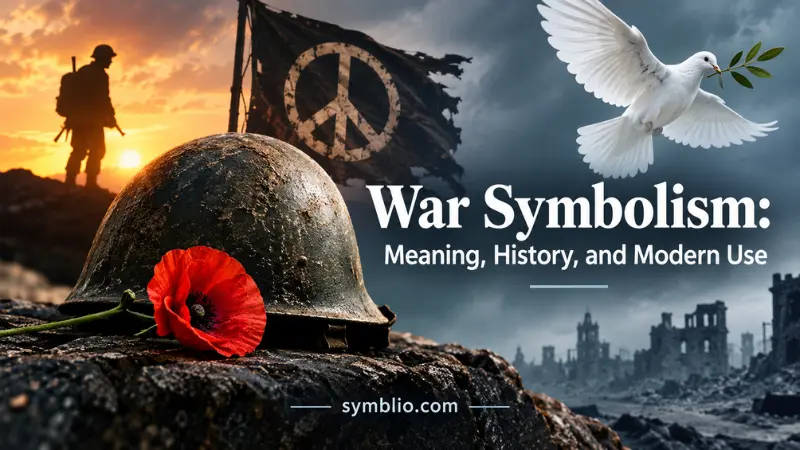
War symbolism appears in monuments, flags, memorial ceremonies, military traditions, literature, films, tattoos, public art, and national rituals. These symbols rarely represent combat alone. They can communicate sacrifice, courage, grief, duty, victory, loss, remembrance, resistance, or the hope that conflict will end.
In the United States, war-related symbols are closely connected with national history. The American Revolution, Civil War, World Wars, Vietnam, and more recent conflicts have each produced distinctive ways of remembering those who served and those who died. Memorials and ceremonies often transform the subject of war from an event on a battlefield into something connected with families, communities, citizenship, and national memory.
The meaning of a war symbol also depends on context. A flag may represent national unity in one setting, while a memorial may emphasize grief and remembrance. A poppy can commemorate people who died in war, while an olive branch can communicate the desire for peace after conflict.
Quick Answer
War symbolism commonly represents sacrifice, remembrance, military service, courage, loss, and the desire for peace in modern American culture. Historically, war-related symbols have also expressed victory, national identity, resistance, mourning, and political power.
TL;DR
- War symbols often balance remembrance with ideas of courage and service.
- American memorial traditions developed strongly after the Civil War.
- Flags can represent national identity during wartime.
- Poppies are associated with remembering Americans who died in war.
- Memorials increasingly emphasize individual lives rather than battlefield glory.
- Modern art can question war while still honoring those affected.
What War Symbols Represent
War does not have one universal symbolic meaning, so neither does its imagery. Different symbols highlight different experiences.
Common meanings include:
- Sacrifice: The loss or hardship endured by service members and families.
- Remembrance: Keeping the names and experiences of the dead within public memory.
- Courage: Recognizing people who faced danger while serving.
- Duty: Representing obligations to country, community, or a cause.
- Loss: Acknowledging death, injury, separation, and grief.
- Victory: Marking the conclusion of a conflict or the achievement of a military objective.
- Resistance: Representing opposition to occupation, oppression, or aggression.
- Peace: Expressing the hope that violence will end.
This explains why two symbols associated with the same war can communicate very different ideas. A military medal may emphasize service, while a memorial wall may focus on individual loss.
Ancient Roots and Early Symbolism
Long before modern nations existed, societies used visual signs to identify armies, leaders, victories, and defeated enemies. Standards, banners, shields, ceremonial weapons, animals, crowns, and religious imagery could distinguish one group from another.
Ancient cultures also connected warfare with mythology and religion. Deities associated with battle could symbolize protection, strength, strategy, or destruction. In Greek mythology, for example, Athena was associated with strategic warfare as well as wisdom, while Ares represented a more direct and violent aspect of battle.
Roman military standards carried political and religious importance. The eagle became particularly associated with Roman military power and authority. Similar patterns appeared elsewhere, where animals, celestial imagery, colors, and sacred symbols helped communicate the identity of rulers and armies.
These older traditions established an enduring principle: war symbols often communicate more than the act of fighting. They can express who is fighting, why they claim to be fighting, and what the conflict is supposed to mean.
How War Symbolism Developed in the United States
American war symbolism changed significantly as the country experienced its own conflicts.
During the Revolutionary era, flags, militia imagery, patriotic slogans, and national emblems helped establish a shared identity among supporters of independence. The American flag eventually became one of the country’s most recognizable symbols of national unity.
The Civil War introduced a different emotional dimension. The enormous number of deaths created new mourning and memorial traditions. Graves were decorated with flowers and flags, and communities developed ceremonies for remembering soldiers. These practices contributed to the development of Decoration Day, which eventually became Memorial Day.
The Civil War also demonstrated that war symbolism could be complicated. Different groups remembered the same conflict in different ways, and monuments could communicate competing interpretations of history.
By the twentieth century, American war symbolism increasingly included formal memorials, military cemeteries, medals, remembrance flowers, and public ceremonies.
What War Symbolism Means in the United States
In modern American culture, war symbolism is often connected with memory rather than enthusiasm for warfare itself.
Memorial Day provides one of the clearest examples. The holiday specifically remembers military personnel who died while serving. Veterans Day has a different emphasis: it honors those who served, including living veterans.
This distinction matters because symbols associated with the two observances can communicate different messages. A Memorial Day display may focus on mourning and remembrance, while Veterans Day ceremonies commonly emphasize appreciation for military service.
American war memorials also show how symbolism has changed. Earlier monuments often emphasized generals, victories, heroic figures, or classical imagery. Later memorials increasingly incorporated names, personal stories, stark landscapes, and spaces for quiet reflection.
The Vietnam Veterans Memorial in Washington, D.C., is especially significant in this development. Its long wall of names places individual lives at the center rather than presenting a conventional heroic battlefield scene. The design encourages visitors to confront the human cost of the conflict.
Common Symbols Associated With War
Different symbols emphasize different parts of the war experience.
| Symbol or Image | Common U.S. Meaning | Main Association | Important Context |
|---|---|---|---|
| American flag | National identity and unity | Service and patriotism | Meaning changes with context |
| Red poppy | Remembrance of the war dead | Memorial Day | Particularly associated with World War I |
| Military medal | Service and recognition | Courage and duty | Usually tied to a specific achievement |
| Memorial wall | Individual remembrance | Loss and reflection | Names make personal sacrifice visible |
| Wreath | Honor and mourning | Memorial ceremonies | Used in military and civilian traditions |
| Dove or olive branch | Peace after conflict | Reconciliation | Often contrasts with war imagery |
The same object can carry different meanings depending on where and how it appears. A flag displayed at a military funeral does not communicate exactly the same message as a flag used during a national celebration.
The Red Poppy and Remembrance
The red poppy is one of the clearest examples of a natural object becoming associated with modern war remembrance.
During World War I, poppies appeared in areas of France and Belgium heavily disturbed by fighting. Canadian physician and soldier John McCrae’s 1915 poem about poppies and fallen soldiers helped establish the flower as an international remembrance symbol.
In the United States, Moina Michael became an important advocate for the poppy as a memorial flower. The Veterans of Foreign Wars adopted the poppy as its official memorial flower in 1922, and artificial poppies became part of fundraising and remembrance traditions.
Americans traditionally associate the red poppy with Memorial Day, rather than Veterans Day. That distinction reflects the different purposes of the two observances: Memorial Day remembers those who died in military service, while Veterans Day honors people who served.
The poppy therefore represents more than war itself. It connects a battlefield landscape with memory, mourning, and the continuation of life.
Flags, Colors, and Military Identity
Flags have a special place in war symbolism because they can represent both a nation and the people serving it.
In the United States, the American flag can signify national identity, constitutional ideals, collective memory, and military service. During military funerals and memorial ceremonies, the flag becomes closely associated with honoring the deceased.
Colors can also contribute to military symbolism. Red may suggest sacrifice or courage, while black commonly appears in mourning contexts. White can communicate peace or remembrance. However, these meanings are not fixed rules. Their interpretation depends on the culture, historical period, and specific design.
Military uniforms, insignia, patches, medals, and ceremonial objects also function symbolically. They can identify rank, branch, achievement, service history, or group membership.
Memorials as Symbols of Grief and Memory
A war memorial does not simply tell visitors that a battle happened. Its design determines how visitors are invited to remember that event.
Some memorials use statues of soldiers. Others use walls, columns, names, gardens, empty spaces, or abstract architecture.
American memorial culture increasingly recognizes that remembering war can involve both honor and sorrow. A memorial may respect those who served without presenting war as desirable.
This tension can be seen in the history of American monuments. The National Mall contains memorials that commemorate military conflicts while also encouraging reflection on their human consequences. Smithsonian discussions of American memorial culture have noted how memorial design can move between themes of sacrifice, victory, grief, reconciliation, and national identity.
Religious and Spiritual Meanings
War symbolism sometimes incorporates religious imagery, although the meaning depends heavily on the tradition involved.
Crosses, Stars of David, crescents, prayers, angels, and other religious elements may appear on graves or memorials to reflect the beliefs of individuals being remembered.
American military cemeteries have historically accommodated different religious identities. Government-furnished headstones have included religious emblems, with the range of available emblems expanding over time.
Religious imagery can therefore serve a personal purpose rather than making a statement about the morality of a particular war. A grave marker may communicate the faith of the person being remembered without endorsing the conflict itself.
Emotional and Psychological Meaning
War-related symbols can trigger several emotions at once.
A memorial may produce sadness because it reminds visitors of people who died. At the same time, it may create gratitude toward those who served. A flag may create pride for some people while reminding others of painful personal experiences.
This mixture is important. War symbolism is rarely emotionally simple.
For families, names and memorial objects can provide a tangible connection with someone who is no longer alive. Ceremonies can give communities a shared space for mourning and remembrance. Certain symbols may also represent experiences that veterans feel outsiders cannot fully understand.
Modern memorial design often accommodates this complexity by creating quiet spaces rather than relying exclusively on heroic imagery.
War Symbols in Tattoos and Personal Style
War-related tattoos can communicate many different personal ideas.
A person may choose a poppy to represent remembrance. A military insignia may represent family service or personal military experience. A memorial date or name can preserve the memory of someone who died.
Other people use military imagery to symbolize resilience, discipline, resistance, or overcoming hardship.
Context matters especially with tattoos. A symbol associated with a particular military organization or historical movement can carry meanings that the wearer may not intend. Researching the historical context of a symbol before using it can prevent accidental associations.
War Symbolism in Film, Literature, and Popular Culture
American movies, novels, television programs, music, and video games frequently use war imagery to explore ideas beyond combat.
A battlefield may symbolize chaos or moral uncertainty. A uniform may represent duty or identity. A memorial may represent unresolved grief. A returning soldier may symbolize the difficulty of transitioning from military life to civilian life.
Popular culture has also helped shift portrayals of war. Earlier stories sometimes concentrated heavily on heroism and victory. Many modern works spend more time examining trauma, moral ambiguity, civilian consequences, family separation, and the long-term effects of conflict.
As a result, war imagery can now function as an argument about war rather than simply an advertisement for military courage.
War Symbolism and the Idea of Peace
One of the most interesting aspects of war symbolism is that symbols connected with conflict often end up communicating the opposite: peace.
The olive branch, dove, white flag, poppy, memorial garden, and empty chair can all be used to suggest the absence of violence or the desire for reconciliation.
American memorial architecture frequently creates this contrast. A monument may commemorate a war while simultaneously encouraging visitors to think about the peace that followed—or the peace that was never fully achieved.
The U.S. Capitol Peace Monument offers an especially interesting example. It began as a Civil War memorial honoring Union sailors and Marines but later became associated with broader ideas of peace.
This demonstrates how symbolic meaning can evolve beyond the original purpose of an object.
Controversies and Misuse of War Symbols
War symbols can become controversial when different groups disagree about what they represent.
A military emblem might signify family heritage to one person and political ideology to another. A monument may be interpreted as honoring sacrifice by some viewers while others see it as celebrating a disputed cause.
Historical symbols can also be removed from their original context and reused for modern political purposes. When that happens, the newer association may become more recognizable than the original meaning.
Another issue is oversimplification. Describing every war symbol as representing “heroism” ignores mourning, disagreement, civilian suffering, political conflict, and the experiences of people who opposed a particular war.
A responsible interpretation therefore asks three questions:
- When was the symbol created?
- What did it originally represent?
- How is it being used today?
Those questions help distinguish historical meaning from later appropriation.
How War Symbolism Has Changed Over Time
The evolution of war symbolism reflects changing attitudes toward military conflict.
Ancient and medieval societies often used symbols to demonstrate military authority, divine protection, and victory. National symbols later became important as modern states developed.
In the United States, nineteenth-century memorials frequently emphasized generals, battles, patriotic figures, and classical forms. The twentieth century introduced more memorials focused on names, personal loss, remembrance, and reflection.
World War I also transformed the symbolic language of mourning. The poppy became an internationally recognized reminder of soldiers who died, while military cemeteries and memorial architecture gave greater visibility to individual names.
Later conflicts encouraged even more personal approaches to remembrance. Instead of asking only, “Who won?”, memorial culture increasingly asks, “Who was lost, what did they experience, and how should they be remembered?”
That shift does not eliminate patriotic symbolism. Instead, it adds another layer to it.
Why War Symbols Still Matter Today
War symbols remain visible because societies continue to negotiate how they remember difficult events.
A memorial can preserve history for people who were not alive when the conflict occurred. A photograph can connect a family with a relative’s military service. A poppy can provide a simple way to participate in remembrance. A museum object can demonstrate how ordinary people experienced a major historical event.
Digital culture has expanded this process. People now share photographs of memorials, historical artifacts, remembrance ceremonies, military anniversaries, and family stories online.
At the same time, digital spaces can remove symbols from their historical context. An image can be reposted without explaining where it came from or what it originally meant. That makes historical awareness increasingly important.
FAQs
The most common meanings include remembrance, sacrifice, military service, courage, loss, and national identity. The specific meaning depends on the symbol and the context in which it appears.
In the United States, war symbols often connect military service with remembrance and national history. Many modern memorials emphasize the people affected by war rather than celebrating combat itself.
The red poppy is strongly associated with remembrance of people who died in war, particularly because of its connection to World War I. In the United States, poppies are especially associated with Memorial Day.
A war memorial can represent remembrance, grief, sacrifice, service, national history, or reconciliation. Its architectural design often determines whether the emphasis is on victory, individuals, mourning, or reflection.
Yes. War-related symbols can represent courage, loyalty, resilience, service, remembrance, and solidarity. A positive interpretation does not necessarily mean that the symbol celebrates warfare itself.
A war-related tattoo may represent military service, family history, remembrance, resilience, or a personal connection to a conflict. Because some military and historical symbols have specific associations, their meaning should be considered in context.
Peace symbols often appear alongside war memorials because remembering conflict can reinforce the desire to prevent future violence. This creates a symbolic contrast between the suffering caused by war and the peace people hope to preserve.
Conclusion
War symbolism encompasses far more than images of battle. In American culture, it often brings together remembrance, military service, sacrifice, grief, national identity, and the hope for peace.
Its meaning has changed as American society has changed. From flags and battlefield monuments to poppies, memorial walls, family photographs, and contemporary art, these symbols provide different ways to remember people and confront the consequences of conflict.
Understanding war symbolism requires looking beyond the surface image. The most useful interpretation considers its historical origin, cultural setting, personal associations, and modern use—because the same symbol can honor service, express grief, question war, or call for peace depending on who uses it and why.


