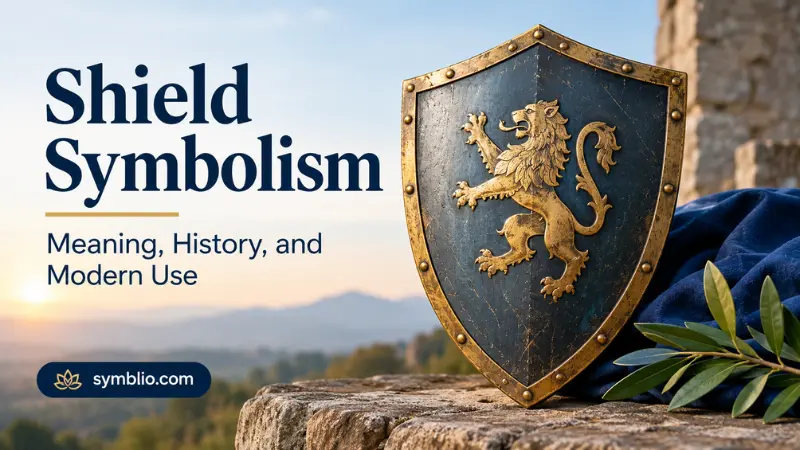
Shield symbolism commonly centers on protection, defense, security, and the determination to guard something valuable. Because a shield physically stands between a person and danger, its symbolic meaning developed from a very direct human experience: creating a barrier against harm.
Today, the shield appears far beyond historical warfare. Americans encounter shield shapes on institutional emblems, family-inspired designs, sports logos, jewelry, tattoos, security imagery, and religious artwork. In these settings, the object usually represents protection, belonging, responsibility, or resilience rather than literal combat.
The meaning can change according to its design. A shield decorated with a family emblem may suggest heritage, while one paired with a star, eagle, cross, or other symbol can communicate national identity, faith, service, authority, or personal values.
Quick Answer
Shield symbolism commonly represents protection, security, loyalty, and defense in modern American culture, especially in institutional emblems, family designs, tattoos, and identity-based imagery. Historically, shields also represented military service, social identity, courage, lineage, and the responsibility to defend a community.
TL;DR
- Shields commonly symbolize protection, security, loyalty, and defense.
- Ancient shields combined practical defense with personal and cultural identity.
- Medieval heraldry turned shields into visual markers of family and organization.
- Americans often associate shields with institutions, service, trust, and responsibility.
- Religious traditions use shields as metaphors for faith, refuge, and divine protection.
- Modern tattoos and designs often turn the shield into a personal boundary symbol.
What a Shield Looks Like and Why Its Shape Matters
A traditional shield is a protective surface held or carried between the body and a threat. Historical examples vary widely, including rounded, oval, rectangular, kite-shaped, and pointed forms.
Its basic visual idea is consistent: a barrier placed between what needs protection and what might cause harm.
That physical function gives the shield unusually straightforward symbolism. Unlike symbols whose meanings depend heavily on mythology or abstract interpretation, the shield begins with an easily understood action—protecting something.
The shield’s enclosed surface also makes it useful as a visual container. Symbols, colors, animals, letters, religious imagery, and other designs can be placed inside it. This is one reason shields became important in heraldry and institutional insignia.
In contemporary design, the outline alone can suggest safety. A shield icon on a website, application, product, or organization may communicate security without showing an actual historical shield.
The Core Meanings of Shield Symbolism
The most common meanings can be grouped into several related ideas.
Protection is the central association. The shield stands between a person and danger, so it naturally represents safeguarding people, places, principles, or possessions.
Security is a modern extension of that idea. A shield can suggest that something is protected from outside threats, which explains its frequent appearance in security-related visual design.
Defense is slightly different from protection. Protection emphasizes keeping harm away, while defense can imply actively responding to a threat or standing up for something important.
Loyalty developed partly from the shield’s connection with groups, households, military units, and heraldic identity. A shield could identify the people a warrior served or the community to which he belonged.
Courage is another common association, particularly when the shield appears with military or heroic imagery. The symbolism is less about being fearless and more about standing between danger and something worth protecting.
Identity is especially important in heraldry. The shield became a visual space for communicating who someone was, what group they represented, and which traditions or achievements were associated with them.
Ancient Roots and Early Symbolism
Shields are much older than medieval heraldry. Ancient societies used protective shields in warfare, hunting, ceremonies, and other social contexts. Their decoration could carry information about status, community, lineage, or personal identity.
The symbolism was therefore not limited to physical defense.
Museum collections show that decorated shields in different cultures could carry distinctive visual systems. For example, Maasai shields included geometric patterns connected with lineage and social identity, while particular markings could indicate recognized bravery. Among the Asmat, shield designs could connect warriors with ancestors and cultural beliefs.
These examples are important because they show that there is no single universal “shield meaning.” The basic idea of defense is widely understandable, but the imagery placed on a shield can communicate very different cultural messages.
A shield could therefore function simultaneously as protection, identification, storytelling, and social expression.
How Medieval Heraldry Changed the Meaning
The shield became especially important in medieval European heraldry. As armor increasingly covered the body and face, identifying individuals on the battlefield became difficult. Colors and symbols displayed on shields offered a practical visual solution.
Over time, these designs developed into recognizable heraldic systems. The shield became the main surface for colors and “charges,” such as animals, objects, crosses, plants, and geometric forms. The designs could communicate lineage, allegiance, achievements, or institutional identity.
This history explains why modern shield imagery often feels connected with heritage and belonging, even when no literal family coat of arms is involved.
The idea also helped establish a lasting visual language. A shield does not merely say “I am protected.” It can also say, “This is who we are, and these are the values we represent.”
What Shields Symbolize in the United States
In the United States, shield imagery is strongly associated with organizations and public institutions.
The U.S. military uses shields extensively in coats of arms, badges, patches, and other insignia. Official Army heraldry treats the shield as a central component of organizational identity, with designs reflecting a unit’s history, traditions, mission, honors, and accomplishments.
This creates several familiar American associations:
- Service — protecting a country or community
- Duty — accepting responsibility for others
- Institutional identity — representing an organization or unit
- Trust — suggesting that something is guarded or dependable
- Heritage — connecting present institutions with earlier traditions
Shield imagery also appears in schools, sports organizations, police-related imagery, civic organizations, universities, and private companies.
The meaning is not always military. In many contemporary American settings, the shield has become a general symbol of reliability and protection.
The Shield in American National Imagery
One of the most recognizable American examples is the shield appearing on the Great Seal of the United States.
The national coat of arms places a shield with thirteen red and white stripes and a blue chief on the breast of the eagle. The design was officially adopted in 1782 after several committees had worked on different proposals.
The shield is not simply decorative. Its placement within the national emblem makes it part of a larger visual statement about the United States as a sovereign nation.
This helped reinforce an American association between shield imagery and national identity, unity, and public authority.
It is important, however, not to treat every American shield design as a direct reference to the Great Seal. A generic shield can have much broader meanings, while national imagery has a specific historical context.
Religious Meanings of the Shield
The shield has a significant metaphorical role in Christianity, particularly in biblical language.
Biblical passages frequently use the shield as an image of God’s protection, refuge, faithfulness, or defense. Psalm 91, for example, compares divine faithfulness with a protective shield, while other passages use shield imagery in connection with trust and deliverance.
Christian art and modern religious design may therefore use a shield to represent:
- faith
- spiritual protection
- trust in God
- perseverance
- refuge
- defense against temptation or adversity
The meaning is metaphorical rather than a claim that a physical shield provides supernatural protection.
For someone choosing a shield tattoo, necklace, emblem, or artwork for religious reasons, the surrounding imagery can make a major difference. A cross inside a shield will usually communicate something different from an eagle, family crest, or abstract pattern.
Shield Symbolism Across Cultures
Although the protective function of a shield is broadly understandable, cultures have assigned additional meanings to shield designs.
In African traditions, shield decoration could communicate lineage, status, bravery, and cultural identity. In South and Southeast Asian examples, shields could be elaborately decorated and associated with elite military culture, craftsmanship, religion, and social status.
European heraldry placed particular emphasis on identity and lineage. Religious traditions added metaphorical meanings involving divine protection and faith.
These traditions should not be collapsed into one universal interpretation. A shield can represent community in one setting, ancestry in another, religious trust in another, and institutional authority somewhere else.
The common thread is the relationship between protection and what a community considers worth protecting.
Shield Symbolism by Context
| Context | Common U.S. Meaning | Common Associations | Notes |
|---|---|---|---|
| Family-inspired design | Heritage and protection | Family, loyalty, ancestry | Often customized rather than historically heraldic |
| Military emblem | Service and defense | Duty, courage, identity | Frequently connected with unit history |
| Religious artwork | Faith and spiritual protection | Trust, refuge, perseverance | Meaning depends on the tradition |
| Tattoo | Personal boundaries or resilience | Strength, survival, values | Usually highly individualized |
| Security branding | Safety and reliability | Privacy, protection, trust | Common in modern digital design |
Why Shields Appear in Tattoos and Personal Style
A shield tattoo often turns an ancient protective object into a statement about personal values.
Someone may choose a shield to represent protecting family, maintaining personal boundaries, overcoming adversity, honoring service, or remaining committed to particular principles.
The surrounding elements matter considerably. A shield combined with flowers can soften the imagery and emphasize family or remembrance. When initials appear on the design, they can highlight personal identity. Pairing the shield with a cross may express faith, while an animal can introduce qualities associated with that creature.
Some people also choose a shield because it communicates resilience without requiring a literal depiction of a battle.
For personal style, the symbolism is usually autobiographical rather than universal. Two people can wear nearly identical shields while attaching completely different stories to them.
Shields in Jewelry, Decor, and Fashion
Shield imagery works well in physical objects because its outline is recognizable even at a small size.
Jewelry may use miniature shield pendants to represent protection, family, heritage, or personal strength. Decorative shields can evoke medieval architecture, ancestral traditions, fantasy, or institutional history.
In fashion, the shield frequently appears as an emblem or badge-like graphic. Its compact shape creates a natural space for initials, animals, letters, stars, or other visual elements.
Modern designers also simplify the shield into a geometric icon. Once reduced to a basic outline, it may no longer refer to medieval armor at all. Instead, it can communicate concepts such as privacy, cybersecurity, safety, or reliability.
The Psychological Appeal of the Shield
The shield has a strong psychological appeal because it represents a boundary.
People naturally distinguish between what belongs inside a protected space and what remains outside it. A shield visually expresses that distinction without requiring many words.
This can make the symbol useful for expressing ideas such as:
- “I protect the people I love.”
- “I stand by my values.”
- “I have boundaries.”
- “I can withstand difficulty.”
- “I want to feel secure.”
- “I am responsible for something important.”
The symbolism can therefore be both outward-facing and inward-facing. A shield may represent someone’s role as a protector, or it may represent their desire for safety.
That difference matters. The same image can communicate responsibility toward others or the need to protect oneself.
Color and Imagery Can Change the Message
A shield’s meaning is often shaped by what appears inside or around it.
A blue shield may suggest loyalty, stability, or institutional trust in contexts influenced by heraldic conventions. Red can be associated with courage, sacrifice, or conflict, although color meanings are not universal. Traditional heraldry developed its own conventions for colors and their visual combinations.
Other elements can narrow the interpretation further.
A lion may introduce ideas of courage or authority.
An eagle can connect the design with national or civic imagery.
A cross may indicate Christian faith.
A star can suggest aspiration, guidance, or achievement.
A wreath may introduce associations with honor or accomplishment.
Initials can shift the emphasis toward family or individual identity.
The shield is therefore best understood as a framework for symbolism, rather than a complete message by itself.
Common Misunderstandings About Shield Symbolism
One common mistake is assuming that every shield represents warfare.
Historical shields certainly have strong connections with combat, but modern shield imagery frequently has nothing to do with fighting. A technology company’s shield icon, for example, may simply represent digital security.
Another misunderstanding is treating every decorative shield as an authentic coat of arms. A shield-shaped design may be inspired by heraldry without belonging to a historically documented family or institution.
It is also misleading to assume that one color or animal has exactly the same meaning everywhere. Heraldic conventions, religious symbolism, cultural traditions, and modern graphic design can assign different meanings to similar imagery.
Finally, the shield should not automatically be interpreted as aggressive. Its central idea can be defensive rather than offensive: protecting something rather than seeking conflict.
How the Symbol Has Evolved in Modern Culture
The shield has moved from a physical object to a highly flexible visual metaphor.
In ancient societies, it was primarily a functional protective tool that could also express identity. Medieval heraldry transformed it into an important surface for communicating lineage and allegiance. Religious traditions developed metaphorical interpretations involving faith and refuge.
Modern American culture has expanded the concept further. Shields now appear in cybersecurity, institutional branding, sports, education, military insignia, tattoos, jewelry, and decorative design.
The most important shift is that the shield no longer needs to be associated with a warrior. It can represent protecting information, preserving family identity, defending principles, maintaining personal boundaries, or creating a sense of trust.
Its basic visual logic has remained remarkably consistent even as the situations surrounding it have changed.
Is Shield Symbolism Always Positive?
Usually, shield imagery has positive or protective associations, but context can change the interpretation.
A shield can suggest defensiveness, emotional guardedness, separation, or resistance when used in a personal or artistic context. Someone might use the image to represent having built emotional boundaries after a difficult experience.
In political, military, or institutional imagery, a shield can also communicate authority and organized defense. That does not automatically make the symbol positive or negative; interpretation depends on the organization, surrounding imagery, and historical context.
The safest approach is to distinguish the basic symbolism of protection from the particular message created by the full design.
FAQs
A shield can symbolize faith, divine protection, refuge, trust, and perseverance in religious contexts. Christian traditions in particular use shield imagery metaphorically for God’s protection and faithfulness.
A shield tattoo often represents protection, resilience, family loyalty, personal boundaries, or commitment to particular values. Its meaning becomes more specific when combined with symbols such as animals, initials, flowers, stars, or religious imagery.
In the United States, shields commonly suggest protection, service, security, institutional identity, and responsibility. Military and organizational heraldry has helped maintain these associations in American public life.
Yes, but usually indirectly. The shield represents the ability to withstand or block threats, so strength is often understood as resilience, preparedness, courage, or the capacity to protect something important.
A shield can represent faith, God’s protection, spiritual refuge, and trust in divine faithfulness. Biblical shield imagery is primarily metaphorical rather than a description of a physical object providing supernatural defense.
It can represent both. Protection emphasizes keeping harm away, while defense emphasizes actively standing against a threat or protecting people, principles, or institutions.
A shield in family-inspired artwork often represents heritage, loyalty, belonging, and the responsibility to protect one’s family. However, a decorative shield should not automatically be treated as an officially documented ancestral coat of arms.
Conclusion
A shield remains one of the clearest visual representations of protection because its physical purpose is so easy to understand. Across different periods and cultures, that basic idea has expanded into meanings involving identity, loyalty, courage, faith, heritage, security, and responsibility.
In modern America, shield symbolism appears in settings that have little connection to historical warfare. It can identify an institution, express religious trust, represent family heritage, communicate digital security, or serve as a personal reminder of resilience and boundaries.
The symbol ultimately asks a simple question: What is worth protecting? The answer—family, faith, identity, community, privacy, principles, or personal well-being—determines what the shield means in any particular design.