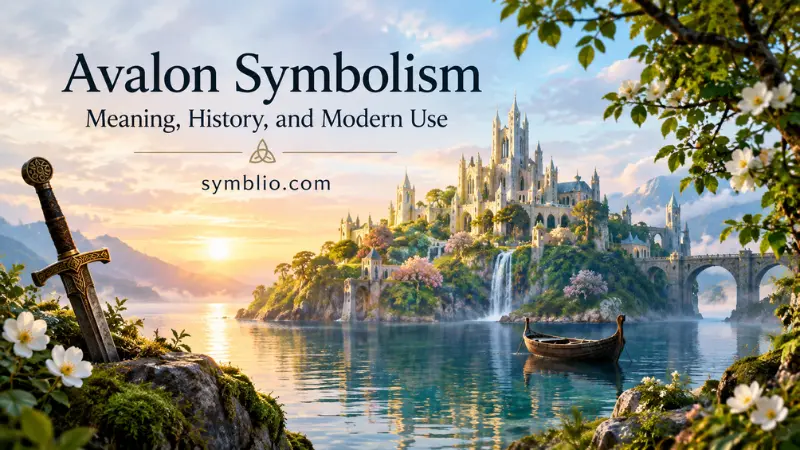
Avalon symbolism centers on a legendary island from Arthurian literature, traditionally connected with King Arthur’s final journey. The name often evokes a distant refuge, healing, transformation, mystery, and a world separated from ordinary life.
Avalon matters because its meaning has changed as writers, artists, and storytellers have reimagined Arthurian legend. Medieval literature gave Avalon a specific role in Arthur’s story, while later traditions added ideas about paradise, magical landscapes, nature, and spiritual renewal.
For modern American audiences, Avalon usually appears through fantasy novels, films, artwork, tattoos, mythology, historical fiction, and popular culture. Its meaning can therefore shift depending on whether someone views it as an Arthurian location, a fantasy realm, or a personal symbol of change.
Quick Answer
Avalon commonly symbolizes refuge, healing, transformation, and an idealized world beyond ordinary life in modern American culture. In Arthurian tradition, Avalon also connects with King Arthur, supernatural forces, and the mysterious destination associated with his final journey.
TL;DR
- Avalon represents refuge, healing, transformation, mystery, and separation.
- Medieval Arthurian literature established Avalon as Arthur’s legendary destination.
- Apples became an important image through interpretations of Avalon’s name.
- Glastonbury later became strongly connected with the legendary island.
- American culture often treats Avalon as a fantasy or mythological realm.
- Modern personal symbolism often emphasizes renewal, escape, and transformation.
What Is Avalon in Arthurian Legend?
Avalon is a legendary island associated with the stories of King Arthur. Medieval writers placed it outside the ordinary world, giving the island an unusual status within Arthurian literature.
Geoffrey of Monmouth provided one of the earliest major literary descriptions of Avalon in the 12th century. In Historia Regum Britanniae, he describes Avalon as the place where Arthur’s sword, Excalibur, originated. Later Arthurian writers gave the island an even stronger connection with Arthur’s final journey.
Avalon therefore serves more than a geographical function. The island creates a boundary between familiar human life and a supernatural or legendary realm.
That boundary explains much of its symbolic appeal. Avalon represents a destination that ordinary people cannot easily reach, understand, or locate. It exists somewhere between history and imagination.
Ancient Roots and the Meaning of the Name
Scholars have proposed different explanations for the origin of the name Avalon. One influential interpretation connects the name with an old Brittonic or Celtic word associated with apples.
This interpretation helped establish Avalon as an apple-bearing land in later literary tradition. The image fits the island’s unusual character because an abundant orchard suggests fertility, beauty, and separation from ordinary landscapes.
However, people should distinguish the medieval literary Avalon from earlier Celtic religion. Modern discussions sometimes combine the two traditions too freely. Medieval authors created and developed the Avalon known from Arthurian literature, while later writers added ideas from Celtic folklore and other sources.
The apple connection remains important because it gives Avalon a recognizable natural image rather than presenting it only as an abstract supernatural realm.
Why Apples Became an Important Avalon Symbol
The apple has become one of Avalon’s best-known symbolic images.
The connection partly comes from the interpretation of Avalon’s name as referring to an apple-bearing place. Later writers and artists could then imagine the island as a fertile landscape filled with extraordinary fruit.
Apples also carry many meanings in European storytelling. Depending on the tradition, they can suggest fertility, knowledge, temptation, health, youth, or abundance.
Avalon’s apple symbolism does not require all of those meanings at once. Within the Arthurian context, the image mainly supports the idea of a fertile and extraordinary island separated from everyday life.
For modern readers, an apple tree can therefore make Avalon recognizable even without showing King Arthur directly.
Avalon and King Arthur’s Final Journey
King Arthur gives Avalon its strongest traditional association.
According to major Arthurian traditions, Arthur travels to Avalon after his final battle. This episode gives the island an important role in the conclusion of his legendary story.
Rather than ending Arthur’s story with an ordinary death and burial, the tradition moves him into an unusual realm. Avalon consequently becomes a symbolic threshold between the world of human rulers and a legendary world beyond it.
The idea also leaves Arthur’s fate partly open to interpretation. His connection with Avalon allows later storytellers to imagine him as absent rather than completely forgotten.
That uncertainty contributes to the island’s symbolism. Avalon can represent an ending without treating that ending as simple disappearance.
Avalon as a Symbol of Healing
Healing represents one of the most recognizable interpretations of Avalon.
Arthur’s connection with the island helped later traditions associate Avalon with restoration after conflict. Medieval and later stories also connected Avalon with supernatural figures and healing abilities.
For modern readers, the island can therefore represent a place where someone withdraws from hardship and begins to recover.
This interpretation works particularly well when Avalon appears as a metaphor. Someone might use the name to describe a peaceful retreat, a period of recovery, or a stage of life that follows a difficult experience.
The healing interpretation does not mean that Avalon represents medical treatment. Instead, it expresses the broader idea of restoration after struggle.
Avalon Represents Transformation and Transition
Avalon also symbolizes transformation because Arthur’s arrival there marks a major change in his story.
Arthur begins as a king who participates in battles, politics, and earthly responsibilities. His movement toward Avalon removes him from that ordinary role and places him within legend.
This makes the island an effective metaphor for personal transition.
A person might connect Avalon with:
- leaving an old identity behind
- beginning a new chapter
- recovering after hardship
- moving away from familiar surroundings
- accepting an uncertain future
- entering a period of personal reflection
The symbolism does not require a dramatic event. Even ordinary life changes can fit the idea of crossing from one stage into another.
Avalon and the Idea of a Hidden Refuge
Avalon often represents a place where someone can escape conflict and find temporary separation from everyday demands.
Its island setting strengthens this interpretation. Water creates a natural boundary, while the legendary distance makes Avalon difficult to reach.
That combination gives the island a strong refuge quality.
In modern American culture, people often use secluded islands, forests, cabins, and remote landscapes as symbols of privacy and escape. Avalon fits this broader cultural pattern while adding an Arthurian and fantasy dimension.
The refuge does not necessarily represent permanent isolation. Instead, Avalon can symbolize a temporary place where someone steps away, reflects, heals, and eventually changes.
Glastonbury and the Avalon Tradition
Glastonbury Abbey played an important role in this development. Medieval accounts connected the area with King Arthur, and stories about the supposed discovery of Arthur’s grave helped strengthen the relationship between Glastonbury and Avalon.
The association has influenced literature, tourism, folklore, and the modern cultural identity of the area.
However, people should not treat the Glastonbury connection as proof that historians have identified the literal historical location of Avalon. The relationship developed through medieval tradition and storytelling.
Glastonbury remains important because it demonstrates how a legendary location can become connected with a real landscape.
Avalon Symbolism in the United States
Avalon does not have one official meaning in American culture. Most Americans encounter the concept through entertainment, mythology, literature, fantasy, art, or personal symbolism rather than through a single established tradition.
Several meanings appear frequently:
| Context | Common U.S. Interpretation | Typical Associations | Main Idea |
|---|---|---|---|
| Arthurian literature | Legendary otherworld | King Arthur, Excalibur | Myth and legend |
| Fantasy fiction | Magical hidden realm | Islands, forests, enchantment | Imagination |
| Personal symbolism | Renewal and retreat | Healing, change, reflection | Personal transformation |
| Art and design | Idealized landscape | Apples, water, mist | Beauty and mystery |
| Spiritual interpretation | Restorative place | Nature, reflection, renewal | Modern personal meaning |
American interpretations often blend the original Arthurian material with modern fantasy conventions. As a result, Avalon can mean something different to a mythology enthusiast than it does to someone who simply likes the atmosphere associated with the name.
Emotional and Psychological Meaning
Avalon can communicate several emotions without having one universal psychological interpretation.
Longing is one important association. The island remains distant and difficult to reach, which makes it a useful image for something a person wants but cannot easily obtain.
Relief comes from the idea of leaving conflict behind. A secluded island naturally suggests distance from pressure and responsibility.
Renewal connects with the island’s association with healing and Arthur’s transition.
Mystery comes from the uncertainty surrounding Avalon’s location and nature.
Together, these ideas make Avalon especially suitable for storytelling and personal expression. The symbol can express the desire to step away from familiar circumstances without specifying exactly what comes next.
Avalon in Tattoos and Body Art
Avalon-inspired tattoos often appeal to people who enjoy mythology, fantasy, Arthurian literature, or symbolic representations of personal change.
Artists may combine the Avalon name with:
- an apple tree
- an island
- a sword
- a castle
- a forest
- water
- a moon
- medieval imagery
- Arthurian symbols
Each element can change the interpretation.
A sword may connect the design to Arthur and Excalibur. An apple tree may emphasize the traditional association between Avalon and an apple-bearing land. An isolated island can highlight refuge or separation.
Someone choosing an Avalon tattoo may also use the symbol to mark a personal transition. In that case, the historical Arthurian meaning provides the foundation, while the individual gives the tattoo a more personal interpretation.
Avalon in Jewelry, Fashion, and Decor
Avalon works naturally in visual design because its mythology provides recognizable imagery.
Jewelry may incorporate swords, leaves, apples, trees, medieval patterns, or fantasy-inspired shapes. Clothing and accessories may use the name to suggest Arthurian mythology or an interest in fantasy.
Home decor can express Avalon through landscapes rather than literal Arthurian imagery. An isolated island, misty forest, orchard, castle, or moonlit scene can evoke the atmosphere associated with the legendary realm.
In these settings, Avalon does not necessarily communicate a specific historical belief. Sometimes the name simply expresses an appreciation for mythology, fantasy, nature, or medieval-inspired aesthetics.
Avalon in Books, Film, and Popular Culture
Modern storytelling has kept Avalon relevant by continually adapting Arthurian legend.
Authors and filmmakers often change Avalon’s role to suit their stories. One version may portray it as a magical island, while another may present it as a supernatural realm or a metaphor for another world.
Fantasy literature has also expanded the meaning of Avalon beyond its medieval origins. Modern creators frequently combine Arthurian material with ideas about magic, nature, ancient civilizations, and alternate worlds.
American audiences often encounter Avalon through this modern fantasy lens. As a result, many people recognize the name even without knowing the medieval texts that first established its literary significance.
Avalon and Modern Spiritual Interpretations
Some modern spiritual communities use Avalon as a symbol connected with nature, feminine imagery, healing, sacred landscapes, or personal transformation.
These interpretations deserve careful distinction from documented medieval Arthurian literature and historical Celtic religion.
Modern spiritual traditions can reinterpret older myths for contemporary purposes. Such interpretations may hold personal importance for practitioners, but they should not automatically receive the status of ancient Celtic beliefs.
This distinction helps explain why different people can use Avalon in very different ways. One person may approach it as mythology, another as fantasy, and another as a personal spiritual symbol.
Common Misunderstandings About Avalon
One common misunderstanding treats Avalon as a historically confirmed island. No universally accepted evidence establishes Avalon as a real geographical location.
Another mistake involves treating every modern Avalon interpretation as an ancient Celtic belief. The literary tradition developed through medieval Arthurian writing, and later generations added new interpretations.
Some people also reduce Avalon to the idea of paradise. The island can certainly represent an idealized or beautiful place, but its traditional associations include much more than comfort. Arthur’s final journey gives Avalon connections with separation, uncertainty, healing, and transition.
Understanding these distinctions makes the symbolism more accurate and prevents later interpretations from appearing older than they actually are.
How Avalon’s Meaning Changed Over Time
Avalon’s meaning developed gradually through different periods of storytelling.
Medieval Arthurian literature established the island as part of Arthur’s legendary world. Writers connected it with supernatural elements and Arthur’s final journey.
Later medieval traditions strengthened the relationship between Avalon and Glastonbury. These stories linked the legendary world with a real English landscape.
During later periods, writers and artists became increasingly interested in medieval legends, folklore, and idealized landscapes. Avalon consequently gained associations with romance, mystery, nature, and fantasy.
Modern popular culture expanded those meanings again. Today, Avalon can represent an enchanted island, a place of recovery, an imagined paradise, or a metaphor for personal change.
Its history shows how symbols develop when different generations reinterpret the same story.
Why Avalon Still Appeals to Modern Audiences
Avalon remains attractive because it expresses an idea that ordinary language does not always capture easily.
The island suggests that a person can leave one world without simply disappearing. It offers a place between endings and beginnings, certainty and uncertainty, history and legend.
That quality makes Avalon particularly useful for people interested in mythology and personal symbolism.
For some, it represents a peaceful destination. For others, it suggests transformation or the possibility of starting again. Fantasy audiences may simply appreciate it as an enchanting legendary realm.
Its flexibility helps explain why Avalon continues to appear in modern creative culture.
Avalon as a Symbol of Mystery
Mystery forms another important part of Avalon’s identity.
The legendary island does not have a universally accepted location, and different traditions have offered different interpretations. That uncertainty allows writers and artists to imagine Avalon without being limited by a precise map.
The symbol therefore works especially well when someone wants to express the unknown.
An Avalon-inspired landscape can suggest that something exists beyond what the viewer can see. It does not have to imply supernatural belief. The same imagery can simply communicate curiosity, possibility, or an unresolved journey.
This open-ended quality separates Avalon from symbols with one clearly defined meaning.
FAQs
Avalon commonly symbolizes refuge, healing, transformation, mystery, and an idealized world beyond ordinary life. Its strongest traditional association comes from Arthurian stories about King Arthur’s final journey.
Avalon often appears in modern discussions of Celtic mythology because of the proposed connection between its name and an apple-bearing land. However, the medieval Avalon of Arthurian literature should not be treated as a complete record of ancient Celtic religion.
An Avalon tattoo can represent transformation, healing, mythology, personal renewal, or the desire for a peaceful refuge. Additional imagery can make the meaning more specific.
Avalon can represent an idealized or paradise-like place, particularly in later interpretations. Its Arthurian meaning also includes healing, mystery, transition, and separation.
Avalon connects with death and transition because Arthur travels there after his final battle in major Arthurian traditions. The island does not represent death alone because later interpretations also emphasize healing and renewal.
The apple association partly comes from interpretations of the name Avalon as referring to an apple-bearing place. Later storytelling strengthened the image of Avalon as a fertile and extraordinary island.
Modern American culture commonly connects Avalon with Arthurian legend, fantasy, hidden realms, healing, escape, and transformation. The exact meaning depends on the context in which someone uses the name.
Conclusion
Avalon represents a legendary place beyond ordinary boundaries. Its major associations include refuge, healing, mystery, transformation, and the continuing story of King Arthur. Medieval literature established its Arthurian identity, while later traditions connected it with apples, Glastonbury, fantasy, and ideas about renewal.
In modern American culture, avalon symbolism remains flexible rather than fixed. It can represent a peaceful retreat, an imagined paradise, a transition between life stages, or a legendary world beyond everyday experience. That combination of history, uncertainty, and personal interpretation keeps Avalon relevant in mythology, art, literature, and modern creative culture.