
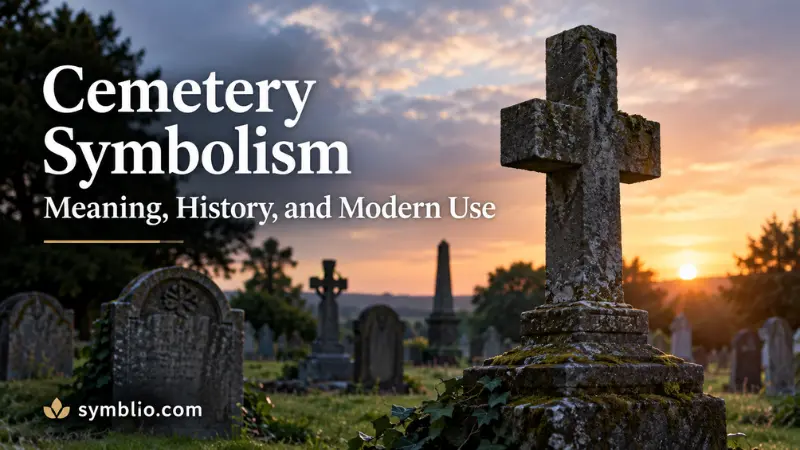
Cemetery symbolism reflects how people remember the dead, express grief, and communicate beliefs about mortality, faith, family, and remembrance. From the shape of a gravestone to the trees surrounding a burial ground, cemeteries use visual details to say things that words alone sometimes cannot.
In the United States, cemeteries have also changed with American culture. Older churchyards often emphasized mortality and religious instruction, while later garden cemeteries introduced landscaped paths, sculpture, monuments, and spaces designed for reflection. Today, cemeteries can function as family memorial spaces, historic landscapes, military sites, cultural landmarks, and quiet places for personal remembrance.
Understanding these symbols requires looking beyond individual gravestones. The landscape, materials, religious imagery, inscriptions, flowers, trees, monuments, and even the arrangement of graves can reveal how different communities have understood death and memory.
Quick Answer
Cemetery symbolism commonly represents remembrance, mourning, mortality, family connection, and hope for peace or an afterlife in modern American culture. Historically, cemetery symbols also communicated religious beliefs, moral lessons, social identity, and changing attitudes toward death.
TL;DR
- Cemeteries symbolize remembrance, mortality, mourning, and continuing family bonds.
- Gravestone imagery changed significantly from colonial America to the Victorian era.
- Crosses, angels, flowers, trees, and urns can express different beliefs.
- American military cemeteries often emphasize service, sacrifice, equality, and national remembrance.
- Modern cemeteries combine traditional memorials with increasingly personal forms of remembrance.
What a Cemetery Represents Beyond a Burial Place
A cemetery is more than a location where people are buried. It is a physical environment created by the living to remember people who have died.
The word itself comes from the Greek koimeterion, associated with a place of sleep. That idea helped shape a gentler vocabulary surrounding burial and encouraged associations with rest rather than simply physical death.
Cemeteries can therefore symbolize a meeting point between absence and memory. A person’s body may no longer be present, but a name, date, photograph, monument, flower, or inscription gives surviving family members something tangible through which to remember them.
The symbolism can also extend to the landscape. Trees, paths, gates, benches, gardens, and monuments influence whether a cemetery feels formal, peaceful, religious, communal, or intensely personal.
Ancient Roots of Burial Symbolism
Burial symbolism predates American cemeteries by thousands of years. Ancient societies developed different ways of marking graves and expressing ideas about death, identity, remembrance, and the afterlife.
Classical Greek and Roman traditions later influenced European funerary art. During periods when neoclassical design became fashionable in the United States, American gravestones adopted elements associated with classical architecture and funerary imagery.
The urn is one notable example. In nineteenth-century American cemetery art, urns were frequently connected with death and mourning, while obelisks drew inspiration from ancient Egyptian and Roman forms.
These designs demonstrate an important point: cemetery symbols do not always originate within the culture where they eventually become familiar. Artists and communities frequently borrow older visual traditions and give them new meanings.
From Colonial Gravestones to American Memorial Art
Early American gravestones often had a more direct relationship with mortality than many modern memorials do.
In parts of colonial New England, skulls and crossbones appeared prominently on gravestones. Their purpose was not simply decoration. They reminded viewers that death was unavoidable and encouraged the living to think about their own mortality.
Over time, these images became less severe. Winged cherubs and soul-effigy designs offered more hopeful interpretations of death and salvation. The change reflected broader shifts in religious thought and attitudes toward mourning.
By the nineteenth century, American funerary art increasingly included more elaborate sculpture and individualized imagery. Gravestones could communicate something about the person’s occupation, personality, family, religion, or social position rather than simply identifying a burial location.
That evolution is important because it shows that cemetery symbolism has never had one fixed meaning.
Why the Rural Cemetery Movement Changed American Symbolism
The rural cemetery movement that began in the United States during the nineteenth century transformed the relationship between cemeteries and public life.
Instead of placing every burial ground in a crowded churchyard or urban setting, new cemeteries were designed as spacious landscapes with winding paths, trees, monuments, gardens, and carefully planned views. The movement is associated with the establishment of Mount Auburn Cemetery near Boston in 1831 and influenced cemetery design across the country.
These landscapes encouraged visitors to spend time among the graves rather than treating burial grounds solely as functional places.
The cemetery could now symbolize reflection and memory through its entire environment. A winding path suggested movement and contemplation, while trees and gardens softened the visual presence of death.
This helped establish an American tradition in which visiting a cemetery could itself become part of mourning.
Common Symbols Found on American Gravestones
Individual symbols can carry different meanings depending on their period, religion, community, and context.
| Symbol | Common American Association | Historical Context | Important Note |
|---|---|---|---|
| Cross | Christian faith, resurrection, hope | Widely used in Christian funerary traditions | Meaning varies by denomination |
| Weeping willow | Grief, mourning, remembrance | Especially common in nineteenth-century funerary art | Often paired with urns |
| Urn | Death, mourning, remembrance | Strongly influenced by classical art | Does not always indicate cremation |
| Lamb | Innocence, childhood, Christian symbolism | Frequently used on children’s graves | Context is important |
| Obelisk | Memorial permanence, classical tradition | Popular in nineteenth-century America | Often marks family graves |
| Angel or cherub | Spiritual protection, salvation, hope | Common in Victorian funerary art | Meaning varies with imagery |
The same image should not automatically be assigned one universal definition. A symbol’s meaning can change according to the inscription, surrounding artwork, religious tradition, and historical period.
The Weeping Willow and the Language of Mourning
The weeping willow became one of the recognizable images of nineteenth-century cemetery art.
Its drooping branches naturally suggested sorrow, making the tree an effective visual representation of mourning. In American funerary art, the willow was frequently combined with an urn, creating a composition that linked grief with remembrance.
The image also illustrates how symbolism often works through visual analogy. A tree with branches that appear to bend downward can communicate sadness without showing a person grieving.
Today, most Americans would probably recognize the willow as a decorative or natural element before immediately identifying its historical funerary meaning. The association remains important in historic cemeteries, even though its symbolism is less familiar to the general public than it once was.
Flowers, Trees, and the Symbolism of Continuing Life
Plants have long provided cemetery symbolism because they connect death with natural cycles.
Evergreen trees can suggest endurance because they retain their foliage through winter. At High Amana Cemetery in Iowa, for example, evergreen trees were regarded as symbols of the eternal life promised through Christ. The cemetery’s layout also reflected the religious beliefs of the community.
Flowers can communicate affection, remembrance, beauty, and the temporary nature of life. Their use at graves can be religious, cultural, personal, or simply an expression of love.
Modern memorial practices continue this tradition, although people now have far more freedom to choose flowers and plants based on personal memories. Someone might select a particular flower because it reminds the family of a garden, wedding, favorite season, or childhood memory rather than because of an established symbolic tradition.
Religious Symbols and Beliefs About the Afterlife
Religious imagery is among the most recognizable forms of cemetery symbolism in the United States.
Christian cemeteries may feature crosses, angels, biblical quotations, praying figures, or images associated with resurrection. Jewish cemeteries commonly use Hebrew inscriptions and Jewish symbols, while other religious communities have their own visual traditions.
Military cemeteries can also contain religious symbols alongside people from different backgrounds. American military burial grounds demonstrate how personal religious identity can coexist with broader commemorative themes such as service and sacrifice. The rows of crosses and Stars of David found in American military cemeteries, for example, reflect religious diversity within a shared memorial landscape.
A religious symbol on a gravestone should therefore be understood as part of an individual’s or family’s tradition rather than assumed to represent every cemetery visitor.
Angels, Cherubs, and the Changing Image of Death
Angels and cherubs became especially common in nineteenth-century funerary art.
Their presence reflected changing attitudes toward death and the afterlife. Earlier American gravestones could present death in stark terms through skulls and other reminders of mortality. Later Victorian imagery often adopted softer representations, including angels, clouds, and weeping willows.
Cherubs were particularly associated with children in American funerary art. Their appearance could express innocence, childhood, and hope rather than focusing exclusively on the tragedy of death. Historical records of American cemetery art specifically identify lambs and cherubs as recurring imagery on children’s graves.
Modern viewers may interpret such sculptures primarily as signs of spirituality or protection, but their historical meanings can be more specific.
Cemetery Symbolism in American Military Memorials
American military cemeteries add another layer to the symbolism of burial.
Here, the grave is not only a personal memorial. It can also represent military service, collective sacrifice, national history, and the human cost of conflict.
The development of U.S. national cemeteries accelerated during and after the Civil War. The federal government increasingly accepted responsibility for burying and commemorating military dead, transforming certain burial grounds into places of national remembrance.
The landscape itself communicates meaning. Uniform grave markers arranged in orderly rows can emphasize equality, collective identity, and shared service. Arlington National Cemetery, for example, became part of a broader American tradition of national commemoration after the Civil War.
In these settings, cemetery symbolism moves beyond private grief and becomes part of public memory.
Why Cemeteries Often Feel Peaceful
Many American cemeteries deliberately use landscape design to create an atmosphere of quiet reflection.
Trees, lawns, gardens, open spaces, stone walls, pathways, and carefully positioned monuments can make a cemetery resemble a park. Nineteenth-century rural cemetery designers intentionally used landscape architecture to encourage contemplation and create a dignified setting for remembrance.
This explains why cemetery symbolism is not limited to objects carved into stone.
Silence can communicate respect. A shaded path can encourage reflection. A bench beside a grave can turn remembrance into an act of sitting and thinking. A carefully maintained garden can express continued care for people who have died.
The physical environment becomes part of the memorial message.
Cemetery Symbolism and Family Identity
Graveyards can also preserve family history.
Large family monuments, shared plots, repeated surnames, and neighboring graves create visual evidence of relationships between generations. In some American cemeteries, central family monuments are surrounded by individual markers for relatives.
This arrangement can symbolize continuity. The deceased are not presented only as isolated individuals; they are positioned within a family story.
Modern families may express this connection differently. Some choose companion monuments, shared inscriptions, photographs, or personalized decorations. Others prefer simple markers that emphasize individual identity.
Either way, the cemetery can become a physical record of relationships that extend across generations.
Personalization and Modern Memorial Culture
Contemporary American memorials are generally more personalized than many older examples.
A gravestone might include a photograph, favorite quotation, military emblem, professional symbol, religious image, hobby reference, or representation of a beloved animal. These choices allow families to describe the deceased as a complete person rather than reducing them to a name and date.
This personalization also changes the meaning of cemetery symbolism. A musical note may represent a musician, while a sports emblem may reflect an important part of someone’s life. A garden feature may recall a person’s love of nature.
The symbol does not necessarily have a traditional dictionary definition. Its meaning may be understood primarily by the people who knew the deceased.
Cemetery Symbolism in Tattoos, Art, and Popular Culture
Cemetery imagery also appears outside actual burial grounds.
In tattoo culture and visual art, gravestones, cemetery gates, crosses, angels, roses, candles, skulls, and memorial inscriptions can represent grief, remembrance, mortality, family history, or an individual’s relationship with death.
The meaning becomes highly personal. Someone may use cemetery imagery to commemorate a loved one, while another person may use it as an artistic reminder that life is temporary.
Popular culture sometimes uses cemetery imagery differently. Horror films, Halloween decorations, and fictional stories often associate cemeteries with fear, ghosts, mystery, or the supernatural. Those associations are culturally familiar, but they represent only one modern interpretation.
Actual cemeteries generally have a much broader cultural role that includes remembrance, history, family identity, religion, art, and community memory.
Common Misunderstandings About Cemetery Symbols
One common mistake is assuming that every symbol has one universal definition.
A cross usually has Christian associations, but the exact meaning can depend on denomination and personal belief. An angel may represent faith, protection, grief, or simply decorative funerary art. An urn may have classical associations and does not automatically mean the person was cremated.
Another misunderstanding comes from applying modern interpretations to historical monuments.
A skull on an eighteenth-century gravestone, for example, may look like a frightening decoration today. Historically, however, it could have served as a direct reminder of mortality and moral responsibility.
Context is therefore essential. The date, location, inscription, religious tradition, and surrounding imagery can all change how a symbol should be interpreted.
How Cemetery Meanings Have Evolved
The history of American cemetery symbolism shows a movement from direct reminders of mortality toward increasingly varied expressions of memory.
Colonial gravestones sometimes emphasized death itself through skulls and mortality imagery. Later designs incorporated cherubs, angels, urns, willows, classical monuments, and sentimental representations of mourning. Victorian cemeteries expanded the role of landscaping and sculpture, turning burial grounds into carefully designed places for visitors.
Modern memorials continue this process of personalization.
The emphasis is often less on warning the living about death and more on remembering an individual life. A grave can now communicate someone’s personality, interests, relationships, achievements, religion, or service.
That does not mean older meanings disappeared. Traditional symbols remain available, but families increasingly combine them with personal imagery.
Why Cemetery Symbolism Still Matters Today
Cemeteries remain important because people continue to need physical places for remembrance.
Digital memorials, photographs, social media pages, and online tributes have expanded the ways people remember someone. Yet a physical grave provides a specific location where family members and friends can visit.
Historic cemeteries also preserve information about communities. Names, dates, occupations, religious affiliations, family relationships, artistic styles, and changing attitudes toward death can all be found in their landscapes.
Some cemeteries have therefore become important historic places rather than functioning solely as burial grounds. Their monuments and layouts can document changes in American architecture, religion, immigration, military history, social class, and family life.
FAQs
Cemetery symbolism commonly expresses remembrance, mourning, mortality, faith, family connection, and hope. The exact meaning depends on the symbol, historical period, religion, and circumstances surrounding the grave.
A gravestone identifies a person while providing a physical focus for remembrance. Its design can also communicate religious beliefs, family relationships, occupation, personality, social identity, or ideas about death.
In the United States, a cemetery can symbolize remembrance and respect for the dead while also serving as a historical and cultural landscape. Military cemeteries add associations with service, sacrifice, and national memory.
A weeping willow traditionally represents grief and mourning. Its drooping branches provided a visual metaphor for sorrow and were especially common in nineteenth-century American funerary art.
An angel can represent spiritual protection, salvation, hope, or the connection between earthly life and the afterlife. Its meaning depends on the specific design and the religious or cultural context.
Flowers can express love, remembrance, mourning, beauty, and continuing care. Their meaning can also be personal, particularly when a family chooses flowers connected with the deceased’s life.
No. Many cemetery symbols are religious, but others represent family identity, military service, occupations, hobbies, personality, nature, or personal memories. Modern memorials often combine religious and secular imagery.
Conclusion
Cemetery symbolism provides a visual language for remembering people who have died. Across American history, gravestones and cemetery landscapes have expressed mortality, religious belief, grief, family connection, personal identity, and collective memory.
The meaning of a cemetery symbol is rarely fixed. A skull can represent mortality, a willow can express mourning, an evergreen can suggest continuity, and a military marker can connect an individual life with national remembrance. Modern memorials add another layer by allowing families to use symbols that reflect the unique life of the person being remembered.
Ultimately, cemetery symbolism is best understood in context. The stone, landscape, inscription, religious tradition, historical period, and personal story all contribute to what a memorial communicates.


