
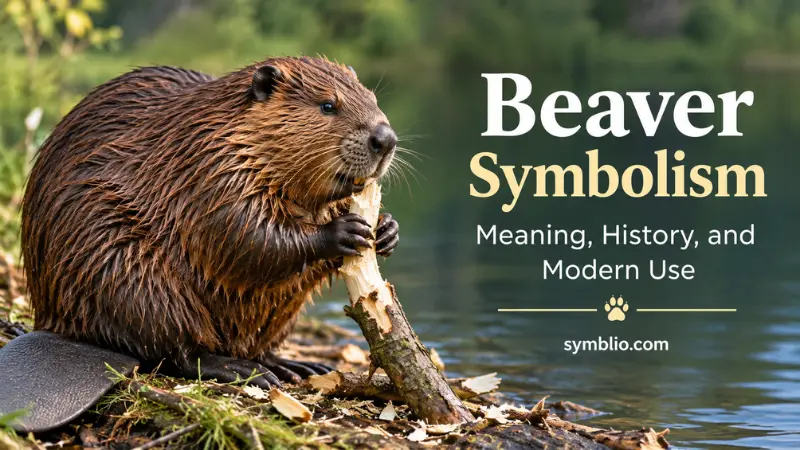
Beavers are often associated with beaver symbolism because of the way they build dams, reshape waterways, and work persistently within their environments. Their behavior naturally connects them with ideas such as productivity, cooperation, preparation, adaptability, and practical intelligence.
In the United States, the beaver has an especially interesting cultural history. It appears in Indigenous traditions, colonial-era trade history, state symbols, school mascots, environmental discussions, and popular expressions such as “busy as a beaver.” Oregon recognizes the beaver as its state animal, while New York also selected the beaver as its official state mammal.
The animal’s meaning is not limited to being hardworking. Its ability to modify landscapes has also made it a useful symbol of construction, environmental change, self-reliance, and the relationship between people and nature.
Quick Answer
Beaver symbolism commonly represents hard work, resourcefulness, cooperation, and practical problem-solving in modern American culture. Historically, beavers also carried important meanings in Indigenous traditions and became closely connected with North American trade, settlement, and environmental history.
TL;DR
- Beavers commonly symbolize productivity, persistence, and practical intelligence.
- Their dams connect them with construction, planning, and environmental change.
- Indigenous traditions give the animal meanings that vary by community.
- Fur trading made the beaver important to early North American history.
- Oregon and New York use the beaver as a state animal symbol.
- Modern imagery often emphasizes teamwork, conservation, and resourcefulness.
What the Beaver Represents in Nature
A beaver is a semi-aquatic mammal recognizable by its broad tail, large front teeth, dense fur, and distinctive building behavior. It gathers branches and other materials to construct dams, lodges, canals, and related structures.
These activities explain many of the animal’s symbolic associations. People can directly observe a beaver changing its surroundings rather than simply adapting to them. The resulting image is one of an animal that plans, builds, maintains, and responds to changing conditions.
Modern ecology also gives this behavior another dimension. Beavers can create wetlands and alter water flow, providing habitat for other organisms. Because of this role, they are often described as ecosystem engineers.
That combination of construction and environmental influence makes the beaver particularly suitable as a symbol of making, organizing, and improving one’s surroundings.
The Core Meanings of Beaver Symbolism
Several ideas appear repeatedly when people interpret the beaver symbol.
Hard work is perhaps the most familiar association. A beaver continually gathers materials, repairs structures, and maintains its habitat, making it an obvious metaphor for sustained effort.
Resourcefulness comes from the animal’s ability to use available materials. Sticks, mud, vegetation, and waterways become components of a functional environment.
Cooperation is another important theme. Beaver families work together around dams, lodges, food supplies, and territory. This makes the animal useful as a symbol for teamwork rather than individual achievement alone.
Preparation also fits the beaver. Food storage and shelter construction reflect planning for changing environmental conditions.
Finally, the beaver can represent adaptability. Its work changes according to water levels, landscape conditions, food availability, and seasonal needs.
Ancient and Indigenous Roots
Beaver traditions in North America cannot be reduced to one universal Indigenous interpretation. Different nations have their own languages, stories, teachings, and relationships with the animal.
In Alaska, for example, National Park Service material documents Koyukon traditions in which beavers are treated with considerable respect and associated with spiritual understandings of the animal and its relationship with people. These traditions include specific practices concerning hunting and treatment of the animal.
Other Indigenous traditions connect beavers with creation stories, water, transformation, family lineage, or practical knowledge. In some communities, the animal’s ability to modify its environment provides a lesson about observation and relationships within an ecosystem.
This is important because phrases such as “Native American beaver symbolism” can give the misleading impression that every Indigenous nation shares one interpretation. The traditions are much more diverse than that.
The Beaver and North American Fur Trade
The beaver acquired another major layer of meaning during the colonial period because of the fur trade.
From the 1600s into the 1800s, European demand for beaver pelts helped drive extensive trade networks across North America. Beaver fur was especially valuable for producing felt used in fashionable hats. The economic importance of the animal influenced exploration, relationships between Indigenous communities and European traders, and the expansion of colonial activity.
The trade also had serious consequences for beaver populations. By the middle of the 19th century, intensive hunting had dramatically reduced their numbers. The Smithsonian’s National Zoo describes the historical decline as reaching roughly 99 percent of historic levels before changing fashion and conservation efforts helped the species recover.
This history complicates the symbolism. The beaver can represent prosperity and commerce, but its history also illustrates how commercial demand can place enormous pressure on wildlife.
Why Beavers Symbolize Hard Work
The phrase “busy as a beaver” captures one of the most familiar cultural associations.
Beavers appear constantly occupied with gathering materials, maintaining structures, and modifying their surroundings. Their work is not simply movement for its own sake. It produces something visible: a dam, lodge, channel, or food supply.
That makes the beaver a particularly practical symbol of work. It suggests effort that produces a useful result.
For this reason, beaver imagery can appeal to people who value craftsmanship, persistence, building, and steady progress rather than dramatic displays of achievement.
Beaver Symbolism in the United States
The beaver has a distinctive place in American culture because it combines wildlife, history, regional identity, and environmental awareness.
Oregon adopted the beaver as its state animal, and the animal also became New York’s official state mammal. The choice reflects qualities historically associated with the animal, including industriousness and its connection with the landscape.
The beaver also appears in American institutional culture. Engineering schools and organizations have used beavers as mascots because the animal’s reputation for construction and problem-solving fits the identity of builders and engineers.
In everyday American culture, however, the symbolism is generally straightforward. A beaver often suggests someone who is busy, capable, productive, organized, or good at building things.
Beaver Meanings by Context
| Context | Meaning in the USA | Common Associations | Notes |
|---|---|---|---|
| Nature | Adaptability and environmental influence | Wetlands, waterways, construction | Based on observable behavior |
| Work | Productivity and persistence | Effort, planning, craftsmanship | Reflected in common expressions |
| Family | Cooperation and preparation | Teamwork, shelter, shared resources | Connected with social behavior |
| State identity | Regional pride | Oregon and New York | Used in official state symbolism |
| Environmentalism | Ecosystem engineering | Wetland creation, habitat | Highlights ecological effects |
The Beaver as a Symbol of Cooperation
A beaver is rarely an ideal symbol of solitary success.
Its environment depends on repeated maintenance, and beavers live in family groups where cooperation plays an important role. This makes the animal a useful metaphor for projects where success depends on multiple people contributing over time.
In American workplaces, classrooms, clubs, and organizations, beaver imagery can therefore suggest teamwork without implying that everyone must perform exactly the same role.
The underlying idea is simple: a functioning structure often requires many small contributions.
Beaver Symbolism and Emotional Meaning
People may identify with the beaver when they value practical achievement over attention or recognition.
The animal can communicate a personality that is:
- dependable
- patient
- industrious
- organized
- protective
- resourceful
- cooperative
- persistent
There is also a quieter emotional association with building a secure home. A dam and lodge create a protected environment, so beaver imagery can suggest stability, family life, preparation, and creating a place where others can feel safe.
That interpretation is especially relevant in artwork, home decor, and personal symbolism.
The Beaver in Environmental Symbolism
Modern ecological understanding has changed how people see the animal.
Rather than viewing beavers only as creatures that cut trees and build dams, scientists also recognize their ability to influence water systems and create habitat. Beaver-created wetlands can support plants, fish, birds, amphibians, and other wildlife.
This gives the beaver a modern environmental meaning: changing an ecosystem through natural engineering.
The symbolism is useful because it challenges the assumption that environmental influence is always negative. A beaver changes its surroundings substantially, yet those changes can create new ecological opportunities.
At the same time, beaver activity can cause conflicts with roads, timber, crops, and property. The ecological role of the animal therefore involves both benefits and practical challenges.
What the Beaver Means in Art and Design
Beaver imagery works well in visual design because its shape is immediately recognizable.
Artists may emphasize the animal’s large teeth to suggest construction or determination, while the tail and water imagery can highlight its connection with rivers and wetlands. A beaver carrying a branch can communicate work or preparation without needing additional explanation.
In logos and mascots, the animal often takes on a more energetic personality. Cartoon beavers may appear cheerful, clever, competitive, or industrious.
More realistic artwork tends to emphasize wildlife, regional identity, conservation, or landscape.
Why Beavers Appear in Tattoos and Personal Symbolism
A beaver tattoo can represent different things depending on the person’s reason for choosing it.
Someone may choose the animal to represent hard work and persistence. Another person may connect it with family, home-building, environmental interests, or a particular geographic identity.
A beaver beside water can emphasize nature and ecological themes. A beaver carrying wood can make the construction symbolism more obvious.
Because the animal has both humorous and serious cultural associations, tattoo designs can range from playful illustrations to realistic wildlife artwork.
The personal story behind the tattoo usually matters more than any fixed dictionary definition of the animal.
Beaver Symbolism in Popular Culture and Everyday Language
The beaver has a long-standing place in everyday American language.
“Busy as a beaver” is the clearest example, turning the animal’s work habits into a description of a person who stays active and productive.
The animal also appears in children’s stories, cartoons, mascots, outdoor branding, educational materials, and environmental campaigns. These representations often exaggerate one characteristic—usually cleverness, energy, or industriousness.
This makes the modern beaver a flexible cultural figure. It can represent serious environmental ideas in one setting and simple humor in another.
The Beaver in Canadian Symbolism and American Perceptions
Although this article focuses on the United States, Canadian symbolism is important because the beaver became one of Canada’s best-known national emblems.
Canada officially recognized the beaver as a symbol of Canadian sovereignty in 1975. The animal had already appeared on Canadian postage, heraldry, and other forms of public imagery because of its historical role in the fur trade.
This creates an interesting North American overlap. Americans may associate the beaver with hard work, wildlife, Oregon, New York, or engineering, while Canadians may additionally see it as a major national symbol.
The meanings overlap, but they are not identical.
Common Misunderstandings About Beaver Symbolism
One common mistake is treating the beaver as if it has one universal symbolic meaning.
Animal symbolism changes according to culture, historical period, and personal context. Indigenous traditions should not be treated as a single belief system, and modern American interpretations should not be projected backward onto earlier communities.
Another misunderstanding is assuming that “hard work” explains everything. The beaver’s symbolism also involves water, habitat modification, family cooperation, resource management, and the complicated history of the fur trade.
There is also a modern slang meaning associated with the word “beaver” that is unrelated to the animal’s traditional symbolism. When discussing cultural history or symbolism, the wildlife meaning should be kept distinct from later slang usage.
How Beaver Meaning Has Changed Over Time
The beaver’s symbolic history has moved through several stages.
For Indigenous peoples, meanings developed within specific cultural and ecological relationships with the animal. During the colonial period, European demand transformed the beaver into a major commercial resource.
Later, the animal became associated with national and regional identity. In the United States, state symbolism and institutional mascots emphasized industriousness and construction. In Canada, the beaver became an official national emblem.
Today, conservation has added another layer. The beaver is increasingly understood not only as a worker but also as an ecosystem engineer whose activities can reshape wetlands and benefit other species.
Its meaning has therefore expanded from resource and worker to builder, community member, ecological agent, and regional emblem.
FAQs
There is no single spiritual meaning shared by all cultures. In some Indigenous traditions, beavers have specific spiritual and ceremonial significance, but those meanings belong to particular communities and should not be generalized to every Indigenous culture.
In modern American culture, the beaver commonly represents hard work, persistence, cooperation, construction, and resourcefulness. It also has specific regional associations with states such as Oregon and New York.
A beaver tattoo can represent productivity, family, persistence, environmental awareness, or the idea of building a stable life. The meaning depends heavily on the person’s design and personal reason for choosing the animal.
The beaver is generally used positively when it represents diligence, cooperation, preparation, and practical intelligence. However, its historical association with the fur trade also reminds us that an admired animal can have a complicated relationship with human economic activity.
Beavers repeatedly gather materials, build structures, maintain dams, and prepare food and shelter. Their observable behavior led to cultural comparisons between beavers and people who work steadily and productively.
There is no single Indigenous interpretation. Different nations have their own stories and teachings involving beavers, including traditions concerning water, respect for animals, environmental relationships, family, and practical knowledge.
Beaver pelts were central to the North American fur trade from the 17th through the 19th centuries. The demand for fur influenced trade networks, exploration, settlement, relationships between Indigenous peoples and Europeans, and conflicts over territory.
Conclusion
Beaver symbolism is largely connected with hard work, resourcefulness, cooperation, preparation, and the ability to build something useful from available materials. Those meanings come from observable behavior rather than an arbitrary symbolic association.
In the United States, the beaver also carries regional, historical, and environmental meanings. Its Indigenous cultural history, role in the fur trade, appearance in state identity, and importance as an ecosystem engineer all contribute to a more complete understanding of the animal.
The most useful way to read the beaver as a symbol is to look at the context: sometimes it represents diligent work, sometimes family and cooperation, and increasingly, the complicated relationship between animals and the environments they shape.


