
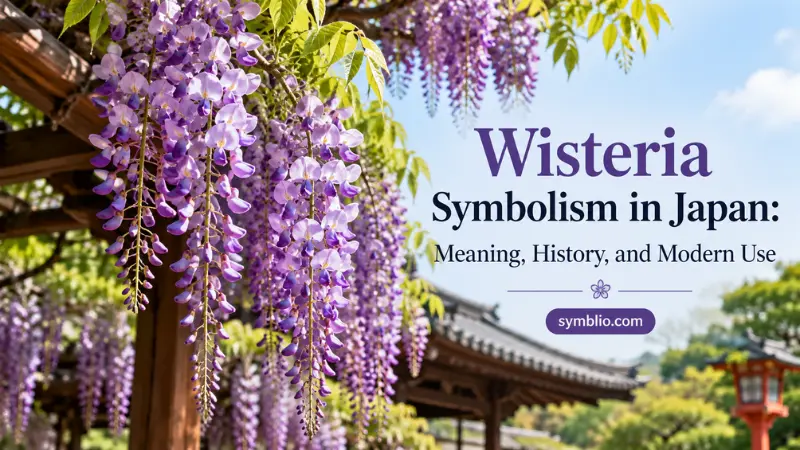
Wisteria symbolism in Japan is closely connected with love, longevity, elegance, fertility, and seasonal beauty. Known as fuji (藤) in Japanese, the plant has appeared in poetry, literature, family crests, paintings, gardens, textiles, and religious spaces for centuries.
Unlike cherry blossoms, which are strongly associated with fleeting beauty, wisteria is a climbing plant with long flower clusters that return each spring and can live for many years. Its distinctive form helped give it meanings associated with endurance and continuity, while its historical connection with the Fujiwara clan linked it with court culture and aristocratic identity.
Today, Americans may encounter Japanese wisteria symbolism in gardens, tattoos, Japanese-inspired artwork, anime, fashion, and decorative design. Understanding its history helps separate traditional Japanese meanings from simplified interpretations that have become popular internationally.
Quick Answer
In modern American culture, wisteria symbolism in Japan commonly suggests love, longevity, elegance, and graceful beauty, while its historical meanings also include fertility, continuity, and aristocratic heritage. Its connection with the Fujiwara clan and its long presence in Japanese poetry and art gave the flower additional associations with status and tradition.
TL;DR
- Wisteria commonly represents love, longevity, elegance, and seasonal beauty.
- Its Japanese name is fuji, written 藤.
- The flower appears in early Japanese poetry and literature.
- The Fujiwara clan connected wisteria with aristocratic heritage.
- Wisteria became a major motif in Japanese art and design.
- Modern Americans often encounter it through gardens, tattoos, and popular culture.
What Wisteria Looks Like and Why Its Form Matters
Japanese wisteria (fuji) is best known for its hanging clusters of flowers, which form long, curtain-like shapes beneath supporting branches or trellises. Purple is especially associated with traditional Japanese wisteria, although white and pink varieties are also cultivated.
The plant’s visual structure contributes significantly to its symbolism. Instead of presenting a single upright flower, wisteria grows outward and downward, creating flowing cascades. When dozens of flower clusters bloom together, they can create an almost architectural effect.
This appearance made wisteria particularly suitable for gardens and decorative arts. Trellises, bridges, gates, and covered walkways provide structures on which the vines can grow, allowing the blossoms to become part of the surrounding landscape rather than simply sitting in a flower bed.
The flowering season also matters. Wisteria generally blooms in spring, around April and May in much of Japan, creating a recognizable seasonal marker after the main cherry-blossom period.
Love and Affection in Japanese Symbolism
Love is one of the meanings most often associated with wisteria in modern discussions of Japanese flowers.
Part of this association comes from the plant’s appearance. The graceful hanging blossoms have long been used to suggest feminine beauty, refinement, and romantic atmosphere in Japanese artistic traditions. Wisteria also appears in scenes connected with courtly romance in classical literature.
The connection is especially visible in artistic treatments of The Tale of Genji. Chapter 33 is known as “Wisteria Leaves,” and artworks based on the episode depict a wisteria gathering associated with romance and courtly life.
This does not mean that every Japanese reference to wisteria represents romantic love. The flower has several overlapping meanings, and its historical associations with longevity, fertility, status, and seasonal beauty are equally important.
Longevity, Fertility, and Continuity
Wisteria can also symbolize longevity and fertility.
One reason is botanical. Mature wisteria plants can survive and continue flowering for generations when properly established. Their ability to grow into large, enduring structures gives the plant an association with continuity.
Historical Japanese interpretations also connected the word fuji with fushi, a term associated with immortality or freedom from death. This word association helped make wisteria an auspicious motif in Japanese decorative culture.
Its vigorous growth and abundant flowers contributed another layer of meaning: fertility and generative abundance. These interpretations appear in historical discussions of wisteria symbolism and help explain why the flower could function as more than an image of simple beauty.
Ancient Roots in Japanese Poetry and Literature
Wisteria has a long literary history in Japan.
The flower appears in the Man’yōshū, an eighth-century anthology that preserves some of Japan’s earliest surviving poetry. Wisteria was also mentioned in other early literary traditions, including the Kojiki and later works of classical literature.
Poets paid attention not only to the flower’s color but also to its movement. The long clusters swaying in the breeze provided an image that could be incorporated into seasonal poetry.
This literary history matters because flowers in classical Japanese culture were often appreciated through multiple senses at once. A flower could mark a particular season, create an emotional atmosphere, evoke a literary reference, and carry associations connected with particular people or places.
Wisteria therefore developed its symbolism gradually through repeated appearances in Japanese cultural life rather than through one single symbolic event.
The Fujiwara Clan and Aristocratic Heritage
One of the most important historical connections is the Fujiwara clan.
The Fujiwara family was one of the most influential aristocratic families in Japan, particularly during the Heian period. The family name contains the character fuji, meaning wisteria, and the clan used a stylized wisteria design as a family crest.
This connection gave wisteria a strong association with elite court culture.
The relationship can still be seen at Kasuga Taisha in Nara, a shrine historically connected with the Fujiwara family. Wisteria is a prominent symbol there, and the shrine’s spring displays continue to attract visitors.
Because of this history, wisteria in Japanese art can sometimes suggest refinement, hereditary status, courtly culture, or an association with the old aristocratic world. That interpretation is more historically specific than simply saying that wisteria represents “beauty.”
Wisteria at Kasuga Taisha
Kasuga Taisha provides one of the clearest examples of wisteria’s continuing cultural importance.
The shrine’s symbol includes a wisteria bloom, and large numbers of wisteria plants flower there in spring. The relationship with the Fujiwara family gives the flowers a historical context that goes beyond seasonal decoration.
One particularly famous plant, the Sunazuri no Fuji, is estimated to be more than 700 years old. Its exceptionally long flower clusters have made it one of the site’s notable natural features.
For visitors, the experience combines landscape, history, religion, architecture, and seasonal celebration. This illustrates an important point about Japanese flower symbolism: the meaning of a plant can depend heavily on where it appears and what cultural traditions surround it.
Wisteria and Seasonal Appreciation
Japan has a long tradition of appreciating flowers as markers of the changing seasons. Wisteria occupies an important place within this calendar.
Its flowering period generally falls in April and May. During this time, parks, temples, shrines, and gardens may become destinations for people who want to see the blossoms.
Famous locations include Kameido Tenjin Shrine in Tokyo and major wisteria gardens such as Ashikaga Flower Park in Tochigi Prefecture.
Wisteria viewing is not simply about assigning a symbolic meaning to the flower. The experience also reflects a broader Japanese appreciation for seasonality. The flowers announce a particular moment of the year and create temporary visual landscapes that people deliberately visit and photograph.
Wisteria in Japanese Art and Decorative Design
Wisteria became a recurring motif in Japanese decorative arts.
Artists used the flower in paintings, woodblock prints, textiles, ceramics, furniture, and other objects. Its long clusters work particularly well in compositions because they create vertical movement and can frame people, buildings, bridges, or landscapes.
The motif could also be combined with other auspicious plants. Historical decorative objects sometimes place wisteria alongside pine, for example, creating associations that extend beyond the individual flower.
The flower’s connection with the Fujiwara family also made wisteria imagery useful when artists wanted to evoke courtly or aristocratic associations.
Its presence in decorative arts demonstrates how Japanese symbolism often operates visually. A flower does not always need an explicit explanation; its historical associations may already be familiar to the intended audience.
What Wisteria Means in the United States
For Americans, Japanese wisteria symbolism is usually encountered outside its original historical setting.
Gardeners may grow wisteria because of its dramatic spring flowers and climbing form. Japanese-style gardens may use it to create overhead canopies or shaded walkways. Artists and designers may choose the flower for its graceful shape rather than because they know its Fujiwara connection.
In contemporary American symbolism, wisteria is often interpreted through broad ideas such as:
- graceful beauty
- romantic affection
- longevity
- renewal
- elegance
- connection with nature
- personal growth
These interpretations can be reasonable, but they should not automatically be treated as traditional Japanese meanings. American decorative culture often blends Japanese symbolism with Western flower symbolism.
That distinction is particularly important when a design is described as “Japanese” simply because it contains wisteria.
Color and Wisteria Symbolism
Purple is the color most strongly associated with traditional Japanese wisteria imagery.
Purple historically carried associations with status and refinement in Japanese culture, which makes it a particularly suitable color for a flower already linked with courtly traditions.
However, color symbolism should not be treated as a universal code. White and pink wisteria also appear in Japanese gardens and modern cultivation, and their presence does not automatically erase the cultural meanings associated with the plant itself.
For modern American audiences, purple wisteria may additionally suggest calmness, romance, creativity, or sophistication because of broader Western associations with the color purple.
Wisteria in Japanese-Inspired Tattoos
Wisteria has become a popular choice for Japanese-inspired tattoo designs.
A tattoo featuring cascading wisteria may represent longevity, love, elegance, personal growth, or appreciation for Japanese aesthetics. Some people choose it because the hanging flowers create a flowing composition that works naturally with the shape of an arm, shoulder, back, or leg.
However, there is no single traditional Japanese tattoo meaning that applies to every wisteria tattoo.
The surrounding imagery changes the interpretation. A tattoo combining wisteria with birds, water, mountains, butterflies, or another flower may communicate a different idea from a design featuring wisteria alone.
For that reason, the wearer’s personal story can be just as important as historical symbolism.
Wisteria in Anime and Popular Culture
Modern international audiences have encountered Japanese wisteria through anime and manga as well as through gardens and art.
A particularly prominent example is Demon Slayer: Kimetsu no Yaiba, where wisteria has a specific fictional role in the story. The series has helped introduce the flower to audiences who may previously have known little about its place in Japanese culture.
That fictional meaning should not be confused with the entire historical symbolism of wisteria in Japan.
Popular culture can give an established symbol a new association, but that association belongs to the fictional world in which it appears. Traditional Japanese meanings developed through centuries of poetry, art, family history, seasonal customs, and landscape design.
Wisteria Symbolism Across Different Contexts
The same flower can communicate different ideas depending on its setting.
| Context | Meaning in Japan | Common U.S. Interpretation | Important Note |
|---|---|---|---|
| Classical poetry | Seasonal beauty and refined emotion | Romance and beauty | Literary context matters |
| Fujiwara heritage | Aristocratic identity and status | Elegance or tradition | Historically specific association |
| Gardens | Seasonal appreciation and beauty | Nature and tranquility | Often interpreted more broadly in America |
| Tattoos | Personal meaning shaped by imagery | Love, growth, longevity | No single universal tattoo meaning |
| Religious or shrine settings | Local history and auspicious symbolism | Spiritual or cultural beauty | Meaning depends on the site |
Emotional and Psychological Associations
Wisteria’s emotional effect often comes from its physical appearance.
The flowers hang downward in soft clusters, while the plant’s vines spread across structures. This combination can create an impression of movement without appearing aggressive or rigid.
For some people, that makes wisteria suitable for themes of grace, patience, affection, and continuity.
Its seasonal nature adds another emotional layer. The flowers arrive for a limited period, encouraging people to notice a particular moment before it passes. This fits within a broader Japanese cultural appreciation for seasonal change, although wisteria should not simply be reduced to the same symbolism as cherry blossoms.
In contemporary American settings, the flower can therefore communicate both permanence and change: an established plant returns each year, while each flowering season remains temporary.
Common Misunderstandings About Wisteria Symbolism
One common mistake is assuming that wisteria has one fixed meaning throughout Japan.
Japanese symbolism is rarely that simple. Historical period, location, literary reference, family association, artistic medium, and surrounding imagery can all affect interpretation.
Another misunderstanding is treating every meaning found on modern Western symbolism websites as an ancient Japanese belief. Ideas such as “wisteria always represents unconditional love” may reflect modern interpretations rather than documented historical tradition.
The safest approach is to distinguish established historical associations—such as the Fujiwara connection, longevity, fertility, and literary use—from newer personal or commercial interpretations.
How Wisteria Symbolism Has Changed Over Time
Wisteria’s meaning has expanded rather than simply changed from one definition to another.
Early Japanese poetry established the flower as a subject of seasonal appreciation. Later court culture connected it with aristocratic identity, particularly through the Fujiwara family. Decorative arts then carried the motif into textiles, furnishings, paintings, and other objects.
During the Edo period, public flower-viewing culture helped make wisteria a familiar part of urban seasonal entertainment. Today, gardens, photography, tourism, design, and popular media have introduced it to an even wider audience.
Modern interpretations therefore sit on top of several older layers. A person looking at wisteria today might see romance, while a historian might also recognize a reference to Fujiwara heritage or classical literature.
FAQs
Wisteria can symbolize love, longevity, fertility, elegance, and seasonal beauty. It also has a specific historical connection with the Fujiwara clan and aristocratic court culture.
Love is one recognized association, particularly through literary and artistic traditions involving courtly romance. It is not, however, the flower’s only or universal meaning.
The Fujiwara family name contains fuji, the Japanese word for wisteria, and the clan used wisteria imagery as a family crest. This helped associate the flower with aristocratic heritage and Heian-period court culture.
Wisteria can appear at religious sites, but its meaning varies by location and tradition. Its presence at Kasuga Taisha, for example, is strongly connected with the shrine’s historical relationship to the Fujiwara family.
A wisteria tattoo may represent love, longevity, elegance, growth, or a personal connection with Japanese art. The surrounding imagery and the wearer’s intention usually determine the most relevant interpretation.
Wisteria has been treated as an auspicious motif in Japanese culture, partly because of its associations with longevity, fertility, and the favorable word association between fuji and fushi. However, calling it a universal good-luck symbol oversimplifies its cultural history.
Its cascading flowers create dramatic seasonal displays, while its climbing growth works naturally with trellises, tunnels, and other garden structures. Wisteria also carries literary and historical associations that add cultural interest to the landscape.
Conclusion
Wisteria symbolism in Japan combines several layers of meaning: love and refined beauty, longevity and fertility, seasonal appreciation, and historical associations with the Fujiwara aristocracy. Its presence in poetry, literature, family crests, gardens, and decorative arts explains why the flower has remained culturally recognizable for so long.
For modern American audiences, wisteria can represent romance, elegance, nature, or personal growth, but its Japanese history offers a more specific picture. The flower is not defined by one symbolic meaning; its significance changes with the setting, imagery, and historical context surrounding it.


