
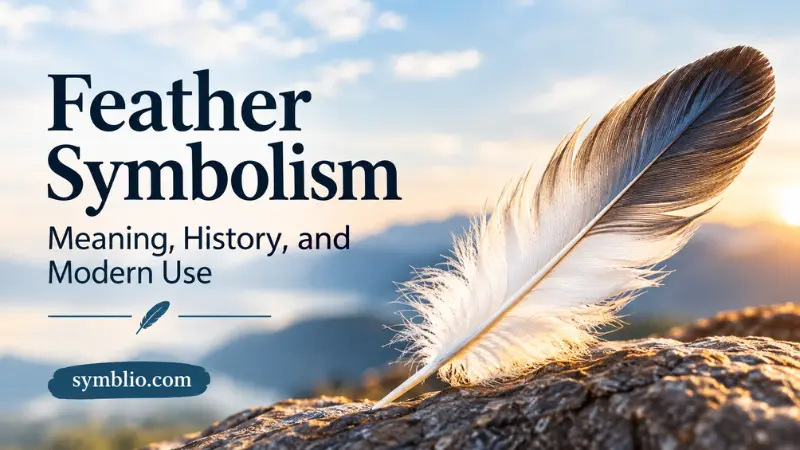
Feathers are ordinary objects from nature, yet people often treat them as meaningful signs of freedom, spirituality, remembrance, or personal change. Feather symbolism varies considerably depending on the feather’s color, species, cultural setting, and the reason someone is using or displaying it.
In the United States, feathers appear in jewelry, tattoos, home decor, fashion, religious imagery, Native American-inspired designs, and memorial objects. Their association with birds also gives them an obvious connection to flight, movement, and the space between earth and sky.
The meaning becomes more interesting when history is considered. Ancient Egyptian religion connected the ostrich feather with truth, justice, and cosmic order, while later religious and cultural traditions developed their own associations between feathers, wings, protection, and spiritual life.
Quick Answer
Feather symbolism commonly represents freedom, spirituality, protection, and remembrance in modern American culture, especially in jewelry, tattoos, memorial art, and decorative designs. Historically, feathers have also represented truth, justice, divine authority, status, and connections between the earthly and spiritual worlds.
TL;DR
- Feathers commonly symbolize freedom, movement, and spiritual connection.
- Ancient Egypt associated the ostrich feather with truth and justice.
- American meanings vary according to culture, context, color, and design.
- Feather tattoos often represent individuality, remembrance, or personal growth.
- Religious imagery uses feathers mainly through wings and angelic symbolism.
- Modern designs can carry meanings unrelated to their historical origins.
What a Feather Looks Like and Why Its Shape Matters
A feather is a lightweight structure that grows from a bird’s skin. Its central shaft supports rows of fine barbs, creating a surface capable of interacting with air.
That physical design helps explain several common symbolic associations. Birds use feathers for flight, warmth, protection, display, and communication. Humans therefore have an immediate visual reason to connect feathers with movement, freedom, elevation, and the sky.
A loose feather also has a particular visual quality. Unlike a whole bird, it is small, portable, and separated from its original owner. Someone can find one on a sidewalk, keep it in a box, wear it as jewelry, or incorporate it into artwork.
Its meaning therefore depends heavily on context rather than on the object alone.
What Feathers Commonly Mean in the United States
In contemporary American culture, feathers are frequently associated with freedom. The connection is straightforward: birds can fly, cross large distances, and move through spaces inaccessible to humans.
Feathers can also suggest independence. A person wearing a feather pendant or tattoo may use it to communicate a desire for personal freedom or a transition into a new stage of life.
Another common association is spirituality. Because birds occupy the sky, feathers can function as visual reminders of heaven, angels, prayer, or a connection with something beyond ordinary physical life.
Remembrance is another modern interpretation. Feather imagery sometimes appears in memorial jewelry, tattoos, artwork, and keepsakes after the death of someone important. In these cases, the feather may represent memory rather than a universal supernatural message.
Ancient Egyptian Roots: The Feather of Ma’at
One of the clearest ancient examples of feather symbolism comes from Egypt.
The goddess Ma’at represented truth, justice, balance, and order. She was commonly identified by an ostrich feather worn on her head. In Egyptian funerary tradition, Ma’at’s feather played a role in the judgment of the deceased, where the heart was weighed against the feather.
This gives the feather a meaning that differs considerably from the modern idea of simply representing freedom.
Here, the feather represented a standard against which a person’s life could be judged. The imagery connected lightness with truth and moral order rather than merely with flight.
Museum collections also document the ostrich feather as an established emblem of Ma’at in Egyptian art.
The Egyptian example is particularly important because it demonstrates that feather symbolism has never had one universal meaning. Different societies have attached different ideas to the same natural object.
Feathers, Wings, and Religious Imagery
Feathers are closely connected to wings, so religious imagery often gives them meanings associated with protection, heaven, and divine beings.
In Christianity, angels are commonly depicted with wings in art, although the familiar artistic image developed through centuries of religious and cultural representation rather than from a single simple biblical description.
That distinction matters. A feather itself is not automatically a Christian symbol. Its meaning depends on the surrounding imagery and context.
A feather beside an angel, for example, may suggest protection or heavenly presence. The same feather incorporated into a bird tattoo may communicate freedom or individuality instead.
Native American Contexts Require Cultural Care
Feathers have important roles in numerous Indigenous cultures of North America, but there is no single “Native American meaning” for a feather.
Different Indigenous nations have their own traditions, ceremonies, laws, and relationships with particular birds and feathers. Eagle feathers, for example, can hold specific cultural and spiritual importance in some Native communities.
Because of this diversity, broad claims that every feather represents the same Native American idea are misleading.
Modern commercial designs sometimes use generic “tribal” feather imagery without identifying its actual cultural origin. That can separate the image from the traditions that gave particular feathers their significance.
When discussing Indigenous symbolism, it is more accurate to identify the specific nation or tradition whenever that information is known.
Feather Colors Can Change the Meaning
Color often influences how Americans interpret feather imagery.
A white feather may suggest peace, purity, innocence, remembrance, or spirituality. Its meaning is highly dependent on context. Historically, white feathers also acquired a very different association with military service and accusations of cowardice during World War I, particularly in Britain. That historical meaning should not automatically be applied to contemporary American feather designs.
A black feather may communicate mystery, mourning, seriousness, or individuality.
A blue feather can suggest calmness, openness, or emotional expression.
A red feather may be interpreted through associations with courage, passion, vitality, or strength.
A gold feather often appears more decorative and can suggest honor, achievement, prestige, or celebration.
These interpretations are not fixed rules. Color symbolism changes between cultures, artistic traditions, and individual experiences.
Feather Symbolism and Personal Freedom
Freedom is probably the easiest modern meaning to understand.
The reasoning comes from the bird itself. Birds move through the sky without roads, borders, or ordinary physical barriers. A feather therefore becomes a compact visual reminder of that ability.
For someone beginning a new chapter, a feather might represent independence. For another person, it might symbolize the desire to travel, explore, or make decisions without feeling constrained.
This is especially common in personal artwork and tattoos because a feather can communicate an idea without requiring a literal picture of a bird.
Feathers as Symbols of Remembrance
Feathers are also used to represent memory.
A person may choose a feather design after losing someone because the object can suggest continuing connection without directly depicting death. Memorial jewelry and tattoos sometimes combine feathers with names, dates, birds, flowers, or short personal phrases.
The meaning is therefore highly individual.
A feather does not objectively prove that a deceased person is communicating with someone. Rather, it can serve as a personal symbol through which someone expresses remembrance, love, or the desire to carry a memory forward.
That distinction keeps symbolic interpretation separate from claims about supernatural events.
Emotional and Psychological Associations
Feather imagery can evoke several emotional ideas because of its physical qualities.
A feather’s light weight can suggest gentleness, while its connection with birds often brings freedom to mind. The way a feather drifts through the air can also evoke change, travel, or impermanence.
The object can also produce a feeling of vulnerability. A feather is delicate compared with many natural materials, so artists sometimes use it to represent sensitivity or fragility.
These associations are psychological and cultural rather than universal laws. Two people can see the same feather and attach entirely different memories to it.
| Context | Common U.S. Interpretation | Common Associations | Important Note |
|---|---|---|---|
| Feather tattoo | Freedom or individuality | Change, identity, memory | Personal meaning matters most |
| White feather | Peace or remembrance | Purity, spirituality | Historical meanings also exist |
| Feather jewelry | Personal expression | Freedom, elegance, memory | Often decorative as well |
| Feather in memorial art | Remembrance | Love, loss, continuing memory | Meaning is usually personal |
| Egyptian feather imagery | Truth and justice | Ma’at, order, judgment | Specific to ancient Egyptian tradition |
Why Feathers Appear in Tattoos
Feathers work particularly well as tattoos because their shape can be adapted to many styles.
A realistic feather can emphasize natural beauty. A simplified outline can create a cleaner, more understated design. A feather combined with birds can make the connection to freedom more explicit.
Some people choose feathers to represent a personal transition. Others use them to honor someone they remember.
The species can also matter. An owl feather, peacock feather, eagle feather, or generic feather may carry different associations. However, tattoo symbolism should not be treated as a fixed dictionary. The person who chooses the image ultimately determines much of its personal meaning.
Feathers in Jewelry, Fashion, and Home Decor
Feather motifs are common in necklaces, earrings, bracelets, clothing patterns, wall art, pillows, prints, and decorative objects.
In fashion, feathers can function primarily as visual elements rather than symbolic statements. A person may choose a feather-shaped pendant because they like its appearance without attaching any spiritual meaning to it.
In home decor, feather illustrations can contribute to a natural, airy, or minimalist aesthetic. They can also complement bird, botanical, or outdoor themes.
This is an important part of modern symbolism: not every decorative feather is intended to communicate a specific belief.
Feathers in Weddings and Celebrations
Feather imagery sometimes appears in weddings, particularly in invitations, floral arrangements, accessories, table decorations, and nature-inspired themes.
In these settings, feathers can suggest freedom, partnership, travel, or a new beginning.
Their visual connection with birds also works naturally with outdoor or rustic wedding themes.
However, there is no universal American wedding tradition requiring feathers to represent a particular idea. Their meaning depends on the couple’s chosen design and personal story.
Feathers in Digital Culture and Popular Design
Social media has made feather imagery even easier to circulate.
A feather can be used in profile graphics, inspirational artwork, memorial posts, digital illustrations, and aesthetic content. Because it is visually recognizable, it can communicate an idea quickly without much explanation.
Digital culture also encourages simplified symbolism. A single feather emoji, illustration, or graphic may represent freedom, nature, writing, spirituality, or remembrance depending on the surrounding conversation.
This flexibility is one reason feather imagery remains common in contemporary design.
Common Misunderstandings About Feather Symbolism
One of the biggest misconceptions is that finding a feather always has one predetermined spiritual meaning.
There is no universal rule that every naturally found feather is a message from a deceased person, angel, spirit, or supernatural force. Such interpretations can be meaningful personal beliefs, but they should not be presented as established facts.
Another misconception is that every feather carries the same Indigenous meaning. North America’s Indigenous nations have diverse traditions, so a generalized explanation can erase important cultural differences.
A third misconception is that white feathers have always symbolized peace or purity. Historical examples show that the same image can acquire very different meanings in different places and periods.
How Feather Meanings Have Changed Over Time
The history of feathers shows how symbolism develops through cultural context.
In ancient Egypt, the ostrich feather was closely connected with Ma’at, truth, justice, and cosmic order.
Other societies developed meanings connected with birds, authority, adornment, ceremony, warfare, spirituality, and social identity.
Modern American culture tends to emphasize freedom, individuality, spirituality, nature, and remembrance. Those meanings are not replacements for every older tradition; they exist alongside them.
The same physical object can therefore carry multiple layers of meaning without having one final interpretation.
Positive and Negative Meanings Can Exist Together
Feathers are usually presented positively, but symbolism is rarely completely fixed.
A feather may represent freedom to one person and loss to another. A white feather can suggest peace in one context while carrying a historical association with military shaming in another.
This is why context matters more than a simple list of “good” and “bad” meanings.
The surrounding imagery, cultural tradition, color, personal history, and setting can all change the interpretation.
What a Feather Can Represent Today
For a contemporary American audience, the most common interpretations can be summarized as:
- Freedom: connected to birds and flight.
- Independence: a visual expression of personal choice.
- Spirituality: associated with heaven, wings, or religious imagery.
- Remembrance: used in memorial art and personal keepsakes.
- Change: representing movement from one stage of life to another.
- Truth and justice: especially in reference to ancient Egyptian Ma’at.
- Nature: reflecting an appreciation for birds and the natural world.
- Identity: used in tattoos, jewelry, fashion, and personal artwork.
No single interpretation needs to override the others.
FAQs
A feather may symbolize spiritual connection, protection, freedom, or a relationship with the heavenly world. These interpretations vary by religion and personal belief rather than representing one universal spiritual doctrine.
A feather tattoo commonly represents freedom, individuality, personal change, or remembrance. The bird species, color, accompanying imagery, and the person’s own reason for choosing it can significantly change the interpretation.
In modern American settings, a white feather can suggest peace, purity, remembrance, or spirituality. Historically, however, white feathers were also used as symbols of military shame in Britain during World War I, so context is essential.
The ostrich feather associated with Ma’at represented truth, justice, balance, and order. Egyptian funerary traditions connected the feather with the judgment of the deceased.
Feathers have important meanings in many Indigenous cultures, but there is no single meaning shared by all Native American nations. Particular feathers, especially those connected with specific birds, can have distinct cultural and ceremonial significance.
No. Someone may interpret a found feather spiritually, but feathers also fall naturally from birds and can have completely ordinary explanations. Its symbolic meaning depends on the beliefs and circumstances of the person who finds it.
In memorial settings, a feather often represents remembrance, continuing love, or carrying someone’s memory forward. The meaning usually comes from the individual’s relationship with the person being remembered rather than from a universal rule.
Conclusion
Feathers carry a wide range of meanings because their physical connection with birds naturally brings together ideas of flight, freedom, nature, and movement. Religious and historical traditions add other layers, including spirituality, protection, truth, justice, and remembrance.
Today, feather symbolism is especially flexible in the United States. It can appear in a tattoo honoring a personal transformation, jewelry representing independence, memorial artwork expressing remembrance, or simply a decorative design inspired by nature.
The most accurate interpretation is therefore the one that considers context, cultural tradition, and personal intention rather than assigning one fixed meaning to every feather.


