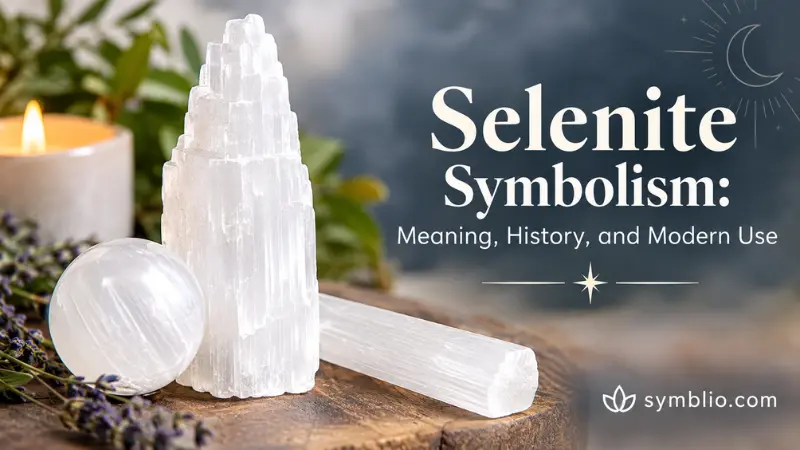
Selenite is a clear to white variety of gypsum known for its glassy appearance, delicate crystal structure, and association with moonlight. In modern selenite symbolism, people often connect the mineral with clarity, calm, renewal, and reflection, although these symbolic meanings come largely from contemporary crystal culture rather than established ancient religious traditions.
Its appeal comes partly from its appearance. Transparent or translucent crystals can catch and diffuse light in a way that resembles moonlight, while long crystal blades and white surfaces create an unusually clean visual effect. Those qualities have made selenite popular in jewelry, home decor, meditation spaces, and contemporary spiritual practices.
The history is more geological than mystical. Selenite is a form of gypsum, and its name comes from the Greek word for moon. Understanding that distinction helps separate the mineral’s documented history from meanings that developed much later through modern spiritual and wellness communities.
Quick Answer
Selenite commonly symbolizes clarity, calm, renewal, and inner reflection in modern American crystal culture. Its moon-related name and translucent appearance also connect it with ideas of light, nighttime reflection, and emotional stillness, while many of its spiritual associations are contemporary rather than ancient.
TL;DR
- Selenite commonly represents clarity, calm, renewal, and reflection.
- Its name comes from the Greek word associated with the moon.
- Scientifically, selenite is a transparent or translucent form of gypsum.
- Modern American crystal culture gives it strong cleansing associations.
- Its white appearance contributes to ideas of purity and simplicity.
- Historical mineral evidence should be separated from modern spiritual claims.
What Selenite Looks Like and Why That Matters
Selenite is generally colorless or white, although small amounts of other material can give specimens subtle variations. It belongs to the gypsum family and can occur as transparent crystals, translucent plates, or elongated crystal formations.
The mineral has a distinctive ability to split along flat planes. Some specimens form large, blade-like crystals, while others appear as sheets or clusters. Because clear selenite can transmit light, its surfaces may look almost glasslike without actually being glass.
That appearance has an obvious influence on symbolism. White often suggests cleanliness and simplicity in American visual culture, while transparency can suggest openness or visibility. When light passes through a selenite crystal, the result naturally encourages associations with illumination and clarity.
These visual impressions do not prove that the mineral has supernatural properties. They explain why people may find certain symbolic meanings intuitive.
What Selenite Commonly Symbolizes in the United States
In contemporary American crystal culture, four ideas appear especially often: clarity, calm, renewal, and reflection.
Clarity is connected to the crystal’s transparent appearance. People may use the stone as a visual reminder to simplify their surroundings or think more carefully before making decisions.
Calm comes from its pale color and quiet appearance. A white crystal placed beside a bed, desk, or meditation area can function as part of a deliberately peaceful environment.
Renewal relates to the idea of starting fresh. Because white objects are frequently associated with cleanliness and new beginnings in American culture, selenite can easily take on that role.
Reflection has a slightly different origin. The mineral’s name and appearance invite comparisons with moonlight, which has long served as a cultural image for nighttime contemplation.
These meanings describe how people use the symbol. They should not be treated as scientific evidence that the mineral changes emotions, health, or circumstances.
The Moon Connection Behind the Name
The word “selenite” comes from the Greek word selene, meaning moon. The mineral received this name because of its moonlike appearance and the way light can interact with translucent gypsum.
The name itself is important because it provides a documented historical connection between the mineral and lunar imagery. However, that does not mean ancient Greek religious traditions assigned selenite all the modern meanings found in today’s crystal shops.
The mineral name was formally introduced in European mineralogical writing in the eighteenth century. Earlier people certainly encountered gypsum in different forms, but the modern mineral classification and terminology developed much later.
This distinction matters. A connection between a mineral’s name and the moon is historically supportable. Claims that ancient civilizations used selenite for specific spiritual practices require much stronger evidence and should not automatically be accepted simply because the crystal has a moon-related name.
Ancient Roots and the History of Gypsum
Gypsum itself is an old and widely occurring mineral. Humans have used gypsum for practical purposes such as plaster, construction materials, decorative objects, and artistic work for thousands of years.
Selenite is specifically a crystalline form of gypsum. Its transparent or translucent qualities make it visually different from massive gypsum varieties such as alabaster.
The mineral’s scientific identity is therefore more firmly established than its modern symbolic identity. Geological records show selenite occurring in many parts of the world, including the United States and famous crystal localities elsewhere.
One of the best-known examples is the giant gypsum crystals found at Naica in Mexico. These formations demonstrate just how striking naturally occurring gypsum crystals can become.
The geological story provides an important foundation for understanding why selenite has such a distinctive place in modern mineral collecting.
Selenite and Moon Symbolism
The moon has many meanings in American culture, including nighttime, cycles, reflection, change, and quiet observation. Selenite’s name and pale appearance allow people to transfer some of these ideas onto the crystal.
Moon symbolism is especially relevant because the moon changes visibly through recurring phases. As a result, it often represents cycles rather than a fixed state. A person who views selenite symbolically may therefore associate it with transition, rest, or beginning again.
The connection works primarily through metaphor. The crystal does not physically come from the moon, and its lunar association is not evidence of a supernatural relationship with the Moon.
Instead, selenite demonstrates how an object’s appearance and name can shape the meanings people attach to it.
Why White Selenite Suggests Purity and Clarity
White has a strong symbolic presence in American culture. It appears in wedding clothing, religious settings, clean interiors, medical environments, and minimalist design. Depending on context, it can suggest innocence, cleanliness, peace, simplicity, or a fresh beginning.
Selenite naturally fits this visual vocabulary.
A white or nearly transparent crystal can look orderly and uncomplicated. When placed in a room, it may contribute to a minimalist aesthetic. When worn as jewelry, it can communicate softness and restraint rather than boldness.
This is one reason selenite symbolism often centers on clarity. The association does not require a supernatural explanation. People frequently interpret visual qualities through familiar cultural ideas.
Selenite in Contemporary Spiritual Culture
Selenite became particularly visible through modern crystal and New Age communities. In those settings, it is often described using concepts such as energetic cleansing, protection, spiritual clarity, or meditation.
These are belief-based interpretations, not established mineralogical properties.
For many people, the symbolic value is personal. Holding or displaying a crystal can create a pause in a busy routine. Someone may associate the object with meditation, journaling, quiet time, or a personal intention.
That psychological function can be meaningful without requiring a claim that the mineral produces measurable spiritual effects.
This distinction is useful when discussing symbolism responsibly: a cultural practice can be real and significant to its participants even when its supernatural claims are not scientifically established.
Emotional and Psychological Symbolism
Selenite’s symbolism often reflects a desire for mental order.
Someone drawn to the crystal may see it as a reminder to slow down, reduce distractions, or create a calmer environment. The object can become connected with a personal routine, such as setting aside a few minutes for reflection.
Its symbolism also fits the idea of emotional distance from confusion. A clear crystal can serve as a visual metaphor for seeing a situation more plainly.
This does not mean selenite has a proven psychological effect. The symbolic meaning comes from the way a person interprets and incorporates the object into everyday life.
In this sense, selenite can function much like other meaningful objects: its value may come from the attention, memory, or intention attached to it.
Selenite in American Homes and Interior Design
Selenite has become increasingly recognizable as a decorative mineral. Long crystal towers, plates, lamps, bowls, and polished pieces can fit naturally into modern interiors.
Its popularity is partly aesthetic. White and translucent materials work well with neutral color palettes, natural wood, stone, glass, and minimalist furniture.
Symbolically, placing selenite in a living space can communicate a preference for simplicity and calm. Some people display it beside books, plants, candles, or other objects associated with relaxation.
The crystal therefore operates on two levels: it is a geological specimen and a decorative object. Its symbolism can depend on the owner’s beliefs, while its visual appeal remains accessible even to someone who does not accept crystal spirituality.
Selenite in Jewelry and Personal Style
Selenite is sometimes incorporated into jewelry and small personal objects, although its relative softness means it requires more care than many harder gemstones.
As a wearable symbol, it can represent personal calm, simplicity, reflection, or a connection with natural materials.
Its pale appearance also makes it visually versatile. It can complement understated clothing rather than functioning as a highly colorful statement stone.
For some wearers, the meaning is private rather than public. A small crystal pendant or stone carried as a personal object may represent an intention or reminder that only the wearer fully understands.
That personal dimension is common in contemporary symbolic jewelry.
What Selenite Can Represent in Tattoos
Selenite is less common as a tattoo subject than familiar symbols such as flowers, animals, celestial bodies, or traditional gemstones. When it does appear, the design usually draws from its visual relationship with moonlight and crystal structure.
A selenite-inspired tattoo might represent clarity after confusion, personal renewal, quietness, or an interest in crystals and mineral collecting.
The design can also be combined with moons, stars, botanical elements, geometric forms, or other natural imagery. In those combinations, the meaning becomes more individualized.
Unlike the mineral itself, a tattoo permanently records the owner’s interpretation. Consequently, there is no single universal meaning for a selenite tattoo.
Selenite Symbolism Across Different Cultural Contexts
Selenite should not be presented as though one ancient civilization assigned it one universal sacred meaning.
Gypsum has been known and used in many regions, but the modern symbolic language surrounding selenite largely comes from contemporary mineral collecting, metaphysical communities, decorative culture, and wellness-oriented practices.
The moon, meanwhile, has an enormous symbolic history across world cultures. Lunar imagery has been associated with calendars, fertility, time, nighttime, deities, change, and cycles in different traditions.
Those broader lunar traditions can influence the way modern people interpret a moon-linked mineral. However, that influence should not be confused with evidence that those cultures specifically considered selenite a sacred stone.
This distinction keeps the history respectful and avoids turning modern interpretations into invented ancient traditions.
Common Meanings by Context
| Context | Meaning in the USA | Common Associations | Notes |
|---|---|---|---|
| Home decor | Calm and simplicity | White interiors, natural materials | Often aesthetic as well as symbolic |
| Jewelry | Personal clarity | Reflection, renewal | Meaning varies by wearer |
| Crystal practice | Cleansing and clarity | Meditation, intention-setting | Primarily contemporary belief |
| Moon-themed design | Reflection and cycles | Lunar imagery, nighttime | Connected partly to the mineral’s name |
| Mineral collecting | Natural beauty | Crystals, geology, rarity | Focuses on physical rather than spiritual meaning |
Common Misunderstandings About Selenite
One common misunderstanding is that every claim about selenite comes from ancient tradition. Much of what appears in modern crystal culture developed relatively recently.
Another misconception involves the word “selenite” itself. Because it resembles “selenium,” some readers assume the two are related. They are not simply different names for the same substance. Selenite is a variety of gypsum, chemically calcium sulfate dihydrate.
It is also important not to confuse symbolic claims with medical claims. Statements that a crystal can diagnose, prevent, or treat illness go beyond what mineralogy can establish.
A more grounded approach is to describe selenite as a mineral that people may use as a symbolic object for reflection, personal rituals, decoration, or spiritual practice.
Why Selenite Remains Popular Today
Selenite fits several major trends in contemporary American culture at once.
Home decor benefits from selenite’s clean, translucent appearance. As a collectible, the mineral also appeals to people interested in crystals and geology. Its presence in personal spiritual practices reflects the human tendency to use physical objects as reminders of intentions and reflection.
And it works in social media imagery because translucent crystals photograph particularly well.
Its symbolism also fits modern interest in simplifying spaces and creating small personal rituals. A person may place a crystal on a desk not because they believe it has supernatural powers, but because seeing it reminds them to pause and refocus.
That flexibility helps explain its continuing popularity.
How the Meaning of Selenite Has Evolved
Selenite’s story shows how symbolism can develop through several layers.
The first layer is geological: it is a crystalline form of gypsum with identifiable physical properties.
The second is linguistic: its name connects it with the Greek word for moon because of its appearance and relationship with light.
The third is cultural: modern crystal communities have developed additional associations involving clarity, cleansing, calm, and renewal.
The fourth is personal. Individual users may assign the crystal a meaning based on memories, goals, beliefs, or experiences.
None of these layers has to erase the others. A mineral collector can appreciate selenite scientifically, an interior designer can appreciate its appearance, and a spiritual practitioner can treat it as a symbolic object. The meanings simply come from different frameworks.
FAQs
In contemporary spiritual practices, selenite is commonly associated with clarity, cleansing, calm, and reflection. These associations belong primarily to modern crystal traditions rather than a single ancient religious system.
Yes, its name has a documented connection to the Greek word for moon. The name refers to the mineral’s moonlike appearance and the way light can pass through or reflect from some specimens.
Selenite is a variety of the mineral gypsum. It is composed of calcium sulfate dihydrate and is commonly recognized by its transparent or translucent crystal forms.
In home decor, selenite can symbolize calm, simplicity, clarity, and a fresh atmosphere. Some people also display it for its appearance without assigning it a spiritual meaning.
A selenite tattoo can represent clarity, personal renewal, reflection, or an interest in crystals and lunar imagery. Because tattoo symbolism is highly personal, the surrounding design often changes the intended meaning.
There is no strong basis for treating modern selenite symbolism as a universal ancient religious tradition. The mineral’s lunar name has historical roots, but many of the spiritual meanings attached to selenite today developed through contemporary crystal culture.
There is no established scientific evidence that selenite possesses supernatural healing abilities. People may still use it as a personal reminder for meditation, reflection, or relaxation, which is different from claiming a medical effect.
Conclusion
Selenite combines a straightforward geological identity with a much broader modern symbolic life. Its transparent appearance, pale color, and moon-related name naturally encourage associations with clarity, reflection, calm, and renewal.
In modern American culture, selenite symbolism is shaped less by one ancient tradition than by the meeting of mineral collecting, interior design, personal spirituality, and contemporary crystal culture. Understanding that distinction makes the symbol more interesting rather than less meaningful: its story shows how people continually create new associations around the natural objects they bring into their lives.
For some, selenite is simply a beautiful variety of gypsum. For others, it serves as a visual reminder to pause, reflect, and begin again.


