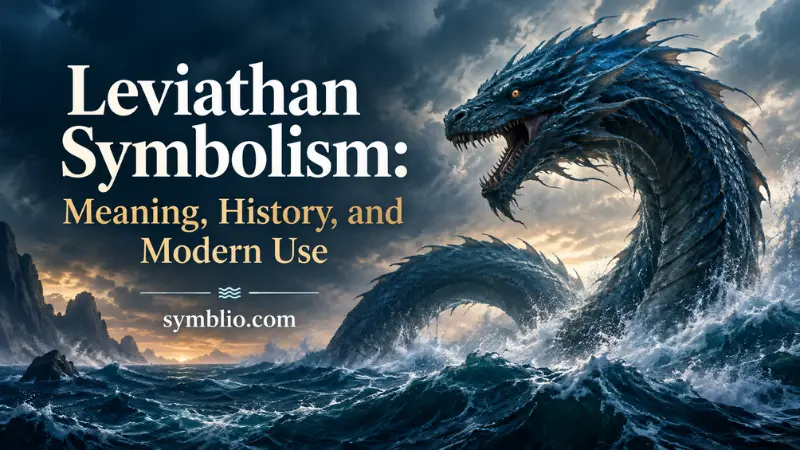
The leviathan symbolism found in modern culture comes from an ancient image of an enormous creature associated with the sea, chaos, danger, and forces beyond human control. In the Hebrew Bible, Leviathan appears as a formidable sea creature, while later Jewish traditions expanded the figure into a cosmic monster connected with the end of the age.
Today, Americans may encounter Leviathan in religious discussions, fantasy literature, tattoos, video games, political writing, and popular culture. Its meaning depends heavily on context: it can represent destructive chaos, overwhelming power, an opponent worthy of confronting, or simply an enormous and intimidating force.
Quick Answer
Leviathan commonly symbolizes overwhelming power, chaos, and forces beyond human control in modern American culture, especially in mythology, fantasy, tattoos, and religious imagery. Historically, it represented a gigantic sea creature associated with the biblical imagination and later Jewish traditions concerning cosmic conflict and ultimate divine victory.
TL;DR
- Leviathan commonly represents chaos, danger, and overwhelming natural power.
- Its biblical imagery connects it with the sea and an enormous creature.
- Jewish tradition developed Leviathan into an important eschatological figure.
- American culture often treats Leviathan as a symbol of enormous power.
- Tattoos may use Leviathan to express strength, defiance, or survival.
- Thomas Hobbes gave “Leviathan” a separate political meaning in 1651.
What Is Leviathan?
Leviathan is an enormous sea creature described in biblical literature, most famously in Job 41. The description emphasizes its size, armored body, teeth, strength, and resistance to ordinary attempts at capture.
The imagery is deliberately larger than everyday zoology. Some interpreters have compared aspects of the biblical description with a crocodile, particularly because Job’s account includes details resembling scales, teeth, armor, and difficulty of capture. Other passages treat Leviathan more clearly as a mythic sea monster.
That distinction matters. Leviathan does not have one fixed identity across every ancient text. Sometimes the name appears to refer to a creature that could be imagined through observations of large aquatic animals. Elsewhere, it belongs to a much larger mythological picture involving the sea, chaos, and divine authority.
This combination explains why Leviathan remains so useful symbolically. It can stand somewhere between a real creature, a legendary monster, and an image of something humans cannot easily control.
The Core Symbolism of Leviathan
The most common symbolic meanings associated with Leviathan include chaos, overwhelming strength, danger, the unknown, resistance, and divine authority over creation.
Its connection with chaos comes partly from ancient Near Eastern ideas in which sea monsters represented threatening forces associated with the untamed waters. Biblical writers adapted related imagery within a monotheistic framework, presenting God as sovereign over even the greatest forces imaginable.
This creates an important distinction.
Leviathan is not simply a symbol of evil.
In biblical poetry, the creature’s extraordinary strength can instead emphasize the limits of human power. Job 41, for example, challenges the assumption that humans can control everything in creation. The creature’s frightening qualities become part of a larger argument about the difference between human capability and divine power.
That is why Leviathan can symbolize humility as well as danger.
A person using Leviathan imagery may not be saying, “I am evil.” They may instead be expressing, “There are forces larger than me,” “I survived something overwhelming,” or “I refuse to be intimidated.”
Ancient Roots and the Sea Monster Tradition
Leviathan belongs to a broader ancient Near Eastern world in which enormous sea creatures and serpentine monsters appear in stories about creation and divine conflict.
The ancient city of Ugarit, located in present-day Syria, produced literary texts that reveal a Canaanite religious world in which gods, storms, fertility, water, and the cosmic order were closely connected. These texts help modern scholars understand the wider cultural environment surrounding biblical descriptions of supernatural sea creatures.
Biblical references to Leviathan appear in several different forms. Psalm 74 associates Leviathan with multiple heads and describes God breaking the monster’s heads. Isaiah 27:1 presents Leviathan as a twisting or fleeing serpent who will ultimately be defeated by God. Job 41, by contrast, concentrates on the creature’s extraordinary physical characteristics.
These passages should not automatically be treated as describing one identical creature in exactly the same way. Ancient religious poetry could reuse familiar monster imagery for different theological purposes.
The recurring idea, however, is clear: the sea represents a realm that humans cannot completely master, while God remains greater than it.
Leviathan in the Hebrew Bible
The biblical Leviathan is particularly important because its symbolism changes according to the passage.
In Job, Leviathan is presented as an almost impossible creature to capture. The description emphasizes human helplessness in the face of its strength. The point is not simply to frighten the reader; it forms part of God’s larger response to Job’s questions about suffering, creation, and human understanding.
In the Psalms, Leviathan can take on a more cosmic character. Psalm 74 describes God crushing Leviathan and giving it as food to creatures of the wilderness. Isaiah similarly uses serpent imagery when describing God’s eventual defeat of Leviathan.
As a result, Leviathan can symbolize two related ideas:
- The enormous forces humans cannot control
- The ultimate defeat of chaos by divine order
That dual meaning remains central to how the creature is interpreted today.
Leviathan in Jewish Tradition
Later Jewish literature expanded the Leviathan story considerably.
Rabbinic traditions describe Leviathan as an extraordinary creature associated with the future and the messianic age. Some traditions describe a future banquet involving Leviathan, while others develop elaborate stories about its enormous size and supernatural characteristics.
Leviathan therefore became more than a frightening sea monster. It could represent something preserved within God’s creation for a future purpose.
This development also shows why it is inaccurate to describe Leviathan simply as a biblical version of Satan. Some later interpretations connected Leviathan with forces of evil or cosmic opposition, but Jewish tradition contains several different interpretations rather than one universally accepted meaning.
In some interpretations, the creature represents hostile powers that will eventually be overcome. In others, it belongs to the mysterious order of creation and becomes part of an imagined future feast.
The symbolism consequently moves between threat and purpose.
What Leviathan Symbolizes in the United States
In the United States, Leviathan does not have one standard cultural meaning.
For religious readers, it is most likely to evoke biblical imagery and questions about God’s authority over creation. For readers interested in mythology or fantasy, Leviathan may simply mean a gigantic sea monster.
American literature and popular culture have also broadened the word. A person might call a corporation, institution, bureaucracy, or technological system a “Leviathan” to suggest that it has become enormous and difficult to control.
This usage has an important historical precedent in political philosophy. Thomas Hobbes used Leviathan as the title of his 1651 work about government, sovereignty, and social order. In that context, the monster became a metaphor for the immense authority of the state rather than merely a supernatural sea creature.
That meaning remains particularly relevant to American political language, where “Leviathan” can suggest an institution that has grown extraordinarily powerful.
A Quick Comparison of Leviathan’s Meanings
| Context | Meaning in the USA | Common Associations | Notes |
|---|---|---|---|
| Biblical symbolism | Divine authority over overwhelming forces | Sea, creation, chaos | Meaning varies by passage |
| Jewish tradition | Cosmic creature connected with the future | Judgment, messianic age, feast | Expanded significantly in rabbinic literature |
| Fantasy culture | Giant sea monster | Adventure, danger, strength | Often separated from its religious origins |
| Tattoos | Defiance or formidable strength | Survival, resistance, power | Personal meaning varies |
| Political language | Massive institutional power | Government, bureaucracy, authority | Influenced by Hobbes |
Leviathan as a Symbol of Chaos
Chaos is one of Leviathan’s most recognizable meanings.
Water has always presented humans with a particular symbolic problem. A calm lake can suggest peace, but an enormous ocean can also represent uncertainty, depth, storms, and territory that cannot easily be controlled.
A sea monster intensifies those qualities.
Leviathan gives a recognizable form to something that cannot be seen clearly beneath the surface. In that sense, it can symbolize fears that are difficult to define: social disorder, uncertainty, overwhelming circumstances, or an opponent whose full strength remains unknown.
Yet the symbolism does not necessarily suggest that chaos will win.
In biblical imagery, Leviathan can instead become an example of something that appears uncontrollable from a human perspective but remains within divine authority.
Leviathan as Strength and Defiance
Modern interpretations often place more emphasis on Leviathan’s physical power than ancient religious interpretations did.
That is especially noticeable in fantasy art and tattoo culture. A massive serpent or sea dragon can communicate endurance, toughness, independence, and resistance.
Someone attracted to Leviathan imagery might identify with the creature’s refusal to be easily subdued. In this interpretation, the monster becomes a metaphor for standing against pressure rather than causing harm.
This is a distinctly modern shift.
Ancient texts frequently use Leviathan to emphasize God’s superiority. Contemporary personal symbolism can instead focus on the creature itself and treat its size and resilience as desirable characteristics.
The two interpretations are not identical, but they can coexist.
Leviathan in Tattoos and Personal Style
Leviathan tattoos are often chosen for their dramatic visual qualities as much as their historical symbolism.
A tattoo may depict Leviathan as a serpent, dragon-like marine creature, enormous fish, or highly stylized sea monster. The surrounding imagery can change its meaning substantially.
For example, waves can emphasize its relationship with the sea. A crown may suggest dominance or sovereignty. A ship can make the image feel like a confrontation between human vulnerability and an enormous natural force.
A person might choose Leviathan imagery to represent:
- overcoming an intimidating challenge
- resistance to control
- fascination with mythology
- personal strength
- respect for the ocean
- confrontation with uncertainty
- interest in biblical symbolism
There is no universal tattoo dictionary that assigns one meaning to every Leviathan design. Personal symbolism matters more than a fixed interpretation.
Emotional and Psychological Meaning
Psychologically, Leviathan can represent the feeling of confronting something much larger than oneself.
That “something” might be an overwhelming responsibility, a difficult transition, an uncertain future, or simply the recognition that not everything can be controlled.
The creature can therefore symbolize fear without surrender.
Its enormous size makes vulnerability part of the image. A person who identifies with Leviathan imagery may be interested not only in strength but also in the experience of facing something intimidating.
There is another psychological dimension as well: the sea monster gives shape to the unknown.
Human beings often find uncertainty harder to handle when it has no recognizable form. A monster turns the invisible threat into an identifiable figure. Once represented visually, the unknown can become something that stories, art, and imagination can explore.
Leviathan in Fantasy and Popular Culture
Modern fantasy has transformed Leviathan into a flexible monster archetype.
Books, games, films, comics, and other forms of speculative fiction frequently use the name for gigantic creatures associated with oceans or enormous destructive power. These versions may borrow only the basic idea of a colossal sea monster rather than preserving the original biblical or Jewish meanings.
This distinction is important when interpreting modern references.
A fictional “Leviathan” is not necessarily making a theological statement. Sometimes the name is chosen simply because it communicates scale. Calling something a Leviathan tells the audience that it is extraordinarily large, formidable, or difficult to defeat.
The word has effectively become a cultural shorthand for something gigantic and intimidating.
Leviathan and Political Power
One of the most important non-religious uses of the Leviathan image comes from Thomas Hobbes.
In Leviathan, published in 1651, Hobbes used the biblical monster as the title and central visual metaphor for his discussion of political authority and the social order.
This produced a second major meaning for the word: an institution whose power is immense.
In American political language, “Leviathan” can therefore describe a government, bureaucracy, corporation, or other large organization perceived as exercising extensive control.
This meaning differs sharply from tattoo and fantasy interpretations. The political Leviathan is not primarily a monster beneath the sea. It is a metaphor for organized human power.
That difference is worth remembering because modern references to Leviathan sometimes have nothing to do with mythology.
Positive and Negative Meanings
Leviathan symbolism can be either positive or negative depending on context.
Positive associations may include:
- resilience
- strength
- endurance
- independence
- protection
- survival
- resistance
- respect for nature
Negative associations may include:
- chaos
- destruction
- uncontrollable power
- fear
- oppression
- danger
- disorder
The same image can communicate opposite ideas.
Context determines the message.
Common Misunderstandings About Leviathan
One common mistake is treating Leviathan as if it has always meant exactly the same thing.
It has not.
Biblical passages differ from later rabbinic traditions, and both differ from modern fantasy culture. Some interpretations emphasize a sea creature; others emphasize a cosmic adversary; still others use Leviathan as a metaphor for political authority or overwhelming institutional power.
Another misunderstanding is assuming Leviathan is simply another word for “Satan.” That interpretation appears in some later symbolic traditions, but it does not adequately describe the creature’s varied biblical and Jewish meanings.
It is also misleading to assume that Leviathan was necessarily imagined as a literal animal in every ancient context. Some descriptions may draw from real aquatic creatures, while other passages clearly employ mythic imagery.
Understanding those differences produces a much more accurate interpretation.
How Leviathan’s Meaning Has Changed
The history of Leviathan symbolism is essentially a story of reinterpretation.
In ancient biblical poetry, Leviathan could embody the untamed power of the sea and serve as an image of forces beyond human control. Later Jewish traditions developed elaborate stories surrounding the creature and connected it with future events and divine justice.
In early modern political philosophy, Hobbes transformed the name into a metaphor for sovereign political power.
Modern popular culture then expanded the word again. Fantasy writers, artists, game designers, and tattoo enthusiasts can use Leviathan simply to communicate immense size, danger, or strength.
The creature has therefore moved from cosmic sea monster to religious symbol, political metaphor, and popular cultural archetype.
Its appearance changes, but the underlying idea of extraordinary power remains remarkably consistent.
Why Leviathan Still Matters Today
Leviathan continues to work as a symbol because it gives a recognizable shape to an old human concern: What do we do when we encounter something larger than our ability to control it?
Ancient religious texts answered that question in theological terms. Political philosophy used the monster to think about authority and social order. Modern entertainment uses it to create a memorable image of enormous danger.
For Americans today, the meaning may be religious, artistic, political, personal, or purely fictional.
That flexibility is part of the symbol’s modern appeal. Leviathan can represent the ocean, uncertainty, institutional power, personal resistance, or an imagined creature from another world without losing its basic association with extraordinary scale.
FAQs
Leviathan commonly symbolizes overwhelming power, chaos, danger, and forces beyond ordinary human control. In biblical contexts, the creature can also demonstrate divine authority over forces that humans cannot master.
Not necessarily. Some later traditions associate Leviathan with hostile or destructive forces, but biblical and Jewish interpretations are more varied than simply calling it a symbol of evil.
A Leviathan tattoo may represent strength, resistance, survival, fascination with mythology, or confrontation with something intimidating. The meaning depends heavily on the design and the person’s reason for choosing it.
In the Bible, Leviathan is an enormous sea creature whose meaning varies by passage. Job emphasizes its extraordinary strength, while passages such as Isaiah 27 portray it in a more cosmic struggle involving divine judgment.
Leviathan shares characteristics with ancient dragon and sea-monster traditions, but the terms are not interchangeable in every historical context. Biblical descriptions use several different words and images for large serpentine or aquatic creatures.
Hobbes used Leviathan as a metaphor for immense political authority and the sovereign power of the state. His 1651 book gave the name an important political meaning that remains separate from its religious and mythological uses.
It can be either. It may represent danger and chaos, but it can also express resilience, strength, endurance, and the ability to confront overwhelming circumstances.
Conclusion
Leviathan symbolism has never had only one meaning. Its oldest associations center on the enormous power of the sea and forces that exceed ordinary human control, while biblical poetry uses the creature to place that power within a larger vision of divine authority. Later Jewish tradition, political philosophy, and modern popular culture each added new layers.
In contemporary America, Leviathan can therefore mean a biblical sea monster, a symbol of chaos, an image of personal strength, a metaphor for political power, or simply an enormous creature in fantasy. The most useful interpretation comes from looking at the context rather than forcing every appearance into one definition.
At its most basic, leviathan symbolism is about confronting something that seems larger than human control—and asking what that power means.


