

A white heron standing motionless beside a marsh can look almost sculptural: long legs, pale feathers, a deliberate posture, and a landscape of water and reeds around it. In the United States, that image often suggests grace, patience, purity, independence, and close attention to nature.
The phrase white heron symbolism refers to the meanings people attach to white herons and closely related white egrets. Those meanings come partly from the birds themselves and partly from American history, art, conservation, folklore, and the cultural associations of the color white.
The symbol is especially interesting in the United States because white herons have represented both beauty and exploitation. Their elegant breeding feathers once made them targets of the fashion trade, while the effort to protect them helped strengthen America’s early bird-conservation movement.
Quick Answer
White heron symbolism commonly represents grace, patience, purity, and peaceful observation in modern American culture. Historically, white herons and egrets also became associated with beauty, fashion, conservation, and the protection of wildlife.
TL;DR
- White herons often symbolize patience, grace, and peaceful observation.
- White feathers commonly add associations of purity and renewal.
- American conservation history gave egrets an important environmental meaning.
- Indigenous animal traditions vary widely among Native communities.
- Modern art uses the bird to suggest calm and natural beauty.
- Negative meanings usually come from cultural context, not the bird itself.
What a White Heron Represents in Nature
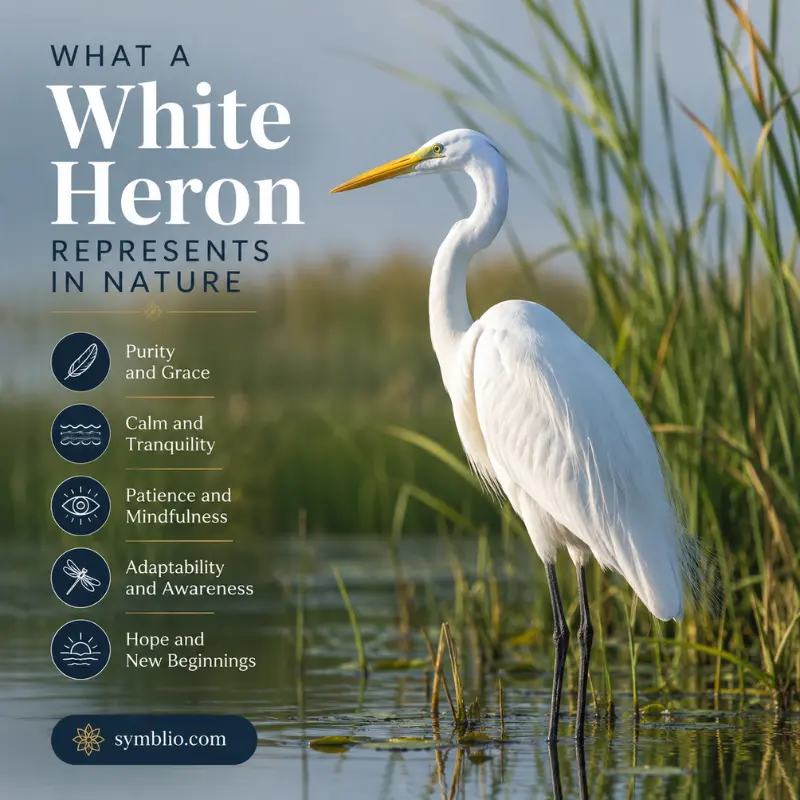
Before looking at folklore or symbolism, it helps to understand the animal itself.
Several North American birds may be described informally as white herons. The Great Egret is one of the most recognizable: a tall white wading bird with a long neck, yellow bill, and black legs. It lives around wetlands, ponds, rivers, coastal areas, marshes, and other shallow-water habitats.
The Snowy Egret is smaller and also white, with distinctive breeding plumes. The Great White Heron, meanwhile, is a white form of the Great Blue Heron found particularly in southern Florida.
Their behavior contributes strongly to their symbolic reputation. A heron may remain still for long periods while watching the water, then move quickly when an opportunity appears. That combination makes patience without passivity one of the most fitting interpretations.
The bird does not need to rush to appear purposeful. Its stillness is part of how it survives.
Patience, Stillness, and Careful Observation
The most natural symbolic association is patience.
A white heron standing at the edge of a pond appears to be waiting, but it is not simply inactive. It is watching its surroundings and responding at the right moment. Because of this, the bird can represent someone who values observation before action.
This interpretation works especially well in modern American visual culture. A heron on a lakehouse print, nature photograph, journal cover, or meditation-inspired illustration can communicate calm attention without requiring a religious explanation.
The symbolism can also apply to personal growth. Someone might choose a heron image as a reminder to avoid reacting immediately and instead give a situation time to become clearer.
In that sense, the heron represents a practical form of patience: watch carefully, conserve your effort, and act when the moment is right.
Why White Adds Purity and Renewal
The bird’s symbolism becomes different when its white plumage is emphasized.
Across American visual culture, white commonly suggests cleanliness, innocence, peace, simplicity, and renewal. Those associations can be transferred to white-feathered birds, even when the original animal symbolism has nothing specifically to do with purity.
A white heron therefore may suggest:
- purity of intention
- peaceful surroundings
- a fresh beginning
- simplicity
- clarity
- spiritual reflection
These meanings should not be treated as universal rules. Color symbolism changes between cultures and situations.
A photograph of a white heron flying over blue water, for example, may feel serene because several visual elements work together: white feathers, open space, water, light, and the bird’s slow flight.
Grace and Elegance in American Culture
The long neck, narrow body, extended legs, and broad wings give white herons an unmistakable visual elegance.
That elegance became especially significant in American history because people once treated heron and egret feathers as fashionable decorations. Breeding birds grew specialized plumes, and those feathers became valuable in the millinery trade. The resulting hunting severely damaged populations of white herons and egrets.
This history gives the idea of “elegance” an unusual second layer.
Today, people can admire the bird’s appearance without necessarily thinking about the destructive fashion industry that once targeted it. Yet the historical connection explains why beauty, feathers, fashion, and conservation became intertwined in the American story of the white egret.
White Herons and American Conservation
Few aspects of the symbol are more specifically American than its connection with conservation.
During the late nineteenth and early twentieth centuries, plume hunters killed enormous numbers of egrets and other birds for their feathers. The Smithsonian describes the feather trade as a major threat to white egrets and herons, while reports of bird slaughter helped encourage the development of conservation organizations and wildlife protections.
The Great Egret eventually became the symbol of the National Audubon Society.
That history transformed the bird’s cultural meaning. A white egret was no longer simply an attractive source of feathers. It became a reminder that wildlife could disappear when human demand went unchecked.
For American audiences, the white heron can therefore symbolize environmental responsibility and the idea that protecting beauty matters as much as appreciating it.
White Heron Symbolism in the United States
In contemporary America, the white heron tends to appear in settings connected with nature, water, travel, regional identity, and conservation.
Its strongest associations include:
| Context | Meaning in the USA | Common Associations | Notes |
|---|---|---|---|
| Nature art | Calm and observation | Wetlands, lakes, wildlife | Often emphasizes landscape |
| Conservation | Protection of wildlife | Bird preservation, habitats | Connected to egret conservation history |
| Home décor | Elegance and tranquility | Coastal or waterside living | Often decorative rather than religious |
| Personal symbolism | Patience and independence | Reflection, self-direction | Meaning depends on the individual |
| Photography | Natural beauty | Water, light, solitude | Common in wetland and coastal imagery |
The bird is particularly appropriate for American regions where wetlands and coastal ecosystems are part of everyday life. Florida is an obvious example, but herons and egrets occur across much broader portions of the country.
Indigenous Perspectives Require Cultural Care
It is tempting to describe a white heron as having one universal “Native American meaning.” That would be misleading.
Native nations have distinct languages, histories, ceremonial systems, stories, and relationships with animals. The Smithsonian’s educational material specifically cautions against treating the broad modern idea of a generic “spirit animal” as though it represents Native American cultures collectively. Animal relationships differ among communities and can involve family, clan, storytelling, spiritual beliefs, and local environments.
Herons do appear in documented Native American folklore and teachings, including material associated with the Seneca and other communities. But those traditions should be understood within their particular cultural settings rather than reduced to a universal list of symbolic meanings.
For a general American audience, the most respectful approach is to say that heron symbolism exists in different Indigenous contexts but does not have one meaning shared by every Native nation.
Herons, Wetlands, and the Meaning of Place
A white heron does not symbolize only the bird itself. It can also represent the ecosystem where people encounter it.
Wetlands support birds, fish, insects, plants, and other wildlife. When a heron appears in artwork, the surrounding water and vegetation often become part of the message.
A heron beside reeds may suggest:
- connection with wetlands
- respect for wildlife
- coastal or Southern identity
- quiet natural spaces
- ecological balance
This makes the white heron especially suitable for environmental art. The symbol can communicate appreciation for an entire habitat rather than simply admiration for one attractive bird.
Emotional and Psychological Meaning
People often respond emotionally to herons because the birds combine movement with stillness.
A white heron can represent quiet confidence. It does not need dramatic behavior to dominate a scene. Its posture creates a sense of presence without aggression.
That makes it useful as a personal symbol for someone who identifies with qualities such as:
- independence
- restraint
- attentiveness
- patience
- composure
- adaptability
The symbolism should not be interpreted as a psychological diagnosis or universal personality type. A person who chooses a heron image may simply appreciate the bird’s appearance or connection to a particular place.
Symbolism works because people give images personal associations. The same bird can represent peaceful solitude to one person and memories of a favorite shoreline to another.
White Heron Symbolism in Tattoos and Personal Art
White herons can work well in tattoo-inspired artwork because their silhouette is immediately recognizable.
A flying heron may suggest freedom, transition, or movement. A standing bird can emphasize patience and composure. A heron surrounded by reeds or water places the meaning more firmly in nature.
The color treatment also changes the impression. Black-and-gray artwork tends to emphasize shape and movement, while an illustration that highlights white feathers can place more attention on purity, simplicity, or visual elegance.
For personal symbolism, the most meaningful interpretation usually comes from the reason someone chose the bird rather than from a fixed symbolic dictionary.
White Herons in Home Décor and Design
In American interiors, herons and egrets frequently fit naturally into coastal, lake, tropical, and nature-inspired designs.
A white heron print can make a room feel connected to open water and outdoor landscapes. Its tall vertical shape also works well in artwork where designers want a sense of height and spaciousness.
Unlike some animal symbols, the heron does not normally communicate aggression or danger. That makes it particularly adaptable to bedrooms, offices, reading spaces, entryways, and vacation homes.
Its decorative meaning is often straightforward: quiet nature, elegance, and a connection to water.
Religious and Spiritual Interpretations
There is no single Christian or broadly American religious doctrine assigning one universal meaning to the white heron.
Some people may interpret a white bird through broader religious associations with purity, peace, creation, or spiritual reflection. Those interpretations are personal or tradition-specific rather than established rules about herons themselves.
The distinction matters because modern spiritual websites sometimes present animal symbolism as though every bird has one ancient, universally accepted message. Historical evidence rarely supports such simple claims.
A responsible interpretation separates documented cultural traditions from contemporary personal spirituality.
Positive and Negative Associations
White heron symbolism is generally positive, but context can change the impression.
Positive interpretations include:
- patience
- peace
- elegance
- purity
- independence
- environmental awareness
- renewal
- careful observation
More complicated associations arise from history.
Because white herons and egrets were heavily hunted for their feathers, the bird can also remind Americans of commercial exploitation of wildlife. Its beauty once contributed to its vulnerability.
That does not make the heron a negative symbol. Instead, it gives the image a historical contrast: something admired for its beauty became something people had to protect from the consequences of that admiration.
How the Meaning Has Changed Over Time
The cultural meaning of the white heron has shifted considerably.
In the nineteenth century, its feathers could represent fashionable luxury. During the conservation movement, the same feathers became evidence of a destructive trade. Today, the living bird is more often associated with wetlands, wildlife photography, environmental awareness, and natural beauty.
That evolution illustrates an important principle of symbolism: meanings do not always originate from mythology. Sometimes they develop from real historical events.
The white heron became culturally important in America partly because people changed their relationship with the animal. What was once treated as a commodity increasingly came to be regarded as wildlife worth preserving.
Common Misunderstandings About White Heron Symbolism
One common mistake is assuming that “white heron” identifies one specific species. In ordinary language, several white wading birds may be described this way, while bird identification requires looking at size, bill, legs, habitat, and other characteristics.
Another mistake is claiming that the bird has one ancient meaning shared across all cultures. Heron traditions vary, and Indigenous traditions in particular should not be combined into one generalized belief system.
It is also misleading to claim that seeing a white heron automatically predicts a particular event. Symbolic interpretations are cultural or personal associations, not established scientific predictions.
The most useful approach is to ask which bird, which culture, and which context.
White Heron Symbolism in Modern American Life
Today, the white heron can carry several meanings at once.
Social media has also made wildlife imagery more personal. A photograph of a white heron can function as a quiet visual statement about solitude, nature, travel, or slowing down.
The bird’s modern appeal comes partly from its versatility. It does not require a complicated mythology to be meaningful. Its behavior, appearance, habitat, and history already provide enough material for interpretation.
FAQs
A white heron may be interpreted spiritually as a symbol of peace, patience, purity, or thoughtful observation. These interpretations are personal or tradition-specific rather than a universal religious doctrine.
A white heron tattoo can represent patience, independence, grace, connection with nature, or a meaningful relationship with water. The bird’s posture and surrounding imagery can change the intended message.
Some people may regard an encounter with a heron as fortunate, but there is no single American tradition that universally defines a white heron as a good-luck sign. Its meaning is usually personal or cultural.
There is no single Native American meaning because Native nations have distinct traditions and relationships with animals. Herons appear in some Indigenous stories and teachings, but those traditions should be discussed within their specific cultural contexts rather than generalized.
White egrets were heavily targeted during the feather trade, particularly because breeding plumes were fashionable. Public concern over bird slaughter helped strengthen early American conservation efforts, and the Great Egret eventually became the symbol of the National Audubon Society.
It can. The bird’s white plumage naturally connects it with common American associations of whiteness such as cleanliness, peace, innocence, and renewal, although those associations are culturally constructed rather than inherent properties of the bird.
Yes. “White heron” can be an informal description, while the Great Egret is a specific species. The Great White Heron is a white form of the Great Blue Heron found especially in southern Florida, so identifying the exact bird matters when discussing natural history.
Conclusion
The white heron symbolism most commonly centers on patience, grace, purity, observation, and peaceful connection with nature. In the United States, however, the symbol carries an additional historical layer because white egrets and herons became central figures in the fight against destructive feather hunting.
That history makes the bird more than a decorative image. A white heron can represent the beauty of wetlands, the value of restraint, and the changing American idea of what wildlife deserves from us.
Its meaning ultimately depends on context, but one interpretation remains especially fitting: sometimes strength is expressed not through force, but through the ability to remain attentive, composed, and ready to move when the moment arrives.


