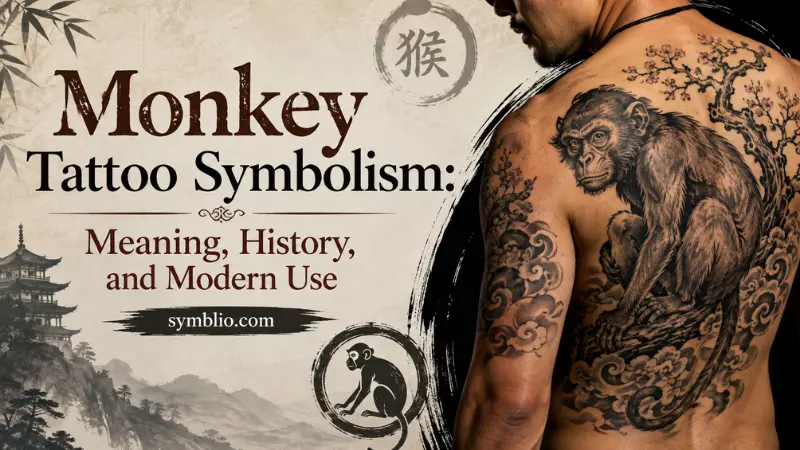
A monkey tattoo can communicate several different ideas, but in contemporary American tattoo culture it most often suggests cleverness, curiosity, playfulness, adaptability, or a mischievous personality. The meaning becomes more specific when the design refers to a cultural figure such as Hanuman, Sun Wukong, or the Three Wise Monkeys.
That flexibility is one reason monkey imagery works so well as body art. A realistic macaque, a cartoon monkey, a Monkey King portrait, and a devotional image of Hanuman may all feature the same basic animal while expressing very different identities.
Understanding the symbolism requires looking beyond the animal’s appearance. The monkey has occupied very different roles in mythology, religion, literature, folklore, and popular culture, and those traditions continue to influence how Americans interpret the image today.
Quick Answer
Monkey tattoo symbolism commonly represents intelligence, curiosity, adaptability, playfulness, and mischief in modern American culture. Historically, monkeys have also represented devotion and courage in Hindu traditions, trickery and restless thought in Buddhist contexts, and rebellion and cleverness through figures such as Sun Wukong.
TL;DR
- Monkeys commonly symbolize curiosity, intelligence, humor, and adaptability.
- Hanuman connects monkey imagery with courage, loyalty, and devotion.
- Sun Wukong represents rebellion, cleverness, and resilience.
- Three Wise Monkeys emphasize restraint, discretion, and moral awareness.
- Tattoo style can change the meaning from humorous to spiritual.
- Modern Americans often use monkey tattoos for individual identity.
What Does a Monkey Tattoo Commonly Mean?
The simplest modern reading is cleverness with a playful edge.
Monkeys are observant, social, expressive animals, and popular culture has long portrayed them as inquisitive and capable of learning. A person who chooses a monkey tattoo may therefore be expressing curiosity, quick thinking, adaptability, or an unwillingness to take life too seriously.
Mischief is another common association. The monkey often appears as a rule-bender rather than a villain: someone who experiments, improvises, gets into trouble, and finds an unexpected way out.
That distinction matters. A monkey tattoo does not automatically mean irresponsibility or chaos. For many people, its appeal comes from combining intelligence with humor.
The specific image supplies additional information. A smiling cartoon monkey communicates something very different from a solemn Hanuman, while three monkeys covering their eyes, ears, and mouth point toward an entirely different idea.
Why Monkeys Became Symbols of Cleverness and Mischief
The connection between monkeys and cleverness is not simply a modern tattoo trend.
Across several storytelling traditions, monkeys appear as characters who solve problems through intelligence, movement, deception, or improvisation. They may also make mistakes because their curiosity gets ahead of their judgment.
This creates an unusually broad symbolic range. The monkey can represent intelligence without perfect discipline.
That combination explains why monkey imagery often feels humorous rather than solemn. A fox might suggest cunning, an owl wisdom, and a lion authority. The monkey tends to occupy a more unpredictable position: clever enough to understand a situation but playful enough to disrupt it.
Modern tattoo designs build on this familiar character.
Ancient Roots and Early Monkey Symbolism
Monkey imagery is considerably older than contemporary tattoo culture.
In South Asian religious and literary traditions, monkeys appear in stories concerning morality, courage, loyalty, devotion, and the relationship between human behavior and spiritual discipline. Buddhist literature also includes stories in which monkeys demonstrate generosity, intelligence, or compassion, while other traditions use the animal to represent an unsettled or undisciplined mind.
Ancient Egyptian culture provides another example. Baboons appeared in religious imagery and were associated with divine figures and solar rituals. Their behavior at sunrise likely contributed to some of these associations.
In ancient American civilizations, monkey imagery also had important artistic and religious roles. Maya traditions, for example, associated howler-monkey figures with artistic activities such as writing, music, and craftsmanship.
These traditions should not be collapsed into one universal meaning. The same animal could symbolize wisdom in one context and foolishness or uncontrolled desire in another.
Hanuman and the Meaning of Courage and Devotion
One of the most important monkey figures in religious symbolism is Hanuman, the monkey-faced Hindu deity associated with the Ramayana tradition.
Hanuman is especially connected with courage, loyalty, service, devotion, and extraordinary physical strength. Stories about him emphasize his dedication to Rama and his willingness to overcome enormous obstacles in service of others.
Because of this, a Hanuman tattoo should not simply be treated as a generic “strong monkey.”
For someone intentionally choosing Hanuman, the image may express religious devotion or respect for qualities such as faithful service and courage. The surrounding design matters as well. A devotional representation has a different cultural meaning from a generic cartoon monkey wearing athletic clothing.
In the United States, Hanuman imagery may appear among people interested in Hindu art, Indian heritage, yoga, mythology, or religious devotion. Because Hanuman is a sacred figure for many Hindus, treating such imagery respectfully is important.
Sun Wukong and the Symbolism of Rebellion
Chinese mythology and literature provide another major monkey figure: Sun Wukong, the Monkey King.
Sun Wukong is the central monkey character in Journey to the West, the classic Chinese novel traditionally associated with the sixteenth century. His character combines extraordinary ability with rebelliousness, humor, intelligence, and a tendency to challenge authority.
For tattoo symbolism, this creates a particularly distinctive combination:
- rebellion against restriction
- clever problem-solving
- resilience
- independence
- transformation
- confidence
- refusal to accept imposed limitations
Sun Wukong is more specific than an ordinary monkey tattoo. Someone choosing his image is usually referencing a particular cultural character rather than merely wanting an animal associated with cleverness.
The character’s history is complex, and scholars have debated possible influences behind his development, including earlier Chinese traditions and possible connections with Indian monkey mythology. Those influences should not be presented as a simple one-to-one borrowing.
The Three Wise Monkeys and Moral Restraint
Three monkeys covering their eyes, ears, and mouth represent one of the most recognizable forms of monkey symbolism in American popular culture.
The familiar interpretation is often summarized as:
- See no evil
- Hear no evil
- Speak no evil
The imagery is associated with Japanese cultural traditions and became widely recognizable outside Japan. Its meaning centers on restraint, discretion, and avoiding participation in wrongdoing.
In modern American usage, however, the design can be interpreted in more than one way.
It might represent moral discipline: refusing to look at, listen to, or repeat harmful behavior. Alternatively, someone might use the image ironically to suggest deliberate ignorance—choosing not to acknowledge something obvious.
That ambiguity makes the Three Wise Monkeys particularly interesting as tattoo art. The same design can communicate either ethical restraint or a joke about refusing to get involved.
What Monkey Tattoos Mean in the United States
American interpretations tend to be highly individual.
Unlike a religious emblem with one established doctrinal meaning, a generic monkey tattoo does not have a fixed definition in the United States. People often choose the animal because it matches their personality or because they associate it with a particular experience.
Common American readings include:
| Tattoo Context | Meaning in the USA | Common Associations | Notes |
|---|---|---|---|
| Cartoon monkey | Humor and playfulness | Fun, personality, childhood | Usually lighthearted |
| Realistic monkey | Curiosity and intelligence | Nature, observation, adaptability | Often emphasizes the animal itself |
| Hanuman | Courage and devotion | Hinduism, loyalty, service | Sacred context requires respect |
| Sun Wukong | Rebellion and resilience | Chinese literature, independence | Refers to a specific character |
| Three Wise Monkeys | Discretion or irony | Restraint, silence, avoidance | Meaning depends heavily on context |
This flexibility reflects a broader feature of American tattoo culture: images frequently become personal symbols rather than fixed cultural statements.
Monkey Tattoos and Personal Identity
A tattoo can function as a small visual biography.
For one person, a monkey may represent a naturally curious personality. Another may use it to remember a period when humor helped them deal with difficulty. Someone else may connect the animal with a favorite childhood story, animal, movie, or family tradition.
The symbolism can therefore be autobiographical.
A swinging monkey might suggest freedom and movement. A monkey sitting calmly could emphasize observation. A mischievous expression might foreground humor. A group of monkeys could represent friendship or social connection.
The image does not have to carry an ancient meaning to be meaningful. Contemporary tattoos frequently combine inherited symbolism with personal experience.
Intelligence, Curiosity, and Adaptability
Three of the most useful positive meanings associated with a monkey tattoo are intelligence, curiosity, and adaptability.
Curiosity fits the animal’s familiar image as an active observer. Intelligence comes from its reputation in stories and popular representations as a problem-solver. Adaptability follows from the monkey’s association with movement, exploration, and improvisation.
Together, these ideas can form a coherent personal message:
I learn, I adapt, and I find another way.
That interpretation works particularly well for people who see themselves as unconventional thinkers or who have gone through major changes and learned to adjust.
The Playful and Mischievous Side
Not every monkey tattoo needs to carry a serious message.
Some people choose monkey imagery precisely because it is funny.
A grinning monkey, exaggerated facial expression, banana, or cartoon-style character can communicate humor and a willingness to be playful. In this context, the tattoo may function more like a personality marker than a philosophical emblem.
Mischief is particularly important because it occupies a middle ground. The monkey can challenge rules without necessarily representing cruelty or aggression.
That makes it appealing to people who identify with independence but do not want a conventionally intimidating tattoo.
Emotional and Psychological Symbolism
Monkey imagery can also represent the tension between impulse and self-control.
Buddhist traditions provide an especially useful framework here. The idea of the “monkey mind” describes a restless mental state that jumps from thought to thought rather than remaining settled. The metaphor turns the animal’s constant movement into a way of thinking about attention and discipline.
A tattoo inspired by this idea could therefore mean something more reflective than simple mischief.
It might symbolize learning to manage distraction, recognizing one’s impulsive side, or accepting that curiosity needs direction.
This interpretation also explains why the monkey can represent both freedom and restraint. Its symbolic value often comes from the tension between those qualities.
How Tattoo Style Changes the Meaning
The artistic treatment can change the emotional message dramatically.
Realistic monkey: Usually emphasizes intelligence, nature, observation, or respect for the animal.
Cartoon monkey: More likely to suggest humor, childhood memories, playfulness, or personality.
Traditional tattoo style: Can emphasize bold character, movement, and visual storytelling.
Three Wise Monkeys: Points toward discretion, moral restraint, silence, or ironic avoidance.
Hanuman: Connects directly with Hindu religious symbolism, particularly courage, devotion, and service.
Sun Wukong: Emphasizes rebellion, transformation, cleverness, and resilience.
This is why asking only “What does a monkey tattoo mean?” can produce an incomplete answer. The design itself is part of the symbolism.
Monkey Tattoos in Modern American Tattoo Culture
In the United States, monkey tattoos appear in many visual styles, from small line drawings to large illustrative pieces.
The image works especially well for people who want an animal tattoo that feels less conventional than a wolf, eagle, bear, or lion. Its expressive face also gives tattoo artists opportunities to create humor, movement, exaggeration, or narrative.
Social media has broadened the range further. People can encounter Japanese, Chinese, Indian, American, and contemporary tattoo traditions in the same visual environment. As a result, a single tattoo may combine several influences.
That can be creative, but it also creates a responsibility: a sacred or culturally specific image should not be treated as interchangeable decoration.
Positive and Negative Monkey Symbolism
Monkey symbolism is not universally positive.
Historically and culturally, monkeys have sometimes been associated with foolishness, vanity, uncontrolled appetite, deception, ugliness, or unruly behavior. Buddhist and Chinese traditions, for example, contain both favorable and unfavorable monkey imagery.
In modern American culture, however, a generic monkey tattoo is usually read more positively—as playful, clever, curious, humorous, or unconventional.
There is an important exception involving racist imagery. In American and European history, racist propaganda has used comparisons between Black people and apes or monkeys to dehumanize them. That history means monkey imagery can become offensive when it is directed at a racial or ethnic group.
A neutral animal tattoo should not be confused with that form of racist imagery. Context, surrounding text, and intended target matter.
Common Misunderstandings About Monkey Tattoos
One common misconception is that every monkey tattoo has a spiritual meaning. It does not.
A monkey may simply be an animal the wearer likes.
Another mistake is assuming that all monkey deities and mythical figures represent the same qualities. Hanuman and Sun Wukong come from different traditions and should be understood on their own terms.
It is also inaccurate to claim that monkeys universally symbolize wisdom. In some traditions they represent cleverness; in others they represent distraction, foolishness, desire, or trickery.
The most reliable interpretation begins with the specific monkey, pose, cultural reference, and reason for choosing the tattoo.
How Monkey Symbolism Has Evolved
The meaning of monkey imagery has changed because the animal has repeatedly been placed into new cultural contexts.
Ancient religious traditions gave monkeys sacred, moral, or cosmological roles. Folklore developed them into tricksters and clever characters. Literature created memorable figures such as Sun Wukong. Popular entertainment then turned monkeys into comic characters, companions, villains, and symbols of curiosity.
Modern tattoo culture adds another layer: personal identity.
The result is not one fixed meaning but a collection of overlapping associations. A contemporary American tattoo might draw from mythology while also expressing humor, independence, family heritage, or a personal memory.
That evolution is important because symbols do not remain frozen. People reuse familiar images and give them new purposes.
Choosing a Monkey Design With Clear Meaning
If the goal is symbolic rather than purely decorative, the design should communicate the intended idea without relying entirely on an explanation.
A playful expression works for humor. Movement can suggest freedom or adaptability. A focused expression can emphasize intelligence. A culturally specific figure can connect the tattoo to a particular tradition.
It is also worth distinguishing between a generic monkey and a sacred or literary character. If the intended reference is Hanuman or Sun Wukong, understanding that character’s story will produce a more meaningful design than simply selecting an attractive image.
The strongest symbolic tattoos usually have a clear reason behind them, even when that reason is personal rather than historical.
FAQs
A monkey tattoo commonly symbolizes intelligence, curiosity, adaptability, playfulness, and mischief. The meaning can become more specific when the design represents Hanuman, Sun Wukong, or the Three Wise Monkeys.
Yes. Monkeys are frequently portrayed as observant, clever, and capable problem-solvers, making intelligence a common modern interpretation. The symbolism is usually more playful than the wisdom traditionally associated with an owl.
A Hanuman tattoo can represent courage, loyalty, devotion, strength, and selfless service. Because Hanuman is a sacred Hindu figure, the image carries religious significance beyond generic monkey symbolism.
A Sun Wukong tattoo commonly represents rebellion, cleverness, resilience, transformation, and independence. The reference comes from the Monkey King of the Chinese classic Journey to the West.
They can be either. Modern American interpretations tend to emphasize positive qualities such as humor and intelligence, while some historical and religious traditions also associate monkeys with distraction, foolishness, deception, or uncontrolled desire.
The Three Wise Monkeys traditionally communicate the idea of avoiding evil through what one refuses to see, hear, or say. In modern American use, the image can also be interpreted humorously as deliberate ignorance or staying out of trouble.
Not necessarily. A generic monkey tattoo may simply represent personality or humor, while designs connected to Hanuman, Buddhist traditions, or other religious imagery can carry specific spiritual meanings.
Conclusion
Monkey tattoos occupy an unusual place in symbolism because they can be humorous, intellectual, rebellious, devotional, or reflective depending on the design. In modern American culture, the most common associations are curiosity, cleverness, adaptability, playfulness, and mischief, but older traditions add much more specific meanings.
For someone choosing monkey tattoo symbolism, the most important question is not simply what monkeys mean in general. It is which story the particular image tells—whether that story is about humor, independence, devotion, cultural heritage, personal growth, or the ability to adapt when circumstances change.
The monkey remains useful as a tattoo precisely because it leaves room for personality. It can make a serious point without looking severe, or express a playful identity without being meaningless.


