The snowy owl symbolism that people recognize today grows from the bird’s striking white appearance, Arctic habitat, unusual behavior, and long association with the broader symbolism of owls. In the United States, it often suggests wisdom, observation, independence, calmness, and the ability to remain composed in difficult conditions.
Unlike many symbolic animals, the snowy owl has a distinctive visual identity of its own. Its white plumage, yellow eyes, broad wings, and association with snow and open northern landscapes give it meanings that go beyond the general symbolism of an owl.
Quick Answer
Snowy owl symbolism commonly represents wisdom, clear perception, independence, calmness, and resilience in modern American culture. Its broader historical associations come from the longstanding symbolism of owls, while its Arctic environment and white plumage add ideas of solitude, winter, adaptation, and northern wilderness.
TL;DR
- Snowy owls commonly symbolize wisdom and careful observation.
- White plumage adds associations with clarity, peace, and winter.
- Arctic life connects the bird with endurance and adaptation.
- American culture often treats it as a rare winter visitor.
- Owl imagery also carries older associations with knowledge.
- Modern designs use snowy owls for individuality and quiet strength.
What a Snowy Owl Represents
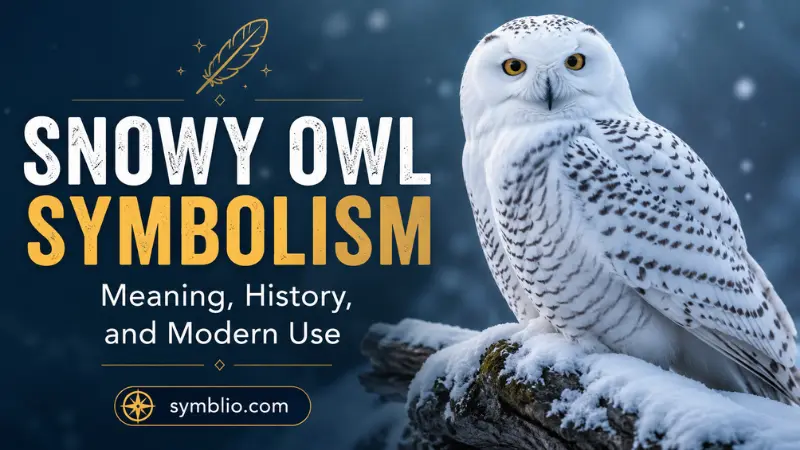
The snowy owl is one of the most visually distinctive owls in North America. Its large body, rounded head, bright yellow eyes, and predominantly white feathers make it immediately recognizable. Adult males can become almost completely white, while females and younger birds usually retain more dark barring.
That appearance naturally influences symbolism.
White can suggest cleanliness, clarity, simplicity, and winter. The owl’s fixed gaze can suggest observation and awareness. Its habit of sitting quietly for long periods can be interpreted as patience rather than inactivity.
The bird’s physical characteristics therefore create a cluster of related ideas:
- wisdom
- attentiveness
- independence
- patience
- resilience
- solitude
- clarity
- adaptation
- quiet confidence
These meanings should be understood as cultural interpretations rather than qualities that the animal consciously represents.
Why the White Color Matters
Color is one of the first things that separates the snowy owl from other owl imagery.
White commonly carries associations with snow, winter, innocence, cleanliness, peace, and visual simplicity in American culture. When those associations are combined with an owl, the result is different from the darker, more nocturnal image often attached to owls generally.
A snowy owl can therefore communicate wisdom without appearing ominous.
Its white feathers can also suggest a sense of distance from ordinary surroundings. In photographs, artwork, and decorative designs, a white owl standing against snow may appear almost camouflaged. That visual relationship supports interpretations involving stillness, concealment, observation, and harmony with one’s environment.
At the same time, it is important not to treat white as universally positive. Color meanings vary by culture, setting, and personal experience. The snowy owl’s symbolism comes from the combination of its color, behavior, habitat, and established owl traditions rather than from white alone.
Ancient Roots of Owl Symbolism
The snowy owl is a modern species-specific symbol, but some of its symbolic associations come from much older ideas about owls.
In ancient Greek culture, the owl was closely associated with Athena, the goddess of wisdom. The connection became especially visible in Athenian art and coinage, where the owl appeared alongside Athena’s image. A Greek silver tetradrachm from the fifth century BCE, for example, depicts Athena on one side and an owl on the other.
The Romans continued the association through Minerva, who was identified with Athena. Museum collections from later European periods also repeatedly show Minerva accompanied by an owl, reinforcing the bird’s connection with wisdom, intellect, learning, and judgment.
This history matters because modern Western owl symbolism did not develop independently in the United States. Ideas about the owl as a thoughtful or intellectual creature have been carried forward through classical art, literature, education, and visual culture.
The snowy owl inherits part of that tradition simply because it is an owl. Its Arctic identity then adds another layer.
The Arctic Environment Adds a Different Meaning
Snowy owls breed across the Arctic tundra and spend their lives in environments that demand adaptation to cold, open landscapes. During winter, some move into southern Canada and the northern United States, while occasional irruptions bring them much farther south.
That seasonal movement has encouraged modern interpretations of the snowy owl as a symbol of:
- adaptability
- endurance
- migration
- independence
- survival in difficult environments
- connection with wilderness
The bird does not live in the forested landscape many Americans associate with owls. Instead, it is strongly connected with tundra, shorelines, fields, dunes, and other open spaces.
This gives its symbolism a more expansive quality. A snowy owl can represent someone who does not need familiar surroundings to function confidently.
Snowy Owl Symbolism in the United States
In the United States, snowy owls have a particularly interesting cultural presence because many Americans encounter them only occasionally.
They breed far north, but some appear during winter in northern states and parts of the Northeast, Great Lakes, and northern Plains. In unusual years, individuals can travel much farther south.
That rarity affects perception.
A snowy owl sighting can feel like a special seasonal event. Birdwatchers may travel to beaches, fields, airports, dunes, or open farmland hoping to see one. The bird’s unexpected appearance makes it associated with discovery and unusual encounters.
For the broader American public, its symbolism often combines:
Wisdom + winter + rarity + wilderness + independence.
That combination helps explain why snowy owls appear frequently in winter artwork, nature photography, educational materials, ornaments, greeting cards, children’s media, and wildlife-inspired decor.
How Snowy Owls Differ From General Owl Symbolism
It is useful to distinguish the snowy owl from the owl as a general symbol.
A generic owl may represent wisdom, intelligence, nighttime, secrecy, mystery, or knowledge. Those associations have developed through centuries of cultural storytelling.
The snowy owl adds a different visual vocabulary.
| Context | Meaning in the USA | Common Associations | Notes |
|---|---|---|---|
| Wisdom | Knowledge and observation | Books, learning, intelligence | Comes largely from broader owl traditions |
| Winter | Calm and seasonal change | Snow, cold, quiet landscapes | Strongly connected to appearance and habitat |
| Wilderness | Independence and adaptation | Arctic, open land, wildlife | Reflects the bird’s natural environment |
| Personal identity | Individuality and self-reliance | Tattoos, art, jewelry | Usually depends on the owner’s interpretation |
| Wildlife | Rarity and discovery | Birdwatching, conservation | Often linked with unusual winter sightings |
This distinction prevents an overly simple interpretation. Not every meaning traditionally associated with owls automatically applies to snowy owls.
The Snowy Owl and Wisdom
Wisdom remains one of the most recognizable meanings attached to owl imagery.
The association is partly historical and partly visual. Owls have large forward-facing eyes and can remain remarkably still while observing their surroundings. Humans naturally interpret that appearance through familiar ideas about attention and intelligence.
The snowy owl strengthens the impression because its bright yellow eyes stand out sharply against white feathers.
In modern American design, a snowy owl with books, glasses, a library setting, or academic imagery usually communicates knowledge or learning. Without those additional elements, however, the bird may communicate something broader: watchfulness, thoughtful decision-making, or an observant personality.
The symbolism works best when the surrounding imagery provides context.
Solitude, Independence, and Quiet Strength
Snowy owls are associated with enormous open landscapes rather than crowded environments. Their winter appearances can occur in isolated fields, beaches, dunes, and other exposed places. Cornell’s bird guide notes that they often perch on the ground or on raised points where they can survey the surrounding area.
That behavior makes solitude a natural modern interpretation.
A snowy owl can symbolize someone who is comfortable standing apart from the crowd. In this sense, solitude does not necessarily mean loneliness. It can represent independence, self-possession, or the ability to think without constant outside influence.
This is one reason snowy owl imagery can appeal to people who want an animal symbol that feels quiet rather than aggressive.
Resilience and Adaptation in Difficult Conditions
The snowy owl’s environment contributes another important layer: resilience.
The species is adapted to Arctic conditions, with dense feathering that helps it withstand extreme cold. Its legs and feet are heavily feathered, and its life cycle is closely tied to the availability of prey such as lemmings.
Symbolically, this can translate into an image of endurance.
Rather than representing strength through aggression, the snowy owl represents functioning effectively in a demanding environment. Its symbolism is therefore particularly suitable for ideas such as:
- adapting to change
- remaining calm under pressure
- protecting personal boundaries
- enduring difficult seasons
- finding opportunity in unfamiliar places
This interpretation is metaphorical, but it is grounded in recognizable features of the species.
Snowy Owls in Indigenous and Arctic Contexts
The snowy owl also has an important place in Arctic Indigenous cultures, and those traditions should not be reduced to a single universal “spiritual meaning.”
For the Iñupiat, the snowy owl has a direct connection to place and language. Utqiaġvik, Alaska, was historically associated with the Iñupiaq word ukpik, referring to the snowy owl and describing the place where the bird nests.
The broader Arctic relationship with the bird also appears in Inuit art. The Smithsonian’s National Museum of the American Indian holds Inuit owl carvings from communities including Repulse Bay and Pangnirtung.
These examples demonstrate something important: Arctic relationships with the snowy owl are connected to lived environments, language, art, and community traditions.
It is therefore better to avoid assigning one simplified spiritual meaning to all Indigenous peoples. Different nations and communities have their own traditions, stories, languages, and relationships with animals.
Emotional and Psychological Meaning
People often choose animal symbols because they want a visual representation of a personal quality.
The snowy owl can communicate a particular emotional combination: calmness without passivity.
The snowy owl’s still posture suggests patience, while its alert eyes convey awareness. Life in harsh northern environments reinforces associations with adaptability and endurance. Its occasional movements far south can also suggest independence, change, and an ability to move beyond familiar surroundings.
For someone choosing the snowy owl as a personal symbol, it might therefore represent:
“I observe before I act.”
Or:
“I can remain myself when circumstances change.”
Those interpretations are personal rather than universally established. Symbolism becomes meaningful when the viewer connects the visible characteristics of the animal with a particular experience or identity.
Snowy Owl Meaning in Tattoos and Personal Art
Snowy owl tattoos are often chosen for visual reasons as much as symbolic ones.
The white feathers create opportunities for contrast, while the yellow eyes provide a strong focal point. Artists may emphasize the bird’s face, wings, Arctic surroundings, moonlight, snow, or geometric patterns.
The surrounding design changes the meaning.
A snowy owl flying over mountains can emphasize freedom and independence. An owl surrounded by snowflakes may emphasize winter and transformation. A snowy owl with books can emphasize wisdom and education. A close-up portrait can focus almost entirely on observation and individuality.
Because tattoos are personal, there is no single official interpretation.
Snowy Owl Symbolism in Home Decor and Fashion
In American homes, snowy owl imagery often appears in winter-themed decor, nature prints, ornaments, blankets, ceramics, children’s rooms, and seasonal artwork.
The image works particularly well because it combines wildlife with a recognizable winter palette.
Unlike symbols that depend on religious or political meanings, the snowy owl can function as a broadly accessible nature image. A homeowner may choose it simply because it evokes snowy landscapes, northern wilderness, or a quiet winter atmosphere.
In fashion and accessories, the bird can similarly communicate individuality without requiring a viewer to understand a complicated cultural reference.
Snowy Owls in Popular Culture
Popular culture has helped make white owls especially recognizable to American audiences.
One well-known example is the snowy owl character Hedwig from the Harry Potter series. Cornell notes that the extremely white owls associated with the character are male snowy owls, whose plumage can become particularly white with age.
This association contributed to the snowy owl’s visibility among people who might otherwise never encounter the species.
Popular culture can simplify animal symbolism, though. Fictional owls may be portrayed as magical messengers, companions, or supernatural creatures. Those roles belong to storytelling rather than to the biological behavior of the species.
Recognizing the difference keeps symbolic interpretation grounded.
Common Misunderstandings About Snowy Owl Symbolism
Several assumptions deserve clarification.
First, seeing a snowy owl does not inherently predict good fortune, bad fortune, or a supernatural event. Those interpretations belong to particular belief systems or personal experiences.
Second, the snowy owl should not automatically be assigned every traditional meaning associated with all owls. Its white plumage, Arctic ecology, and seasonal movements create additional associations.
Third, Indigenous traditions should not be blended into a single generalized “Native American owl meaning.” Indigenous peoples in North America have diverse cultural traditions, and the available evidence does not justify treating them as one symbolic system.
Finally, rarity does not necessarily mean the bird is an omen. A snowy owl appearing far south can have ecological explanations connected to prey availability, age, weather, and population movements.
How the Symbol Has Changed Over Time
The meaning of the snowy owl has developed through several overlapping layers.
Its oldest symbolic foundation comes from general owl traditions, especially the Western association between owls and wisdom. Classical imagery connected the owl with Athena and later Minerva, helping establish an enduring visual relationship between the bird and intellectual qualities.
Later, natural history and wildlife observation made the snowy owl recognizable as a species in its own right. Its Arctic habitat, striking plumage, and occasional movements into populated areas gave it a distinctive identity.
Modern photography and digital culture have expanded that identity further. Today, the snowy owl can represent wisdom, winter, wilderness, independence, resilience, or simply appreciation for an unusual bird.
The meaning has therefore moved from a general owl archetype toward a more specific combination of species, landscape, and personal interpretation.
What Snowy Owl Symbolism Means Today
In contemporary American culture, the snowy owl is best understood as a symbol with several connected themes rather than one fixed definition.
Wisdom remains the strongest inherited meaning. The bird’s white appearance adds clarity and winter associations. Its Arctic lifestyle suggests endurance and adaptation. Its solitary presence in open landscapes supports ideas of independence and observation.
Together, these qualities create a symbol that feels quieter than many animal emblems.
The snowy owl does not need to symbolize dominance or aggression. Its appeal often comes from restraint: watching carefully, adapting to circumstances, and remaining distinctive without demanding attention.
FAQs
What does a snowy owl symbolize spiritually?
A snowy owl may be interpreted spiritually as a symbol of wisdom, awareness, solitude, clarity, and adaptation. There is no single spiritual meaning shared by all religions or cultures, so personal and cultural context matters.
What does a snowy owl tattoo mean?
A snowy owl tattoo can represent wisdom, independence, resilience, winter, or individuality. The meaning can change significantly depending on accompanying elements such as mountains, snow, books, moons, or other animals.
Is a snowy owl a symbol of good luck?
Some people may personally interpret an unusual snowy owl sighting as fortunate, but there is no universal cultural rule that makes the bird a symbol of good luck. Its rarity and striking appearance can simply make an encounter feel memorable.
Does the snowy owl symbolize death?
Owls in some folklore have been connected with darkness, nighttime, or death, but that association should not automatically be applied to snowy owls. In modern American culture, snowy owls are more commonly associated with wisdom, winter, wilderness, and observation.
What does a white owl symbolize?
A white owl can combine traditional owl associations such as wisdom and awareness with the cultural meanings commonly attached to white, including clarity, peace, winter, and simplicity. The exact interpretation depends on the setting.
What does seeing a snowy owl mean?
A snowy owl sighting does not necessarily carry a supernatural message. From a wildlife perspective, the bird may simply be using a suitable winter habitat, while a symbolic interpretation can be personally meaningful if the observer connects the encounter with ideas such as independence or resilience.
Are snowy owls connected with Native American symbolism?
There is no single Native American meaning for the snowy owl. Arctic Indigenous communities have their own relationships with the bird, including Iñupiaq and Inuit connections reflected in language, stories, art, and place names, and these traditions should be understood in their specific cultural contexts.
Conclusion
The meaning of snowy owl symbolism comes from a meeting point between ancient owl traditions and the distinctive character of the snowy owl itself. Wisdom and observation come from the broader history of owl imagery, while the bird’s white plumage, Arctic habitat, seasonal movements, and solitary presence add ideas of clarity, resilience, independence, and winter.
In modern American culture, the snowy owl can therefore mean different things without becoming meaningless. It may appear as a symbol of learning, a reminder of wilderness, a personal emblem of independence, or simply an appreciation for one of North America’s most unusual winter birds. Its strongest interpretations remain grounded in what makes the bird recognizable: watchfulness, adaptability, and a striking ability to stand out against a stark landscape.