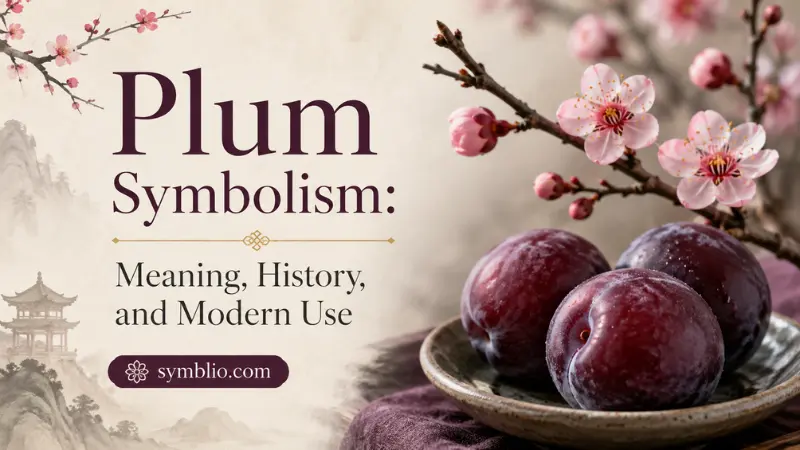
The plum carries several different kinds of symbolism, depending on whether people mean the fruit, the plum blossom, or the deep purple color called plum. In modern American culture, the word often suggests sweetness, abundance, richness, or an elegant dark-purple aesthetic, while the blossom has a much older symbolic tradition tied to endurance and renewal.
That distinction matters because plum symbolism is not one fixed idea. A bowl of ripe plums, a flowering plum branch in a painting, and a plum-colored dress can communicate entirely different things.
Among the most influential historical meanings comes from East Asian art, particularly Chinese traditions in which the plum blossom appears during winter and became associated with perseverance, moral character, purity, and the return of spring. In the United States today, those older associations coexist with newer interpretations shaped by food, fashion, interior design, holidays, and personal style.
Quick Answer
Plum symbolism commonly represents sweetness, abundance, elegance, and renewal in modern American culture, while the plum blossom is especially associated with perseverance and hope after hardship. Historically, plum blossoms also symbolized purity of character, resilience, spring’s return, and refined personal virtue in Chinese and Japanese traditions.
TL;DR
- Plum often symbolizes sweetness, abundance, elegance, and renewal.
- Plum blossoms traditionally represent endurance through winter and adversity.
- Chinese art gave the blossom especially strong moral symbolism.
- Japanese traditions connected plum blossoms with spring and Zen aesthetics.
- Plum purple suggests sophistication, creativity, and restrained luxury.
- Modern Americans encounter plum symbolism in food, fashion, decor, and tattoos.
What Plum Symbolizes in American Culture
In the United States, plum does not have one universally recognized symbolic meaning. Its interpretation changes according to context.
As a fruit, plum tends to evoke natural sweetness, nourishment, harvest, abundance, and seasonal pleasure. Because ripe plums are associated with summer produce and homemade foods, they can also suggest simplicity and connection with nature.
As a color, plum is quite different. The dark reddish-purple shade is commonly perceived as sophisticated, dramatic, mature, and somewhat luxurious. It is less aggressive than a vivid red and generally more grounded than a bright purple.
As a flower, the plum blossom carries the most specific historical symbolism. Americans encountering plum-blossom imagery in Asian-inspired art, tattoos, gardens, or decorative objects may associate it with resilience and renewal, particularly when the blossoms appear against snow or bare branches.
So, in contemporary American life, plum can operate on three symbolic levels:
- Fruit: sweetness, nourishment, abundance
- Color: elegance, creativity, richness
- Blossom: resilience, renewal, hope
The surrounding imagery usually determines which meaning people understand.
Why the Plum Blossom Became a Symbol of Resilience
The symbolism of the flowering plum becomes clearer when you look at when it blooms.
Unlike flowers that wait for warm weather, plum blossoms can appear in the cold season, sometimes around the period preceding the lunar new year. Their appearance on otherwise bare branches makes them a visual sign that winter will not last forever. The Smithsonian notes that this contrast helped establish associations with purity, courage in adversity, and renewed hope in Chinese tradition.
The symbol therefore does not mean simply “beauty.”
It communicates beauty appearing under difficult circumstances.
That distinction explains why the plum blossom has become an appealing modern symbol for people marking a difficult transition, recovery, a new beginning, or perseverance.
The image of delicate flowers emerging from an old, weathered tree also creates an important contrast: fragility and durability exist together.
Ancient Chinese Roots of Plum Symbolism
Plum blossoms became particularly important in Chinese poetry and painting, where artists could use a natural scene to express qualities expected of an admirable person.
The blossom’s ability to flower in winter made it a metaphor for maintaining character when circumstances were unfavorable. Chinese artistic traditions associated it with purity, courage, perseverance, and hope. Over time, the plum also became connected with the scholar or recluse who maintained personal integrity rather than compromising for social advantage.
The subject was not merely decorative.
A painter depicting a crooked, old plum tree with flowers could be making a statement about character. The tree’s age suggested endurance, while the flowers represented vitality appearing despite the cold.
This is one reason plum imagery became especially prominent in literary and scholarly art.
The Plum as One of the Three Friends of Winter
One of the most important historical contexts is the Chinese artistic grouping known as the Three Friends of Winter: pine, bamboo, and plum.
Together, these plants offered a visual vocabulary for endurance. The pine remained evergreen, bamboo retained its characteristic structure, and plum produced flowers during the cold season.
The plum therefore represented a different kind of endurance: the ability to begin again when conditions still look barren.
This symbolism also appears in museum collections of Chinese painting and decorative art. Historical objects show plum branches paired with bamboo and other winter imagery to communicate qualities such as endurance and moral steadfastness.
The association became so established that the plum was sometimes used beyond individual virtue, including as an emblem during periods of national uncertainty.
Plum Symbolism in Japanese Culture
Plum-blossom imagery traveled from China into Japan, where it developed its own artistic and seasonal associations.
Japanese artists adopted plum blossoms as an important subject, particularly within ink painting and Zen artistic circles. The Metropolitan Museum of Art describes plum blossoms as symbols of spring’s arrival and notes their popularity among Japanese Zen painters after Chinese ink traditions entered Japan.
The Japanese interpretation often emphasizes seasonal awareness as much as endurance.
A plum branch emerging from snow can suggest that spring is approaching. The image does not need to represent struggle in an explicitly moral sense; it can simply mark the transition between seasons.
This gives plum blossom symbolism an important second dimension: change can be anticipated before it is fully visible.
Plum Symbolism and Beauty
Plum blossoms have not always represented toughness or moral virtue.
Chinese literary and artistic traditions also connected them with feminine beauty and romantic imagery. A Smithsonian collection entry for a Qing-dynasty plum painting notes the flower’s longstanding associations with feminine beauty and sensual literary contexts.
That history prevents an overly narrow interpretation.
A plum blossom can symbolize:
- delicacy
- beauty
- romantic attraction
- youthfulness
- seasonal renewal
- purity
- endurance
The meaning depends heavily on the surrounding imagery.
A solitary branch in snow tends to emphasize endurance. Blossoms combined with other flowers may emphasize beauty or seasonal celebration.
The Symbolism of the Plum Fruit
The fruit has a different symbolic vocabulary from the blossom.
A ripe plum is soft, sweet, colorful, and associated with harvest. In American contexts, that makes it a natural symbol of pleasure, abundance, nourishment, and the rewards of cultivation.
Plums also appear in preserves, desserts, beverages, farmers-market displays, and seasonal cooking. These associations make the fruit feel domestic and approachable rather than solemn.
There is another interesting symbolic contrast between the fruit and blossom:
The blossom suggests what is coming; the fruit suggests what has arrived.
A flowering branch represents possibility and renewal. Ripe fruit represents fulfillment, maturity, and the result of growth.
That makes plum imagery useful when someone wants to express both stages of a life process.
Plum as a Color Symbol
Plum is also the name of a color, generally understood as a dark purple with reddish or wine-like undertones.
Color symbolism is never universal, but in contemporary American design, plum can communicate a combination of qualities associated with purple and red. Purple has long been used in Western visual culture to suggest distinction and luxury, while red can add warmth, passion, and intensity.
Plum softens both.
It can therefore feel:
- sophisticated without being stark
- dramatic without being bright
- romantic without being sugary
- luxurious without looking metallic
- creative without appearing childish
This helps explain its recurring use in clothing, cosmetics, interiors, stationery, floral arrangements, and seasonal design.
Rather than demanding attention like a saturated primary color, plum tends to create a more subdued impression.
Plum Symbolism in Weddings and Celebrations
Plum can work particularly well in celebrations because it combines warmth with formality.
In American wedding design, a plum or deep-purple palette can suggest elegance, romance, maturity, and seasonal richness. Its interpretation changes with accompanying colors: paired with pale neutrals it can appear refined, while combined with warm autumn shades it can feel harvest-oriented.
The plum blossom, however, carries a more specific message.
Used in a wedding or anniversary setting, the blossom can represent the hope of continuing growth through changing seasons of life. Historical Chinese imagery even uses plum and bamboo together in compositions that can symbolize a married couple.
That does not make plum an inherently “wedding flower” in American culture. Rather, it gives people with an interest in East Asian symbolism a historically grounded meaning they may choose to incorporate.
What Plum Means in Tattoos and Personal Style
Plum imagery can be especially attractive for tattoos because it permits several layers of interpretation without requiring a large or complicated design.
A plum blossom tattoo often communicates resilience, renewal, beauty after difficulty, or a new beginning. A branch emerging from winter imagery makes the message especially clear.
A plum fruit tattoo tends to be more playful or personal. It may represent sweetness, nourishment, abundance, favorite foods, family associations, or simply appreciation of the fruit.
A plum-colored design is different again. The color can contribute an impression of individuality, elegance, creativity, or romantic sophistication.
Because tattoos are personal statements, there is no single authoritative meaning. The historical symbolism provides context, but the wearer ultimately determines the message.
Plum Symbolism in Art and Interior Design
Plum imagery works unusually well in decorative settings because it can be both attractive and meaningful.
A flowering branch in a room may suggest renewal without making the symbolism obvious. A plum-colored wall, chair, textile, or accent can create a more sophisticated atmosphere without literally depicting a plum.
In Asian-inspired interiors, plum branches can carry cultural associations that go beyond decoration. In Chinese painting, the branch was often treated as a serious artistic subject, with its shape, age, blossoms, and placement contributing to the meaning of the work.
For American viewers, context is particularly important. A plum blossom image does not automatically carry every traditional Chinese or Japanese association simply because it appears in an American home.
A Quick Comparison of Plum Meanings
| Context | Meaning in the USA | Common Associations | Notes |
|---|---|---|---|
| Plum fruit | Sweetness and abundance | Food, harvest, pleasure | Usually informal and approachable |
| Plum blossom | Renewal and perseverance | Winter, spring, hope | Strong historical East Asian associations |
| Plum color | Elegance and creativity | Fashion, luxury, sophistication | Meaning depends heavily on design context |
| Plum in wedding design | Romance and refinement | Flowers, seasonal palettes | More contemporary than traditional |
| Plum tattoo | Personal resilience or beauty | Transformation, identity | Individual meaning varies |
Emotional and Psychological Meaning of Plum
Symbolically, plum often works because it combines apparently opposite qualities.
The fruit is sweet but has a firm pit. The blossom is delicate but appears in cold weather. The color is dark but still carries the liveliness associated with purple and red.
These contrasts make plum useful for expressing maturity without dullness.
Someone drawn to plum imagery may use it to communicate a preference for things that are understated rather than flashy. In visual design, the color can create an atmosphere that feels introspective, creative, romantic, or sophisticated.
The plum blossom adds another emotional layer: optimism that is based on evidence rather than fantasy. The flowers appear because the season is changing, even when the landscape still looks wintry.
Modern Plum Symbolism in American Life
Today, plum symbolism appears less often as a formal code and more often as an aesthetic language.
You might encounter it in:
- clothing and accessories
- home decor
- floral artwork
- tattoo designs
- packaging and food branding
- seasonal color palettes
- gardens and landscaping
- stationery
- digital graphics
- wedding decorations
- Asian-inspired art and design
Social media has also encouraged people to treat colors, flowers, and objects as shorthand for personality and mood. That can make plum seem to have a single universal “meaning,” but real-world symbolism is more flexible.
A plum-colored object does not automatically represent resilience. A plum blossom does not automatically represent romance. Meaning emerges from the object, setting, cultural context, and personal intention.
Common Misunderstandings About Plum Symbolism
One common mistake is treating plum fruit, plum color, and plum blossom as interchangeable symbols.
They are related visually, but their histories are different.
Another mistake is assuming that every meaning associated with plum blossom imagery belongs equally to all East Asian cultures. Chinese and Japanese traditions share historical connections, but their artistic and religious contexts developed differently. Japanese Zen painters, for example, adopted plum imagery through Chinese artistic traditions and gave it distinctive seasonal and Zen associations.
It is also misleading to claim that plum universally symbolizes good luck, wealth, love, or protection. Those interpretations may occur in particular settings, but they should not be presented as universal definitions.
The strongest interpretation is usually the simplest one: look at the form of the plum and the context in which it appears.
How Plum Symbolism Has Changed Over Time
The history of plum symbolism shows a movement from concrete seasonal observation toward increasingly personal interpretations.
In early Chinese artistic traditions, the winter-blooming plant provided an obvious metaphor for endurance and renewal. Scholars and painters then developed that image into a sophisticated language about character, beauty, solitude, and integrity.
Japan adopted and transformed the imagery, particularly through seasonal poetry and Zen painting.
In contemporary America, most people encounter plum outside those original literary contexts. The fruit belongs to food culture; the color belongs to fashion and design; the blossom appears in tattoos, artwork, gardens, and cross-cultural decoration.
The older symbolism has not disappeared. It has simply become one layer within a much larger modern vocabulary.
FAQs
A plum blossom can symbolize renewal, perseverance, purity, and hope after hardship. These associations are particularly well established in Chinese artistic traditions, where the flower’s winter blooming made it a metaphor for maintaining character under difficult conditions.
A plum blossom tattoo commonly represents resilience, renewal, beauty, or beginning again after a difficult period. The meaning can also be connected to appreciation of Chinese or Japanese artistic traditions, depending on the design and the person’s cultural context.
Sometimes, but love is not the single traditional meaning of plum. Chinese literature and art have used plum blossoms in romantic and feminine imagery, while other traditions emphasize endurance, purity, and the arrival of spring.
Plum as a color often suggests sophistication, creativity, richness, and restrained drama in contemporary American design. Its meaning is strongly influenced by the surrounding palette and whether it appears in fashion, interiors, branding, or another setting.
The plum blossom is associated with purity of character, courage in adversity, resilience, and renewed hope. It also became an important subject in Chinese poetry and painting and was associated with scholars, recluses, and moral integrity.
Plum symbolism is generally positive, especially when referring to the blossom. Its most established meanings involve perseverance, renewal, beauty, and hope rather than danger or misfortune.
Plum blossoms became symbolically important partly because they appear when much of the landscape is still dormant. Their emergence before spring made them a natural image of renewal and survival, particularly in Chinese and Japanese art.
Conclusion
Plum symbolism is best understood as a collection of related meanings rather than one universal definition. In modern American culture, the fruit suggests sweetness and abundance, the color suggests elegance and creative sophistication, and the blossom most strongly communicates renewal and perseverance.
The blossom’s historical importance makes the symbolism especially distinctive. Its appearance during winter gave Chinese and Japanese artists a natural way to represent hope before circumstances visibly improved.
Today, plum symbolism continues to work because its central images remain easy to understand: something delicate can survive difficult conditions, something beautiful can appear before the season has fully changed, and growth can begin before it is obvious to everyone else.