
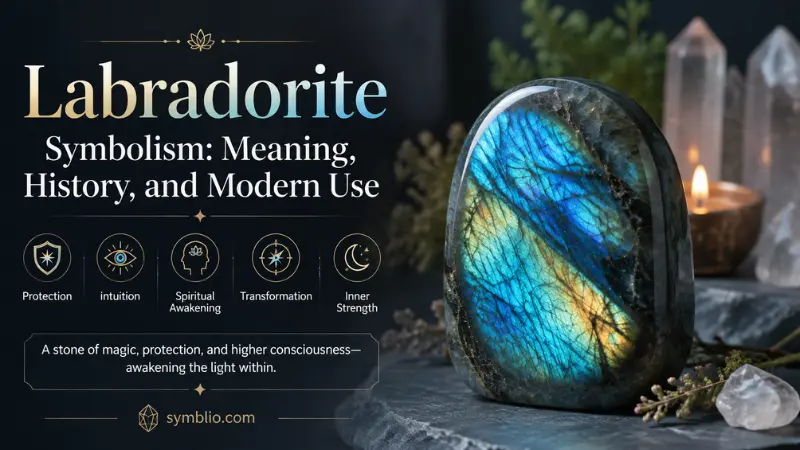
Labradorite is a feldspar mineral known for its gray or dark body and bright flashes of blue, green, yellow, and other colors. These flashes appear as the stone moves under light. Because of this changing appearance, labradorite symbolism often centers on transformation, intuition, self-discovery, and new perspectives.
The stone has a long geological history and a strong connection to Labrador, Canada. Indigenous people in the region knew the material before European scientists formally classified it. However, many meanings now found in crystal shops and online spiritual communities developed much later.
Today, Americans see labradorite in jewelry, home decor, mineral collections, tattoos, and personal spiritual practices. Some people value its symbolism, while others simply enjoy its unusual natural beauty.
Quick Answer
Labradorite symbolism commonly represents transformation, intuition, self-discovery, and changing perspective in modern American culture. People often connect these ideas with the stone’s shifting flashes of color, while its history links it to Labrador and Indigenous knowledge of the region.
TL;DR
- Labradorite often represents transformation and changing perspective.
- Its color flashes inspire ideas about intuition and discovery.
- The mineral takes its name from Labrador, Canada.
- Indigenous history differs from later commercial gemstone stories.
- Americans use labradorite in jewelry, decor, and personal art.
- Spiritual claims about the stone remain matters of personal belief.
What Is Labradorite?
Labradorite belongs to the feldspar family of minerals. Most pieces look gray, brownish-gray, greenish, or dark. Some pieces show bright flashes of blue, green, yellow, orange, or other colors.
Scientists call this color effect labradorescence.
Light creates this effect as it moves through tiny structures inside the mineral. When you turn a piece of labradorite, you may see one color appear and then disappear a moment later.
The stone itself does not change. Your viewing angle changes.
That simple feature helps explain much of the stone’s modern symbolism. People often see labradorite as a reminder that a new viewpoint can reveal something you could not see before.
What Does Labradorite Symbolize Today?
Modern American gemstone and crystal culture commonly links labradorite with four ideas:
- transformation
- intuition
- self-awareness
- protection
Transformation has the clearest connection to the stone’s appearance. A dark piece can suddenly show bright color when you move it. Many people see this change as a symbol for personal growth or a new stage of life.
People also connect labradorite with intuition. The stone does not show all its colors at once, so it can serve as a metaphor for noticing things that first escape your attention.
Modern crystal practices also link labradorite with protection. This idea belongs to spiritual belief rather than established science.
For most readers, one simple idea captures its modern meaning: labradorite represents the possibility of seeing something new when your perspective changes.
Why Does Labradorite Symbolize Transformation?
The stone provides a simple visual example of transformation.
A polished piece may look plain from one angle. Turn it slightly, and a bright blue or green flash can appear. Move it again, and the color may fade.
That experience creates a natural metaphor for personal change.
Labradorite can represent:
- starting a new chapter
- changing your point of view
- discovering something about yourself
- adapting to a new situation
- looking beyond first impressions
You do not need to believe in crystal energy to appreciate this meaning. The symbolism comes from an actual feature of the mineral.
Where Did Labradorite Get Its Name?
Labradorite takes its name from Labrador, a region in northeastern Canada.
European mineralogists learned about the mineral in the 18th century and later gave it its formal scientific identity. The mineral’s name reflects its connection to Labrador.
However, Europeans did not discover the stone in the sense of being the first people to know about it. Indigenous communities in the region already knew and used local stone materials.
That history matters because modern gemstone stories sometimes make European classification sound like the beginning of labradorite’s human history. It was not.
At the same time, we should avoid claiming that every modern story about labradorite comes from an ancient Indigenous tradition. Historical evidence does not support such a broad claim.
Is Labradorite Connected to the Northern Lights?
Many modern descriptions connect labradorite with the Northern Lights, also called the aurora borealis.
The connection makes visual sense. Labradorite can show blue, green, yellow, and other flashes against a dark background. Those colors can remind people of light moving across a northern sky.
Some modern gemstone stories say that Inuit people viewed labradorite as frozen or captured Northern Lights.
However, we should treat that claim carefully.
Inuit communities have diverse cultures and traditions. A story repeated in modern jewelry marketing does not automatically represent the beliefs of every Inuit community.
A safer explanation is that the Northern Lights provide a popular modern image for describing labradorite’s colorful appearance. Specific Indigenous traditions require more careful historical context.
How Does Labradorescence Create Its Symbolism?
Labradorescence gives labradorite much of its visual appeal.
When light interacts with structures inside the feldspar, the stone can show bright flashes. The color changes as you change the angle of the stone.
This physical feature supports several common symbolic ideas.
Hidden qualities: Something may have value even when you cannot see it right away.
Perspective: A small change in viewpoint can reveal something new.
Adaptability: You can respond to change without losing your sense of self.
Discovery: Careful observation can reveal details that a quick glance misses.
These meanings come from human interpretation. Science explains why the stone shows color; symbolism explains why people connect that effect with personal experiences.
Labradorite Symbolism in American Jewelry
Jewelry gives Americans one of the most common ways to experience labradorite.
Jewelry makers often cut labradorite as a cabochon. This smooth, rounded shape can display the stone’s flashes well.
You can find labradorite in:
- necklaces
- rings
- earrings
- bracelets
- pendants
- statement jewelry
Unlike diamonds or traditional birthstones, labradorite does not carry one standard message in American culture.
One person may wear it to mark a major life change. Another may choose it because they like blue-green stones. Someone else may simply enjoy its natural pattern.
That flexibility makes labradorite a useful personal symbol.
What Does a Labradorite Tattoo Mean?
A labradorite tattoo can represent transformation, self-discovery, individuality, or a change in perspective.
The other elements in the tattoo can add more meaning. For example, a labradorite crystal with a butterfly may emphasize change. A crystal surrounded by mountains may suggest nature or a connection with northern landscapes.
No official tattoo dictionary assigns one meaning to labradorite.
The person wearing the tattoo gives the image its most important meaning.
Labradorite in Home Decor
Labradorite also works well in home decor.
People use polished slabs, spheres, carvings, bookends, and mineral specimens as decorative pieces. Large pieces can show wide flashes of blue or green when light hits them from the right direction.
In a home, labradorite can symbolize:
- natural beauty
- individuality
- curiosity
- contrast
- discovery
It can also serve as a purely decorative object. You do not need a spiritual belief to appreciate the stone.
Many people collect minerals because they enjoy geology, natural history, or unusual materials.
What Does Labradorite Mean in Crystal Culture?
Modern crystal culture gives labradorite several spiritual meanings.
Many practitioners associate the stone with intuition, meditation, transformation, protection, and self-reflection. Some also connect it with chakras and ideas about energy.
These beliefs differ from scientific descriptions of the mineral.
Scientists can study labradorite’s structure, chemistry, and optical effects. They have not established that the stone creates supernatural protection, predicts events, or produces special mental abilities.
Someone can still use the stone as a personal reminder during meditation or reflection.
For example, a person might hold a labradorite stone while thinking about a difficult decision. The stone does not need a proven supernatural effect to serve as a meaningful symbol.
What Does Labradorite Represent Emotionally?
Labradorite often represents change and self-reflection.
Its appearance can remind someone that a difficult period may reveal new possibilities. The stone can also encourage people to look beyond first impressions.
For this reason, some people use labradorite as a personal reminder to:
- stay open to new ideas
- accept periods of change
- consider another point of view
- notice personal growth
- remain curious
These ideas describe symbolism, not medical treatment. Labradorite cannot replace professional mental health care or other evidence-based support.
Its emotional meaning comes from the person who uses it.
Labradorite Meaning by Context
| Context | Common U.S. Meaning | Common Association | Key Point |
|---|---|---|---|
| Jewelry | Transformation | Personal change | Meaning often comes from the wearer |
| Crystal practice | Intuition | Reflection | Spiritual belief, not science |
| Tattoos | Self-discovery | Change | Design affects the meaning |
| Home decor | Natural beauty | Uniqueness | It can be purely decorative |
| Mineral collecting | Discovery | Geology | Focus stays on natural properties |
| Folklore | Northern light | Northern landscapes | Stories vary by source and tradition |
Does Labradorite Have a Religious Meaning?
Labradorite does not have one universal religious meaning.
No major world religion uses labradorite as a single, standard symbol across all of its traditions.
Modern spiritual communities often use the stone for meditation, intuition, protection, or personal reflection. These practices come from contemporary spiritual culture rather than from one established religious teaching.
A person can include labradorite in a private spiritual practice without claiming that every person in that religion shares the same belief.
Common Misunderstandings About Labradorite
Labradorite has attracted many claims online, but not all of them have historical or scientific support.
One common mistake is to describe every modern meaning as an ancient tradition. Modern crystal culture created or popularized many ideas about intuition, energy, and protection.
Another mistake involves Indigenous history. Labradorite has genuine connections with Indigenous communities in Labrador, but that does not mean every popular gemstone legend represents a universal Indigenous belief.
People also sometimes assume that every labradorite specimen shows dramatic blue flashes. That is not true. Some pieces show strong color, while others show a much softer effect.
Finally, labradorite does not have scientifically proven healing or supernatural powers. People may value those beliefs personally, but they should not confuse them with established mineral science.
How Has Labradorite’s Meaning Changed?
Labradorite has gained different meanings as different groups encountered it.
Its earliest human history connects it with the land and communities of Labrador. European mineralogists later studied and named the mineral.
Gemstone markets then introduced labradorite to wider audiences. Its unusual appearance encouraged decorative use and folklore.
Modern crystal culture added meanings such as intuition, protection, transformation, and personal growth.
Today, Americans may view the same stone in very different ways. A collector may see an unusual feldspar. A jewelry buyer may see a personal symbol. A spiritual practitioner may use it during meditation.
None of these interpretations needs to erase the others.
Why Is Labradorite Popular in the United States?
Labradorite fits several modern interests.
Jewelry buyers can choose it as an alternative to more familiar gemstones. Mineral collectors can appreciate its unusual optical effect. Interior designers can use it as a distinctive natural material. People interested in symbolism can connect its changing colors with personal transformation.
The stone also has a strong sense of individuality.
One piece may look very different from another. Even the same piece can appear different under different lighting.
That quality makes labradorite appealing to people who enjoy objects that feel natural, unusual, and personal.
Most importantly, labradorite does not require one fixed interpretation. A person can appreciate its geology while another person connects it with personal change.
FAQs
Labradorite commonly symbolizes transformation, intuition, self-discovery, and changing perspective. These meanings appear often in modern American jewelry and crystal culture.
Modern spiritual practices often connect labradorite with intuition, reflection, protection, and personal change. These ideas describe spiritual beliefs rather than scientifically proven effects.
A labradorite tattoo can represent transformation, individuality, hidden potential, or a new way of seeing life. Other tattoo elements can make the message more specific.
Labradorite has historical Indigenous connections in Labrador, where local communities knew the material before European mineralogists classified it. However, you should not treat one popular labradorite legend as a belief shared by every Inuit community.
Labradorite does not have one universal religious meaning. Most modern spiritual associations with the stone come from contemporary crystal practices.
People usually give labradorite positive meanings, such as transformation, awareness, individuality, and self-discovery. Negative symbolism does not form a major part of its documented history.
Its color can appear or disappear when you change the stone’s angle under light. This makes it a natural symbol for changing perspective and discovering something that was not immediately visible.
Conclusion
Labradorite symbolizes transformation, changing perspective, intuition, and self-discovery in modern American culture. Its shifting flashes give people a simple visual reminder that a new viewpoint can reveal something unexpected.
The stone also has a history that deserves careful treatment. Labradorite connects to Labrador and to Indigenous knowledge of the region, while many popular spiritual meanings developed much later through gemstone culture and modern crystal practices.
Whether someone wears labradorite as jewelry, keeps it as a mineral specimen, displays it at home, or uses it as a personal reminder, its meaning can remain individual. The most grounded interpretation is also the simplest: sometimes a change in perspective reveals what you could not see before.


