
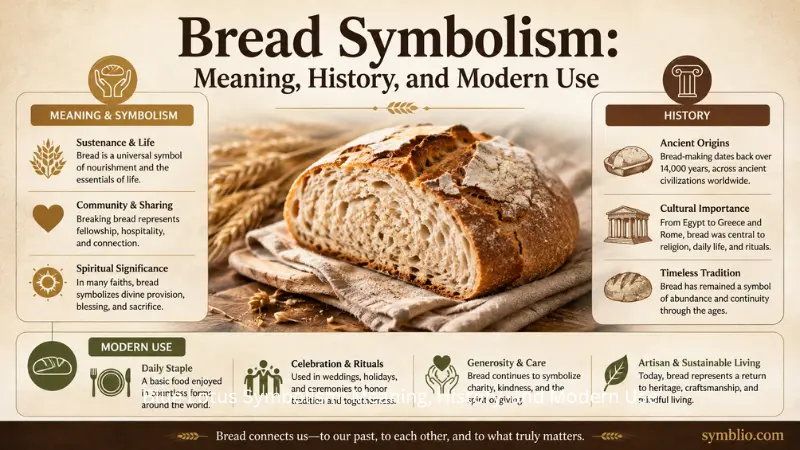
Bread is one of the most familiar foods in American life, yet bread symbolism reaches far beyond the kitchen table. Because bread has long been connected with nourishment, farming, household labor, religious practice, and shared meals, it commonly represents life, provision, work, hospitality, family, and community.
Its meaning changes with context. A loaf offered to a guest can suggest welcome and generosity. Bread shared during a family meal may represent belonging, while religious traditions can give particular breads sacred meanings. Even everyday expressions such as “breadwinner” connect bread with income and responsibility.
That range explains why bread remains such an effective symbol. It begins with a basic human necessity and expands into questions of who provides, who belongs, what people share, and what communities consider sacred.
Quick Answer
Bread symbolism commonly represents nourishment, life, work, family, and community in modern American culture, especially when bread is shared, baked for others, or associated with providing for a household. Historically, it has also represented hospitality, religious devotion, divine provision, remembrance, and abundance.
TL;DR
- Bread commonly symbolizes nourishment, survival, and basic human needs.
- Sharing bread can express hospitality, fellowship, and belonging.
- Christianity gives bread important meanings connected with communion and Christ.
- Jewish traditions give specific breads distinct ritual and historical meanings.
- American language connects bread with income, work, and household provision.
What Bread Represents at Its Most Basic Level
Before bread became a religious symbol or social metaphor, it was food. That practical role remains the foundation of most of its symbolic meanings.
Bread requires grain or flour, water, preparation, heat, and human effort. A finished loaf therefore connects several basic human concerns: agriculture, labor, nourishment, household security, and the ability to feed other people.
In societies where grain-based foods formed a major part of the daily diet, access to bread could mean the difference between having enough to eat and facing hunger. For that reason, bread naturally developed into a symbol of life and sustenance.
Its meaning is grounded in ordinary experience rather than abstract theory. Bread represents survival because people have depended on staple foods like it for generations.
The Core Meanings Associated With Bread
Bread can communicate several ideas at once, but the surrounding setting usually determines which meaning matters most.
| Context | Meaning in the USA | Common Associations | Notes |
|---|---|---|---|
| Family meals | Care and belonging | Home, comfort, togetherness | Stronger when linked with tradition |
| Shared meals | Community and hospitality | Friendship, welcome, trust | Often reflected in “breaking bread” |
| Religious practice | Faith and sacred nourishment | Communion, blessing, remembrance | Meaning varies by tradition |
| Work and finances | Livelihood and provision | Breadwinner, income, responsibility | Common in everyday language |
| Scarcity | Basic human need | Hunger, poverty, insecurity | Absence of bread can symbolize hardship |
| Baking and gifting | Care and generosity | Effort, patience, hospitality | Meaning comes from making and sharing |
These meanings often overlap because bread belongs to both private household life and larger social traditions.
Why Bread Became a Symbol of Life and Sustenance
Many symbols gain importance because they are rare. Bread gained symbolic importance for almost the opposite reason: it became significant because it was ordinary, useful, and necessary.
Across many agricultural societies, grain-based foods supplied a substantial part of everyday nourishment. Bread therefore came to stand not only for a particular food but also for the necessities required to maintain life.
That connection survives in expressions about “putting bread on the table.” The phrase is rarely about bread alone. Instead, it refers to earning enough money to provide food and other basic needs for a household.
This is why bread remains closely associated with security. A full table suggests that essential needs are being met, while the absence of basic food can represent hardship and vulnerability.
Ancient Roots: Bread, Labor, and Offerings
Bread occupied an important place in several ancient societies, including ancient Egypt, where grain foods were dietary staples. Archaeological evidence shows that bread was eaten in everyday life and could also appear in ritual and funerary contexts.
Its importance was partly practical. Making bread required an entire chain of labor, from growing and harvesting grain to grinding, preparing dough, and baking. A loaf could therefore represent agricultural productivity as well as nourishment.
When food appeared in religious or funerary offerings, it also reflected the idea that valuable necessities could be dedicated in sacred contexts.
This helps explain a larger pattern in symbolism: people often attach special meaning to the things they depend on most. Bread became symbolically important not because it was decorative, but because it sustained life.
Bread in Judaism: Remembrance, Blessing, and Sacred Time
Bread does not carry one single meaning across Jewish tradition. Different breads are associated with different practices, holidays, and forms of remembrance.
Matzah has a central place at Passover and recalls the Exodus from Egypt. Its unleavened form is connected with the haste of departure described in the biblical narrative and has also been associated with humility in later interpretation.
Challah belongs to a different context. It is closely connected with Shabbat and festive meals, where bread becomes part of blessing, gathering, family life, and sacred time.
Other biblical bread traditions also connect food with provision and religious observance.
These distinctions are important. It would be inaccurate to treat every Jewish bread as if it expressed the same idea. Meaning comes from the specific bread, ritual, occasion, and community.
Bread in Christianity: Christ, Communion, and Spiritual Nourishment
Bread has especially recognizable symbolic importance in Christianity.
In the Gospel of John, Jesus refers to himself as the “bread of life,” giving bread a meaning connected with spiritual nourishment and dependence on Christ. Early Christian communities also associated the breaking of bread with worship, fellowship, and communal religious life.
The Last Supper gives bread another central meaning. Jesus breaks bread and associates it with his body, an action remembered in Christian communion traditions.
Christian denominations do not interpret communion in exactly the same way. Catholic teaching, for example, gives the consecrated bread a specific sacramental meaning, while many Protestant traditions place different levels of emphasis on presence, remembrance, fellowship, and symbolism.
For that reason, bread in Christianity can represent Christ, sacrifice, spiritual nourishment, communion, remembrance, and unity, depending on the theological setting.
What Bread Commonly Means in the United States
In American culture, bread belongs to several symbolic worlds at the same time.
At home, it often suggests comfort and familiarity. Toast at breakfast, sandwiches packed for school, rolls served during holiday dinners, or bread baked for neighbors can all become associated with everyday care.
Specific breads can also preserve family and cultural identity. Immigrant communities have brought their own baking traditions to the United States, allowing recipes, ingredients, and rituals to connect later generations with earlier family histories.
Bread also has an economic meaning in American language. A person who provides financial support for a household may be called a breadwinner.
As a result, bread can represent both emotional home life and the material work required to sustain that home.
Breaking Bread as a Sign of Fellowship
To “break bread” with someone usually means more than physically tearing a loaf. In modern English, the expression commonly refers to sharing a meal, often with an added sense of fellowship or social connection.
The symbolism works because eating together creates a temporary shared space. People sit at the same table, participate in the same activity, and acknowledge one another as guests, hosts, relatives, friends, or members of a community.
Offering food can also express trust. The host provides nourishment, while the guest accepts that gesture.
Still, sharing a meal should not be treated as a magical form of reconciliation. Two people can eat together and still disagree. Symbolically, breaking bread suggests openness to connection, not a guarantee that conflict has disappeared.
Hospitality, Welcome, and Generosity
Bread can become a symbol of hospitality when it is offered to another person rather than simply eaten.
A loaf placed on a guest table, bread baked for a new neighbor, or food taken to a family experiencing hardship communicates a practical message: you are welcome, and someone is willing to provide for you.
That is why bread often represents generosity. Its symbolic value comes from giving something useful and nourishing.
Bread-and-salt traditions found in parts of Eastern Europe offer a well-known example of this connection. The combination has been used to welcome guests and can express goodwill, prosperity, and the hope that visitors will not lack necessities.
In the United States, families from many cultural backgrounds continue hospitality customs involving traditional foods. A welcoming loaf can therefore carry both a general meaning of generosity and a more specific inherited cultural meaning.
Bread as a Symbol of Work, Income, and Responsibility
Few foods have entered the language of work as strongly as bread.
The word “breadwinner” refers to someone whose earnings help support a household. Informal uses of “bread” as a word for money also reflect the older link between food, livelihood, and survival.
This gives bread a symbolic connection with responsibility. Providing bread does not literally mean supplying only baked food. It represents earning enough to maintain daily life.
Modern households no longer fit a single provider model. Many families rely on two or more incomes, and a breadwinner can be a person of any gender.
The metaphor remains useful because its underlying idea is still clear: income provides the necessities that keep a household functioning.
Homemade Bread as a Symbol of Care
Homemade bread often communicates something that mass-produced bread does not: visible personal effort.
Mixing ingredients, kneading dough, waiting for it to rise, shaping it, and baking it all take time. When someone gives homemade bread as a gift, that labor becomes part of the meaning.
The loaf may represent attention, patience, hospitality, domestic care, or affection.
This is one reason fresh bread frequently appears in visual storytelling about home and family. Flour-covered counters, rising dough, ovens, and warm loaves create associations with preparation, routine, and feeding others.
The symbolism does not mean homemade bread is always emotionally significant. Context matters. However, when bread is deliberately made for another person, the act of preparation often becomes as meaningful as the food itself.
Bread, Abundance, and Scarcity
Bread can symbolize abundance when it appears in plentiful quantities, but it can communicate the opposite message when it is absent.
A table filled with loaves may suggest prosperity, harvest, generosity, or having enough food to share. In contrast, an empty bread basket can suggest hunger, poverty, rationing, or economic insecurity.
Because bread is associated with basic needs rather than luxury, its absence can become a particularly direct image of hardship.
This gives bread a social dimension as well. Images of bread lines, shortages, or rationing often communicate broader problems related to wages, food access, war, economic disruption, or public welfare.
The symbolic contrast is straightforward: plentiful bread suggests provision, while inaccessible bread suggests unmet need.
Emotional and Psychological Meaning
Bread often communicates security more strongly than excitement.
Its emotional power usually comes from familiarity. The smell of a particular loaf, a family recipe, a holiday bread, or a meal repeated throughout childhood can connect food with memory.
For one person, bread may recall a grandparent’s kitchen. For another, it may represent religious observance, migration, cultural heritage, or a sense of home.
That makes bread useful as a personal symbol of groundedness, gratitude, belonging, or family continuity.
Its emotional meaning can also be bittersweet. Traditional foods may remind people of relatives who have died, places they left, or communities that have changed. Food symbolism often carries comfort and loss at the same time because sensory memories can remain strong for many years.
Bread in Tattoos, Art, Decor, and Digital Culture
Bread imagery appears in modern visual culture in both serious and playful ways.
A bread tattoo might represent baking as a profession, family heritage, hospitality, livelihood, faith, or appreciation for simple pleasures. There is no single standardized meaning, so the wearer’s intention matters more than the image alone.
In kitchen decor and illustration, bread often supports themes of warmth, domestic life, abundance, and handmade food.
Digital culture has added new associations. Images of sourdough loaves, bakery counters, and bread-making processes can communicate craftsmanship, patience, comfort, or a slower style of domestic life.
At the same time, bread can simply be humorous. A cartoon baguette or novelty bread design does not automatically require spiritual or historical interpretation.
Context should come before symbolism.
Bread Across Different Cultures
Bread exists in many forms, and a European-style wheat loaf should not be treated as the only form that matters.
Pita, naan, injera, tortillas, challah, flatbreads, baguettes, and many other staple foods can serve comparable roles within different communities. Their ingredients, preparation methods, histories, and meanings are not interchangeable.
A particular bread may belong to a religious holiday, wedding, communal meal, family tradition, hospitality ritual, or everyday diet.
In many cultures, the symbolic importance of bread comes from its connection with shared life. Staple foods can become expressions of community identity because people prepare, serve, and remember them together.
The most accurate interpretation therefore begins with the specific culture and occasion rather than assigning every form of bread one universal meaning.
Why Bread Can Represent Transformation
Bread can also symbolize transformation because the baking process visibly changes simple ingredients.
Grain is harvested and ground into flour. Flour combines with liquid to become dough. Fermentation may cause the dough to rise, while heat changes its texture, flavor, structure, and color.
Artists and writers can use this process as a metaphor for patient change, skilled work, or the transformation of basic materials into something nourishing.
This meaning is strongest when the process itself appears in the image or story. Kneading, rising dough, ovens, grain, and finished loaves make the transformation easy to recognize.
A single loaf, however, does not automatically symbolize personal growth or transformation. Interpretation should depend on the surrounding details.
How the Meaning of Bread Has Evolved
The earliest symbolic importance of bread was closely tied to necessity. Where grain foods were dietary staples, bread represented nourishment because it was essential to daily life.
Religious traditions later developed more specialized meanings around particular breads and rituals. Jewish practices connected specific breads with remembrance, blessing, festivals, and sacred time. Christianity gave bread central meanings related to Christ, communion, sacrifice, spiritual nourishment, and fellowship.
Economic language expanded the symbol further. Bread became a metaphor for livelihood and money, while the idea of the breadwinner linked it with supporting a household.
Modern culture has added still more meanings. Bread can now appear as a symbol of nostalgia, craft, cultural identity, domestic comfort, or even humor.
These layers continue to coexist. A loaf can be sacred in one setting, economic in another, sentimental in a third, and purely playful in a fourth.
Common Misunderstandings About Bread as a Symbol
One common mistake is assuming bread has one universal spiritual meaning.
It does not.
Religious meanings depend heavily on tradition. Passover matzah should not be interpreted as though it carries exactly the same meaning as Christian communion bread. Even within Christianity, different denominations understand communion in different ways.
Another mistake is assigning complicated symbolism to every image of bread. Sometimes a loaf in a painting, tattoo, advertisement, or photograph simply represents food, baking, work, or a profession.
It is also easy to romanticize the phrase “breaking bread.” Sharing a meal can encourage conversation and connection, but it does not automatically resolve conflict.
Accurate interpretation begins with three questions: What kind of bread is shown? What cultural setting surrounds it? What are people doing with it?
FAQs
Bread is generally positive when it represents nourishment, generosity, hospitality, family, or dependable provision. In contexts involving famine, shortages, poverty, or rationing, however, it can emphasize insecurity and unmet basic needs.
The meaning depends on the religious tradition. Christianity strongly connects bread with Christ and communion, while Jewish traditions give specific breads such as matzah and challah distinct meanings connected with remembrance, blessing, and sacred observance.
Bread can represent Christ, spiritual nourishment, communion, sacrifice, remembrance, and fellowship. The exact interpretation varies among Christian denominations and their teachings about the Eucharist or Lord’s Supper.
Sharing bread commonly represents hospitality, fellowship, trust, generosity, and social connection. The phrase “breaking bread” reflects the broader idea that eating together can create a space for companionship and conversation.
A bread tattoo can represent family, livelihood, baking, cultural heritage, faith, hospitality, or appreciation for simple pleasures. Because bread tattoos have no single universal meaning, the person’s reason for choosing the design matters most.
Bread became associated with money because earning a living allows people to obtain food and other necessities. Expressions such as “breadwinner” preserve this connection between income, provision, and household survival.
Yes, especially when bread appears in plentiful amounts or on a full communal table. In those contexts, it can suggest prosperity, successful harvests, generosity, and having enough resources to share with others.
Conclusion
Bread carries an unusually wide range of meanings because its symbolism grew from practical human experience. People cultivate grain, prepare food, work to provide it, serve it to guests, share it with family, and use particular breads in religious and cultural traditions.
In modern American culture, bread symbolism most often centers on nourishment, provision, work, home, hospitality, faith, and community. The exact meaning depends on whether bread appears at a family table, in a religious ceremony, in an economic expression, or as a personal image.
Its lasting importance comes from something simple and concrete: bread begins as food people need, then becomes a symbol of what they provide, remember, believe, and share.