
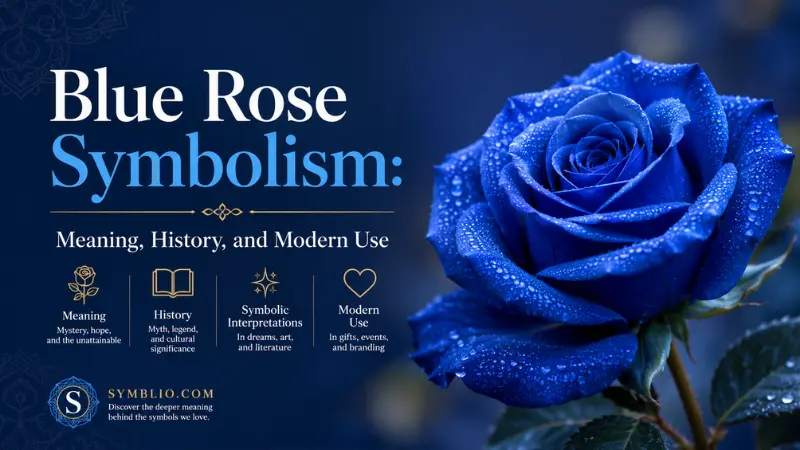
Blue roses stand apart from almost every other rose color. Blue rose symbolism is most closely tied to mystery, rarity, individuality, impossible desires, and the determination to achieve something once thought unreachable.
The reason is surprisingly practical. True naturally blue roses do not exist in the same way red, yellow, pink, or white roses do. For generations, people could imagine a blue rose, paint one, write about one, or try to breed one, but nature did not readily produce it.
That gap between imagination and reality shaped the flower’s meaning. Today, blue roses appear in romantic gifts, wedding arrangements, tattoos, fantasy art, jewelry, home decor, and personal symbolism. Depending on the setting, they can represent an unreachable dream, unusual love, personal independence, mystery, or a breakthrough that once seemed impossible.
Quick Answer
Blue rose symbolism commonly represents mystery, rarity, individuality, and the pursuit of something that seems impossible. Historically, its meaning grew from the fact that naturally blue roses were unavailable, while modern interpretations also connect the flower with ambition, breakthroughs, and dreams achieved.
TL;DR
- Blue roses often symbolize rarity, mystery, and impossible desires.
- Their meaning developed partly because true blue roses do not occur naturally.
- Modern symbolism also connects them with achievement and perseverance.
- In love, they may suggest rare or difficult affection.
- Tattoos often represent individuality, ambition, or personal transformation.
- Bright blue florist roses are usually dyed or specially treated.
What Does a Blue Rose Look Like?
A blue rose usually looks like a traditional rose with layered petals arranged around a tightly formed center, but its color may range from pale powder blue to turquoise, royal blue, navy, or violet-blue.
In nature, however, roses do not normally produce the clear blue pigment seen in flowers such as delphiniums or cornflowers. Some rose varieties are sold with “blue” in their names, but their petals are usually closer to lavender, lilac, mauve, or gray-purple.
The vivid blue roses commonly seen in American flower shops are often created by dyeing white or pale roses. Genetically modified roses capable of producing a blue-associated pigment have also been developed, though their color is generally more lavender or violet than bright sky blue.
This unusual botanical background is central to the flower’s symbolism. A blue rose represents something familiar transformed into something unexpected.
What Blue Roses Commonly Symbolize
The meaning of a blue rose changes depending on the occasion, but several interpretations appear repeatedly in modern American culture.
| Context | Common Meaning | Typical Association | Notes |
|---|---|---|---|
| Romantic gift | Rare or difficult love | Fascination, longing | Can suggest someone hard to reach |
| Tattoo | Individuality | Identity, personal goals | Meaning often depends on the wearer |
| Achievement | Doing the unlikely | Perseverance, success | Strong modern interpretation |
| Art and fiction | Mystery | Fantasy, secrets, imagination | Often emphasizes the unreal |
| Weddings | Originality | Unique style, individuality | May be symbolic or purely decorative |
| Memorial imagery | Remembrance | Distance, uniqueness, loss | Not a universal mourning flower |
The strongest recurring ideas are rarity, mystery, difference, desire, and the challenge of reaching something beyond ordinary expectations.
Why Blue Roses Came to Represent the Impossible
The connection between blue roses and impossibility developed naturally from the flower itself.
For centuries, plant breeders could produce roses in many colors, but achieving a genuinely blue rose through normal breeding remained out of reach. Roses lacked the biological ability to create the pigment needed for a clear blue color.
That made the imagined blue rose useful as a metaphor.
It could represent a goal someone desperately wanted but could not reach. It could describe an ideal person who seemed impossible to possess, an unrealistic dream, or something existing only in imagination.
This differs slightly from ordinary rarity.
A rare object exists but is difficult to find. The traditional blue rose represented something people wanted even though nature seemed not to offer it at all.
That difference explains why “the impossible” became one of its most persistent meanings.
Blue Roses and the Language of Flowers
Flower symbolism became especially fashionable during the nineteenth century. Flowers were often assigned emotional meanings, allowing bouquets to communicate affection, admiration, grief, friendship, rejection, or longing.
Roses played an important role because they already had strong connections with romance and beauty. Different rose colors gradually developed different associations.
Blue roses were unusual because people could imagine them long before they could easily obtain them. Their absence made them particularly useful in poetry, fiction, decorative art, and symbolic storytelling.
However, flower meanings were never perfectly standardized. Different flower dictionaries and cultural traditions sometimes assigned different interpretations to the same plant.
For that reason, it is more accurate to say that blue roses gradually became associated with impossible desires, rarity, and mystery rather than claiming that one universal historical definition existed everywhere.
How Science Changed Blue Rose Meaning
Modern biotechnology added an unexpected new chapter to the blue rose story.
Researchers spent years trying to create roses capable of producing pigments associated with blue flowers. Eventually, genetic engineering made it possible to develop roses containing delphinidin, a pigment roses do not normally produce.
The resulting flowers were not the intense royal blue that many people imagine. They appeared closer to lavender or violet-blue.
Still, the scientific achievement changed the symbolism.
For generations, the blue rose had represented something people could imagine but could not create. Once researchers pushed beyond that limitation, the flower could also represent accomplishing what had once seemed impossible.
This produced a modern shift in meaning:
Impossible dream → determined effort → breakthrough
Because of that history, blue roses now work particularly well as symbols of perseverance, innovation, and difficult goals finally reached.
What Blue Roses Mean in American Culture
In the United States, blue roses usually feel more unconventional than traditional.
Red roses have an established association with passionate romance. White roses are common at weddings and memorials. Yellow roses are widely associated with friendship and warmth.
Blue roses have fewer fixed social rules.
That flexibility allows people to use them for more personal meanings, including:
- being different from everyone else
- admiring someone unusual
- pursuing an ambitious goal
- celebrating a major accomplishment
- expressing fascination or curiosity
- representing a difficult relationship
- showing independence from tradition
For some Americans, the color itself is enough. A person may simply choose blue roses because blue is their favorite color or because the flowers fit a wedding or event theme.
Symbolism depends heavily on context.
Blue Rose Symbolism in Love and Relationships
Blue roses can carry a particularly interesting romantic meaning.
The rose already suggests affection or attraction. Blue introduces rarity, distance, mystery, or something difficult to obtain.
Together, those qualities can represent a love that feels extraordinary but complicated.
A blue rose may suggest:
- loving someone from a distance
- being attracted to someone mysterious
- wanting a relationship that seems difficult to achieve
- seeing a partner as completely unique
- admiring someone who does not fit ordinary expectations
The meaning does not have to be sad.
In an established relationship, giving blue roses can simply mean, “There is nobody else like you.”
For couples who prefer unconventional gifts, blue roses may feel more personal than traditional red ones.
The occasion usually determines whether the symbolism leans toward longing or celebration.
Blue Roses as Symbols of Ambition and Achievement
The blue rose has become especially suitable for representing difficult goals.
Because the flower itself was once considered beyond normal horticultural possibilities, it can symbolize refusing to accept assumed limits.
Someone might use a blue rose to mark:
- graduation
- career advancement
- completion of a major project
- reaching a long-term personal goal
- overcoming repeated setbacks
- entering an unusual career
- accomplishing something others doubted
In this sense, the flower does not simply mean success.
It suggests success after difficulty.
That makes the blue rose different from symbols that represent victory alone. Its story focuses on wanting something unlikely, working toward it, and eventually crossing a boundary that once seemed fixed.
Mystery, Fantasy, and the Unknown
Blue roses also have a strong place in fantasy and imaginative art.
A rose is instantly recognizable, but a naturally vivid blue rose feels slightly unreal. That combination makes the flower visually suited to stories involving dreams, hidden worlds, supernatural events, secrets, or unexplained experiences.
In fiction and artwork, a blue rose may suggest:
- an unknown destination
- a hidden truth
- a mysterious character
- a secret relationship
- a magical object
- something existing outside ordinary reality
The symbolism usually creates curiosity rather than fear.
That distinction separates the blue rose from darker floral images. A black rose may imply death, rebellion, endings, or gothic themes. A blue rose can feel strange and distant while still appearing calm, beautiful, or hopeful.
Emotional Meaning of the Color Blue
The emotional effect of a blue rose also comes from the color itself.
Blue is often associated with calmness, reflection, stability, and emotional distance. At the same time, English speakers also connect blue with sadness through expressions such as “feeling blue.”
That gives blue roses a useful emotional range.
A pale blue rose can feel peaceful, delicate, or dreamlike.
A bright electric-blue rose may suggest creativity, confidence, individuality, or rebellion.
A dark navy rose can feel more serious, private, solemn, or mysterious.
Because shade changes mood, two blue rose designs may communicate very different emotions even when they share the same basic symbolic associations.
This is especially important in tattoos, memorial art, fashion, and event design.
Blue Rose Tattoo Meaning
Blue rose tattoos are popular because their symbolism can be highly personal.
For one person, the tattoo may represent achieving something others believed was impossible. For someone else, it may honor a rare relationship, an unconventional identity, or a major personal transformation.
Common tattoo interpretations include:
Individuality: The wearer does not want to follow ordinary expectations.
Ambition: The rose represents a difficult goal worth pursuing.
Rare love: It may honor a relationship considered unusual or irreplaceable.
Mystery: The tattoo can represent privacy, curiosity, or an unknown side of someone’s identity.
Transformation: A blue rose may mark becoming someone different from the person one used to be.
Additional tattoo elements can change the meaning.
A blue rose with thorns may suggest that meaningful goals require struggle.
A wilting blue rose can represent a lost dream or relationship.
A blooming rose may suggest new possibilities.
A butterfly beside the rose can shift the design toward change or renewal.
Ultimately, tattoo symbolism belongs to the wearer rather than to any fixed dictionary definition.
Blue Roses in Weddings, Gifts, and Decor
Blue roses are widely used in modern decorative settings because their color creates an immediate visual impact.
At weddings, they may match navy, royal blue, icy blue, or fantasy-inspired color schemes. They can suggest originality, but sometimes their purpose is simply aesthetic.
For birthdays, graduations, promotions, or celebrations, blue roses can communicate that someone is unusual, memorable, or worthy of recognition.
They can also make an appropriate gift for someone who dislikes conventional romantic flowers.
In home decor, preserved arrangements, artificial roses, wall art, and decorative prints, the meaning may become even less formal. The flower may simply create a dreamy, elegant, or unusual atmosphere.
Not every blue rose needs to carry a hidden message.
Sometimes the symbolism is chosen deliberately. Other times, the visual appeal comes first.
Cross-Cultural Interpretations of Blue Roses
Blue rose meanings should be handled carefully when discussing different cultures.
Roses themselves have long histories in many societies, and the color blue carries different religious, artistic, and cultural associations around the world. But that does not mean every culture historically had a specific tradition devoted to blue roses.
Because naturally blue roses were unavailable, many modern claims about ancient blue rose symbolism are difficult to support.
A particularly important modern connection comes from Japan, where genetically engineered blue-toned roses were commercially introduced after years of scientific development. In that context, the flower became strongly associated with dreams becoming possible.
Elsewhere, meanings usually come from a combination of rose symbolism, color symbolism, modern floristry, literature, and personal interpretation.
It is better to recognize those differences than to force one universal cultural definition onto the flower.
Do Blue Roses Have a Religious Meaning?
There is no standard biblical meaning specifically assigned to blue roses.
Roses appear in religious art and later Christian symbolism, while the color blue has its own associations in religious visual traditions. However, combining the two does not create a historical biblical symbol called the blue rose.
Modern individuals may personally interpret a blue rose as representing:
- faith when success seems unlikely
- hope
- spiritual mystery
- reaching beyond ordinary limitations
- trust during uncertainty
Those meanings can be meaningful to the person using them, but they should be understood as personal or modern interpretations rather than universal religious doctrine.
The same caution applies to claims that blue roses have one fixed spiritual meaning across all traditions.
Common Misunderstandings About Blue Roses
One common misconception is that intensely blue roses grow naturally.
Most do not.
Flowers sold in vivid cobalt, turquoise, or royal blue are usually created through coloring techniques. Roses described as naturally “blue” are generally closer to lavender or purple.
Another misunderstanding is that blue roses always symbolize impossible love.
That is only one interpretation.
They can also represent individuality, ambition, curiosity, achievement, or simply unconventional beauty.
A third misconception is that blue rose symbolism comes from one ancient tradition.
Its modern meaning developed from several influences, including the biological rarity of blue roses, flower language, storytelling, color associations, floristry, and scientific innovation.
Understanding that mixed history produces a more accurate interpretation than assigning the flower one rigid meaning.
How Blue Rose Symbolism Has Evolved
The most interesting part of the blue rose story is how its meaning changed as human possibilities changed.
Originally, the imagined flower represented something nature seemed unable to produce.
That encouraged associations with longing, fantasy, unattainable goals, and impossible desires.
Over time, modern culture expanded those meanings to include uniqueness and individuality. A blue rose could represent a person who seemed unlike anyone else.
Scientific development added another interpretation.
Once researchers succeeded in creating roses that produced a blue-associated pigment, the flower was no longer only about what could not be achieved. It could also represent what determination and experimentation might eventually make possible.
The old meaning did not disappear.
Instead, the blue rose now represents both sides of the same idea: the dream that seems impossible and the determination to pursue it anyway.
FAQs
A blue rose commonly symbolizes mystery, rarity, uniqueness, and the desire for something difficult or impossible to obtain. Because naturally blue roses are extremely unusual, they are often associated with extraordinary dreams, unreachable love, and fascination with the unknown.
In romantic contexts, a blue rose can represent mysterious attraction, rare love, admiration, or longing for someone who seems unattainable. Its meaning can vary depending on the relationship and the intention behind the gift.
Yes. Blue roses are frequently connected with impossible or unattainable love because true blue coloring does not naturally occur in conventional roses. This association has made the blue rose a poetic symbol of wanting something that feels beyond reach.
Receiving a blue rose may suggest that the giver sees you as unique, intriguing, rare, or unforgettable. It can also express admiration, curiosity, or romantic feelings that are difficult to put into words.
Yes. Mystery is one of the strongest meanings of the blue rose. Its unusual color gives it an almost unreal appearance, which has helped connect it with secrets, imagination, wonder, and things that cannot easily be explained.
A blue rose tattoo can symbolize individuality, mystery, personal dreams, rare beauty, or pursuing the impossible. For some people, it may also represent a meaningful relationship or a goal that remains difficult to achieve.
Conclusion
What makes blue rose symbolism distinctive is its connection with something people could imagine long before they could realistically create it. That history gave the flower associations with mystery, rarity, unusual love, distant desires, and goals that appear beyond reach.
Modern culture has added a more hopeful interpretation. The blue rose can now represent determination, individuality, innovation, and the satisfaction of accomplishing something once considered impossible.
Its meaning ultimately depends on context, but the central idea remains remarkably consistent: a blue rose represents stepping outside what is ordinary and reaching toward something difficult, rare, or unexpected.


