
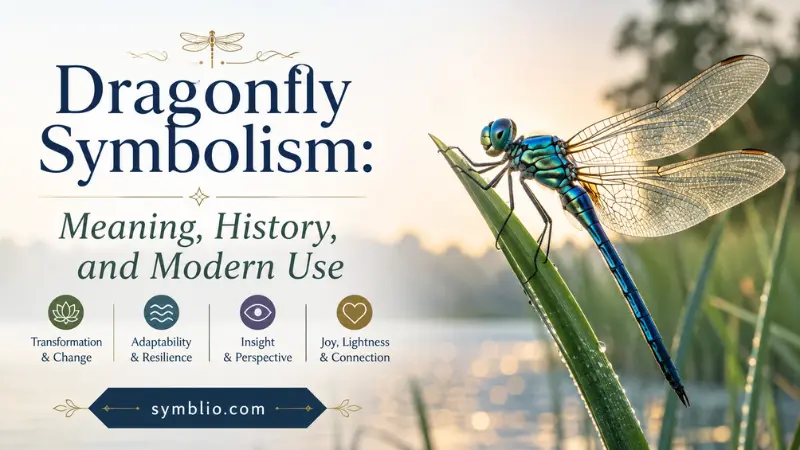
Dragonflies are instantly recognizable by their long bodies, transparent wings, large eyes, and quick movements around ponds, streams, lakes, and wetlands. Dragonfly symbolism in modern American culture is most commonly associated with transformation, adaptability, personal growth, freedom, and gaining a different perspective on life.
These meanings are closely connected to the insect’s real life cycle. Dragonflies spend their early development underwater before emerging as winged adults, making them a natural visual metaphor for moving from one stage of life into another.
Their meaning is not identical everywhere, however. Dragonflies have appeared in Indigenous North American art, Japanese decorative traditions, European folklore, American design, tattoos, jewelry, and contemporary personal symbolism. Each context adds something different to the way people understand the insect today.
Quick Answer
Dragonfly symbolism commonly represents transformation, adaptability, freedom, and personal growth in modern American culture. Historically, dragonflies have also carried meanings connected with water, seasonal change, determination, victory, and, in some European traditions, superstition.
TL;DR
- Dragonflies commonly symbolize transformation, adaptability, freedom, and personal growth.
- Their aquatic-to-airborne life cycle reinforces the idea of major change.
- Indigenous dragonfly meanings differ between individual communities and traditions.
- Japanese imagery has historically linked dragonflies with determination and victory.
- Tattoos often represent independence, recovery, transition, or a new life stage.
- Older European folklore sometimes portrayed dragonflies with fear or suspicion.
What Dragonflies Look Like and Why Their Form Matters
Dragonflies have elongated bodies, two pairs of wings, six legs, and unusually large compound eyes. They are strong, agile fliers that can hover, accelerate quickly, and change direction with impressive control.
Their appearance naturally influences the meanings people give them.
The wings suggest freedom and movement. Their rapid changes in direction encourage associations with adaptability. Their large eyes have inspired modern ideas about awareness and perspective.
Water is equally important to their symbolic identity. Young dragonflies live underwater before becoming flying adults. The dramatic change from an aquatic environment to the open air gives the insect one of the clearest natural connections with transition.
What Dragonflies Commonly Mean in the United States
There is no official American meaning assigned to the dragonfly. Instead, several interpretations have become familiar through tattoos, art, jewelry, garden decor, memorial objects, gifts, and personal storytelling.
| Context | Meaning in the USA | Common Association | Typical Use |
|---|---|---|---|
| Personal growth | Transformation | Entering a new life stage | Tattoos, gifts |
| Independence | Freedom | Movement and self-direction | Jewelry, fashion |
| Difficult change | Adaptability | Responding to uncertainty | Personal reminders |
| Self-reflection | Perspective | Seeing life differently | Art, journals |
| Remembrance | Continuing connection | Memory of a loved one | Memorial tattoos |
| Nature | Water and summer | Ponds, wetlands, outdoor life | Garden decor |
These meanings are mostly modern cultural interpretations rather than fixed rules.
A person may choose a dragonfly because it represents recovery after hardship, while another may associate it with childhood summers beside a lake. The same image can carry different meanings without either interpretation being incorrect.
Why Transformation Became the Best-Known Meaning
Transformation is probably the strongest modern interpretation because it mirrors the dragonfly’s actual development.
Dragonflies begin life in or near water. Their young, usually called nymphs, live underwater and may remain there much longer than they eventually spend as flying adults.
When development is complete, the nymph leaves the water. Its adult body emerges, its wings expand, and the insect enters a completely different environment.
That biological transition creates an obvious human metaphor.
A dragonfly can represent graduating, changing careers, leaving an unhealthy relationship, moving to a new place, recovering from a difficult experience, or simply becoming a different version of oneself.
The symbolism is especially effective because the earlier stage is not erased. The adult dragonfly is still the same living organism that developed underwater.
For many people, that suggests growth without denying the experiences that came before it.
Adaptability, Movement, and Freedom
Dragonflies are exceptionally maneuverable insects. Their ability to hover, accelerate, turn sharply, and move through changing surroundings helps explain why adaptability is another common meaning.
Transformation and adaptability are related, but they are not identical.
Transformation means entering a different state or stage.
Adaptability means responding effectively while circumstances continue to change.
That distinction matters.
Someone going through an uncertain period may use a dragonfly not because they want to become an entirely different person, but because they want to remain flexible enough to handle unfamiliar conditions.
Its wings also create an easy connection with freedom.
In contemporary American symbolism, winged animals often represent independence, release, movement, and freedom from restrictions. The dragonfly adds agility to that idea, making its version of freedom feel active rather than passive.
Clarity, Awareness, and Changing Perspective
A dragonfly’s eyes dominate much of its head and give it an exceptionally broad field of vision.
Modern symbolism has turned that physical feature into ideas about awareness, observation, and seeing situations differently.
A dragonfly can therefore represent the moment when someone begins to understand a problem from another angle.
This may involve recognizing an unhealthy relationship, reconsidering a career choice, noticing a repeating behavior pattern, or becoming more aware of personal needs.
In this interpretation, clarity does not mean supernatural knowledge.
It means seeing enough of a situation to make a better decision.
That idea connects naturally with transformation because meaningful change often starts when a person begins looking at familiar circumstances differently.
Resilience Without Aggression
Many traditional strength symbols are physically imposing.
Bears, lions, wolves, and eagles often communicate power through size, hunting ability, or dominance.
Dragonflies create a different image.
Their wings look delicate and their bodies are slender, yet they are highly capable predators and extremely effective fliers.
That contrast makes them useful symbols of resilience without aggression.
A dragonfly can represent surviving difficulty through responsiveness rather than force. Its strength comes from movement, precision, and the ability to function in changing conditions.
For someone who does not identify with bold or intimidating strength imagery, the dragonfly offers another interpretation of resilience.
It suggests that strength can involve adjusting rather than resisting every change.
Dragonflies in Native American Traditions
Discussions of Indigenous dragonfly symbolism require care because there is no single Native American culture or universal Native American interpretation.
North America is home to many distinct Indigenous nations, each with its own languages, beliefs, histories, and artistic traditions.
Dragonfly motifs appear in Indigenous art, including material traditions of the American Southwest. They can be found in pottery and other decorative forms produced by particular communities and artists.
Their exact meaning should be understood within the specific cultural context in which the image appears.
It is misleading to claim that every Native American group viewed the dragonfly as a universal symbol of transformation, healing, happiness, or spiritual guidance.
Modern websites and commercial products sometimes combine several different Indigenous traditions and present them as one belief system. That approach removes important cultural distinctions.
When a dragonfly appears in Indigenous art, the most respectful interpretation begins by identifying the community, artist, period, and object rather than assuming one universal definition.
Dragonflies in Japanese Culture
Dragonflies have a long and distinctive place in Japanese visual culture.
Historically, they appeared on military equipment, sword fittings, clothing, and decorative objects. Their persistent forward movement and agile flight contributed to associations with determination, courage, and victory.
Dragonfly imagery became especially familiar in warrior culture, where the insect could represent successful effort and refusal to retreat.
Its Japanese significance extends beyond warfare.
Dragonflies are also connected with landscapes, seasonal imagery, agriculture, poetry, and nature observation. Because they are commonly seen around wetlands and rice-growing environments, they became familiar parts of everyday scenery as well as decorative art.
This historical context gives Japanese dragonfly imagery a somewhat different emphasis from the modern American transformation narrative.
Where modern Americans often focus on personal change, traditional Japanese imagery can place greater emphasis on determination, progress, and victory.
The Darker Side of European Dragonfly Folklore
Dragonflies were not always treated positively.
Older European folklore sometimes portrayed them as frightening or suspicious creatures.
Folk names such as “devil’s darning needle” reflected stories claiming that dragonflies could sew people’s mouths, eyes, or ears. Other legends incorrectly connected them with snakes or imagined them as threatening insects.
None of these beliefs reflects actual dragonfly behavior.
The stories likely grew from the insect’s unusual appearance, fast flight, large eyes, association with wetlands, and limited scientific understanding among earlier communities.
Those beliefs gradually lost influence as people became more familiar with dragonfly biology.
Today, most Americans view dragonflies positively, but the old folklore remains useful because it shows how dramatically symbolic meaning can change between cultures and historical periods.
Dragonflies in American Art and Decorative Design
Dragonflies became especially visible in decorative art during the Art Nouveau period of the late nineteenth and early twentieth centuries.
Art Nouveau designers favored flowing natural shapes, including flowers, vines, birds, butterflies, and insects.
The dragonfly was particularly well suited to this style.
Its symmetrical wings, elongated body, and shimmering appearance could be translated into stained glass, jewelry, metalwork, lamps, and decorative objects.
In the United States, Tiffany Studios helped make dragonfly designs especially recognizable through elaborate lampshades and decorative glass.
That history remains visible today.
Dragonfly lamps, stained-glass ornaments, garden decorations, wall art, and jewelry often reflect both modern symbolism and the influence of historic nature-inspired design.
This means not every dragonfly object is intended as a spiritual symbol. Sometimes the insect is chosen primarily because of its shape, color, and artistic appeal.
Why Dragonfly Tattoos Are So Popular
Dragonflies work particularly well as tattoos because their shape is recognizable even in a small or minimalist design.
They can also be adapted to many artistic styles.
A simple outline may represent a private turning point. A detailed dragonfly with colored wings may emphasize individuality, movement, or beauty. Designs incorporating flowers, water, initials, dates, or other objects can create more specific personal meanings.
Common modern interpretations include:
- beginning a new stage of life
- recovering after emotional hardship
- accepting personal change
- choosing independence
- adapting to uncertainty
- remembering a loved one
- leaving an old identity behind
- celebrating personal growth
No single meaning is required.
Someone may also choose a dragonfly tattoo simply because the insect reminds them of a particular place, person, childhood memory, or experience in nature.
That flexibility is a major part of its appeal.
Jewelry, Gifts, and Memorial Meaning
Dragonfly jewelry often carries many of the same meanings as dragonfly tattoos, but it allows the symbol to be worn or given without permanence.
A necklace may mark graduation or a career change.
A bracelet may be given to someone starting over after a difficult period.
Earrings or rings may simply represent freedom, movement, or appreciation for nature.
Dragonflies have also become popular remembrance symbols.
Some people wear dragonfly jewelry after losing someone close to them, or they associate an unexpected dragonfly encounter with memories of a deceased relative or friend.
That interpretation can be emotionally meaningful without being treated as an established supernatural fact.
For many people experiencing grief, the dragonfly’s movement from water into the air provides a comforting image of transition.
The value of the symbol lies in the personal connection rather than in proving that the insect carries a literal message.
Does Dragonfly Color Change Its Meaning?
Color can influence how dragonfly imagery feels, but there is no universal symbolic code assigning one official meaning to every dragonfly color.
In modern design, blue dragonflies may suggest calmness, reflection, openness, or water.
Green dragonflies can suggest growth, nature, renewal, or balance.
Red dragonflies may feel energetic and are sometimes associated with courage, passion, or intensity.
Black dragonfly designs often appear more minimalist, serious, elegant, or memorial-oriented.
Gold or metallic dragonfly imagery may communicate celebration, beauty, or luxury.
These interpretations mostly come from broader color associations rather than ancient rules about dragonflies.
Real dragonfly colors result from biology, species differences, sex, age, pigmentation, structural effects, and light.
The insect’s natural color does not assign it a spiritual message.
Dragonflies in Modern Personal and Digital Culture
Social media has made symbolism more individualized than ever.
People now use dragonfly images to mark events such as moving to a new city, completing treatment, leaving a difficult relationship, becoming a parent, graduating, changing careers, or reaching an important personal milestone.
Another person may post the same image because a dragonfly reminds them of someone they lost.
This illustrates an important difference between historical and contemporary symbolism.
Traditional meaning is usually shaped by a community over time.
Personal symbolism can develop from one person’s experience.
Neither should automatically be presented as the other.
Problems arise when an individual interpretation becomes a universal claim.
For example, someone may personally believe that seeing a dragonfly means a deceased loved one is nearby. That may be meaningful within their spiritual worldview, but it should not be presented as an established meaning shared by every culture or religion.
Common Misunderstandings About Dragonflies
The most common mistake is assuming that dragonflies have always represented transformation everywhere.
Transformation is especially convincing in modern symbolism because it matches the insect’s life cycle, but different cultures have emphasized completely different qualities.
Another misunderstanding is treating Indigenous North American traditions as a single belief system.
A dragonfly motif from one Native community should not automatically be assigned the meaning of another.
European folklore creates the opposite problem.
Old frightening names do not prove that dragonflies universally symbolized evil. They reflect particular folk stories rather than one permanent European meaning.
Another modern misconception is that every dragonfly encounter must predict an event.
Seeing one can certainly feel meaningful, especially during a major life transition, but symbolism involves interpretation rather than objective prediction.
Recognizing that difference allows people to appreciate the dragonfly without turning personal belief into historical fact.
How Dragonfly Meaning Has Evolved
Dragonfly meaning did not develop along one continuous path.
Different societies noticed different qualities in the insect.
Some Japanese traditions emphasized determination and victory.
Indigenous artists incorporated dragonfly forms into specific community traditions.
European folklore sometimes transformed the insect into something unsettling.
Art Nouveau designers admired its geometry, movement, and natural beauty.
Contemporary American culture has placed much greater emphasis on personal transformation.
Tattoos, jewelry, memorial objects, self-development language, and social media have made the dragonfly an increasingly individualized symbol.
The result is a modern meaning shaped by both nature and culture.
Its life cycle gives people an obvious image of transition, but personal experiences determine what that transition actually represents.
FAQs
A dragonfly commonly symbolizes change, transformation, adaptability, freedom, and personal growth. Its movement between water and air also makes it a natural symbol of transition and seeing life from a new perspective.
Seeing a dragonfly is often interpreted as a reminder to adapt to change, stay flexible, and appreciate the present moment. Symbolic interpretations vary by culture and personal belief, so there is no single universal meaning.
In some cultural traditions and modern interpretations, dragonflies are associated with good fortune, happiness, courage, and positive change. However, their meaning differs across cultures and historical periods.
In modern spiritual symbolism, the dragonfly may represent transformation, emotional maturity, self-awareness, and spiritual growth. Some people also connect it with clarity and moving beyond illusions.
In love and relationships, a dragonfly can symbolize emotional growth, openness, freedom, and a relationship changing for the better. It may also suggest learning to approach love with greater honesty and flexibility.
A dragonfly tattoo often represents transformation, resilience, freedom, adaptability, or a meaningful life change. The exact meaning depends on the wearer and may also serve as a personal reminder of growth or overcoming challenges.
Conclusion
The appeal of dragonfly symbolism begins with a real transformation in nature. An animal that develops underwater eventually emerges into a life defined by wings, movement, and a completely different environment, making it an understandable symbol of personal change, adaptability, freedom, and changing perspective.
Its cultural history is broader than that modern interpretation. Dragonflies have appeared in Indigenous North American art, Japanese warrior and decorative traditions, European folklore, American Art Nouveau design, tattoos, jewelry, memorial objects, and contemporary personal expression.
The dragonfly works best as a symbol when its meaning is connected to the culture, object, or personal experience in which it appears rather than treated as one universal message.


