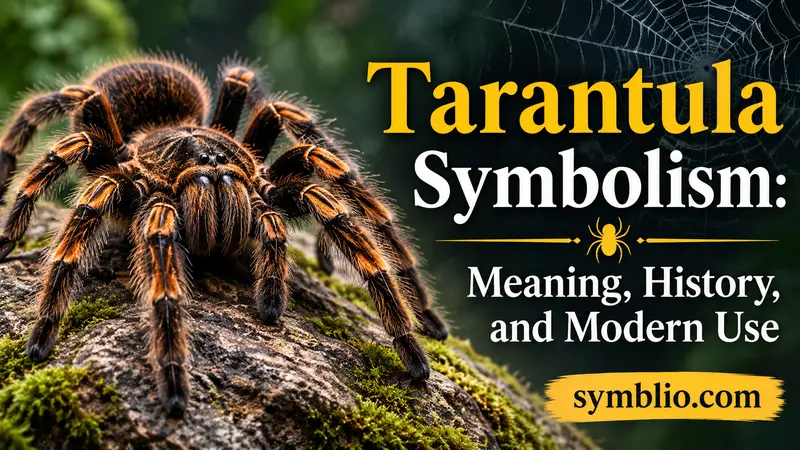
Tarantula symbolism often centers on patience, independence, protection, transformation, and the ability to face fear. These large, hairy spiders attract attention because of their unusual appearance, deliberate movements, and reputation as intimidating creatures. Although many people associate them with danger, tarantulas are generally less threatening to humans than their appearance suggests.
In the United States, tarantulas carry several different meanings. Some people view them as symbols of courage and self-protection, while others associate them with fear, mystery, and the unfamiliar. Their presence in deserts, nature documentaries, horror films, artwork, and tattoo designs has helped shape their modern cultural identity.
Understanding what a tarantula represents requires looking beyond its frightening reputation. Its solitary behavior, hunting methods, defensive abilities, and remarkable life cycle offer several explanations for why people connect this spider with personal strength, resilience, and change.
Quick Answer:
Tarantula symbolism commonly represents patience, independence, protection, courage, and overcoming fear in modern American culture. Its associations with spiders, ancient folklore, transformation, and self-preservation also connect it with mystery, creativity, and the ability to adapt to changing circumstances.
TL;DR:
- Patience: Waiting carefully for the right opportunity.
- Independence: Living and functioning without constant companionship.
- Protection: Defending personal boundaries when necessary.
- Courage: Facing fears instead of avoiding unfamiliar experiences.
- Transformation: Growing through change and difficult experiences.
- Mystery: Representing the unfamiliar and misunderstood parts of nature.
What Makes the Tarantula a Distinctive Symbol?
Tarantulas belong to the family Theraphosidae, a group of large, hairy spiders found in different parts of the world. They are especially familiar in the United States through species native to the Southwest, including Texas, Arizona, New Mexico, and surrounding regions.
Their thick legs, noticeable body hairs, and sometimes striking colors make them recognizable. Some species have dark brown or black bodies, while others display orange, red, blue, or golden markings.
Several physical characteristics contribute to their symbolic associations.
Their slow, deliberate movements suggest patience and careful decision-making. Their ability to survive in challenging environments connects them with resilience. Their defensive behavior represents protection and personal boundaries.
Tarantulas also spend much of their lives away from human attention. Many species live in burrows or sheltered spaces, making them natural symbols of privacy, solitude, and independence.
These characteristics explain why the tarantula can represent qualities that have little to do with aggression.
The Core Symbolism of Patience and Timing
One of the clearest symbolic associations of the tarantula is patience.
Tarantulas are generally ambush predators. Rather than constantly chasing prey, many species wait in sheltered locations and respond when an opportunity appears. Their hunting behavior illustrates the value of timing and conserving energy.
This creates a useful metaphor for human experiences.
In everyday American culture, people often connect patience with discipline, career development, education, and personal growth. The tarantula fits naturally into these ideas because it represents the ability to wait without abandoning a goal.
A person who identifies with this symbolism may prefer careful preparation over rushed decisions. They might believe that not every opportunity requires an immediate response.
The tarantula therefore represents thoughtful action rather than unnecessary activity. Its symbolism reminds people that progress sometimes depends on recognizing the right moment.
Independence and the Strength of Solitude
Tarantulas are generally solitary animals. Unlike social insects such as ants and honeybees, they do not depend on organized colonies or cooperative groups to complete their daily activities.
This behavior gives them a strong connection with independence.
In human symbolism, independence can represent self-confidence, personal responsibility, and the freedom to make individual decisions. The tarantula reflects these qualities through its solitary lifestyle.
Its symbolism can appeal to people who value privacy or prefer working independently. It may also represent someone learning to become comfortable with their own company.
However, solitude and loneliness are not the same thing. The tarantula’s symbolism is more closely connected with self-reliance than social isolation.
In modern personal expression, this interpretation can make the tarantula an appropriate symbol for someone who values individuality without needing constant approval from others.
Protection, Boundaries, and Self-Defense
Another important meaning associated with tarantulas is protection.
Although their appearance can make them seem aggressive, tarantulas generally prefer avoiding unnecessary confrontation. When threatened, they may retreat, display defensive behavior, or use specialized hairs as a protective mechanism.
This behavior provides a meaningful connection with personal boundaries.
In human relationships, boundaries help people recognize what they are comfortable accepting and when they need to protect their well-being. The tarantula can represent the importance of knowing when to withdraw and when to defend oneself.
Its symbolism does not necessarily encourage confrontation. Instead, it suggests that protection can involve awareness, distance, and choosing not to engage with every threat.
For someone who has learned to establish healthier boundaries, the tarantula may represent a new understanding of personal strength.
It communicates an important idea: being peaceful does not mean being defenseless.
Courage and Overcoming Fear
Tarantulas have an unusual relationship with human fear. Their size, hairy bodies, and multiple legs make them intimidating to people who already feel uncomfortable around spiders.
This reaction has contributed to their association with courage.
In the United States, tarantulas frequently appear in Halloween decorations, horror entertainment, haunted attractions, and frightening movie scenes. These representations reinforce their connection with suspense and fear.
However, the animal itself offers another interpretation.
Learning about tarantulas often changes how people perceive them. Many discover that these spiders are not naturally interested in attacking humans and generally prefer to avoid encounters.
This creates a symbolic contrast between appearance and reality.
The tarantula can represent the experience of confronting something that initially seems frightening but becomes easier to understand through knowledge and familiarity.
For this reason, it may symbolize:
- Facing unfamiliar situations.
- Challenging personal assumptions.
- Developing confidence.
- Moving beyond irrational fears.
- Recognizing strength beneath an intimidating appearance.
Its symbolism is particularly relevant when someone is learning to approach difficult experiences with greater understanding.
Historical Origins of Tarantula Symbolism
The history of tarantula symbolism is closely connected with older European beliefs about spiders, venomous bites, and unexplained physical symptoms.
One important historical connection comes from southern Italy, particularly the region of Apulia.
During the early modern period, a condition known as tarantism was associated with the belief that a bite from a local spider called the tarantula caused unusual physical and emotional symptoms. The spider involved in these historical accounts was generally identified with the European wolf spider, Lycosa tarantula, rather than the large American tarantulas commonly recognized today.
People believed that music and dancing could help affected individuals recover. This tradition became associated with the tarantella, a lively Italian dance.
The historical relationship between tarantism and the tarantella is important because it shows how spiders became connected with fear, illness, movement, and healing in European folklore.
Over time, the tarantula’s cultural identity expanded beyond these beliefs. Scientific observation and improved knowledge of spider behavior gradually challenged older explanations.
Today, the animal is more commonly understood through zoology, wildlife education, and popular culture than through historical medical folklore.
Tarantula Symbolism in the United States
In the United States, tarantulas have a recognizable place in Southwestern wildlife culture.
States such as Texas, Arizona, Colorado, and New Mexico are known for native tarantula populations. During certain seasons, some male tarantulas become more visible as they travel in search of females.
These seasonal movements have become familiar natural events in parts of the American Southwest.
For some residents, seeing a tarantula is an ordinary reminder of local wildlife. For others, it creates excitement, curiosity, or nervousness.
American interpretations generally fall into several categories.
A symbol of courage: The tarantula represents facing something intimidating without immediately retreating.
A symbol of individuality: Its solitary lifestyle connects it with independence and personal identity.
A symbol of nature: In wildlife education, it represents biodiversity and the importance of understanding misunderstood species.
A symbol of fear: Its appearance and presence in horror entertainment make it a recognizable image of suspense.
A symbol of protection: Its defensive abilities provide a metaphor for maintaining personal boundaries.
Unlike symbols strongly associated with particular American holidays or religious traditions, the tarantula does not have one universally accepted cultural meaning. Its interpretation depends heavily on the person and context.
Spiritual and Cross-Cultural Interpretations
Spiders appear in the folklore and traditional stories of many cultures, but their meanings vary considerably. It is important not to assume that every spider tradition specifically refers to tarantulas.
In some African storytelling traditions, the spider is associated with Anansi, a well-known trickster figure connected with intelligence, storytelling, creativity, and clever problem-solving. Anansi traditions are particularly associated with Akan culture and became influential across the Caribbean and other parts of the African diaspora.
In ancient Greek mythology, the story of Arachne connects spider imagery with weaving, artistic skill, pride, and transformation. Arachne was a talented weaver whose story became associated with the origin of spiders.
These traditions concern spiders generally rather than the tarantula specifically.
In some Indigenous American traditions, spider figures appear in creation stories, teachings, and cultural narratives. Their meanings differ among individual nations and communities, so there is no single Native American interpretation of the spider.
Modern spiritual interpretations sometimes connect tarantulas with:
- Personal transformation.
- Creative expression.
- Independence.
- Protection.
- Patience during uncertainty.
- Awareness of personal fears.
These are contemporary symbolic interpretations, not universal religious teachings.
For American readers, understanding this distinction helps separate documented cultural traditions from newer personal or spiritual associations.
Emotional and Psychological Meaning
The tarantula can represent different emotional experiences depending on how someone feels about spiders.
For people who fear them, the animal may bring attention to anxiety, uncertainty, and the discomfort of encountering something unfamiliar.
For people who appreciate spiders, it may represent fascination, respect for nature, and confidence in understanding animals that others misunderstand.
This difference makes the tarantula an interesting psychological symbol.
Its appearance can produce an immediate emotional response, but knowledge may gradually change that reaction. Someone who once viewed tarantulas exclusively as frightening creatures might eventually develop an interest in their behavior and ecological importance.
The symbolic lesson is not that every fear disappears. Rather, understanding can create a more balanced response.
The tarantula may also represent the ability to remain composed when circumstances become uncomfortable. Its association with patience and defensive behavior makes it a natural metaphor for responding thoughtfully instead of reacting impulsively.
In personal reflection, it can encourage people to consider which situations require courage, which require distance, and which simply require better understanding.
Tarantula Symbolism in Dreams
Dream interpretations involving tarantulas are subjective. There is no scientific evidence that a particular spider dream predicts future events or carries one fixed universal message.
Nevertheless, people often interpret dreams through personal experiences and emotional associations.
A tarantula appearing in a dream may reflect something the dreamer considers intimidating or difficult to understand.
Several common interpretations include:
A large tarantula: This may represent an issue that feels overwhelming or receives considerable attention.
A calm tarantula: Some people interpret it as a reflection of patience, self-control, or becoming comfortable with something unfamiliar.
A moving tarantula: This may symbolize an approaching change or a situation that requires attention.
A tarantula hiding: This could reflect privacy, uncertainty, or something the dreamer has not yet addressed.
A tarantula in the home: Some interpretations connect this setting with personal boundaries, family concerns, or private emotions.
The most useful approach is to consider the feelings experienced during the dream and any relevant circumstances in waking life.
A dream about a tarantula does not automatically indicate danger or a negative event.
What Different Tarantula Colors Can Represent
Tarantula species display a variety of colors and patterns. Some have bright markings, while others blend into their surroundings. These differences can influence how people interpret their appearance in art, jewelry, and tattoo designs.
Color symbolism is subjective, but several common associations can help explain these interpretations.
| Tarantula Appearance | Possible Symbolic Meaning | Common Association |
|---|---|---|
| Black tarantula | Protection, mystery, independence | Privacy and personal strength |
| Red-marked tarantula | Courage, intensity, confidence | Boldness and determination |
| Blue tarantula | Individuality, creativity, uniqueness | Self-expression |
| Brown tarantula | Stability, patience, resilience | Connection with nature |
| Golden tarantula | Confidence, achievement, distinction | Personal growth |
These meanings come from broader color symbolism rather than established traditions specifically associated with tarantula species.
A red-kneed tarantula, for example, may appeal to someone because of its striking appearance rather than because red has a particular historical meaning for that animal.
Why Tarantulas Appear in Tattoos and Personal Style
Tarantula tattoos are visually distinctive. Their eight legs, textured bodies, and recognizable shape make them suitable for detailed artwork.
In American tattoo culture, the tarantula can communicate several personal ideas.
Overcoming fear: Someone may choose a tarantula tattoo to represent an experience of facing something that once intimidated them.
Independence: Its solitary nature can represent self-reliance and individuality.
Protection: The spider’s defensive characteristics may represent the importance of personal boundaries.
Interest in nature: Some people choose tarantula tattoos simply because they appreciate arachnids, wildlife, or unusual animals.
Individuality: A less conventional tattoo subject can communicate an interest that differs from mainstream preferences.
The artistic style also changes the impression.
A realistic tarantula tattoo may emphasize respect for nature and biological detail. A dark illustrative design might communicate mystery or an interest in gothic aesthetics. A colorful design may highlight the animal’s unusual appearance.
Not every tarantula tattoo represents fear or danger. For some people, it is simply a tribute to an animal they find interesting.
Tarantulas in American Movies, Halloween, and Popular Culture
Tarantulas have become familiar images in American entertainment because their appearance creates immediate visual tension.
Classic monster movies, suspense films, television programs, and Halloween decorations frequently use large spiders to establish an unsettling atmosphere.
Their recognizable shape makes them effective visual symbols. Even a simple spider silhouette can suggest danger, suspense, or an unexpected encounter.
During Halloween, tarantula decorations commonly appear alongside cobwebs, skeletons, bats, and other traditional spooky imagery.
In this setting, the tarantula represents the frightening side of nature rather than its actual biological behavior.
Popular culture also presents a more educational image. Wildlife documentaries, nature programs, and educational videos introduce audiences to tarantula habitats, feeding behavior, molting, and ecological roles.
This creates an interesting contrast in American culture: the same animal can appear as a frightening creature in entertainment and an important part of the natural world in educational settings.
The difference demonstrates how presentation influences symbolic meaning.
The Tarantula’s Connection With Transformation and Renewal
Transformation is another meaningful association connected with tarantulas.
Like other arthropods, tarantulas grow through a process called molting. During this process, they shed their old exoskeleton and develop a new one.
Molting is essential to their growth. Young tarantulas undergo repeated molts as they mature, while adult females may continue molting throughout their lives.
This biological process offers a natural metaphor for personal development.
People often use transformation symbolism to describe changes in identity, relationships, education, careers, and personal beliefs.
The tarantula’s molting process can represent leaving behind an earlier stage and entering another period of growth.
However, the process is not simply effortless renewal. Molting is a vulnerable period for the animal and requires suitable conditions.
That detail adds another layer to the symbolism: meaningful change can involve uncertainty, patience, and a period of adjustment.
For someone experiencing a major transition, the tarantula may represent the idea that growth sometimes requires moving beyond an earlier version of oneself.
Common Misunderstandings About Tarantula Symbolism
Tarantulas are frequently misunderstood because people often judge them by their appearance.
Their large bodies and hairy legs can create an impression of extreme danger. Movies and horror imagery have strengthened this reputation, sometimes presenting them as aggressive animals that actively pursue humans.
In reality, most tarantulas are not interested in confronting people. They generally prefer avoiding unnecessary contact, although they can defend themselves when threatened.
Several misconceptions also affect their symbolic interpretation.
Every tarantula represents danger. This is incorrect. Its appearance may create fear, but its symbolic meaning can also include patience, independence, and protection.
Tarantulas are always aggressive. Defensive behavior should not be confused with aggression. Their actions are often responses to perceived threats.
All spider symbolism applies equally to tarantulas. Historical and cultural traditions involving spiders do not necessarily refer to this particular family of spiders.
A tarantula dream predicts something negative. Dream interpretations are personal and do not establish future events.
Tarantulas universally represent bad luck. There is no widely accepted American tradition that gives all tarantulas this meaning.
Separating popular entertainment from actual animal behavior makes it easier to understand the tarantula as a complex natural symbol rather than a simple representation of fear.
How Tarantula Symbolism Has Changed Over Time
The tarantula’s cultural image has developed alongside changes in science, entertainment, and public attitudes toward wildlife.
In earlier European traditions, spider-related beliefs sometimes connected tarantulas with dangerous bites, unusual illnesses, and folk healing practices.
Later, scientific investigation provided better explanations of spider behavior and venom. These developments helped replace some older beliefs with biological understanding.
During the twentieth century, American horror entertainment contributed to the tarantula’s reputation as a frightening creature. Large spiders became convenient symbols of suspense and danger in movies and television.
More recently, wildlife education, photography, and online communities have introduced audiences to different aspects of tarantula behavior.
People can now encounter videos of tarantulas molting, caring for egg sacs, hunting prey, and living in natural habitats.
This broader exposure has helped create a more balanced cultural image.
The tarantula still represents fear in some contexts, but it increasingly appears as a symbol of nature, individuality, patience, and appreciation for misunderstood animals.
Its meaning has expanded rather than settled into one fixed interpretation.
FAQs
In contemporary spiritual interpretations, a tarantula can represent patience, protection, independence, transformation, and facing personal fears. These associations are individual interpretations rather than universal beliefs shared by every spiritual tradition.
A tarantula does not have one universally recognized meaning connected with good luck. Some people associate it with favorable qualities such as resilience, careful timing, and personal growth, while others connect it with fear or uncertainty.
A tarantula tattoo can represent independence, courage, self-protection, individuality, or overcoming fear. Its meaning often depends on the person’s experiences, artistic preferences, and reasons for choosing the design.
Seeing a tarantula has no established supernatural meaning or guaranteed prediction. Symbolically, some people interpret the encounter as a reminder to remain patient, respect personal boundaries, or reconsider something they find intimidating.
Yes, transformation is a common modern symbolic interpretation because tarantulas grow through molting. Their ability to shed an old exoskeleton provides a natural metaphor for personal development and moving into a new stage of life.
A black tarantula may represent mystery, independence, protection, or personal strength in contemporary artwork and symbolic interpretations. These meanings come mainly from broader associations with the color black rather than a specific historical tarantula tradition.
Not necessarily. Although popular entertainment often uses tarantulas to represent fear and danger, their broader symbolism includes patience, resilience, individuality, and respect for nature.
Conclusion
Tarantula symbolism brings together several ideas, including patience, independence, protection, courage, and transformation. Its solitary lifestyle and defensive behavior provide natural explanations for many of these associations, while its unusual appearance has influenced its role in American entertainment and popular culture.
Historically, spider-related beliefs connected the tarantula with folklore, fear, and traditional healing practices. Modern interpretations are more varied, with people increasingly recognizing the animal as an important part of nature rather than simply a frightening creature.
Ultimately, the tarantula represents different things to different people. It can remind someone to respect personal boundaries, approach unfamiliar situations with courage, or recognize that meaningful growth requires patience. Its symbolism shows that even an animal commonly misunderstood can offer thoughtful lessons about independence and resilience.