
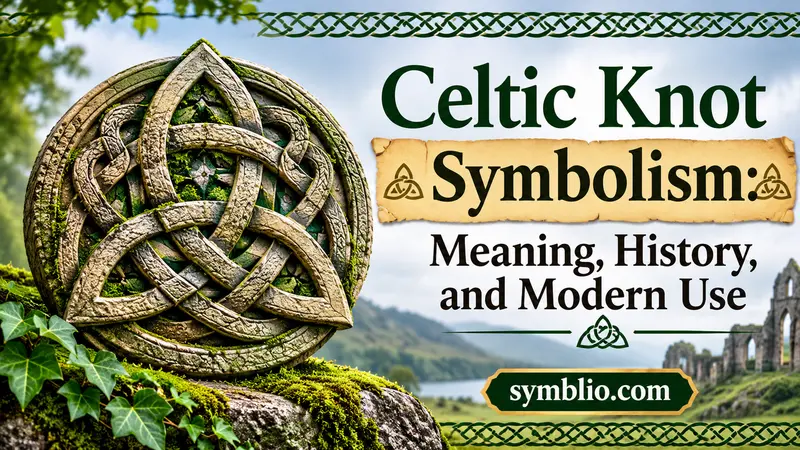
Celtic knot symbolism is commonly associated with eternity, interconnectedness, loyalty, and the lasting bonds between people. Recognized by its intricate lines that weave over and under one another, the Celtic knot has become one of the most recognizable designs connected with Irish and Celtic heritage. Today, people across the United States encounter it in jewelry, tattoos, wedding decorations, religious artwork, and heritage celebrations.
What makes this design particularly interesting is its structure. Unlike many traditional symbols that rely on recognizable objects or figures, a Celtic knot communicates through the movement of its lines. Its continuous patterns can suggest relationships, cycles, and connections that have no obvious beginning or ending.
Although modern interpretations often describe Celtic knots as symbols of eternal love and spiritual unity, their historical background is more complicated. Interlaced patterns appeared in several artistic traditions, and medieval Irish and British artists developed distinctive forms of knotwork in manuscripts, metalwork, and stone carvings.
Understanding the difference between historical artwork and modern interpretations helps explain why the Celtic knot remains meaningful to people with different backgrounds and beliefs.
Quick Answer: What Does Celtic Knot Symbolism Mean?
Celtic knot symbolism most commonly represents eternity, interconnectedness, enduring love, loyalty, and the continuous nature of life in modern American culture. Historically, these intricate patterns became prominent in early medieval Insular Christian art, where they decorated manuscripts, religious objects, and stone monuments.
TL;DR: Key Meanings of Celtic Knots
- Eternity: Continuous lines suggest something without a beginning or ending.
- Connection: Interwoven strands represent relationships and shared experiences.
- Loyalty: Knots can symbolize lasting commitments and devotion.
- Irish heritage: The patterns express cultural identity and ancestral connections.
- Spirituality: Some designs carry Christian associations and modern spiritual interpretations.
- Continuity: Repeating patterns suggest life’s ongoing cycles and relationships.
What Is a Celtic Knot?
A Celtic knot is an ornamental pattern created from interwoven lines, ribbons, or bands. The strands pass over and under one another, creating connected loops and geometric shapes. Many traditional designs have no visible starting or ending point, which contributes to their modern association with eternity.
These patterns appear in different forms. Some contain simple repeating loops, while others feature complicated arrangements of multiple strands. Certain designs incorporate animals, crosses, spirals, or triangular shapes.
The term Celtic knot describes a broad family of decorative patterns rather than one specific symbol. The designs are particularly associated with the artistic traditions of Ireland, Scotland, and other parts of the British Isles.
People encounter Celtic knotwork in several places:
- Illuminated medieval manuscripts
- Carved stone crosses and monuments
- Traditional and contemporary jewelry
- Decorative borders and architectural details
- Tattoos and personal artwork
- Modern representations of Irish heritage
The design’s appeal comes partly from its visual balance. Every strand contributes to the larger pattern, making the individual lines appear connected rather than separate.
The Core Symbolism of Celtic Knots
Modern interpretations commonly connect Celtic knots with several related ideas. Their meanings depend on the particular design, the person using it, and the cultural context.
Eternity and continuity are among the most familiar interpretations. A continuous knot can represent an enduring relationship, an ongoing journey, or the idea that life consists of connected experiences.
Interconnectedness is another common meaning. The woven strands suggest that people, families, communities, and experiences influence one another. No single line exists entirely apart from the others.
Loyalty and commitment also appear frequently in contemporary interpretations. Because the strands remain connected, the design can represent promises, relationships, and personal dedication.
Some people associate Celtic knots with spiritual unity. In this interpretation, the connected pattern represents the relationship between physical life, personal belief, and a larger spiritual understanding.
However, these meanings should not be treated as a universal historical dictionary. Medieval artists did not necessarily assign a separate, fixed meaning to every knot pattern. Many designs primarily served decorative purposes.
Ancient Roots and the Development of Celtic Knotwork
The history of Celtic knotwork developed over many centuries. Its visual influences did not emerge from a single artist, community, or moment in history.
Interlaced decoration existed in several ancient artistic traditions, including Roman, Byzantine, and other European art. Patterns involving woven ribbons and crossing lines circulated through different regions and artistic communities.
During the early medieval period, distinctive forms of interlace became especially prominent in Ireland and Britain. Artists working in the Insular tradition combined intricate geometric patterns with animal forms, decorative initials, and religious imagery.
Between approximately the sixth and twelfth centuries, these designs appeared in manuscripts, metal objects, and carved stonework.
The Book of Durrow, produced around the seventh century, provides an important example of early Insular manuscript decoration. The Book of Kells, created around 800 CE, later became particularly famous for its elaborate illustrations and complex interlaced ornamentation. Trinity College Dublin+2
These works demonstrate that knotwork was not simply an isolated decorative trend. It formed part of a sophisticated artistic tradition that connected craftsmanship, religious presentation, and visual storytelling.
Although modern culture often describes these patterns collectively as ancient Celtic symbols, their development involved multiple influences and artistic exchanges.
Celtic Knots in Early Christian Art
Christianity played an important role in the development and preservation of Irish knotwork.
During the early medieval period, monasteries became important centers of learning, religious activity, and artistic production. Monastic scribes and artists decorated religious manuscripts with elaborate lettering, ornamental borders, and complex illustrations.
Knotwork appeared alongside Christian imagery rather than functioning as an entirely separate artistic language.
The Book of Kells is a particularly significant example. Its pages combine interlaced patterns with representations of biblical figures, animals, and decorated Christian text. The visual complexity made the manuscript an exceptional example of Insular Christian art. Trinity College Dublin+1
In this setting, the patterns contributed to the beauty and presentation of sacred texts. Their placement around religious writing also encouraged viewers to experience the manuscript as an elaborate visual object.
Some modern interpretations connect interlaced designs with divine unity, eternity, and spiritual protection. Such interpretations may be meaningful today, but historians cannot confidently assign every surviving medieval knot a specific religious message.
The distinction matters because the Christian meaning of an entire manuscript does not automatically establish the precise meaning of every decorative pattern.
What the Different Celtic Knot Designs Represent
Not every Celtic knot looks the same. Different forms have developed distinct modern associations, although their historical meanings are not always certain.
Trinity Knot (Triquetra)
The Trinity Knot consists of three connected arcs that create a triangular arrangement. In modern Christian contexts, it is frequently interpreted as representing the Father, Son, and Holy Spirit.
Other contemporary interpretations associate its three connected parts with mind, body, and spirit or different stages of life.
Dara Knot
The Dara Knot is a modern name commonly associated with oak-tree-inspired Celtic designs. Its association with the oak tree makes it a popular representation of strength, stability, endurance, and resilience.
Celtic Shield Knot
The Shield Knot generally features a symmetrical arrangement of interwoven lines. Contemporary interpretations connect it with protection, courage, and security.
Some people choose this design because its balanced structure suggests stability and personal strength.
Celtic Love Knot
Celtic Love Knots are modern decorative interpretations of interlaced designs associated with romantic relationships. Their connected strands make them popular symbols of commitment, affection, and lasting partnerships.
These designs do not all have equally documented ancient histories. Some names and interpretations became popular much later than the medieval artwork that inspired them.
What Celtic Knot Symbolism Means in the United States
In the United States, Celtic knots have become familiar symbols of Irish heritage, family connections, personal identity, and traditional craftsmanship.
Their popularity reflects the influence of Irish immigration and the continuing visibility of Irish American culture. Generations of Irish immigrants brought their customs, religious traditions, family histories, and artistic influences to the United States.
Over time, Irish-inspired designs became part of a wider American appreciation for cultural heritage.
Today, Celtic knotwork appears in several American settings.
Irish American identity: People with Irish ancestry may use Celtic designs to acknowledge family history, cultural roots, or connections to Ireland.
St. Patrick’s Day: Celtic patterns sometimes appear in decorations, clothing, greeting cards, and heritage-themed merchandise during March celebrations.
Family traditions: Knot designs can represent relationships between generations and the importance of maintaining family connections.
Religious communities: Christian versions of the Trinity Knot appear in church artwork, religious jewelry, and personal accessories.
Wedding celebrations: Couples sometimes incorporate interlaced patterns into invitations, rings, ceremony decorations, or keepsakes to represent commitment.
Celtic knotwork is not limited to people with Irish ancestry. Americans from many backgrounds appreciate its design and use it to express personal values.
For some, it represents cultural heritage. For others, it is simply an attractive pattern associated with continuity and connection.
Celtic Knots and Their Connection to Irish Heritage
Celtic knotwork has become closely associated with Irish cultural identity, particularly because of its presence in historic manuscripts, stone monuments, and decorative metalwork.
The Book of Kells is one of the best-known examples of this artistic tradition. Its elaborate decoration has influenced how people around the world imagine medieval Irish craftsmanship.
During the nineteenth century, interest in Ireland’s artistic past became increasingly important to cultural revival movements. Artists and designers looked toward medieval manuscripts, ancient monuments, and traditional decorative forms for inspiration.
Celtic ornamentation consequently became a recognizable part of modern Irish visual identity.
In the United States, this connection is particularly visible during Irish heritage celebrations. Knotwork appears on souvenirs, family gifts, clothing, and decorative objects.
However, Celtic art should not be reduced to a single national identity. Related artistic traditions developed across Ireland, Scotland, Wales, and other parts of the wider Insular world.
The patterns represent a shared artistic history that crosses modern national boundaries.
Emotional and Psychological Meaning of Celtic Knots
The structure of a Celtic knot can influence how people interpret it emotionally.
Its continuous lines suggest stability because the pattern appears connected from beginning to end. This can make it an appealing representation of relationships that people hope will remain meaningful over time.
The interwoven strands also offer a visual way to express belonging. Family members, close friends, and partners may see the design as a reminder that individual lives become connected through shared experiences.
Several emotional associations appear frequently in modern use:
- Belonging: The connected strands suggest a place within a family or community.
- Commitment: Interwoven lines can represent promises and lasting relationships.
- Stability: Balanced patterns communicate structure and consistency.
- Remembrance: A continuous design can represent enduring memories of loved ones.
- Personal growth: Repeating patterns can suggest development through different stages of life.
These associations are personal interpretations rather than established psychological effects.
A person who chooses a Celtic knot may connect it with a family member, an important relationship, a cultural tradition, or a personal experience.
Its meaning often comes from the story attached to it rather than the pattern alone.
Celtic Knots in Weddings, Jewelry, and Home Decor
The continuous structure of Celtic knotwork makes it particularly suitable for objects connected with relationships and family life.
In weddings, couples sometimes use knot designs to represent two lives becoming connected. The pattern may appear on invitations, ceremony programs, decorative signs, or wedding gifts.
Celtic-inspired rings are another familiar example. Their interwoven designs can suggest loyalty and commitment, making them appealing to people who appreciate traditional craftsmanship.
Home decorations offer another way to use the pattern.
Celtic knot designs appear in:
- Wall art and framed prints
- Decorative wooden carvings
- Metal sculptures
- Table decorations
- Glasswork and ceramics
- Family keepsakes
In modern American homes, these designs can communicate an appreciation for Irish heritage or traditional European decorative art.
Some people also incorporate them into spaces intended for reflection, reading, or prayer.
The pattern works across different materials because its visual structure remains recognizable whether it appears in metal, wood, fabric, or stone.
Celtic Knots in Other Cultural and Religious Traditions
Although Celtic knotwork is strongly associated with Ireland and Britain, interlaced patterns are not exclusive to Celtic artistic traditions.
Similar decorative approaches appear in different cultures, sometimes with their own meanings and historical backgrounds.
Christian traditions: Interlaced designs appear in medieval Christian manuscripts and religious objects. The Trinity Knot has become particularly associated with Christian interpretations of the Holy Trinity.
Byzantine art: Interwoven patterns were common in textiles, clothing, and decorative objects. Some designs may also have been connected with protective beliefs. The Metropolitan Museum of Art
Islamic decorative art: Geometric patterns and interlaced designs became important features of architectural decoration, manuscripts, and ornamental objects. Their visual language developed through distinct mathematical and artistic traditions.
Norse and Germanic traditions: Interlaced animal ornament and complex geometric decoration also appeared in northern European artwork.
These similarities show that artists in different regions explored the visual possibilities of connected lines and repeating forms.
However, similar appearances do not necessarily indicate identical meanings or direct historical relationships.
A Celtic knot should therefore be understood within its particular artistic and cultural context rather than treated as a universal symbol shared by every tradition.
What Do the Colors of Celtic Knots Represent?
Traditional Celtic knotwork does not have one universally established color system. Historical artists used colors according to available materials, artistic preferences, and the needs of the object being decorated.
Modern designers, however, often use color to introduce additional associations.
| Color | Common Modern Association | Typical Use |
|---|---|---|
| Green | Irish heritage, nature, renewal | St. Patrick’s Day designs and jewelry |
| Gold | Celebration, prosperity, craftsmanship | Decorative artwork and accessories |
| Silver | Clarity, elegance, tradition | Rings and necklaces |
| Black | Strength, simplicity, remembrance | Tattoos and contemporary artwork |
| Blue | Peace, loyalty, reflection | Jewelry and personal designs |
These meanings reflect contemporary design conventions rather than fixed rules from ancient Celtic culture.
A green knot does not automatically carry a different historical meaning from a silver or black one. The color usually reflects the preferences and intentions of the person choosing the design.
Common Misunderstandings About Celtic Knot Symbolism
The popularity of Celtic knots has encouraged many interpretations, but some modern claims go beyond what historical evidence can establish.
One common misunderstanding is that every Celtic knot has a specific ancient meaning. In reality, many surviving examples function primarily as decorative ornamentation. Their precise intended meanings are often unknown.
Another misconception is that all Celtic knots are ancient Irish religious symbols. Interlaced designs developed across different artistic traditions, and many patterns associated with Celtic culture have broader European influences.
The Trinity Knot also attracts interpretations that require careful distinction. Its modern association with the Christian Trinity is well established in contemporary Christian use, but claims that every three-part knot originally represented a specific ancient Celtic religious belief are not reliably documented.
Similarly, modern names such as Dara Knot and Celtic Love Knot should not automatically be treated as proof of ancient historical terminology.
There is also a difference between appreciating Celtic art and assuming that a single design represents every Celtic community.
Understanding these distinctions does not reduce the value of the symbol. Instead, it allows people to appreciate its artistic history without confusing modern interpretations with documented historical facts.
How Celtic Knot Symbolism Has Changed Over Time
Celtic knotwork has experienced several changes in how people create, understand, and use it.
During the early medieval period, interlaced patterns became prominent features of religious manuscripts, metalwork, and stone monuments. Their artistic importance was closely connected with the visual traditions of Insular culture.
Later generations continued to preserve and reinterpret these designs.
During the nineteenth century, renewed interest in medieval Irish art helped establish knotwork as an important expression of cultural heritage. Artists and designers adapted older decorative patterns for books, jewelry, and other objects.
In the twentieth century, Celtic-inspired designs became increasingly visible in international popular culture.
By the twenty-first century, digital design, tattoo culture, fashion, and personalized jewelry had expanded their use even further.
Modern interpretations now frequently emphasize:
- Eternal love and commitment
- Family and ancestral connections
- Personal spirituality
- Cultural identity
- Continuity and personal growth
This evolution demonstrates how a traditional artistic form can acquire new meanings without losing its historical associations.
The modern Celtic knot is both a recognizable example of historic craftsmanship and a flexible design that people continue to reinterpret.
Celtic Knot Meanings Across Different Contexts
The same pattern can communicate different ideas depending on where it appears and why someone chooses it.
| Context | Common Meaning in the USA | Main Association |
|---|---|---|
| Tattoos | Identity and lasting relationships | Personal commitment |
| Wedding jewelry | Enduring love | Partnership |
| Religious artwork | Spiritual unity | Christian faith |
| Family decorations | Ancestral connections | Heritage |
| Home decor | Traditional craftsmanship | Cultural appreciation |
These interpretations are not universal. A person may select a Celtic knot for its appearance without attaching any particular spiritual or cultural meaning to it.
The surrounding context helps explain what the design communicates.
FAQs
A Celtic knot most commonly symbolizes eternity, interconnectedness, and continuity in modern interpretations. Its continuous woven structure makes it a popular representation of relationships and connections that endure over time.
A Celtic knot tattoo can represent family heritage, loyalty, enduring relationships, or personal spirituality. Its meaning often depends on the particular design and the personal experiences of the individual wearing it.
Some Celtic knot designs have become associated with Christianity, particularly the Trinity Knot, which represents the Father, Son, and Holy Spirit in many Christian interpretations. However, not every Celtic knot is religious, and many historical examples primarily served decorative purposes.
In modern jewelry, wedding traditions, and tattoo culture, Celtic knots frequently represent lasting love and commitment. This interpretation comes from their connected structure, although it should not be assumed that every historical knot was originally created as a romantic symbol.
Celtic knot is a broad term for many interlaced decorative patterns, while the Trinity Knot is one particular design featuring three connected arcs. The Trinity Knot has developed specific Christian associations, although it also receives broader modern interpretations.
Yes. People from different backgrounds can appreciate Celtic knotwork as an example of historical art and craftsmanship. It is helpful to understand its cultural origins and avoid presenting a personal connection to Irish ancestry that one does not have.
Some modern interpretations associate Celtic knots with protection, positive relationships, and lasting stability. However, there is no universal historical rule that every Celtic knot brings good luck; this association generally reflects personal belief and contemporary symbolism.
Conclusion
Celtic knot symbolism represents eternity, interconnectedness, loyalty, and continuity in modern American culture. Its distinctive interlaced patterns have roots in early medieval artistic traditions, particularly the manuscript decoration and craftsmanship associated with Ireland and Britain.
Over time, these designs have moved beyond their historical settings and become familiar in tattoos, wedding jewelry, religious artwork, and cultural celebrations. Their meanings now depend on individual beliefs, family connections, and the contexts in which people use them.
What makes the Celtic knot enduring is the relationship between its structure and its interpretation. Its connected lines provide a simple visual way to express the idea that relationships, memories, and traditions can remain linked across generations.


