
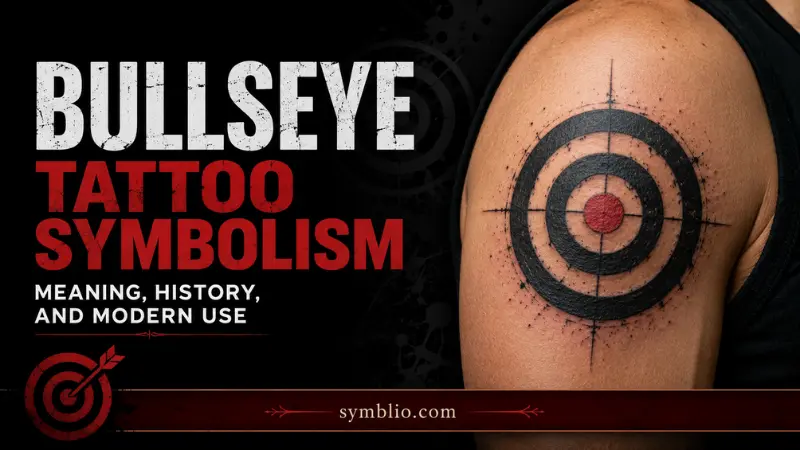
A bullseye tattoo is a simple image of concentric circles, but its meaning can extend far beyond the shape itself. Bullseye tattoo symbolism commonly centers on focus, determination, achievement, and having a clear goal, while the image can also suggest vulnerability, being singled out, or deliberately placing oneself at the center of attention.
The appeal of the design comes partly from its clarity. A bullseye immediately communicates the idea of aiming toward something specific. Unlike many tattoo symbols that depend on elaborate cultural stories, the target has a meaning that most Americans can understand at a glance.
At the same time, the image is not automatically positive. A target can represent success when someone hits the center, but it can also represent exposure when someone feels that they are the one being targeted. The surrounding imagery, placement, color, and personal story therefore matter.
Quick Answer
Bullseye tattoo symbolism commonly represents focus, ambition, precision, and reaching a personal goal in modern American culture. Historically, the bullseye developed from the center of a target and came to represent successfully hitting the mark, while modern tattoos can also express vulnerability, being noticed, or having a specific purpose.
TL;DR
- Bullseyes commonly symbolize focus, precision, and achievement.
- The center represents a clearly defined goal.
- American culture often connects targets with success and purpose.
- A target can also suggest vulnerability or unwanted attention.
- Tattoos personalize the symbol through color, placement, and surrounding imagery.
- Modern interpretations range from disciplined ambition to personal identity.
What Does a Bullseye Look Like?
A traditional bullseye consists of circles arranged around a central point. The outer rings create a visual path toward the center, making the eye naturally move inward.
That structure is important to its symbolism. The design does not merely show a circle; it creates a visual hierarchy. There is an outside, a middle, and a center—the place where attention ultimately lands.
In tattoo art, the design can be extremely minimal or highly customized. Someone might choose a plain black outline, while another person may incorporate arrows, flowers, lettering, dates, geometric elements, or other imagery.
The classic target shape is also familiar from recreational activities such as darts and archery. In American English, “bullseye” refers both to the center of a target and to a successful shot or throw that reaches that center.
The Central Meaning: Hitting the Mark
The most straightforward interpretation of a bullseye tattoo is achievement.
To hit a bullseye means that an intended action reached its precise objective. That makes the symbol useful for people who want to commemorate an accomplishment, a turning point, or a goal that once seemed difficult.
A tattoo might therefore represent:
- accomplishing a long-term goal
- staying committed to a chosen direction
- precision and discipline
- reaching an important milestone
- refusing to lose sight of one’s purpose
The symbolism does not necessarily mean professional or financial success. The “target” can be personal.
For one person, it might represent completing an important stage of education. For another, it might stand for pursuing a creative ambition, maintaining a personal commitment, or remembering a decision that changed their direction.
The important distinction is that the bullseye usually represents intentional achievement, rather than accidental good fortune.
Focus, Direction, and Personal Goals
Concentric circles make the bullseye especially effective as a metaphor for concentration.
The outer rings can be understood as distractions, obstacles, or stages along the way. The center becomes the thing that deserves attention. This makes the design appealing to people who value discipline and clear direction.
A bullseye tattoo can therefore communicate a personal philosophy such as:
Know what you are aiming for, and keep your attention there.
This interpretation is especially compatible with modern American ideas about individual goals and self-direction. The symbol does not tell viewers what the goal should be. Instead, it leaves that goal open to the tattoo owner’s own experience.
That flexibility helps explain why the image can work for very different personalities. A minimalist bullseye may communicate quiet determination, while a larger illustrated design may make the idea more expressive and personal.
Where the Bullseye Meaning Comes From
The word bullseye has a longer history than the modern tattoo trend.
The term was used for circular holes and objects before becoming associated specifically with the center of a target. Its recorded use for the center of a target dates to the nineteenth century, with dictionary evidence placing the term’s target-related meaning in the 1800s.
The expression later developed a second everyday meaning: doing something exactly right or successfully reaching the intended result.
That linguistic development matters because tattoos often draw symbolism not only from an object’s appearance but also from the phrases associated with it. Saying that someone “hit the bullseye” can mean that they made the right decision, identified the correct answer, or achieved the intended result.
The tattoo therefore carries both visual symbolism and language-based symbolism.
What the Bullseye Means in the United States
In the United States, the bullseye is particularly easy to recognize because targets appear in sports, games, advertising, education, entertainment, and everyday expressions.
American audiences commonly understand the image through ideas such as:
- aiming for a goal
- getting something exactly right
- precision
- competition
- accomplishment
- concentration
- being the center of attention
There is also a distinctly American branding association. The bullseye has become strongly connected with Target, the major U.S. retailer whose visual identity has used a bullseye since the company’s first store opened in 1962.
That association does not determine the meaning of every bullseye tattoo. Still, it can affect how some Americans initially read a simple red-and-white version. A tattoo artist may use different colors or additional imagery when the wearer wants to make the personal symbolism unmistakable.
Bullseye Tattoo Meanings at a Glance
| Context | Meaning in the USA | Common Associations | Notes |
|---|---|---|---|
| Personal goals | Determination and achievement | Ambition, progress | Often commemorates an accomplishment |
| Minimalist tattoo | Focus and clarity | Discipline, purpose | Meaning depends heavily on personal context |
| Target with an arrow | Reaching an objective | Direction, precision | Can emphasize the idea of successful action |
| Broken or altered target | Change or disruption | Reinvention, obstacles | Usually represents a departure from an earlier path |
| Target around another symbol | Attention or importance | Identity, priorities | The center becomes the focal point |
| Dark or distressed design | Vulnerability or conflict | Pressure, exposure | Can create a more complicated interpretation |
Why People Choose a Bullseye for a Tattoo
A tattoo is often chosen because a person wants a symbol that can hold a private meaning without requiring an explanation.
The bullseye works particularly well for that purpose because it is visually uncomplicated. A viewer can recognize the image immediately, while the tattoo owner can attach a much more specific story to it.
Someone might use the design to mark the moment they finally reached a goal. Another person might view it as a reminder to remain focused after a difficult period of uncertainty.
The same design can even represent a contradiction: I know what I want, but I also know what it feels like to be under pressure.
That openness is one of the strongest features of the symbol.
The Bullseye as a Symbol of Vulnerability
A target does not always mean success.
A bullseye also identifies a location that has been singled out. In ordinary language, a person can be “a target” when they have become the focus of criticism, attention, pressure, or hostility.
That gives the tattoo a second emotional dimension.
A wearer may interpret the bullseye as representing:
- feeling watched
- being singled out
- surviving difficult attention
- pressure to perform
- learning to handle criticism
- acknowledging personal vulnerability
This interpretation becomes more likely when the tattoo is distressed, pierced by an object, cracked, obscured, or combined with darker imagery.
The distinction is important: the bullseye itself does not inherently mean danger or victimization. Those meanings come from context.
Positive and Negative Interpretations
Few symbols are completely positive or negative, and the bullseye is a good example.
On the positive side, it can communicate accuracy, confidence, direction, and accomplishment. It can represent someone who has identified a goal and deliberately moved toward it.
On the negative side, the same image can suggest pressure or exposure. Being “in someone’s sights” and being “at the center of attention” are not always desirable experiences.
This duality gives the tattoo more interpretive range than a simple motivational emblem.
The surrounding design often determines which side becomes dominant.
A clean, symmetrical target may look disciplined and optimistic. A damaged target may feel reflective or troubled. A target surrounded by celebratory imagery may emphasize achievement, while one placed within a more somber composition may communicate personal struggle.
Bullseye Tattoos and Color Meaning
Color can substantially change how a bullseye is perceived.
Red and white create the most recognizable modern target appearance. In American culture, this combination can also evoke Target’s retail identity, so tattoo artists may alter the palette when the wearer wants a more individual design.
Black and gray often make the image feel more understated, serious, or traditional.
Blue can make the design feel calmer or more restrained, although color symbolism is highly dependent on personal and cultural context.
Gold or yellow can emphasize achievement because gold is associated with winning and first place in many American settings.
The color does not create a fixed meaning. Instead, it changes the emotional tone surrounding the basic idea of focus and targeting.
Bullseye Tattoos With Other Symbols
The meaning becomes more specific when the bullseye appears beside another recognizable image.
A bullseye with an arrow strongly emphasizes direction and successful aim.
A bullseye with flowers can soften the competitive quality of the target and connect achievement with growth, memory, or personal development.
A bullseye with a date can mark a particular life event or milestone.
A broken bullseye may represent a goal that changed, a disrupted plan, or a decision to stop pursuing an old objective.
A bullseye surrounding initials or another personal symbol can make the center represent a particular person, value, or part of the owner’s identity.
In these combinations, the target functions less like a complete message and more like a grammatical structure: it tells viewers that whatever occupies the center is important.
Historical and Cross-Cultural Context
The bullseye does not belong to one religion or ancient spiritual tradition. Its strongest historical meaning comes from target-based activities and the language of successfully reaching a mark.
That makes it different from symbols whose meanings are firmly established within a particular religious tradition.
Target imagery has nevertheless appeared in different visual environments. The concentric-circle form is useful because it is immediately legible as a center-and-periphery design. It can therefore be adapted for games, sports, maps, diagrams, logos, and decorative patterns.
In Britain, for example, a famous concentric-circle design became associated with London Underground transportation and was historically called the “bullseye” before the term “roundel” became more familiar.
These examples show that the visual language of concentric circles can communicate organization and identification without having one universal spiritual meaning.
Emotional and Psychological Associations
Psychologically, the bullseye can symbolize attention.
Human vision naturally notices the center of a circular target, and the structure creates an obvious focal point. That makes the image useful for expressing the idea of deciding what deserves attention.
For some people, this may represent confidence: I know where I am going.
For others, it may represent self-discipline: I need a reminder not to lose sight of my priorities.
And for someone who has experienced unwanted attention, the same design may carry a more complicated message: I know what it means to feel singled out.
These interpretations are personal rather than universal psychological rules. The tattoo’s emotional meaning comes from the owner’s experience.
Modern Uses Beyond the Tattoo Studio
The bullseye remains common in modern visual communication because it is recognizable at small sizes and does not require words to communicate its basic concept.
Its form appears in branding, games, recreational target sports, diagrams, digital interfaces, clothing, posters, stickers, and graphic design.
In American commercial culture, the Target logo is perhaps the most prominent example. The company introduced its bullseye-based identity in 1962 and later simplified the design, helping establish the circle as a major American brand mark.
That widespread exposure gives the symbol an unusual advantage in tattoo culture: most viewers already understand the basic visual metaphor.
The challenge is making the tattoo feel personal rather than generic. Customization through composition, linework, color, or accompanying imagery can solve that problem.
Common Misunderstandings About Bullseye Tattoos
One misconception is that every bullseye tattoo has a secret or fixed meaning. It does not.
There is no universal tattoo dictionary in which a target automatically means one particular life experience. The most established interpretation is related to aiming, reaching the center, and successfully hitting a mark.
Another misunderstanding is that a bullseye necessarily represents aggression. The image does have connections to targeting, but a modern tattoo can just as easily symbolize concentration, goals, or accomplishment.
It is also important not to assume that a red-and-white bullseye is automatically a reference to Target. The retail association is strong in the United States, but the target is also an ordinary and much older visual symbol.
Context remains the best guide.
How Bullseye Symbolism Has Changed
The meaning of the bullseye has gradually expanded from a literal target center into a broader metaphor for success and focus.
Its early target-related use provided the basic image: a clearly defined center that someone attempts to reach. The expression “hit the bullseye” then helped turn that physical action into a metaphor for getting something right.
Modern tattoo culture adds another layer. Tattoos allow people to turn common symbols into personal markers of memory, identity, ambition, or change.
As a result, today’s bullseye can represent not only where someone wants to go, but also what they have already overcome or what they want to keep in sight.
That evolution is less about abandoning the original meaning than expanding it.
FAQs
A bullseye tattoo most commonly represents focus, precision, determination, and reaching a goal. Depending on the surrounding imagery, it can also symbolize being singled out, feeling pressure, or becoming the center of attention.
A standalone bullseye usually communicates a broad idea of aiming toward something important. Its exact personal meaning depends on why the wearer chose the design.
It can be. Because “bullseye” also describes successfully hitting the center of a target, the image naturally lends itself to ideas of accomplishment and getting something right.
Yes, but it is not inherently negative. A target can symbolize unwanted attention, pressure, or vulnerability when the design and personal story emphasize being singled out.
There is no single universal religious meaning attached to the bullseye. Its primary symbolism comes from target imagery and the broader idea of aiming at a specific point.
Color can change the emotional impression without changing the basic symbolism. Black and gray may feel understated, gold can emphasize achievement, and red and white create the most recognizable target appearance.
A broken bullseye may represent a changed goal, a disrupted plan, personal transformation, or moving away from an earlier direction. Because this is a modern interpretive use, the owner’s story is especially important.
Conclusion
The bullseye is fundamentally a symbol of aiming at something specific and reaching the intended point. That simple idea explains its associations with focus, precision, ambition, achievement, and personal direction in American culture.
At the same time, the image can carry a second meaning: being placed at the center of attention. That contrast allows a tattoo to represent either accomplishment or vulnerability, depending on the design and the story behind it.
Ultimately, bullseye tattoo symbolism works because the image is immediately understandable while leaving enough room for personal interpretation. The center can represent a goal, a memory, a person, a turning point, or simply a reminder of what deserves your attention.


