
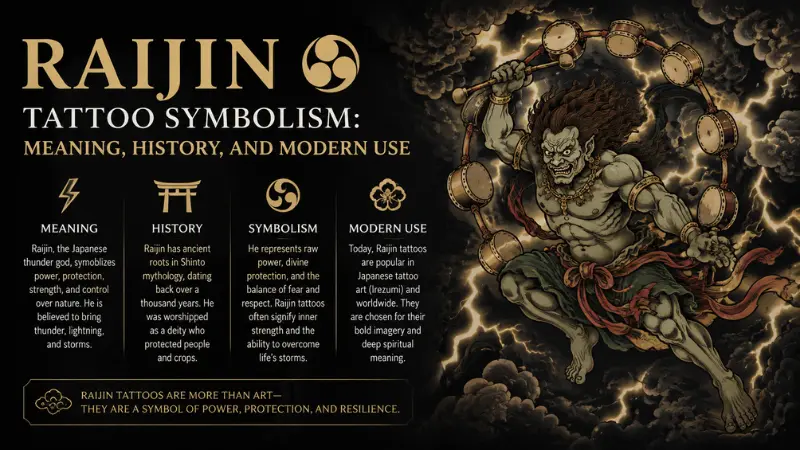
Tattoos often serve as personal stories written through images, and raijin tattoo symbolism connects modern body art with one of Japan’s most recognizable mythological figures. Raijin is the Japanese deity associated with thunder, lightning, and storms, traditionally shown with fierce features, storm clouds, and a circle of drums that represent the sound of thunder.
Today, many people in the United States choose Raijin tattoos because the image represents strength, resilience, transformation, and the ability to face powerful challenges. Although the design looks intimidating, its meaning is more complex than simple aggression. Raijin reflects the balance between danger and protection, destruction and renewal.
Because Japanese mythology has influenced global art, fashion, and tattoo culture, Raijin has become a symbol that carries both cultural history and personal meaning. Understanding the story behind the figure helps explain why this thunder god remains a popular choice for detailed tattoo designs.
Quick Answer
Raijin tattoo symbolism commonly represents strength, protection, resilience, and personal transformation in modern American tattoo culture. Historically, Raijin was a Japanese thunder deity connected with lightning, storms, and the powerful forces of nature.
TL;DR
- Raijin represents thunder, lightning, and natural forces.
- Japanese mythology connects him with storms and protection.
- Tattoos often symbolize courage and resilience.
- Drums represent thunder and powerful energy.
- American tattoo culture values Raijin’s bold design.
- Cultural understanding improves respectful use.
What Is Raijin and What Does the Image Represent?
Raijin, written as 雷神 in Japanese, is traditionally understood as a thunder god associated with lightning and storms. In Japanese artwork, he is usually portrayed as a fierce figure surrounded by drums, clouds, and dramatic movement.
The most recognizable feature of Raijin is the circle of taiko drums around his body. According to traditional imagery, Raijin strikes these drums to create the sound of thunder. Therefore, the drums are not just decorative elements; they visually explain his connection to storms.
In tattoo designs, artists often emphasize his powerful expression, muscular body, lightning effects, and swirling clouds. As a result, the tattoo creates a sense of movement and energy that makes it especially suitable for large body placements.
What Raijin Tattoos Mean in Modern American Culture
In the United States, Raijin tattoos are often interpreted through themes of personal strength and overcoming difficult experiences. While the original figure comes from Japanese mythology, many American tattoo enthusiasts connect the image with their own life stories.
For example, someone may choose Raijin after surviving a major challenge, rebuilding their life, or entering a new stage of personal growth.
Common meanings include:
| Context | Meaning in the USA | Common Associations | Notes |
|---|---|---|---|
| Personal tattoo | Strength and endurance | Courage, survival | Often linked to overcoming struggles |
| Lightning imagery | Change and energy | Transformation, action | Represents sudden shifts |
| Storm imagery | Facing challenges | Growth, resilience | Shows strength during hardship |
| Protective design | Security and confidence | Defense, bravery | Connected with Raijin’s power |
However, meanings are not fixed. A tattoo’s symbolism depends on the wearer’s personal experience and the elements included in the design.
Ancient Origins of Raijin Symbolism
Raijin’s roots come from Japanese mythology and religious traditions connected with nature. In traditional Japanese beliefs, natural events such as storms and lightning were often viewed as signs of powerful spiritual forces.
Because storms could bring both destruction and necessary rain, thunder gods carried complicated meanings. On one hand, storms created fear because lightning could damage homes and crops. On the other hand, rainfall supported agriculture and community survival.
Over time, Raijin developed into a figure representing the unpredictable power of nature. He was not simply viewed as a destructive force; instead, he represented the balance between danger and renewal.
Raijin’s Connection With Thunder, Lightning, and Nature
The strongest association with Raijin is his control over thunder and lightning. His image transforms an invisible natural event into a visible character with emotion and personality.
The major symbols connected with Raijin include:
- Lightning bolts — sudden power and change
- Thunder drums — energy and force
- Storm clouds — uncertainty and movement
- Fierce expression — strength and authority
Additionally, these elements make Raijin highly adaptable for tattoo art. Artists can create dramatic compositions by combining weather imagery with traditional Japanese patterns.
Raijin and Fūjin: The Balance of Storm Forces
Raijin is frequently shown alongside Fūjin, the Japanese wind deity. While Raijin represents thunder and lightning, Fūjin represents wind. Together, they symbolize two connected forces that create storms.
This pairing appears often in Japanese art because storms are rarely caused by one element alone. Instead, wind and thunder work together to create powerful natural events.
For tattoo collectors, combining Raijin and Fūjin can represent balance, duality, and the relationship between opposing forces.
Spiritual Meaning Behind Raijin Tattoos
Although many modern tattoos are chosen for artistic reasons, Raijin also carries spiritual symbolism connected with nature and respect for forces beyond human control.
In traditional contexts, thunder was not merely a weather sound. It represented something larger than everyday human experience.
Because of this, Raijin tattoos may symbolize:
- Respect for nature
- Inner strength
- Protection during difficult times
- Acceptance of change
- Personal courage
Furthermore, the image can remind the wearer that challenges can create growth, just as storms can eventually bring renewal.
Why Raijin Became Popular in Tattoo Culture
Japanese tattoo traditions have long used mythology, animals, and natural imagery to create meaningful artwork. Raijin fits naturally into this tradition because his design contains movement, emotion, and storytelling.
In American tattoo culture, Raijin became popular because the image offers several qualities that many people look for:
- A dramatic appearance
- A strong personal message
- Historical connection
- Detailed artistic possibilities
Additionally, large tattoo styles such as sleeves and back pieces allow artists to include surrounding elements like waves, dragons, clouds, and traditional patterns.
Emotional and Psychological Meaning of Raijin Tattoos
Symbols often communicate personal identity, and Raijin tattoos frequently represent a person’s relationship with challenges.
The storm imagery can suggest:
- Remaining strong during difficult periods
- Turning anger into motivation
- Accepting change
- Recovering after hardship
However, Raijin does not always represent struggle. For some people, the tattoo simply expresses admiration for Japanese mythology, traditional art, or powerful visual design.
Therefore, the emotional meaning depends on the individual rather than the symbol alone.
Color Symbolism in Raijin Tattoo Designs
Color choices influence how a Raijin tattoo feels visually and symbolically. Traditional Japanese artwork often uses strong colors to create contrast and emotional impact.
| Color | Common Meaning | Effect in Tattoo Design |
| Red | Energy and intensity | Highlights Raijin’s fierce nature |
| Blue | Calm and balance | Connects with water and storms |
| Black | Strength and tradition | Creates a classic appearance |
| Gold | Importance and power | Adds a sacred visual quality |
Modern tattoo artists may adjust colors according to the wearer’s preferences while maintaining the main symbolism.
Raijin Tattoos and Identity Expression
Many people use tattoos as visual statements about who they are or what they have experienced. In this context, Raijin often represents a person who sees themselves as resilient and capable of facing difficult situations.
For example, someone who has overcome personal obstacles may connect with the idea of surviving a storm and becoming stronger afterward.
At the same time, others may choose Raijin simply because they appreciate Japanese mythology and artistic detail.
Modern Uses of Raijin Beyond Tattoos
Although Raijin is strongly connected with tattoo culture, the figure appears in many areas of modern entertainment and design.
Examples include:
- Video games
- Anime-inspired artwork
- Fantasy illustrations
- Clothing designs
- Decorative art
Because Japanese mythology has become more visible worldwide, figures like Raijin have reached audiences far beyond their original cultural setting.
Common Misunderstandings About Raijin Symbolism
One common misunderstanding is that Raijin represents only destruction. However, traditional interpretations recognize that storms have both harmful and beneficial effects.
Another misconception is that Raijin is simply a demon because of his fierce appearance. Although some artwork gives him intimidating features, Raijin is traditionally understood as a deity rather than merely a monster figure.
Therefore, understanding the cultural background helps separate the original meaning from modern assumptions.
Cultural Respect and Responsible Tattoo Choices
Using symbols from another culture requires awareness and appreciation. A Raijin tattoo can be meaningful when the wearer understands its connection to Japanese mythology and artistic traditions.
Respect comes from learning the story behind the image rather than using it only because it looks powerful.
Additionally, working with an artist familiar with Japanese-inspired tattoo styles can help preserve important visual details and avoid inaccurate representations.
How Raijin’s Meaning Has Changed Over Time
Raijin’s symbolism has evolved as the figure moved from traditional Japanese beliefs into global popular culture.
Historically, he represented powerful natural forces connected with storms and weather. Today, many people interpret him as a symbol of personal strength, determination, and transformation.
Although the context has changed, the central idea remains similar: Raijin represents the force needed to face powerful moments in life.
FAQs
What does a Raijin tattoo symbolize?
A Raijin tattoo commonly symbolizes strength, resilience, protection, and the ability to overcome challenges. It connects modern personal meanings with the traditional Japanese thunder deity.
Is Raijin a positive symbol?
Yes, Raijin can have positive meanings despite his fierce appearance. He represents natural power, protection, and the balance between destruction and renewal.
Is Raijin a god or a demon?
Raijin is generally considered a Japanese deity associated with thunder and lightning. His aggressive appearance sometimes causes confusion, but his traditional role is not the same as a demon.
What do Raijin’s drums mean?
Raijin’s drums represent thunder. In tattoo designs, they symbolize energy, movement, power, and the force of nature.
Are Raijin tattoos culturally respectful?
Raijin tattoos can be respectful when people understand their Japanese origins and symbolism. Learning about the mythology helps create a deeper connection with the design.
What is the difference between Raijin and Fūjin?
Raijin represents thunder and lightning, while Fūjin represents wind. They are often paired because both forces contribute to storms.
Conclusion
Raijin tattoo symbolism represents strength, transformation, and respect for the forces of nature. In modern American tattoo culture, the image often reflects resilience, protection, and the ability to endure difficult moments.
From its origins in Japanese mythology to its role in contemporary tattoo art, Raijin remains a symbol with multiple interpretations. A thoughtful Raijin tattoo combines striking artwork with an understanding of the cultural meaning behind the thunder deity.


