
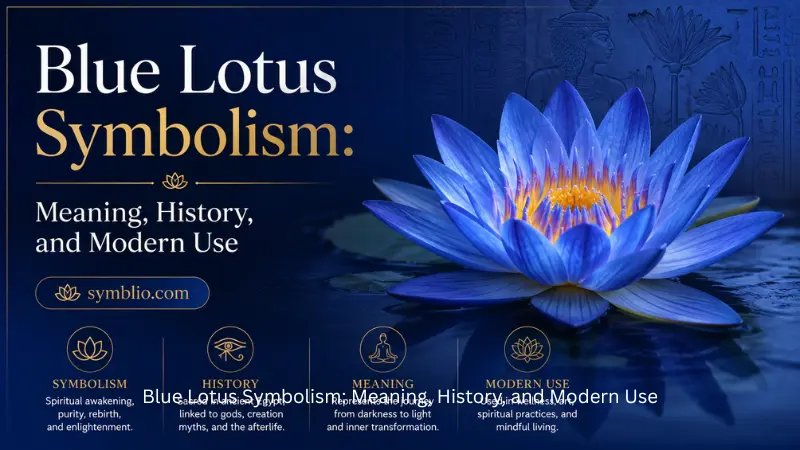
The pale blue flower floating above dark water has become an image of renewal, calm, and inner change. Blue lotus symbolism is especially recognizable today in tattoos, meditation-inspired art, jewelry, botanical decor, and imagery influenced by ancient Egypt. Yet many modern interpretations combine several traditions that did not originally mean the same thing.
The flower has a particularly strong historical connection to ancient Egypt, where its daily opening was associated with the returning sun, creation, fertility, and regeneration. Modern Americans often retain that connection with new beginnings while adding ideas such as emotional balance, resilience, self-discovery, and spiritual awareness.
Understanding the difference between those historical associations and newer personal meanings makes the symbol more accurate and meaningful.
Quick Answer
Blue lotus symbolism commonly represents renewal, personal growth, inner calm, and spiritual awareness in modern American culture. Historically, the Egyptian blue water lily was closely associated with the sun, creation, fertility, rebirth, and regeneration in ancient Egyptian religion and art.
TL;DR
- The blue lotus commonly represents renewal and personal growth.
- Ancient Egyptians connected it with creation, sunlight, and rebirth.
- Americans often associate it with calm and self-development.
- Tattoos may represent resilience, recovery, or a fresh start.
- Buddhist blue-lotus imagery belongs to a separate cultural tradition.
- Modern psychoactive claims differ from historical symbolism.
What the Blue Lotus Actually Is
Despite its familiar name, the Egyptian blue lotus is botanically a water lily, not a true lotus of the genus Nelumbo.
It is usually identified as Nymphaea caerulea, although some classifications treat it as a variety of Nymphaea nouchali. The plant grows from underwater rhizomes and produces floating leaves and flowers ranging from pale sky blue to blue-violet, usually with a yellow center.
That distinction matters because the word lotus is also applied to culturally important plants from South and East Asia. The sacred lotus associated with Hindu and Buddhist traditions is normally Nelumbo nucifera, a different plant.
In modern art, tattoo design, and popular culture, these traditions are sometimes blended together. Historically, however, an Egyptian blue water lily and an Indian sacred lotus should not automatically be treated as interchangeable symbols.
The Core Meanings of the Blue Lotus Today
In contemporary American use, the flower most often communicates renewal, calm, resilience, and personal growth.
| Context | Meaning in the USA | Common Associations | Notes |
|---|---|---|---|
| Personal growth | New beginnings | Change, maturity | Often used after major life transitions |
| Emotional symbolism | Calm | Reflection, balance, peace | Common in wellness-inspired imagery |
| Tattoo culture | Resilience | Recovery, survival, growth | Meaning is often highly personal |
| Egyptian-inspired art | Rebirth | Sun, creation, regeneration | Draws from ancient Egyptian associations |
| Spiritual imagery | Awareness | Meditation, insight | Often reflects modern interpretation |
These meanings work together because the flower creates a strong visual contrast: it emerges from water and opens into a bright, structured bloom. For modern viewers, that image can become a metaphor for finding clarity or stability after uncertainty.
Its ancient connection with daily renewal also gives modern interpretations a historical foundation, even though today’s language of mindfulness, recovery, and self-improvement is much newer.
Why the Flower Became a Symbol of Rebirth
One of the strongest historical reasons for the flower’s association with rebirth comes from its relationship with daylight.
Ancient Egyptians observed the water lily’s flowering cycle and connected its opening with the rising sun. This made the flower a natural image of life returning after darkness.
Its symbolism was therefore more specific than a general association between flowers and beauty. The plant’s visible response to light offered a natural comparison with recurring creation and restored life.
Today, this older meaning adapts easily to personal experiences such as rebuilding after loss, recovering from disappointment, beginning a new chapter, or leaving an earlier stage of life behind.
Ancient Egyptian Roots and the Returning Sun
The strongest documented historical tradition surrounding this flower comes from ancient Egypt.
Water lilies appeared widely in Egyptian decorative art, ritual objects, vessels, gardens, and funerary scenes. They were often shown alongside papyrus and aquatic life, connecting them with the Nile, fertility, regeneration, and the natural cycles on which Egyptian society depended.
The blue flower carried particularly strong solar associations because it opened with daylight.
This connection fitted a culture deeply attentive to recurring natural patterns. Day followed night, agricultural life depended on the Nile, crops returned, and religious beliefs included ideas about existence continuing beyond death.
A flower that visibly opened again with the new day became an appropriate image for restored life and cosmic order.
Creation, Nefertem, and Divine Renewal
The flower also entered Egyptian religious imagery through its association with Nefertem.
Nefertem was connected with the lotus or water lily, fragrance, beauty, and the emergence of life. The flower could evoke the appearance of light from primordial waters and therefore became associated with beginnings and creation.
Ancient Egyptian religion was not completely uniform across every region or historical period. Different religious centers developed different creation traditions, so it is misleading to reduce Egyptian lotus symbolism to one single story.
Still, the relationship among the flower, sunlight, creation, and divine emergence became firmly established in Egyptian visual culture.
For modern viewers, this history can support the idea of beginning again without pretending that the past has disappeared. A new stage can grow from what came before it.
The Flower in Funerary and Afterlife Imagery
The blue water lily also appeared in settings connected with death and continued existence.
Ancient Egyptian funerary culture placed enormous importance on regeneration. Death was not represented only as an ending. Tomb decoration, ritual practices, offerings, and religious texts reflected hopes for restored existence.
The flower’s recurring opening made it a natural image for that idea.
This background gives the blue lotus a nuanced connection with memorial symbolism today. Someone may use it after bereavement to represent remembrance, continuity, or the idea that life continues through memory.
Unlike some flowers that carry strong funeral associations in modern America, the blue lotus is not primarily a mourning symbol. Its historical connection with death is better understood through the idea of life returning or continuing in another form.
What It Commonly Means in the United States
Most Americans who encounter a blue lotus today are not using it as part of ancient Egyptian religious practice.
Instead, the flower appears within several overlapping modern visual styles: botanical art, yoga and meditation imagery, tattoo culture, Egyptian-inspired design, jewelry, wellness branding, fantasy illustration, and social media.
Its modern meaning is therefore often personal rather than institutional.
Someone displaying the flower may intend to express:
- a fresh beginning after a difficult period
- emotional steadiness
- independence from an earlier identity
- interest in ancient Egyptian culture
- spiritual exploration without formal religious affiliation
- resilience after hardship
- appreciation for aquatic plants and botanical design
The flower works especially well as a symbol of transition because it suggests movement from one condition into another without belonging exclusively to one modern religion, holiday, political movement, or organization.
Emotional and Psychological Meaning
Psychologically, the blue flower often communicates controlled change rather than dramatic upheaval.
Its appearance contributes to that impression. The bloom is orderly and symmetrical while surrounded by water, which modern symbolism often connects with emotion, uncertainty, memory, or the unconscious.
A flower rising clearly above that surface can therefore suggest composure during emotional difficulty.
Blue adds another layer. In American visual culture, the color can suggest calm, trust, seriousness, distance, sadness, or introspection depending on context.
Combined with a flower, however, blue often feels reflective rather than gloomy.
For that reason, the image appeals to people who want to represent progress without implying that every difficulty is completely resolved. It can suggest steady development rather than instant transformation.
Why It Appears in Tattoos
Blue lotus tattoos often represent recovery, self-knowledge, personal growth, or an important turning point.
Some designs emphasize Egyptian history by including suns, scarabs, pyramidal forms, or Egyptian-inspired imagery. Others remove the historical context entirely and use the flower as a minimalist personal emblem.
Placement and style can also influence interpretation.
A large geometric design may emphasize balance or spiritual development, while a smaller flower on the wrist, shoulder, or ankle may quietly mark a private milestone.
People may choose the design after:
- ending a difficult relationship
- changing careers
- recovering from a stressful period
- becoming more independent
- beginning a spiritual practice
- reaching a personal milestone
There is no universal tattoo definition. Historically grounded meanings include rebirth and regeneration, while ideas such as self-love, sobriety, healing, or emotional recovery are more personal and modern.
Jewelry, Decor, Fashion, and Digital Culture
The flower has moved far beyond historical reproductions and museum imagery.
In jewelry, it commonly appears as a symmetrical pendant, charm, or engraved motif. Such designs may suggest balance, personal change, or an interest in Egyptian-inspired imagery.
In home decor, blue floral designs fit naturally into spaces built around calm, water, meditation, or botanical themes.
Fashion often uses the flower more loosely. A lotus print may be chosen simply because it is visually attractive, without any deliberate historical or spiritual meaning.
That distinction matters. Not every blue lotus on clothing represents awakening or spiritual practice.
Digital culture has broadened the symbol further.
Stylized lotus graphics appear in profile images, inspirational posts, wellness branding, meditation content, wallpapers, and graphic design. In those settings, the flower often serves as shorthand for serenity, reflection, or personal development.
Blue Lotus Meaning in Buddhist and Asian Contexts
This is one of the areas where symbolism can easily become oversimplified.
Lotus imagery is extremely important in Buddhism and several South Asian religious traditions, but the sacred lotus of India is botanically different from the Egyptian blue water lily.
Tibetan Buddhist art also includes the utpala, often described in English as a blue lotus or blue lily. It can appear with Buddhist figures associated with wisdom, compassion, and enlightened understanding.
Those Buddhist associations should not automatically be projected onto ancient Egyptian Nymphaea caerulea.
Modern designs sometimes combine Egyptian symbolism, generalized lotus imagery, yoga aesthetics, and Buddhist concepts. Such combinations may be personally meaningful, but they are modern blends rather than evidence of one universal ancient tradition.
Recognizing those differences makes the symbolism more culturally accurate.
Spiritual Awakening as a Modern Interpretation
“Spiritual awakening” is now a common meaning attached to lotus imagery in Western popular culture.
For the Egyptian blue water lily, however, the phrase should be used with care.
Ancient Egyptian symbolism supports connections with creation, solar renewal, divine emergence, and regeneration. Modern Americans sometimes translate those ideas into the language of awareness, meditation, consciousness, or spiritual growth.
That does not mean ancient Egyptians understood the flower through today’s self-development vocabulary.
It is therefore more accurate to say that the flower can represent spiritual awakening today, while recognizing that this interpretation developed from older themes rather than reproducing one exact ancient belief.
Common Misunderstandings About the Symbol
The first major misconception is that every lotus tradition refers to the same plant.
It does not.
Egyptian blue water lilies, Indian sacred lotuses, and blue lilies in Buddhist iconography come from different botanical and cultural contexts.
Another misconception is that the flower had one fixed meaning in ancient Egypt. Symbols could carry different associations depending on the object, deity, ritual, period, and setting.
The flower might suggest sunlight in one context, regeneration in another, fertility elsewhere, or fragrance and divine beauty through its association with Nefertem.
A third misunderstanding is that every modern use is religious.
For many Americans, the flower simply represents starting over, calmness, persistence, or appreciation for its appearance. A tattoo or pendant does not automatically indicate Buddhist practice, Egyptian spirituality, or membership in a particular belief system.
Context remains essential.
Modern Wellness Culture and Psychoactive Claims
One modern development requires some caution.
Products sold as blue lotus now appear in teas, extracts, smoking mixtures, vaping products, and wellness preparations. They are sometimes marketed for relaxation or psychoactive effects.
However, the identity and composition of commercial products can vary considerably. Products carrying the blue-lotus label are not always guaranteed to contain the same botanical material or preparation.
There is also evidence that the blue water lily may have been used in certain ancient ritual settings, but it would be inaccurate to assume that every Egyptian use of the flower involved intoxication.
Its historical role was much broader, including art, religion, regeneration, beauty, fertility, and solar symbolism.
Modern commercial claims should therefore be kept separate from the flower’s established cultural meaning.
How the Meaning Has Changed Over Time
The blue water lily shows how symbols change when they move between cultures and historical periods.
In ancient Egypt, its meaning developed largely from the environment and religion. The Nile, sunlight, aquatic growth, creation, fertility, and funerary beliefs all shaped how the flower was understood.
Later audiences encountered Egyptian imagery through archaeology, museums, decorative arts, books, movies, and periods of renewed interest in ancient Egypt.
In contemporary America, the focus has become more individual.
Instead of primarily representing cosmic creation or divine regeneration, the flower often represents a person’s recovery, new direction, emotional balance, or changing identity.
The underlying visual idea remains similar: something emerges, opens, and continues.
What has changed is the scale of the meaning. Ancient symbolism often connected the flower with the order of life and the universe, while modern symbolism frequently applies that same image to personal experience.
FAQs
The Blue Lotus commonly symbolizes rebirth, spiritual awakening, peace, wisdom, and transformation. Its association with opening in daylight and closing later helped connect it with renewal and the recurring cycle of life.
In ancient Egyptian culture, the Blue Lotus was associated with rebirth, creation, the sun, and regeneration. It frequently appeared in Egyptian art, religious imagery, and funerary contexts.
Spiritually, the Blue Lotus is often interpreted as a symbol of inner peace, higher awareness, personal growth, and enlightenment. Modern spiritual interpretations may also connect it with meditation and self-discovery.
Yes. Rebirth is one of the best-known meanings associated with the Blue Lotus, particularly because of its strong connections with renewal and regeneration in ancient Egyptian symbolism.
A Blue Lotus tattoo can represent personal transformation, spiritual growth, resilience, peace, wisdom, or a new beginning. The exact meaning depends on the wearer’s personal intentions and cultural references.
The Blue Lotus can sometimes be connected with beauty, affection, intimacy, and emotional connection, especially when interpreted through ancient Egyptian imagery. However, rebirth, spirituality, and renewal are generally more central symbolic meanings.
Today, the Blue Lotus often represents calmness, transformation, spiritual awareness, mystery, and personal renewal. It is commonly seen in tattoos, jewelry, artwork, meditation imagery, and modern spiritual symbolism.
Conclusion
The meaning of this flower is most firmly rooted in the idea of life returning and beginning again. Ancient Egyptian art connected the blue water lily with sunlight, creation, fertility, rebirth, and regeneration, while modern American culture has adapted those themes into ideas about emotional balance, resilience, recovery, and personal change.
Today, blue lotus symbolism can reference ancient Egypt, mark an important transition, express quiet strength, or simply reflect appreciation for a flower whose natural cycle made it an enduring image of renewed life.
Its meaning is strongest when modern interpretations are allowed to grow without erasing the cultural history behind the symbol.


